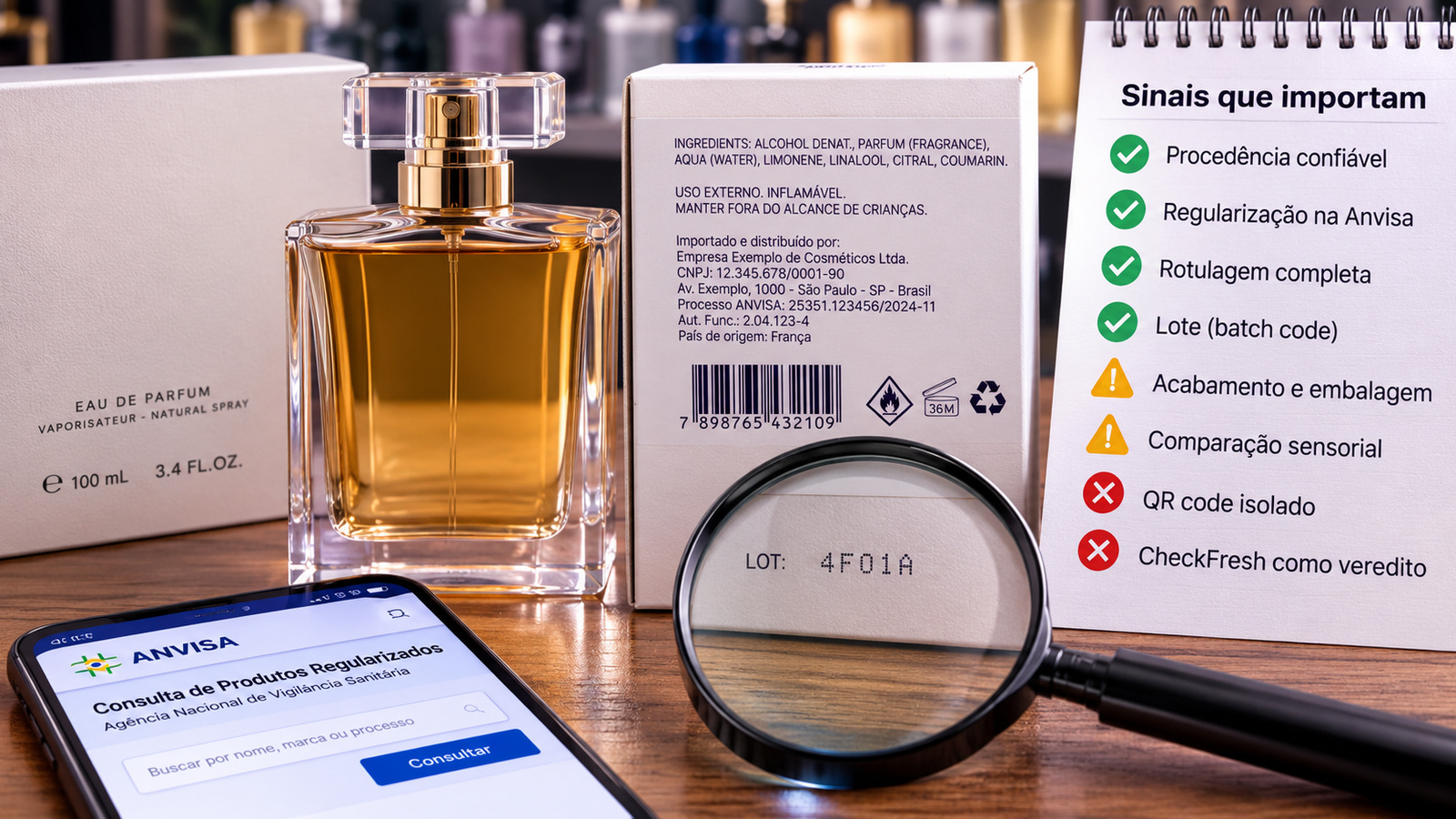
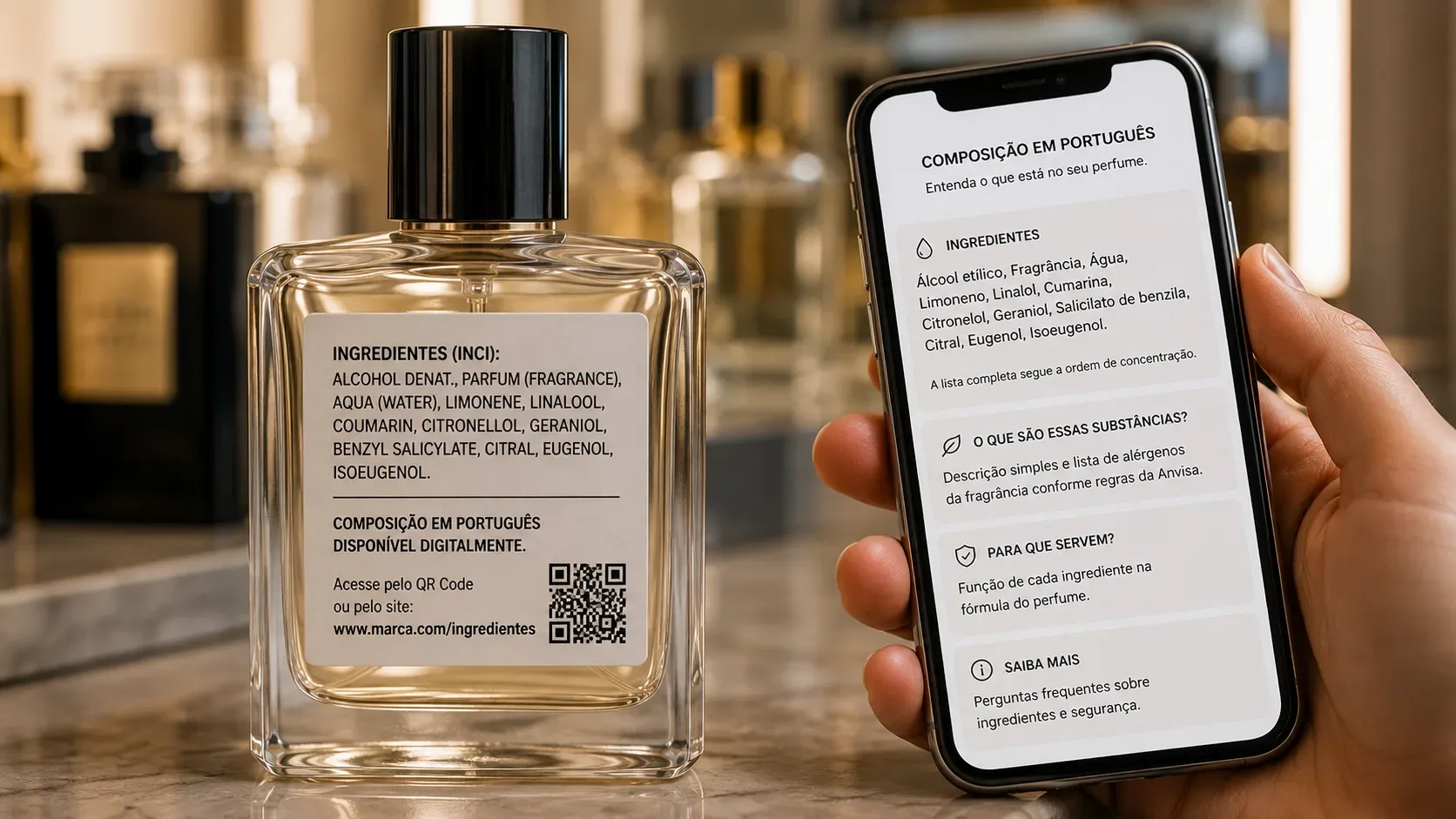
If you are looking for a perfume's ingredients in Portuguese, you do not necessarily need to find a long translated list printed on the box. Brazil's health regulator Anvisa keeps INCI nomenclature mandatory and allows the composition in Portuguese to be provided either in print or digitally, including through a QR code or a link indicated on the label. The key point is that digital access must lead directly to the composition of that specific product.
Where to look for the composition in Portuguese
Start with the outer packaging, the bottle and any additional label attached to the product. Look for the expressions “Composição (português):” or “Ingredientes (português):”. After them, you may find the translated list itself or a digital access method.
- Printed list: the Portuguese translation may appear immediately after the INCI description.
- QR code: Anvisa allows digital presentation and states a preference for a code on the label that can be read with a mobile device.
- Link: it can also be used, as long as the indication on the label leads directly to the composition of the specific product.
If the QR code opens only the brand's home page, an online store, a campaign or a generic search page, that does not match the direct-access format described by Anvisa. The official guidance is available in Anvisa's FAQ.
INCI and Portuguese ingredient names are not simply interchangeable versions of the same text
INCI stands for International Nomenclature of Cosmetic Ingredients. According to Anvisa, it remains mandatory on the labels of personal hygiene products, cosmetics and perfumes. That is why you may see terms such as Alcohol Denat., Parfum, Aqua, Limonene or Linalool even on a product sold in Brazil.
The composition in Portuguese is the layer intended to make those ingredients understandable in Portuguese. Anvisa maintains an INCI Translation Panel to support ingredient translation. Consumers should therefore not treat the presence of INCI terms as an automatic substitute for the Portuguese composition when the rule applies.
What applies to products manufactured since November 2023
Anvisa's official FAQ states that personal hygiene products, cosmetics and perfumes manufactured from November 1, 2023 onward must include the chemical composition in Portuguese on the labeling, in addition to other applicable requirements. Products manufactured up to October 31, 2023 may remain on the market until their respective expiration dates.
This matters when interpreting older packaging still in stock. The absence of a visible translation on an older product does not, by itself, prove that the item is noncompliant: the manufacturing date matters. For newer products, the translation may be printed on the label or offered through digital access indicated on it.
How to tell INCI, the Portuguese translation and perfume notes apart
| Layer | Where it usually appears | What it tells you | What it cannot establish by itself |
|---|---|---|---|
| INCI list | Box, bottle or label | Identifies ingredients using international nomenclature | It is not, by itself, the Portuguese translation |
| Composition in Portuguese | Printed on the label/sticker or accessed by QR code/link | Presents the declared ingredients in Portuguese | It does not necessarily disclose percentages or the full industrial formula |
| Fragrance notes and marketing descriptions | Brand website, promotional material, box or advertisement | Describe the olfactory experience, such as citrus, floral, woody, vanilla or amber | They do not replace the regulatory ingredient list and should not be read as the formula |
Why top, heart and base notes are not the composition
An olfactory pyramid is a way of communicating how a fragrance is perceived over time. It may mention bergamot, jasmine, leather, amber or other sensory references, but that does not mean that every term corresponds literally to an ingredient with the same name in the formula. A note may result from several raw materials or from an aromatic construction.
Use fragrance notes to understand the perfume's style, and use the INCI list/Portuguese composition to identify ingredients declared on the labeling. Mixing these layers can lead to incorrect conclusions, especially when trying to infer the presence, absence or concentration of a substance from marketing copy alone.
Step-by-step: how to check a perfume
- Find the INCI ingredient list on the packaging.
- Look for “Composição (português):” or “Ingredientes (português):”.
- If there is a QR code or link, open it and check whether the page directly shows the composition of that specific perfume.
- Compare the Portuguese names with the INCI list if you want to understand how the names correspond.
- Do not use the fragrance pyramid, “notes” or promotional text as substitutes for the composition.
- If you are unsure about a translated ingredient name, consult Anvisa's INCI Translation Panel.
Is a QR code mandatory?
No. What Anvisa requires, when applicable, is that the composition in Portuguese be made available. It may be printed. When a company chooses a digital format, a code on the label is the preferred access method mentioned by the regulator, and the FAQ also allows a link. Therefore, the absence of a QR code does not by itself indicate noncompliance: check whether the Portuguese composition is available through another accepted method.
What to check if the translation is on an additional label
Anvisa allows an added label to provide the Portuguese composition or the code/link that gives access to it. The company must ensure that the label remains intact throughout the product's shelf life. The FAQ also says there is no restriction on the printing technology used, provided the information remains on the labeling for the required period.
In short: which information answers which question?
If the question is “which ingredients were declared?”, check the INCI list and the composition in Portuguese. If the question is “what is this perfume supposed to smell like?”, use the fragrance notes and the brand's description. If the question is “must the Portuguese translation be printed?”, the answer is not necessarily: it can be provided digitally, as long as the label indicates the access method and it leads directly to the composition of the specific product.
For the current rule and future updates, refer to Anvisa's official FAQ on cosmetic ingredient translation.