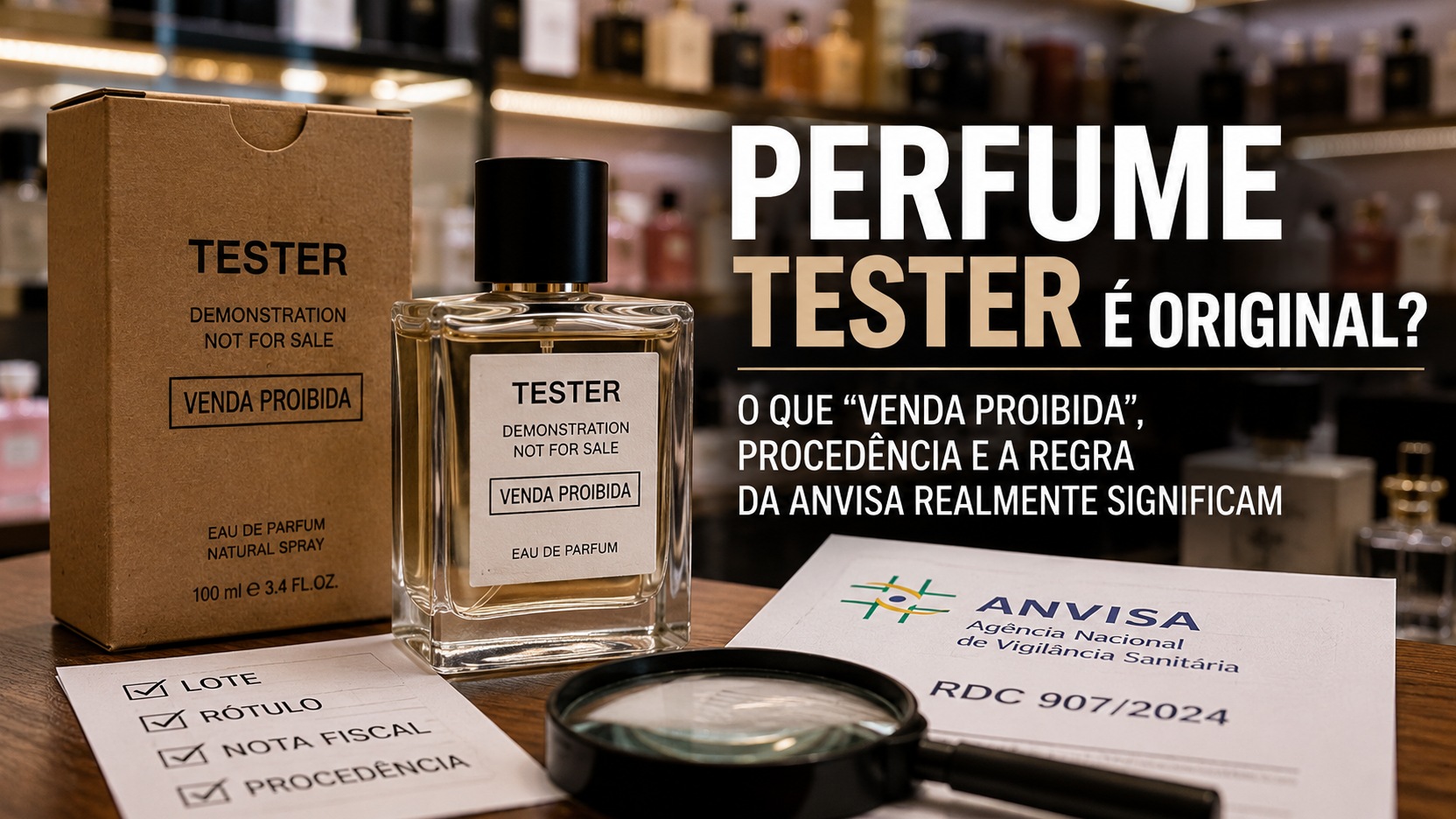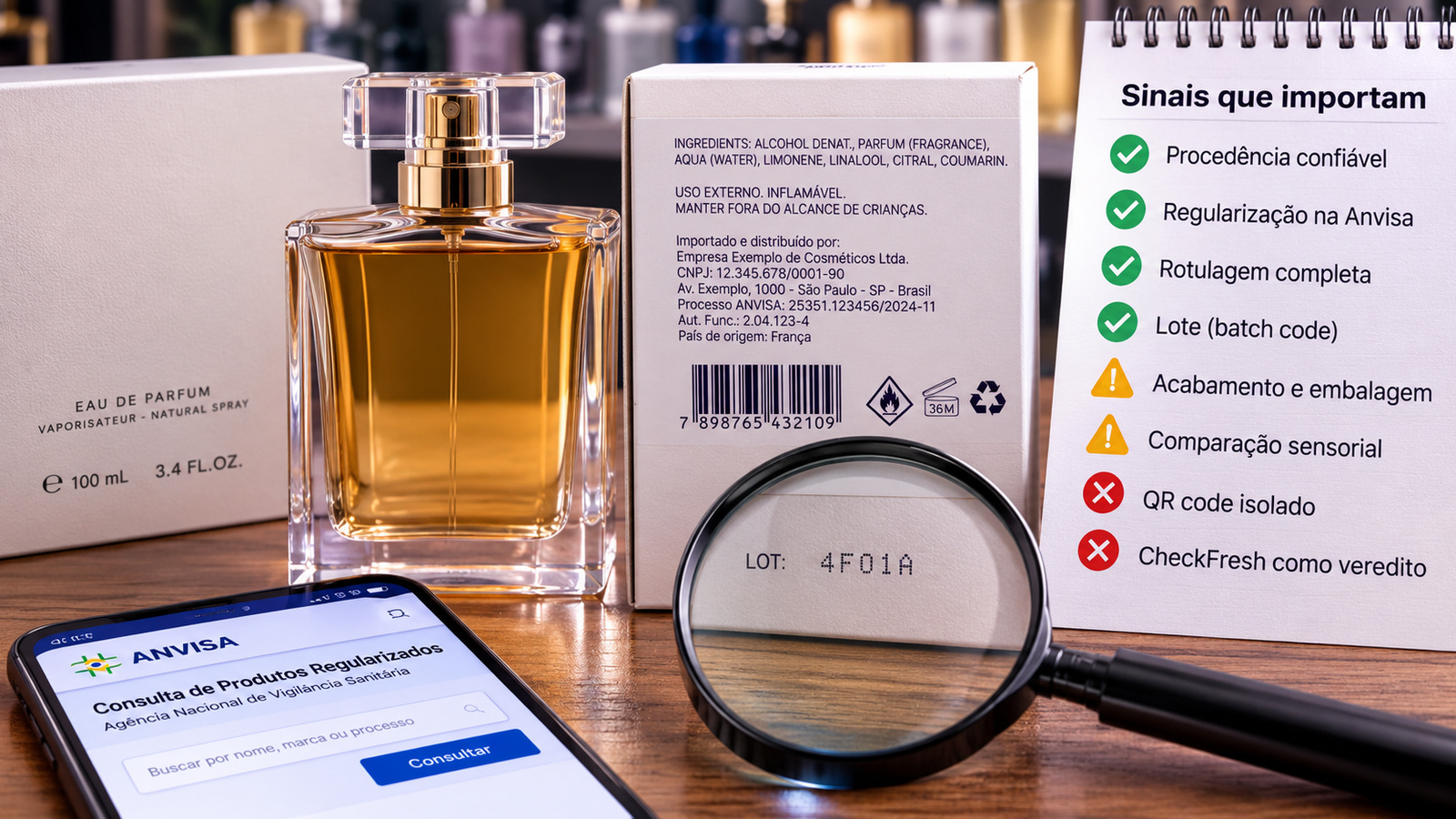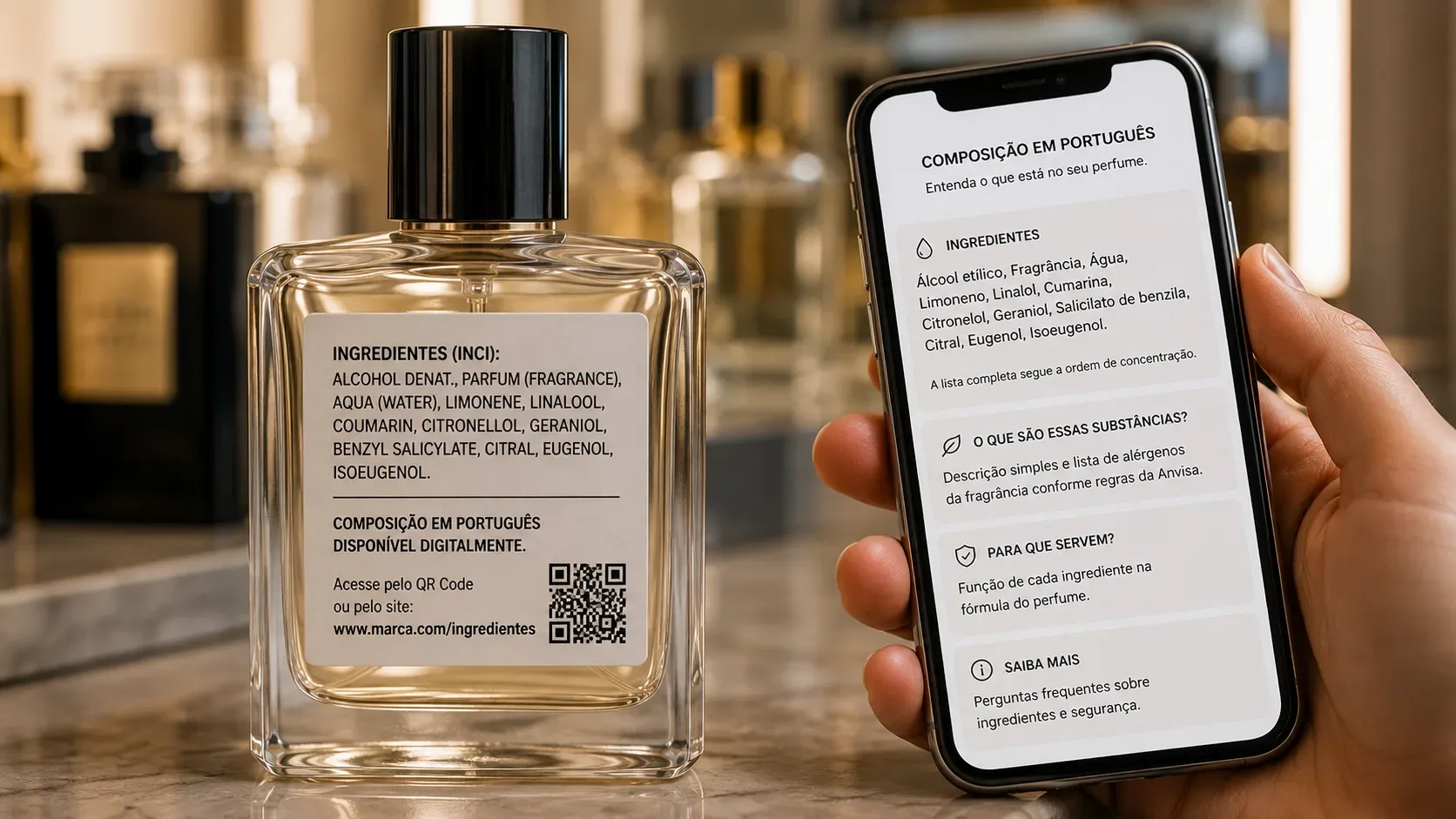
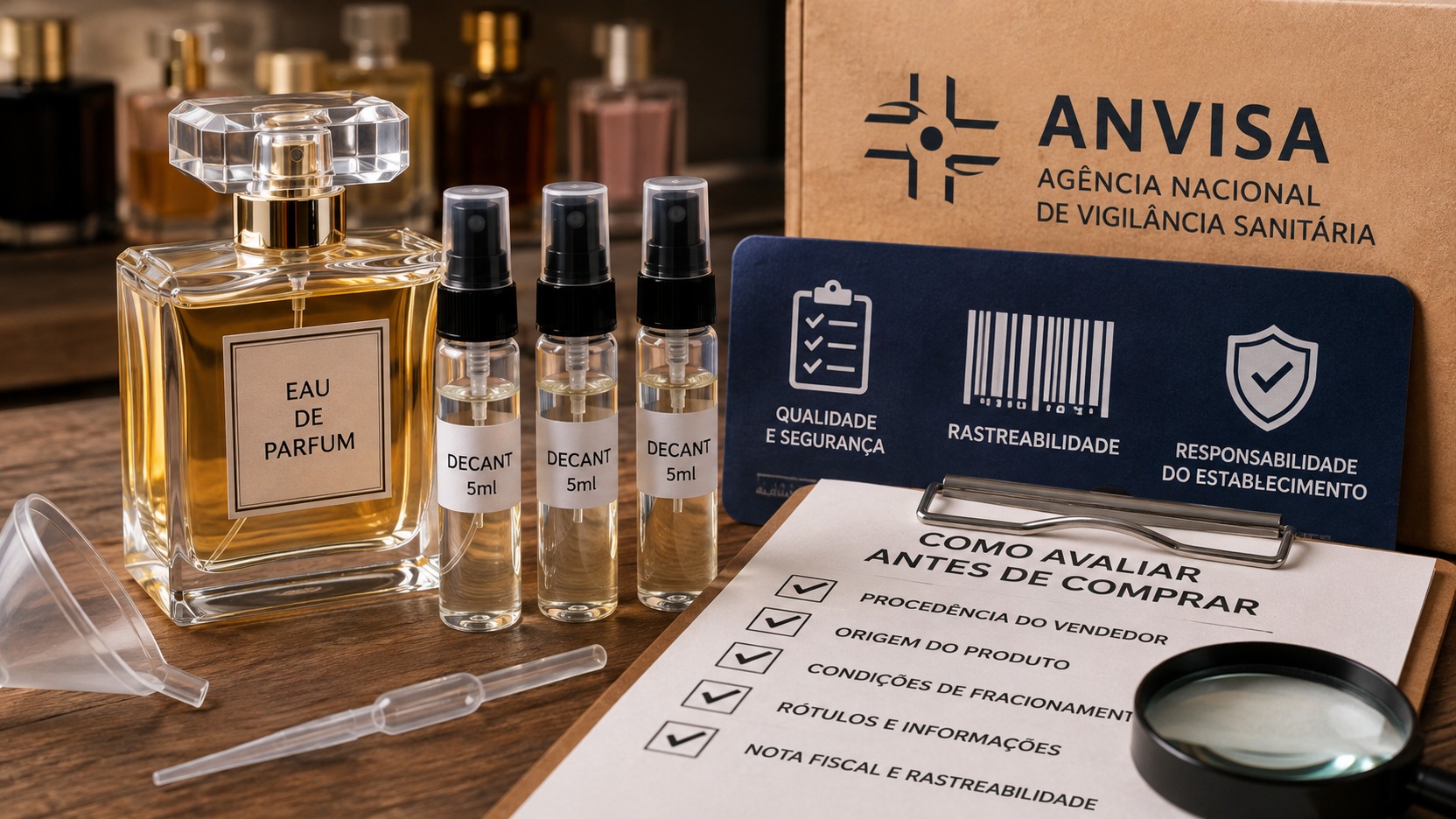
A decant can contain authentic perfume and still fail to provide a decanting chain that the consumer can verify. That is why the answer to “is a decant original?” cannot be reduced to a simple yes or no. The origin of the liquid matters, but Brazilian sanitary rules also look at who decants it, how the product is handled, what information accompanies the package and whether there is traceability between the source perfume and the portion sold.
In practice, there are three different questions. The first is whether the liquid came from an authentic perfume. The second is whether that source perfume is properly regularized. The third is whether the decanting and direct sale to consumers follow the model established by sanitary surveillance rules. A seller may answer only the first question and leave the other two without evidence. That is exactly where the phrase “taken from the original bottle” becomes insufficient.
“Original” describes the liquid; compliance describes the path
When someone advertises a decant as “original,” they usually mean that the contents were supposedly taken from a legitimate branded bottle, without dilution or imitation. That claim may be true, but by itself it does not prove how the product was acquired, stored, transferred, identified and offered for sale.
For Anvisa, the relevant regulatory concept is the decanting of personal hygiene products, cosmetics and perfumes for direct sale to consumers. RDC 108/2005 defines decanting as dividing a product into smaller quantities while preserving its quality specifications and the original labeling identification data. The same rule allocates responsibilities between the manufacturer or importer and the decanting company and establishes good practices to reduce risks of contamination, batch mix-ups and loss of traceability.
This creates an important distinction for buyers. Authenticity of the liquid, regularization of the product and compliance of the decanting process are related dimensions, but they are not equivalent. Looking up a perfume in Anvisa's system, for example, helps confirm the status of the source product. It does not physically authenticate the liquid inside a 5 ml bottle purchased from a third party.
What RDC 108/2005 requires for decanting
RDC 108/2005 is the central reference for companies that decant personal hygiene products, cosmetics and perfumes for direct sale to consumers. In the official sources consulted on August 29, 2026, the review of the rule remains on the 2026-2027 Regulatory Agenda, while Public Consultation 1,380/2026 is already shown as closed. Therefore, the proposed update should be treated as a proposal, not as an automatic replacement for the rule currently in force.
Perfumes are among the categories allowed
The rule allows the decanting, with direct sale to consumers, of perfumes and similar products for adult use, in addition to certain other categories. The important point for decant buyers is that perfume decanting is not an activity ignored by sanitary regulation: there is a specific regulation for this sales model.
The source product must be regularized
The RDC requires products intended for decanting to be duly regularized. Currently, perfumes are among the cosmetics exempt from mandatory registration, but that does not mean there is no regularization requirement. Anvisa maintains a public consultation system for regularized cosmetic products, including those exempt from registration.
When searching for the perfume, consumers can use information such as the product name, process number or the CNPJ of the company that holds the regularization. An “active” status indicates that the product is regularized with the Agency. This check is useful for validating the existence and regulatory status of the source product, but it does not replace analysis of the decanter or confirm that the specific sample came from the stated batch.
The decanter must be identified and licensed
The RDC defines a company that decants products for direct sale to consumers as a company duly licensed by the competent sanitary surveillance authorities. Licensing is local and is handled by sanitary authorities in the states, Federal District or municipalities, depending on the structure applicable to the establishment.
The rule also provides for a contract between the manufacturer or importer and the decanter for the regulated activity. This contract must be available to the sanitary authority and must clarify the activities, technical and operational aspects and quality control after decanting. For consumers, this means that buying a bottle at retail and simply dividing it into smaller portions does not, by itself, demonstrate that the seller is operating within the decanting model established by the RDC.
This distinction does not justify automatically concluding that liquid sold outside that model is counterfeit. The point is different: the claim that the perfume is genuine does not replace the licensing, responsibility, quality and traceability requirements established for commercial decanting.
Batch, expiration date and decanting date matter
Traceability appears concretely on the label. The RDC requires the product delivered to the consumer to carry information identifying the decanter, including the legal company name and CNPJ, as well as the expiration date and decanting date. The batch number and expiration date must correspond to those of the source product supplied by the manufacturer or importer.
This is one of the most useful criteria for distinguishing a traceable sample from an almost anonymous package. A sticker that only states the perfume name and “5 ml” may be convenient for personal use, but it provides little information to connect the contents to the decanter, the batch and the source product.
Good practices go beyond using clean tools
The rule requires the company to ensure product quality and comply with good decanting practices. This includes facilities and equipment compatible with the activity, staff training, cleaning and sanitizing procedures, controls for receiving and storage, and measures to prevent cross-contamination.
Among the guideline points are the need for an exclusive area for decanting or an equivalent technical structure provided for by the rule, adequate separation of products and a prohibition on mixing different batches of the same product or different products. Items received for decanting must also be controlled and documented.
An ordinary buyer cannot audit a decanting room over the internet. Even so, a seller operating in a traceable manner should generally be able to say who the company is, where it is licensed, how batches are identified and what information accompanies the bottle. When those answers do not exist, the consumer is left relying only on personal trust in the store.
How to assess provenance before buying
The best check does not depend on a single “sign of originality.” It combines the seller's identity, information about the source perfume, details of the decanting process and consistency among those elements.
Start with the decanter's legal name and CNPJ
Ask for or look for the business identification of the party that actually decants the perfume. A profile name, follower count or marketplace reputation does not replace the legal company name and CNPJ. Under the RDC, this information is part of the identification that must accompany the decanted product.
If the store uses a trade name different from its legal company name, that is not necessarily a problem. What matters is being able to link the selling brand to the establishment responsible for the operation. If the seller does not disclose which company is behind the profile, traceability is already incomplete.
Check the batch, expiration date and decanting date
Before buying, ask whether the decant is shipped with the batch number, expiration date and decanting date. These details are especially relevant because the RDC requires the batch and expiration date to correspond to the source product.
A vague answer such as “we always work with original bottles” does not resolve this check. The practical question is whether that decant can be linked to a specific batch, with an identifiable expiration date and information about when it was decanted.
Look up the source perfume in Anvisa's system
Use Anvisa's consultation system to check the product's status. Perfumes are generally in the category of cosmetics exempt from mandatory registration, but they are regularized through a simplified procedure. The Agency itself provides guidance on consulting regularized cosmetics and explains that products with active status are regularized.
This step reduces one type of uncertainty: it confirms whether the product presented as the source exists and has regular status with the Agency. It does not settle the authenticity of the individual sample. A seller cannot turn a screen showing an active product into proof that every smaller bottle they advertise contains that perfume.
Ask about the establishment's sanitary license
Because licensing is handled by the competent sanitary surveillance authority, confirmation may vary by municipality or state. The seller should be able to identify the establishment responsible and provide the license or the sanitary authority that licensed it for the applicable activity.
When there is doubt about a specific company, the safest confirmation is with the Sanitary Surveillance authority responsible for local licensing. That verification is more meaningful than photos of a workbench, attractive packaging or videos showing a large bottle being opened.
Understand the role of the invoice
A tax invoice and proof of purchase are useful for identifying the transaction and seller and make any complaint easier. But an invoice by itself does not prove the authenticity of the liquid, the regularization of the source product or compliance of the decanting process.
It should be viewed as one piece of commercial traceability, not as a sanitary seal. Likewise, an active CNPJ demonstrates the formal existence of a company, but it does not automatically prove that the establishment is licensed to decant perfumes.
Inspect the package without turning appearance into a forensic test
Leaks, complete lack of identification, dirt, visible particles or packaging unsuitable for transport justify caution. However, color, intensity and small differences in olfactory perception are not reliable methods of authentication on their own. Storage, time, batch and conditions of use can alter the experience without, by themselves, proving counterfeiting.
The stronger analysis is documentary and traceable: who decanted it, what the source product is, which batch was used, when the decanting took place and which establishment assumes responsibility for the operation.
Warning signs that deserve more questions
“It came from the original bottle” is the only explanation
That phrase addresses only the claimed origin of the liquid. It does not say whether the source product is regularized, who the decanter is, which batch was used or whether the establishment has a sanitary license for the activity. For a traceable purchase, that is not enough.
The bottle arrives without CNPJ, batch or dates
The absence of the decanter's identification, batch, expiration date and decanting date greatly reduces the ability to reconstruct the sample's origin. Even if the perfume is authentic, the consumer is left without basic elements for checking the product's path.
The store uses the Anvisa lookup as a “certificate” for the decant
Anvisa's database allows users to check the regulatory status of products and companies in its systems. It does not physically track every transfer of a few milliliters made by a seller. The lookup is an important step, but it needs to be combined with identification of the decanter and with batch and date information.
The seller avoids explaining where and how the decanting is done
A store does not need to expose sensitive internal details of its process. But it should be able to explain, in a verifiable way, which company performs the decanting, which establishment is responsible for the activity and how traceability is maintained. Inconsistent answers among the listing, label and business information are a reason to stop the purchase and check more carefully.
What changed in 2026
In January 2026, Anvisa opened Public Consultations 1,380 and 1,381 to update the rules on decanting and reuse of packaging for personal hygiene products, cosmetics and perfumes sold directly to consumers. The proposals address technical requirements, good practices and categories that may be subject to these activities.
The Agency highlighted quality, safety and traceability as objectives of the update, along with defining the responsibilities of companies that hold sanitary regularization and of establishments that perform decanting. The proposals also cover topics such as documentation, training, facilities, equipment, sanitization, complaints, returns, recalls and cosmetovigilance.
Public Consultation 1,380 is closed. The 2026-2027 Regulatory Agenda, updated on Anvisa's website in August 2026, still lists as topic 4.5 the review of the technical regulation for companies that perform decanting with direct sale to consumers. This matters because proposals submitted for public consultation should not be treated as final obligations before the definitive regulatory act is published.
For anyone buying today, the practical consequence is simple: do not discard RDC 108/2005 based on headlines about future modernization. At the same time, keep track of the update, because the regulatory model is under review and may change in areas such as permitted categories, packaging reuse and operational responsibilities.
So how do you decide whether a decant is trustworthy?
The question “is it original?” remains valid, but it should only be the beginning. A trustworthy decant is easier to assess when the seller allows the sample to be linked to an identified company, a regularized source product, a batch, an expiration date, a decanting date and an establishment that assumes responsibility for the activity.
If the only proof presented is a photo of a large bottle or a promise that “we always buy from official stores,” you still do not have the traceability chain that regulation seeks to preserve. The perfume may indeed be authentic, but that has not been demonstrated sufficiently to answer the other questions about the decanting process.
Before paying, check the decanter's details, look up the source product in Anvisa's system, ask for the batch and dates, and confirm the sanitary license when necessary. If the seller cannot provide basic information or the details do not match one another, the prudent decision is not to treat the word “original” as a complete guarantee of provenance.