Yes, a perfume tester can be authentic. But "tester" is not a seal of originality and, under Brazilian rules, it is not a retail category created to sell the same perfume for less. In the consolidated text of RDC 907/2024, Anvisa defines a sampler or tester as a regularized demonstration product, displayed at the point of sale near its corresponding product for sale and intended solely for consumer trial. That definition changes the question to ask when you see an online offer: besides finding out whether the bottle is genuine, you need to understand where that unit came from and why an item intended for demonstration is being offered for sale.
Testers exist - but not as an economy version
The word tester is not a marketplace invention. RDC 907/2024 itself uses the Portuguese terms "provador" and "testador". The central point, however, is purpose: it is a regularized demonstration unit for consumer trial at the point of sale, near the product that is actually being sold.
That differs from the common wording of listings that present testers as a parallel retail category, usually summarized with phrases such as "same perfume, simple box" or "original product without luxury packaging". The health regulation does not define a tester by discount, absence of cellophane, missing cap or a white box. It defines the product by its demonstration use and its link to a product for sale.
For that reason, a listing may use the word tester commercially or imprecisely. Before concluding that an offer matches the regulatory concept, you need to look at the actual unit, its labeling and its provenance.
What "Venda Proibida" really means
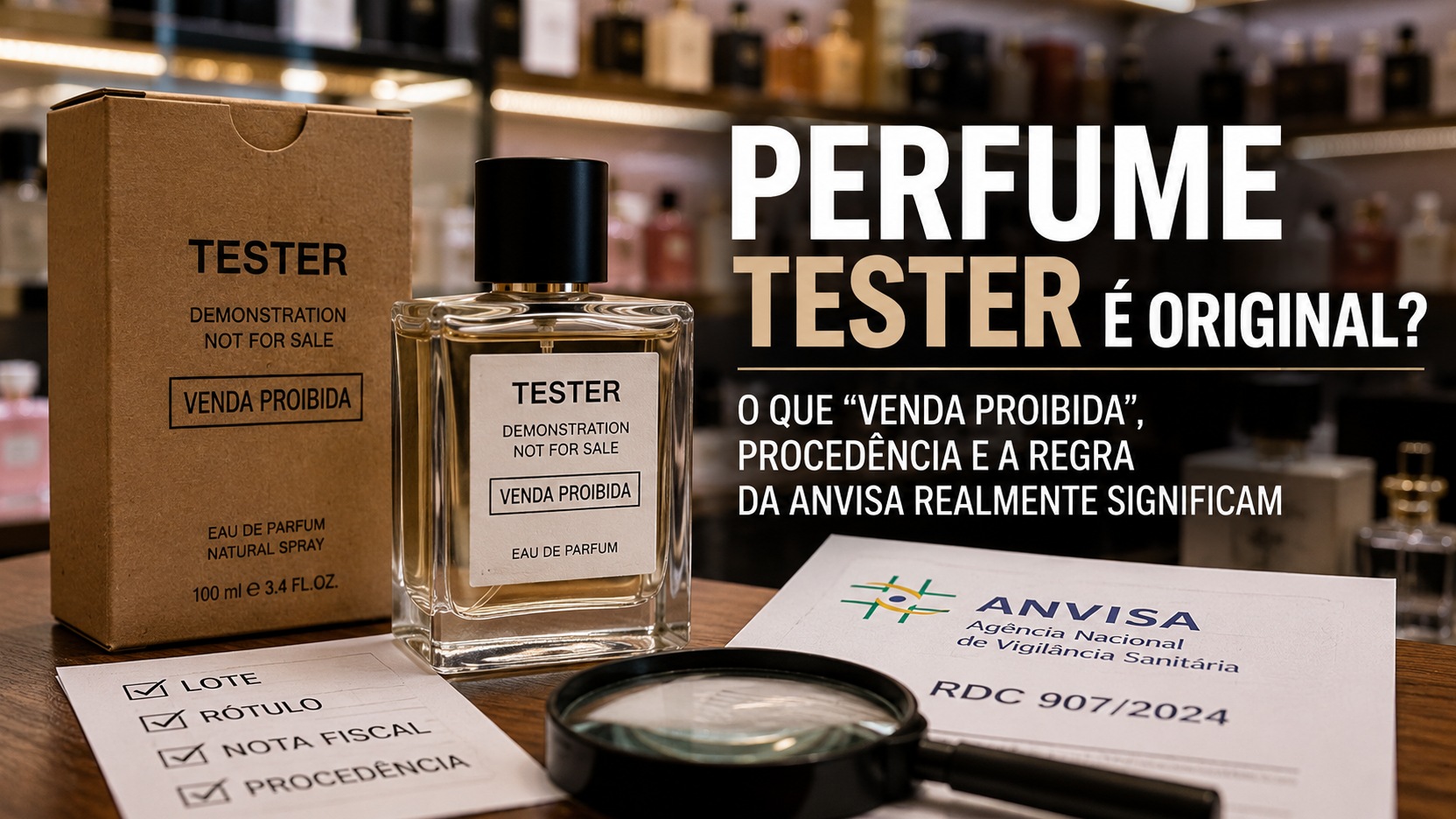
Article 23 of RDC 907/2024 addresses a specific situation: when a sampler or tester is displayed only in its primary packaging, the label must show, at minimum, the information required for that packaging, the expiration date and the phrase "Venda Proibida" ("Sale Prohibited").
The phrase, therefore, is neither decorative nor a seal that makes the product more trustworthy. It indicates that the unit was presented as a sampler or tester and was not intended for sale as a
normal retail presentation.
There is an important nuance. Article 23 expressly describes testers displayed only in primary packaging. Therefore, the absence of the phrase "Venda Proibida" in a photo does not, by itself, allow you to conclude that the item is cleared for sale, that it is no longer a tester or that it is fake. Likewise, the presence of the phrase does not authenticate the bottle. A label inscription must be read together with the unit's origin and the product's other information.
Can a tester be original? Yes - and that does not settle the purchase
An authentic tester can exist within a brand's official distribution because the health regulation itself recognizes the category of a regularized demonstration product. That answers only part of the question.
Authenticity and commercial destination are different questions. A unit can be genuine and still not have been intended for retail. That is exactly why the statement "it is original" does not end the analysis of an offer showing a bottle marked as a tester or "Venda Proibida".
The reverse is also true: printing "tester" on a box or in a listing does not make a product original. The word describes an alleged condition of use; it does not function as a certificate of authenticity.
In practice, the buyer needs to separate three things. The first is the product's health regulatory status. The second is the authenticity of the unit being offered. The third is the commercial provenance of that specific bottle. They are related, but they are not equivalent.
RDC 907/2024 does not promise "same perfume, only a simple box"
It is common to see the claim that a tester always contains exactly the same perfume as the retail presentation and differs only in packaging. That may be the practice of a particular brand or distributor, but it is not the definition RDC 907/2024 provides to consumers.
Anvisa's rule does not use the presence or absence of a cap, box design, amount of liquid, cellophane or a supposed concentration difference as criteria for defining a tester. Nor does it create a general guarantee that every unit called a tester in the market will follow a standardized commercial configuration.
To find out how a specific brand presents its demonstration units, the most useful source is the manufacturer, official distributor or responsible importer. The regulation helps explain the health-related purpose and labeling; it does not replace confirmation of each brand's commercial characteristics.
This distinction is especially important when a seller uses the phrase "it is a tester, that is why it came different" to explain any discrepancy in the bottle, cap, box, label or volume. "Tester" should not serve as an automatic justification for inconsistencies.
Provenance: what to check before interpreting the offer
Start with the supplier, not the bottle
In e-commerce, Decree 7.962/2013 requires the offer to identify the supplier with information such as business name, CPF or CNPJ when applicable, physical and electronic address, and essential product characteristics. When buying perfume, these details matter because they create a path for accountability and origin tracing.
A store with a verifiable CNPJ, contact channels, exchange policy, issuance of a fiscal document and an identifiable history offers a more auditable provenance chain than an anonymous listing that only shows photos of the bottle. An invoice by itself does not authenticate what is inside the bottle, but the absence of any documentation and of an identifiable supplier greatly reduces the buyer's
ability to verify origin or make a complaint later.
Check the correct Anvisa regularization record
Perfume, as a rule, is among the cosmetics exempt from registration and subject to notification, according to Anvisa's current guidance. That means searching only the area for "registered" products and not finding the name does not prove that the perfume is irregular.
The appropriate search is for regularized cosmetics or products exempt from registration. Anvisa states that the search can be made by product name, regularization process number or the CNPJ of the company holding the product. The process number often starts with 25351. and is one of the most useful references for cross-checking the label against the database.
If the result appears as active, that confirms the regulatory status of that product in the Agency's database. It is not, however, an individual authentication of the bottle being offered. A valid record alone does not prove that the photographed unit came through the official chain of that holder.
Look at Brazilian labeling and the importer
RDC 907/2024 establishes mandatory labeling information and requires it to be legible in Brazilian Portuguese, subject to the exceptions in the regulation itself. For imported products, the resolution allows information missing from the original label to be added by sticker or another means before commercialization.
For that reason, a supplementary label in Portuguese should not automatically be treated as a sign of counterfeiting. What matters is whether the information makes sense and allows the responsible party, product and regulatory status to be identified. Conversely, missing essential information, inability to identify the importer or holder, and data that do not match the database are reasons to stop the purchase and ask for clarification.
If it says "Venda Proibida", ask why it is for sale
This is the simplest and, at the same time, one of the most overlooked points. If the unit itself shows the phrase "Venda Proibida", the offer needs to be read in light of the demonstration purpose set by Anvisa. The question is no longer only "is the price good?"; it must also include "what is the commercial origin of this item and why did it leave the demonstration circuit?"
A large discount does not answer that question. A generic explanation such as "testers are always sold this way" also does not replace provenance documentation.
Batch code, box and appearance are not enough
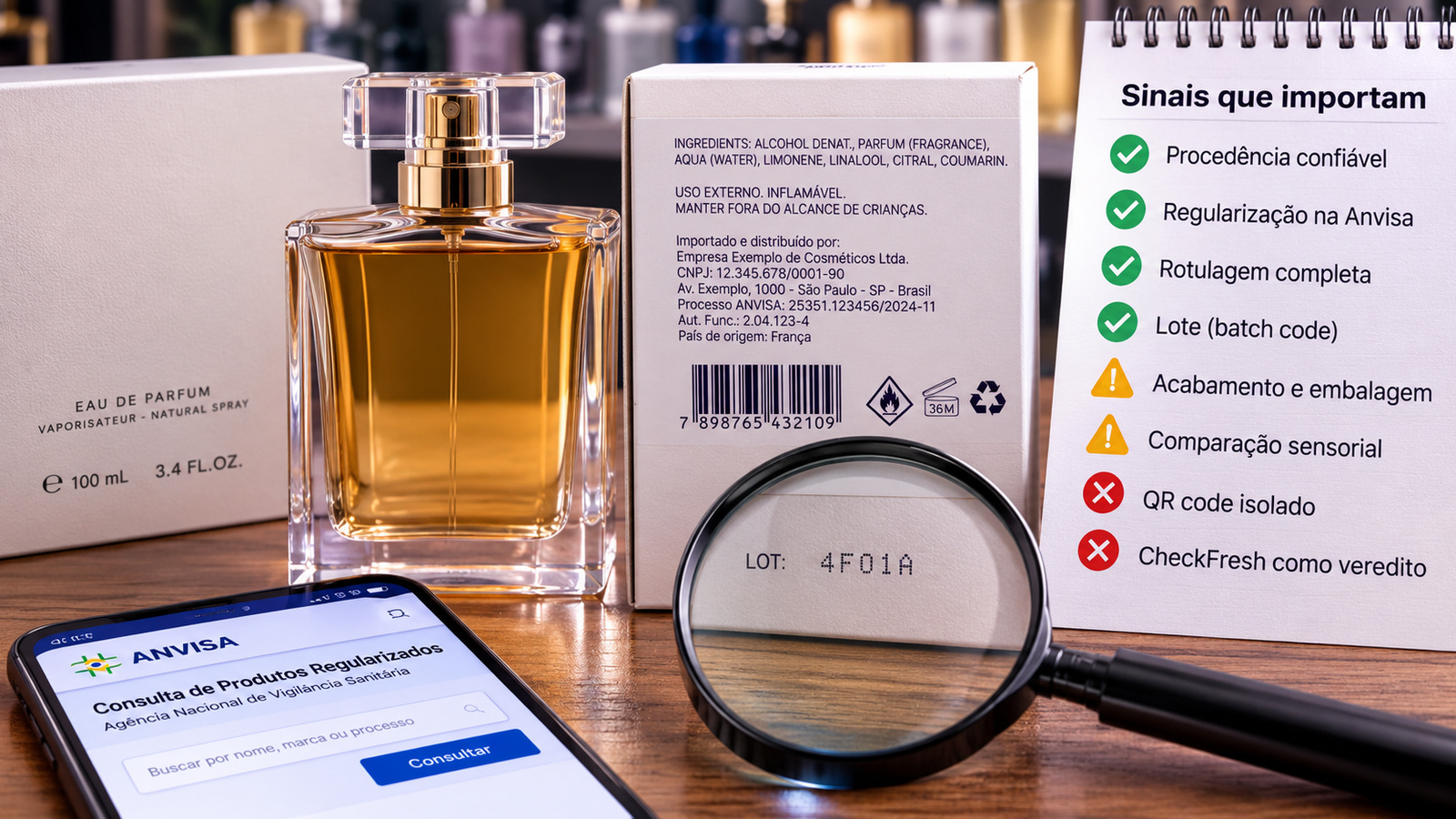
The batch or lot number is information required on the labeling of the primary packaging. Checking that the code is present, legible and not contradicted by the information on the bottle and packaging is useful. Even so, a visually coherent code should not be treated as an independent certificate of originality.
The same applies to glass finishing, printing, atomizer, cap, liquid color and box quality. These elements can reveal inconsistencies and justify further checking, but provenance carries more weight than an isolated aesthetic checklist. Packaging changes across markets, batches and years, and counterfeit products can copy convincing visual characteristics.
When there is genuine doubt, the stronger comparison is with information provided by the brand, importer or official distributor, combined with the health-regulatory record and the seller's documents.
How to read three types of listing
"Original tester" with no proof of origin
The word original is only a seller's claim until there is evidence supporting provenance. Ask for supplier identification, a fiscal document, clear photos of the labeling, and details of the holder or importer. Then check the product's regulatory status with Anvisa.
"Tester" with a simple box but no demonstration marking
Do not automatically conclude that it is fake or that it is a regulatory tester. The seller may be using the term broadly. The appropriate path is to ask about the origin, who supplied the unit, and what, specifically, identifies that bottle as a demonstration unit from the brand.
Bottle or box marked "Venda Proibida"
Here, the message on the label itself should carry weight in the decision. Even if the unit is authentic, the marking points to a demonstration presentation that was not intended for sale as a normal retail product. Without a consistent, documented explanation of provenance, the purchase risk increases.
When it is better to walk away
It is reasonable to stop the purchase when the seller does not identify itself, refuses to provide a CNPJ or origin, does not provide a fiscal document, shows label data that do not match the searchable database, cannot explain who the importer or distributor is, or tries to use the word tester to justify any inconsistency.
It is also prudent to walk away when the offer combines an exceptionally low price, lack of traceability and a bottle marked "Venda Proibida". None of these signs alone proves counterfeiting; together, they leave the buyer with little verifiable evidence supporting provenance.
If the purchase has already been made and signs of irregularity appear, Anvisa provides channels for product consultation and for reporting technical complaints. The manufacturer or importer shown on the label can also help confirm presentation and distribution details.
The short answer on testers and originality
A perfume tester is a real demonstration category recognized by Anvisa and can exist as an authentic product. The mistake is turning that possibility into an automatic rule: "if it is a tester, it is original" or "if it is a tester, it can be sold more cheaply".
RDC 907/2024 links the tester to consumer trial at the point of sale and, in the case described by Article 23, requires the phrase "Venda Proibida". For consumers, that means an online offer should be judged by provenance, supplier identification, health regulatory status and consistency of labeling - not merely by a batch code, a simple box or the word tester printed in the listing.
If the unit is explicitly marked "Venda Proibida", treat that information as central to the decision. The fact that a perfume may be genuine does not automatically turn a demonstration unit into merchandise intended for retail sale.