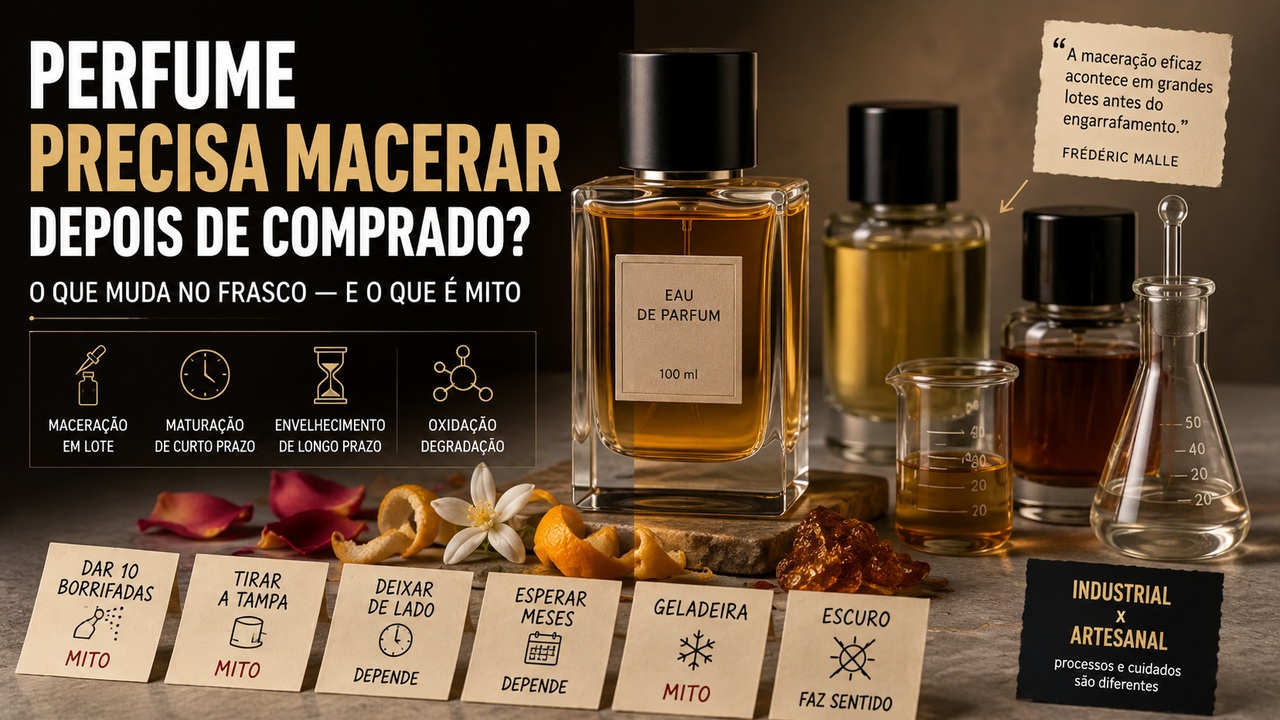
In most perfumes sold by brands that control manufacturing, the answer is no: the newly purchased bottle does not need “home maceration” to be ready. Professional maceration is part of production, before bottling. Once the perfume reaches the consumer, it may continue to change over time, but this is best described as aging of the product — and change does not mean automatic improvement in smell, projection or staying power.
Confusion exists because four different processes usually receive the same name on the networks: maturation, maceration, aging and oxidation. The distinction matters. The IFF describes maceration as a manufacturing stage in which the mixture rests before reaching the consumer, for weeks or even months, depending on the formula. In the Editions de Parfums Frédéric Malle glossary, maturation is the resting of the concentrate before dilution in alcohol, while maceration is the resting of the already diluted solution. The house itself states that, to be truly effective, maceration must occur in large batches before bottling and that, once placed in the bottle, the perfume does not macerate in the same way.
Maceration, maturation, aging and oxidation are not synonymous
Maturation
In the terminology used by Frédéric Malle, maturation is the period in which the aromatic concentrate rests before being mixed with alcohol. It is a step controlled by the manufacturer. The objective is to allow the concentrate to stabilize and be evaluated under defined conditions. Not every company uses exactly the same nomenclature, but the essential point is that this step belongs to the production process, not the consumer ritual.
Maceration
Maceration comes after diluting the concentrate in alcohol, according to the definition of Editions de Parfums Frédéric Malle. The mixture rests in a production container before filtration, packaging and
release. The IFF also treats rest as part of the industrial process and explains that the duration depends on the formula. Frédéric Malle gives a concrete example: Portrait of a Lady undergoes two weeks of maturation and four weeks of maceration. This type of protocol is decided during manufacturing and is not reproduced by simply leaving a purchased bottle in the cabinet.
Aging
Aging is what can continue to happen in the bottle after packaging. Over time, very volatile components may diminish, base notes may appear more pronounced, and certain ingredients may darken. Perfumers interviewed by Allure in 2026 draw attention to precisely this difference: what is usually presented on the networks as “macerating the perfume at home” is, in practice, subsequent aging of the product.
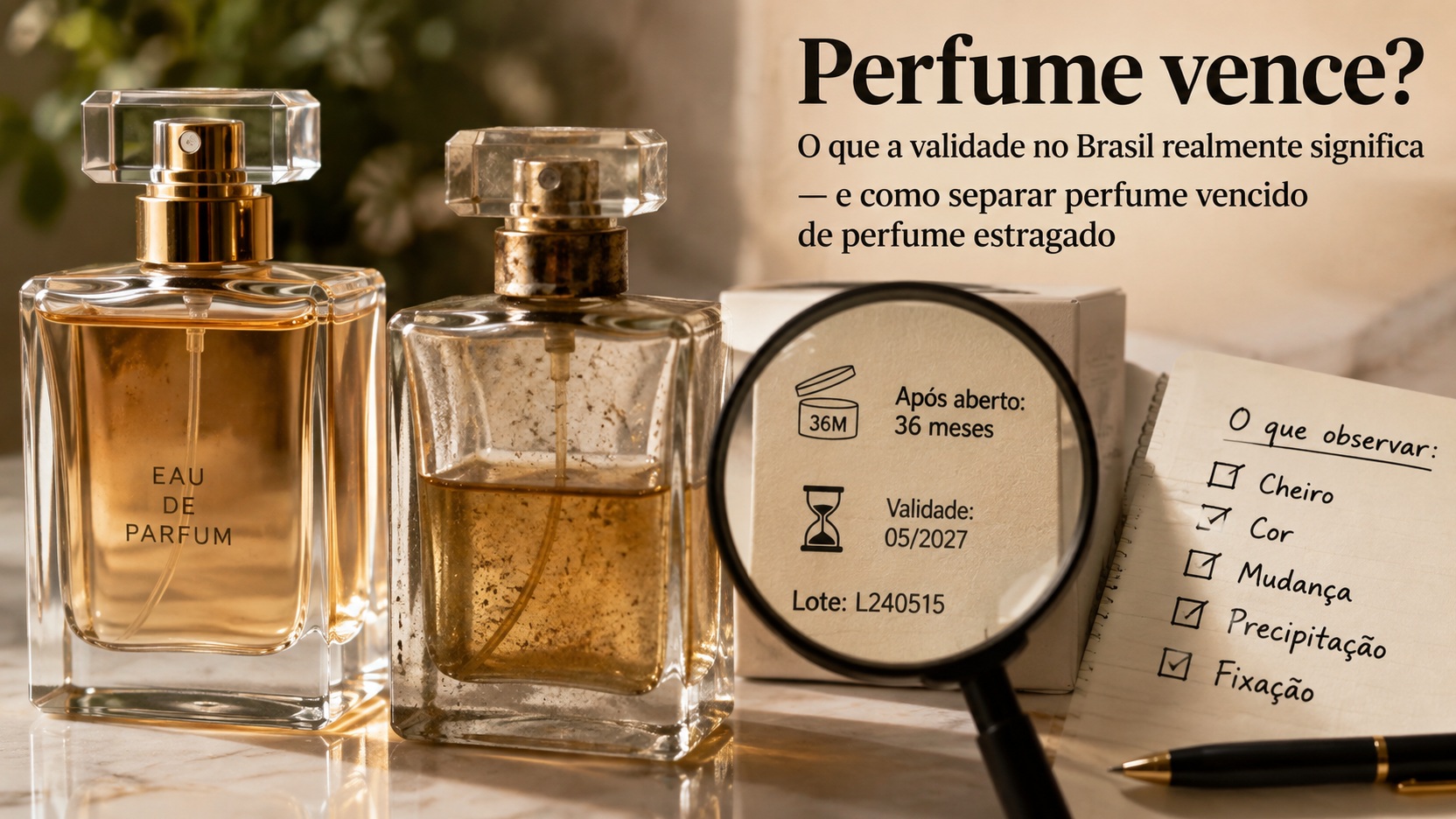
This aging can be perceived as pleasant in some perfumes and unpleasant in others. There may be a change in color without loss of quality. Ingredients related to vanilla, for example, may darken naturally. This does not prove that the perfume has become stronger, that it has become more lasting or that it has “finished macerating”.
Oxidation
Oxidation is a chemical reaction with oxygen and should not be confused with a desirable “improvement” step. Studies with fragrance materials show that compounds such as linalool and limonene can form oxidation products upon exposure to air. In other words, deliberately increasing oxygen exposure is not a professional steeping method and can go in the opposite direction of conservation.
So why can a perfume seem better weeks later?
Because a bottle is not chemically frozen the moment it leaves the factory. The composition may change slowly during the shelf life, especially in fragrances rich in natural raw materials, citrus, vanilla, resins or other more reactive components. Frédéric Malle herself notes that some formulas are more fragile than others and that different perfumes receive different aging protocols during manufacturing.
There is also a perception component. When more volatile notes decrease, the base can become relatively more evident and give the impression that the perfume has gained body or power. Allure reports experts describing precisely this effect: the base can appear “taller” after top elements lose presence, without this meaning an objective and universal increase in fixation.
For this reason, two apparently contradictory experiences can be true at the same time. One person may prefer a bottle that is a few months older, while another may find that the perfume has lost its shine. Change is possible; improvement is not guaranteed.
Do “home maceration” rituals make sense?
Give 10 sprays and store
There is no technical rule of ten sprays to start maceration in the professional sources consulted. The perfume has already been macerated or received the resting protocol defined by the manufacturer before being sold. Spraying a few times may change the volume of liquid and air space inside the jar, but this does not turn the household container into a steeping tank.
If the idea is to use a few sprays and compare the smell weeks later, this can serve as a personal experience. The problem begins when the ritual is presented as a universal requirement to improve any perfume. There is no basis for this fixed rule.
Remove the lid
In spray bottles, the outer lid is usually not the element that seals the solution; the atomizer assembly is what keeps the perfume closed. Leaving just the decorative lid aside therefore does not create a special maceration. Intentionally opening or unscrewing a container that should remain closed increases exposure to air and encourages evaporation and oxidation, which is the opposite of good conservation practice.
Leave the bottle aside
There is no known reason why the horizontal position improves maceration or fixation. For a spray bottle, keeping it upright is the practical option: it reduces the risk of leakage and avoids prolonged contact of the liquid with parts of the sealing system that do not need to be submerged. The position of the bottle does not replace time and controlled production conditions.
Wait weeks or months before using
Waiting can produce change, but there is no obligation to do so with a finished perfume. If the fragrance was produced correctly, it was formulated to reach the consumer usable. Over time, the profile may evolve; Sometimes the person likes the result more, sometimes less. The important thing is to call the process by the right name: aging the bottle, not repeating industrial maceration.
A wait makes more sense when the manufacturer itself informs that that specific product is shipped too young and recommends a rest period. In this case, it is a guide from the house towards a specific formula and process, not a general law applicable to all perfumes.
Store in the refrigerator
For normal use, a refrigerator is not necessary. Editions de Parfums Frédéric Malle informs that its perfumes are stable and were designed for common storage, and does not recommend refrigeration for those who intend to use the bottle normally. The exception indicated by the brand is storage for a very long period.
More important than chasing a very low temperature is avoiding unstable conditions. Memo Paris recommends keeping the perfume away from direct sunlight, in a stable environment, without major temperature fluctuations, and with the bottle closed to reduce exposure to air.
Save in the dark
Here there is a practice that makes sense, but for conservation, not for maceration. Light and heat can accelerate chemical and color changes in aromatic raw materials. An original cabinet, drawer, or box in a cool place with a relatively stable temperature is a better choice than a sunny shelf, a hot bathroom, or the inside of a car.
The dark, therefore, does not “make the perfume macerate”. It just helps preserve the profile that the manufacturer delivered for longer.
Industrial perfume and artisanal perfume: the size of the brand does not solve the issue
It is tempting to turn the discussion into “industrial is already ready; artisanal needs to rest”, but this division is simplistic. Large manufacturers typically work with defined mixing, resting, filtration, stability, safety and batch control processes. The IFF explicitly describes maceration and stability testing prior to market arrival.
An artisanal house may also have a strict maturation and maceration protocol before bottling. What changes is the scale, equipment, batch size and each producer's decision on when to put the product on sale. Frédéric Malle draws attention to the role of time and batch mass in the result, but this does not justify concluding that every small production perfume needs to be corrected by the buyer.
The useful question, therefore, is not “is it industrial or artisanal?”, but “does the manufacturer consider the product finished when he sends it?”. If the house states a specific rest period after receipt, follow that house's guidance. If it doesn't state it, there is no reason to assume that the consumer needs to complete a step that should be part of product development.
What to do with a newly purchased perfume
Use normally. Keep the bottle tightly closed, upright, away from direct sunlight and heat sources, and prefer a place with a relatively stable temperature.. There is no need to waste sprays, remove the cap, open the bottle, lay it down or hide it for months to “activate” the fragrance.
If you want to observe how the perfume evolves, compare the smell over time without trying to speed up the process. It is worth remembering that the perception of the same perfume also changes depending on the skin, climate, amount applied and drying time. An older taster bottle may still present a slightly different profile than a newly opened unit simply because they both have different storage and use histories.
Darker color means better or expired perfume?
Neither conclusion is automatic. Perfumers cited by Allure explain that vanillin and other materials can darken naturally. Color alone does not measure projection, fixation or quality. A perfume can change its appearance and still smell good.
The most relevant signal is the behavior of the product itself. If the smell has become clearly sour, vinegary, metallic or very different from the original profile, the change deserves attention. If skin irritation occurs, discontinue use. These situations are different from a simple gradual darkening of the liquid.
The short answer: preserving is more useful than trying to “macerate”
Perfume purchased ready-made does not, as a rule, require a domestic maceration ritual. Maceration and maturation are professional steps controlled before bottling; What happens next is aging of the bottle, which can change color and smell, but does not automatically improve performance.
Spraying ten times, removing the cap, throwing the bottle down or leaving it open does not reproduce the industrial process. Waiting can change the fragrance, with no guarantee of improvement. Refrigerator is unnecessary for normal use according to Frédéric Malle. Darkness, stable temperature and closed bottle make sense because they help preserve, not because they end pending maceration.
The best rule for the consumer is simple: treat a new perfume as a finished product, unless the manufacturer says otherwise. If it changes over time and you prefer the version
aged, this is a characteristic of the evolution of that bottle — not proof that every perfume needs to “rest” after being purchased.