
An INSS survivor’s pension does not begin with the question “who was closest to the deceased?”, but with two objective checks: whether the deceased had social-security status capable of generating the benefit and which legal dependency class each claimant falls into. The order of the classes is decisive: if an eligible dependent exists in class 1, parents and siblings do not move on to the next line.
For a spouse or partner, the duration is not automatically lifelong either. In many cases it may end after four months; in others, a table based on the dependent’s age on the date of death applies. Under the table currently used by INSS for deaths since January 1, 2021, lifelong entitlement starts at age 45 — provided the requirements that avoid the four-month rule are met.
Before dependency priority: the deceased had to generate entitlement to the pension
The official Urban Survivor’s Pension service, updated in August 2026, states that the benefit is for dependents of a person who, on the date of death, had insured status, was receiving a social-security benefit, or had already acquired the right to a benefit. INSS also has specific rules for presumed death.
This means identifying the family relationship is only part of the analysis. If there is uncertainty about loss of insured status, the statutory grace period, an already-acquired benefit, or the contribution history, that issue must be resolved together with the identification of dependents.
Who comes first: the three dependency classes
INSS organizes dependents into three priority classes. The existence of at least one eligible dependent in a class excludes the classes below it. People in the same class, however, may share entitlement.
| Class | Who may be included | How priority works |
|---|---|---|
| 1 | Spouse or partner; non-emancipated child under age 21; child of any age in the legally defined cases of disability. A stepchild or minor under guardianship may be treated as a child subject to specific requirements. | This is the preferred class. If an eligible dependent exists here, parents and siblings are excluded. |
| 2 | Parents. | They are considered only if there is no eligible class 1 dependent and they must prove economic dependency. |
| 3 | Non-emancipated sibling under age 21; or sibling of any age in the legally defined cases of disability. | They are considered only if there is no eligible dependent in classes 1 or 2 and must prove economic dependency. |
The INSS page on dependents explains that economic dependency is presumed for the standard members of class 1. Parents, siblings, stepchildren and minors under guardianship have specific proof requirements. A stable union must also be documented when there is no formal marriage.
When a spouse’s or partner’s pension lasts only four months
The four-month rule is a duration rule for the spouse’s or partner’s individual share — not a general duration for every dependent. According to INSS guidance, it applies when at least one of the following is true:
- the deceased insured person had not completed at least 18 monthly contributions; or
- the marriage or stable union began less than two years before the death.
Both requirements do not have to fail at the same time: failure of either one can make the four-month rule relevant.
There is an important exception. If the death results from an accident of any kind — and the legislation also covers occupational disease or work-related disease — the age-based duration periods may apply regardless of the 18 contributions and the two years of marriage or stable union. The official INSS survivor’s pension page summarizes this exception.
When the age table applies — and when the pension may be lifelong
If the death occurs after at least 18 monthly contributions and the marriage or stable union has lasted at least two years, the spouse’s or partner’s share depends on that person’s age on the date of death. For deaths occurring on or after January 1, 2021, INSS uses the following table:
| Age of spouse or partner on the date of death | Maximum duration |
|---|---|
| Under 22 | 3 years |
| 22 to 27 | 6 years |
| 28 to 30 | 10 years |
| 31 to 41 | 15 years |
| 42 to 44 | 20 years |
| 45 or older | Lifelong |
“Lifelong” here means the share has no predetermined end date under the age table. It does not make the benefit immune from all other legal grounds for termination, such as the pensioner’s own death.
For a spouse or partner who is disabled, INSS states that the benefit is due while the disability lasts, subject to the applicable minimum periods. These cases require careful review of the recognized condition and the dates involved.
Children and siblings follow a different duration rule
The 3-, 6-, 10-, 15- or 20-year table, or lifelong duration, should not be applied automatically to children or siblings. For a child, person treated as a child, or sibling, the general rule is termination at age 21, except in the legally defined disability cases. The situation must be classified and proven under INSS rules.
This distinction prevents a common mistake: using the child’s age to place that child into the table intended for the duration of a spouse’s or partner’s share.
A practical flow to estimate the situation before applying
- Confirm the deceased person’s social-security status. Check whether the person had insured status, an active benefit, or an already-acquired benefit right.
- Identify the class of each potential dependent. Start with class 1, then class 2, and finally class 3.
- Stop when an eligible class is found. The higher class excludes the lower ones.
- If there is a spouse or partner, check 18 contributions and two years of relationship. Failure of either requirement may lead to a four-month duration.
- Check the accident exception. It may waive the 18-contribution and two-year requirements for duration purposes.
- If the four-month rule does not prevail, use the age on the date of death. For deaths since January 1, 2021, apply the current INSS table.
What to gather and how to apply
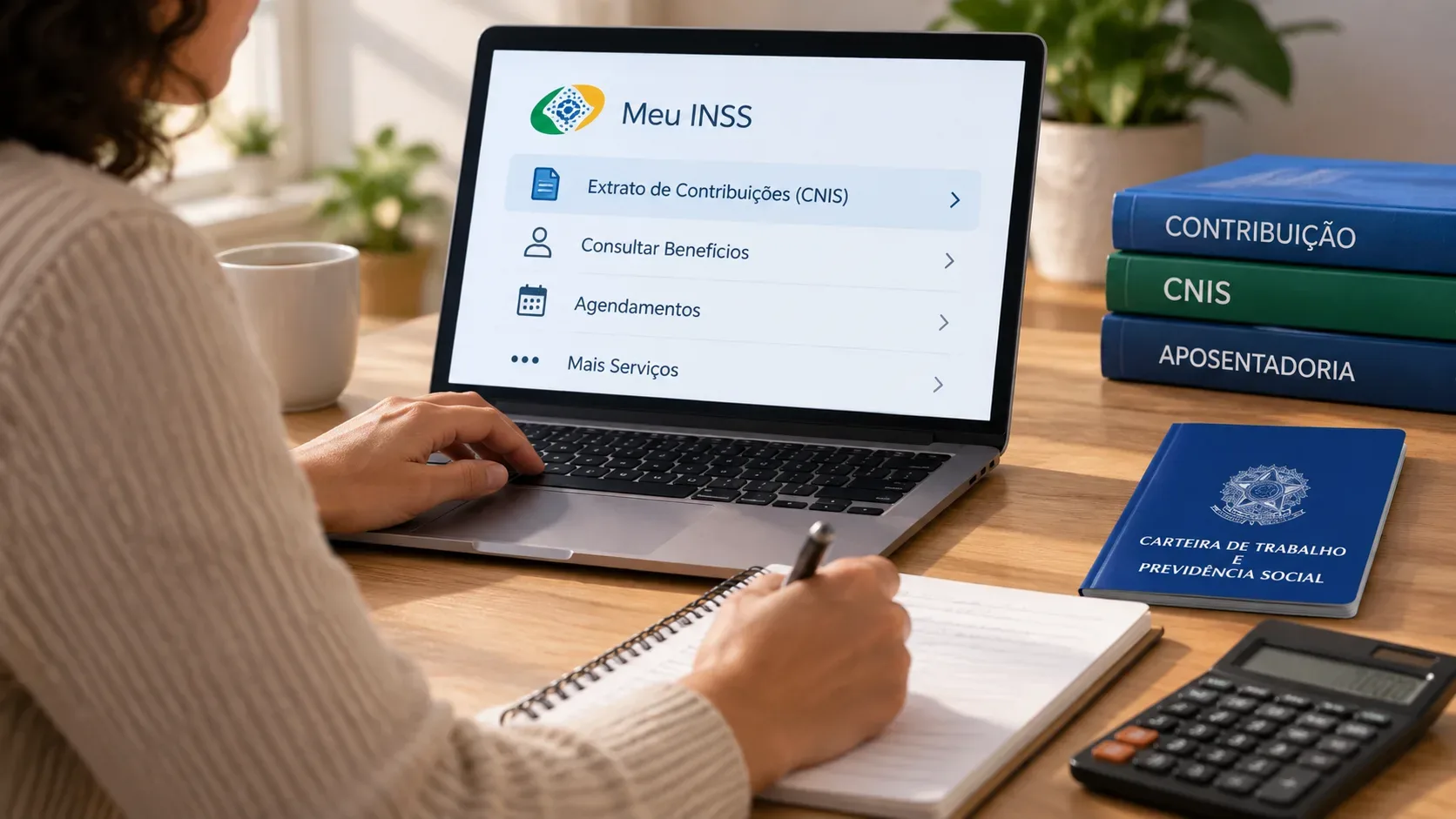
An urban survivor’s pension can be requested through Meu INSS. The official service instructs users to sign in, search for “Pensão por morte urbana” and follow the steps. INSS may require identification documents and specific evidence of the relationship or dependency, depending on the type of claimant. If the system is unavailable, the official service points to the 135 call center.
Documents proving a stable union, economic dependency, guardianship, parentage, and any disability can change the result of the analysis. The best estimate therefore combines the abstract rule with the evidence actually available.
Why the date of death and human review matter
Duration rules have changed over time. The table above is the one INSS uses for deaths from January 1, 2021 onward; earlier deaths may follow different age bands. There are also special situations involving a former spouse receiving alimony, rural special insured persons, presumed death, dependents with disabilities, and disputes about insured status.
This guide is intended for initial screening and does not replace an INSS determination or an individualized social-security review. In cases involving incomplete documents, older dates, disputed stable unions, or disability, it is worth reviewing the classification before concluding that the pension will last four months, a fixed number of years, or for life.