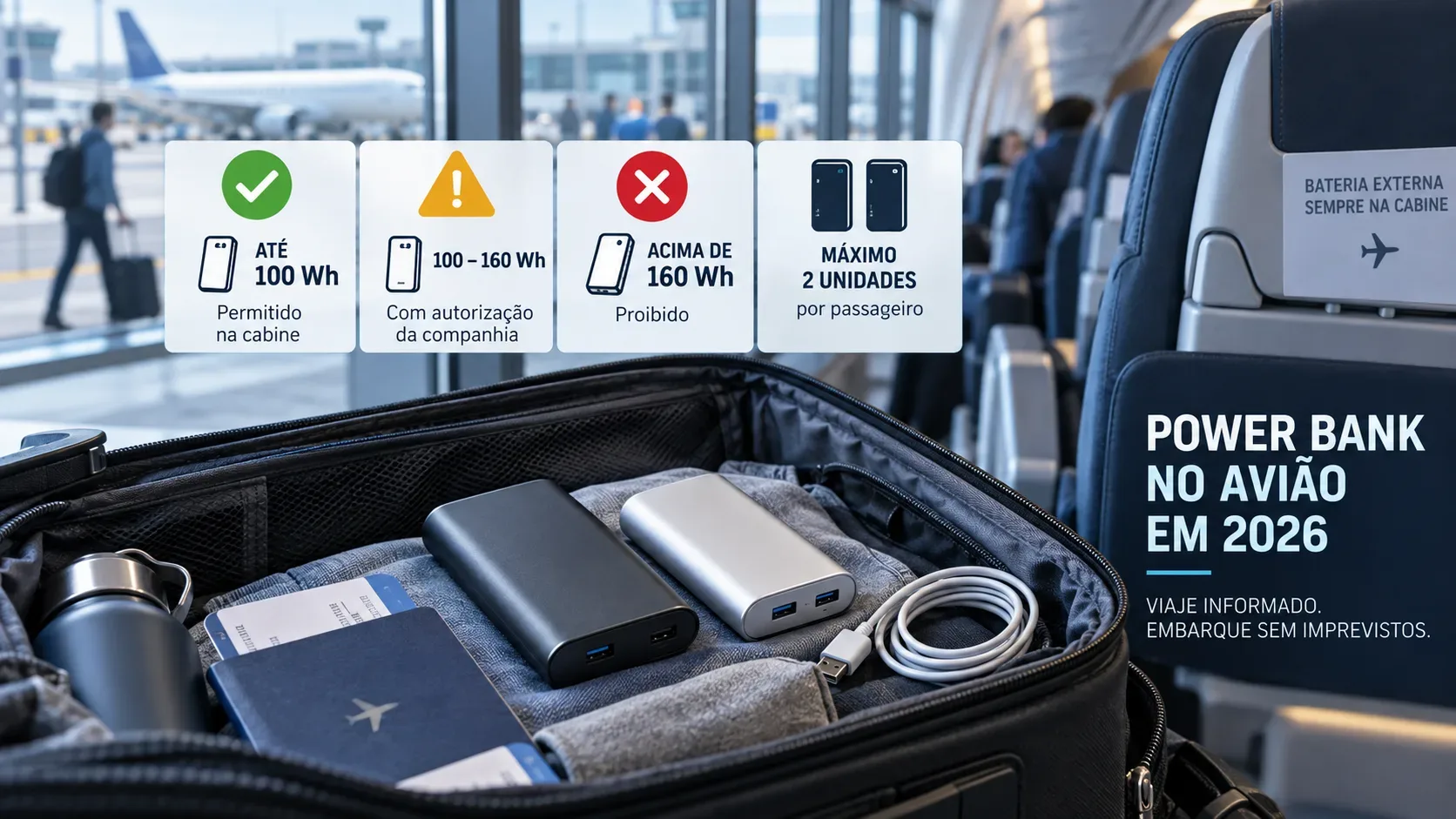
In 2026, the Brazilian rule for taking a power bank on a plane became more straightforward: each passenger may carry up to two portable chargers. Models up to 100 Wh may be carried without prior approval; between 100 Wh and 160 Wh, airline approval is required; above 160 Wh, carriage is prohibited. The power bank must travel in the cabin, inside a backpack, handbag or personal item, and it may not be checked or placed in the overhead bin.
Quick rule: quantity, capacity and where to carry it
| Power bank capacity | Approximate equivalent at 3.7 V | Allowed to fly? | Approval | Where to store it |
|---|---|---|---|---|
| Up to 100 Wh | Up to about 27,000 mAh | Yes, within the limit of up to 2 units per passenger | No | In a backpack, handbag or personal item, under the seat or in the seat pocket |
| Over 100 Wh up to 160 Wh | About 27,000 to 43,000 mAh | Yes, if approved by the airline and within the quantity limit | Yes, in advance | In the cabin, in the personal item; not in the overhead bin |
| Over 160 Wh | Above about 43,000 mAh | No | There is no approval that makes it acceptable for ordinary passenger carriage | It cannot be carried on a passenger flight |
The mAh figures are only approximations calculated with a nominal voltage of 3.7 V. If the device states its capacity in Wh, use the Wh value printed by the manufacturer. Brazil's Ministry of Ports and Airports published the same limits and the approval requirement for 100–160 Wh devices in May 2026: Ministry of Ports and Airports guidance.
How many power banks can I take on a plane?
The limit announced for Brazilian commercial flights is up to two power banks per passenger. This count refers to standalone portable chargers; the battery built into a phone, laptop or tablet does not turn each device into an additional power bank.
Having two units does not remove the capacity rule. A 20,000 mAh power bank and a 10,000 mAh one, for example, are normally below 100 Wh each when they use 3.7 V cells. A 30,000 mAh model is around 111 Wh at the same voltage and falls into the range that requires prior approval.
Power banks go in the cabin, not the hold
Power banks are treated as spare lithium batteries. Because of the risk of short circuits and overheating, they may not be placed in checked baggage. If your carry-on bag is taken at the gate to be loaded into the hold, remove the power bank before handing the bag over.
Under the Brazilian rules publicized in 2026, the precaution goes further: the portable charger must remain in a backpack, handbag or personal item, under the seat in front of you or in the seat pocket, not in the overhead bin. The Tem Regra passenger guidance campaign also recommends protecting the terminals with a case, packaging or another method that prevents short circuits.
How to convert mAh to Wh
Aviation uses Wh (watt-hours) because this unit reflects the battery's energy. Many manufacturers, however, prominently show only mAh. The conversion depends on nominal voltage:
Wh = mAh × V ÷ 1,000
For a power bank with a nominal battery voltage of 3.7 V, the calculation looks like this:
| Advertised capacity | Approx. Wh at 3.7 V | Practical reading |
|---|---|---|
| 10,000 mAh | 37 Wh | Within the up-to-100 Wh range |
| 20,000 mAh | 74 Wh | Within the up-to-100 Wh range |
| 27,000 mAh | 99.9 Wh | Very close to the 100 Wh limit |
| 30,000 mAh | 111 Wh | 100–160 Wh range: approval required |
| 40,000 mAh | 148 Wh | 100–160 Wh range: approval required |
| 50,000 mAh | 185 Wh | Above 160 Wh: prohibited |
The 3.7 V figure is a common reference for lithium-ion cells and is the value used by the Tem Regra calculator. It should not replace the manufacturer's specification when the actual nominal voltage is different.
What if the capacity is not printed?
Do not rely on a visual estimate or the physical size of the device. Before leaving for the airport:
- look for the Wh or mAh rating on the side, back or bottom of the power bank;
- check the original packaging and manual;
- search for the exact model on the manufacturer's website;
- if only mAh is listed, find the nominal voltage as well and convert it to Wh;
- if the capacity cannot be verified, contact the airline before the flight.
The Brazilian campaign advises that a device without a declared or verifiable capacity may not be accepted. A screenshot of the manufacturer's official product page or the model manual may therefore be useful if the physical marking has worn off, but final acceptance remains subject to the airline and airport security procedures.
How approval works between 100 Wh and 160 Wh
In this range, it is not enough to arrive with the device at security screening. Government guidance says passengers should obtain prior airline approval and present the power bank at the check-in counter. Because internal procedures can vary, confirm the requirement with the airline before going to the airport and bring the device's Wh specification.
Airlines may also impose stricter conditions within the applicable rules. IATA recommends checking the carrier's policy and maintains international guidance that power banks and spare batteries be carried only in hand baggage: IATA guidance on lithium batteries.
Can I use or recharge the power bank during the flight?
Brazilian guidance issued in 2026 says the power bank must not be recharged from the aircraft's USB ports or power outlets and must not be used to power other devices during the flight. The aim is to keep the battery accessible and reduce unattended overheating or failure scenarios.
If the device becomes unusually hot, swells, emits an odor or smoke, or is visibly damaged, stop handling it and alert the cabin crew immediately.
Checklist before leaving home
- Count your power banks: no more than two per passenger.
- Check the Wh rating; if only mAh is shown, confirm the voltage and convert it.
- Up to 100 Wh: prior approval is normally not required.
- Between 100 Wh and 160 Wh: obtain airline approval in advance.
- Above 160 Wh: do not take it to the airport for carriage.
- Keep it in a backpack, handbag or personal item, not in checked baggage and not in the overhead bin.
- Protect the terminals against short circuits.
- Do not recharge the power bank or use it to power other devices during the flight.
To avoid surprises at the airport, use both the current Brazilian rule and the policy of the airline operating your flight. If there is an operational difference or an international connection, confirm the conditions for every segment of the itinerary.