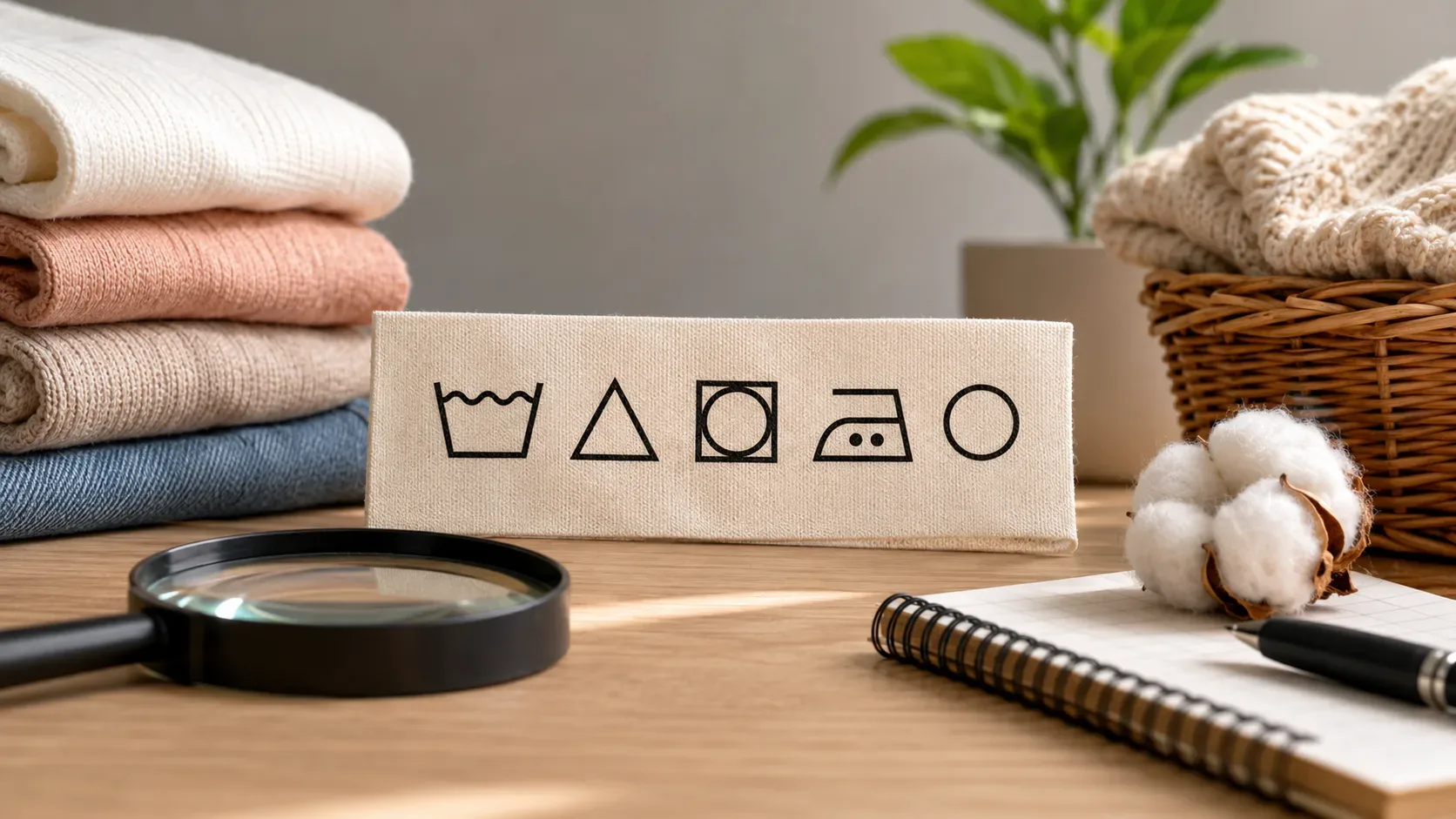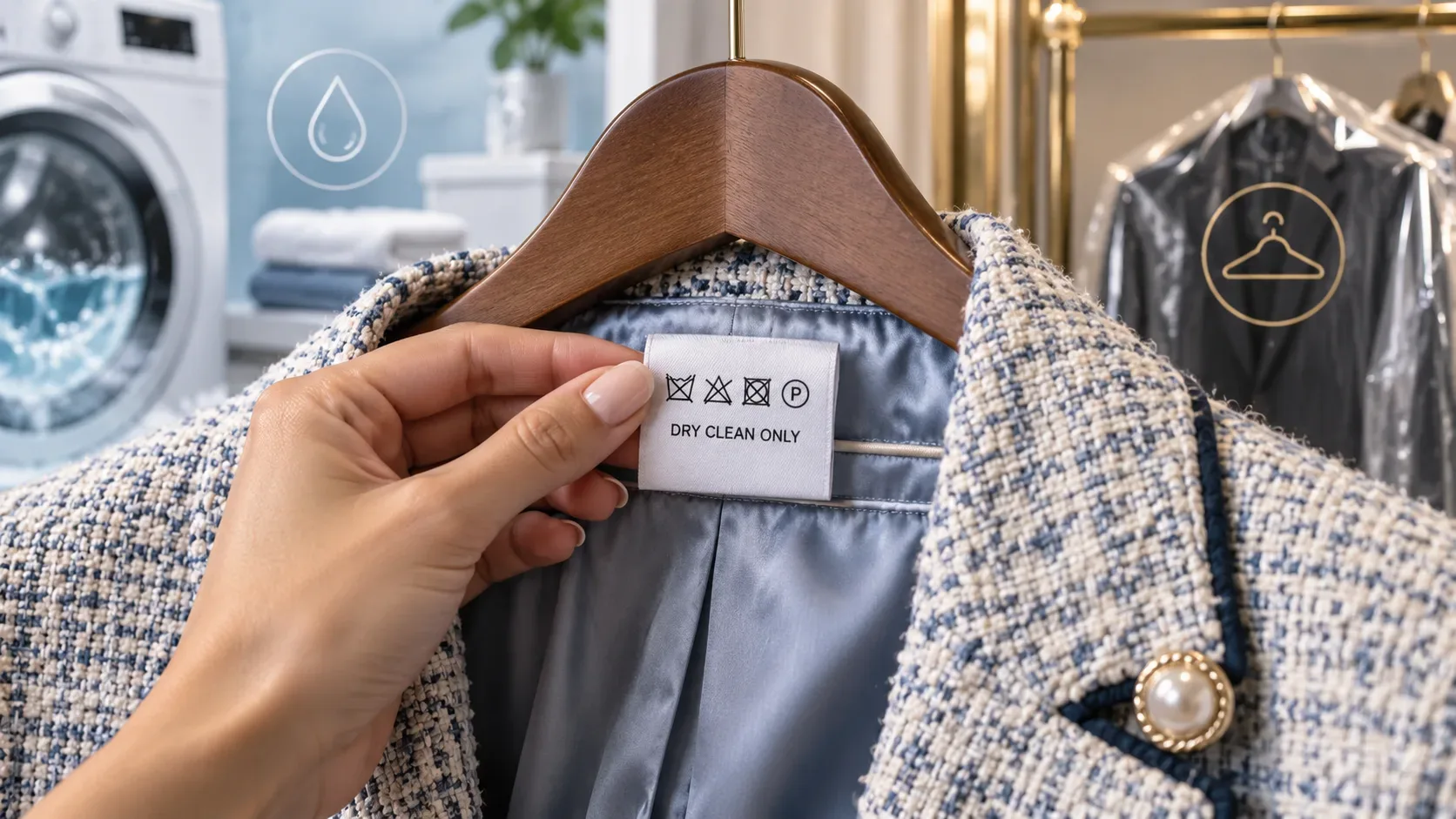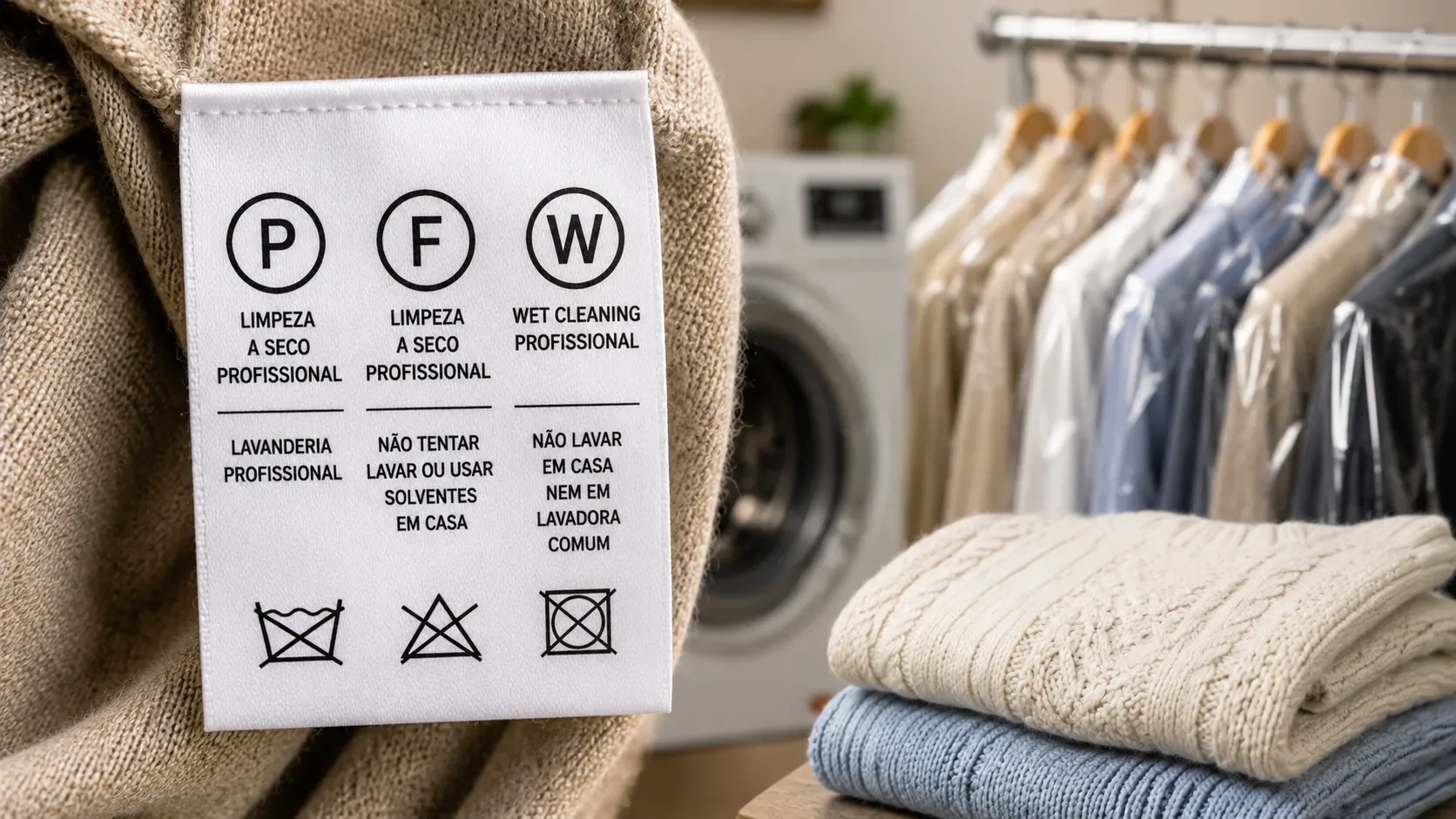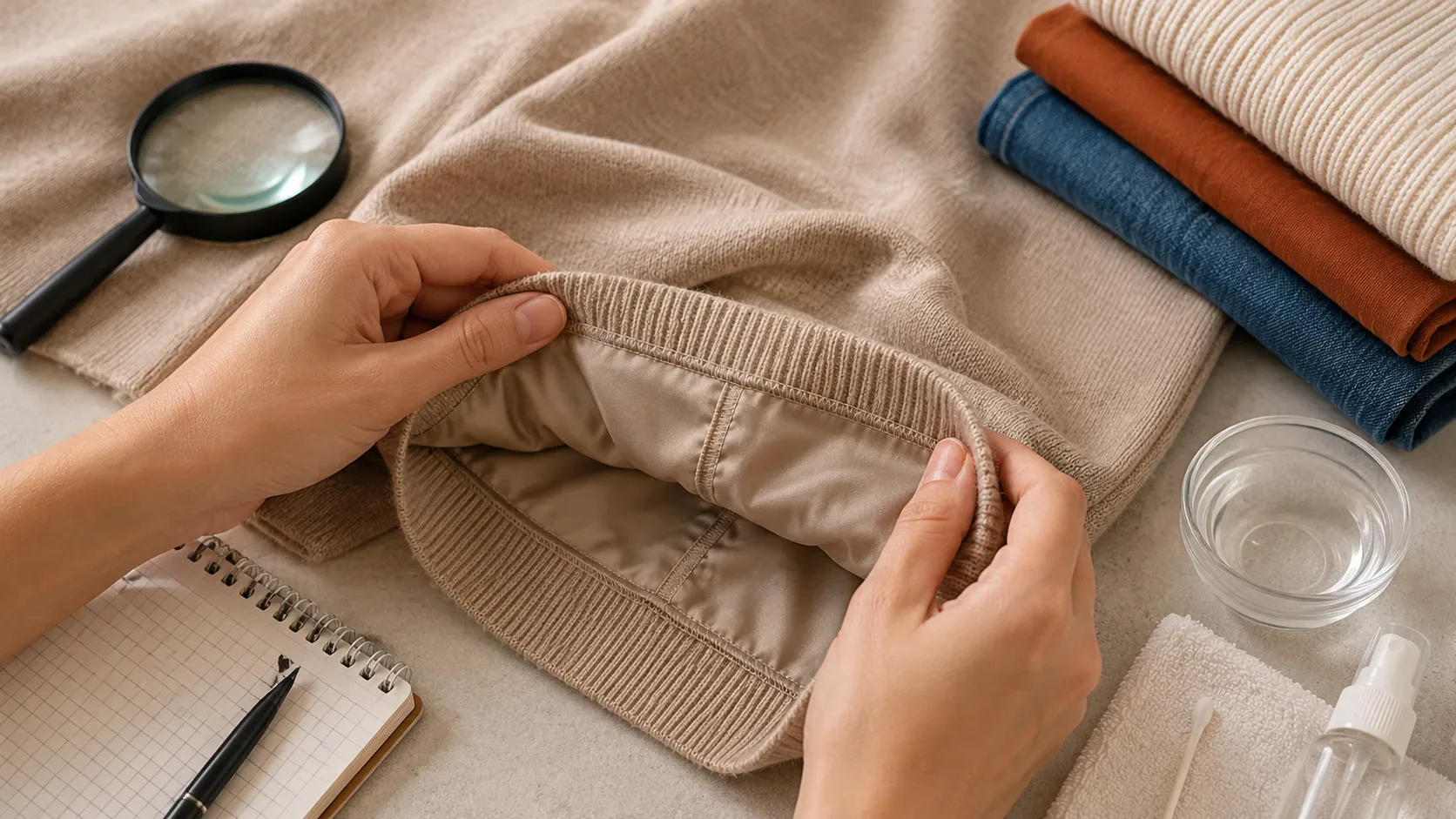
Once the composition or wash label has been cut, there is no simple home test that will reliably reveal everything the garment can withstand. The most prudent path is not to guess whether the fabric “feels like cotton”, “feels like silk” or “must be polyester”. It means evaluating the risk presented by the entire garment and choosing the least aggressive intervention capable of solving the problem.
This distinction matters because the care instruction does not depend solely on the visible fiber. GINETEX, the entity responsible for one of the international systems of conservation symbols, informs that the indication considers factors such as coloring, finishing, buttons, zippers and applications. The United States Federal Trade Commission's labeling rule also requires that the recommendation be supported for the entire garment, and not just for its isolated components.
Therefore, construction, lining, elasticity and finish function as signs of risk not as evidence of composition. The following decision tree is designed to reduce the chance of shrinkage, warping, color migration, loss of gloss or peeling. It does not guarantee that an unknown item can be washed or that damage that has already occurred is reversible.
Before washing, try to recover lost information
Before testing clothes, look for evidence that doesn't require getting them wet:
- check your receipt, purchase history or product page;
- search by brand name, reference, collection or code still present on another label;
- compare the piece with official photos, without assuming that visually similar models have the same composition;
- ask the brand's customer service team, sending photographs of the front, back, seams and any remaining labels;
- check if the piece was part of a set whose other part still has the label.
Recovering the original statement is preferable to reconstructing it for appearance. Even two pieces with similar outer fabric can have different interlinings, dyes, adhesives or linings.
The first decision: do the clothes really need a thorough wash?
The lowest risk precaution might be to simply not wash the entire item at that time.
If the problem is a slight odor, superficial dust or discreet wrinkles, start by letting the clothes air in a ventilated place protected from direct sunlight. Remove lint with a very soft brush or adhesive roller applied without excessive pressure. If there is only a small mark, consider spot treatment before submerging the entire piece.
Don't try to “take advantage of the wash” to solve everything at once. Water, detergent, movement, spinning, heat and drying are different steps, and each can affect different components.
Decision tree for label-free clothing
1. Is the piece structured, lined or composed of many materials?
Look inside out and look for:
- lining attached to the piece;
- shoulder pads, cups, fins or padding;
- interlining on collars, cuffs, waistbands or lapels;
- glued, thermoset or laminated parts;
- leather, suede, fur, metal, wood or paper;
- sequins, stones, fringes or heavy embroidery;
- permanent pleats, very defined pleats or shaped volume;
- rubberized print, shiny coating or resin surface.
If one or more of these elements are present, do not do a thorough wash at home as a first test. External fabrics, linings, threads, interlinings and adhesives can react differently to water or heat. The FTC itself emphasizes that safe guidance must consider the entire garment and that a specific combination of components may impede both washing and conventional dry cleaning.
Look for a specialized dry cleaner and clearly inform them that the tag has been removed. Ask for prior evaluation and testing in a discreet area. Don’t take the phrase “dry cleaning is good for everything” as a guarantee.
2. Is it a simple, one-layer piece with no applications?
An unprinted tee, unlined skirt, or simply constructed blouse has fewer variables than a blazer or structured dress. This reduces the risk, but does not confirm that the item is washable.
Before washing, examine:
- if there are contrasting colors that can migrate;
- if the surface has a shine, relief, hair or satin appearance;
- if the seams are intact;
- if the fabric already shows fading, water stains or deformation;
- if there are glued areas that only appear on the inside out.
If the part is simple and in good condition, proceed to the elasticity assessment and spot testing.
3. Does the material stretch or is the construction mesh?
Gently stretch an area without straining the seams. Observe if the piece:
- extends a lot and returns to shape;
- has a mesh structure, with small visible ties;
- It is heavy and flexible when hung;
- has elastic in the fabric itself, in the cuffs, waistband or straps.
Elasticity does not identify a specific fiber. It simply indicates that heat, twisting and suspension during drying warrant additional caution. The University of Georgia Cooperative Extension notes that elastomeric fibers like spandex can be affected by heat and chlorine bleach. Woolmark, when dealing with woolen knitwear, recommends horizontal drying because the weight of the water can stretch the garment when it is hung.
For an elastic or knit item without a tag:
- do not use bleach;
- do not twist;
- avoid hot water;
- don't start with the washing machine;
- do not use a dryer;
- if washing after the test, dry flat and in the shade.
These measures protect the construction, but do not prove that water washing is permitted.
4. Does the surface have a delicate finish?
Stop before domestic washing if any:
- velvet, fur or brushed surface;
- brightness that changes depending on the direction of light;
- very reinforced or purposely starched fabric;
- fine pleated;
- pressed relief;
- painting, metallization or coating;
- biased cut that makes the clothes fall diagonally;
- combination of dark and light colors with risk of transfer.
Museum conservation sources treat knitwear, bias-cut garments, lined garments, embellishments, and composite materials as high-risk categories for wet cleaning. This guidance is stricter than what is needed for regular clothing, but provides useful signs for recognizing when a home test may be insufficient.
Under these conditions, maintain localized care or seek professional evaluation.
How to do a localized water and color test
The test must be done before wetting a visible area or soaking clothing. It does not identify the fabric and does not guarantee that the entire piece will react in the same way.
Separate:
- a piece of clean, pre-washed white tissue or white absorbent paper;
- water at room temperature, approximately between 20 °C and 30 °C;
- clean white cotton swab or dropper;
- a very dilute solution of the detergent that would be used, prepared separately.
Choose a hidden area, such as an internal seam allowance, hem, back of the waistband or part covered by the lining. If there are multiple colors, contrasting lines, prints or finishes, each element needs to be looked at separately.
- Place the fabric or white paper under the chosen area.
- Apply a small drop of water, without soaking.
- Press another white piece over the spot, without rubbing.
- Check after a few seconds, again after about two minutes, and if there is no change, after five minutes.
- Observe whether there has been color transfer, halo formation, loss of shine, roughness, wrinkling or change in relief.
- If the water does not cause any changes, repeat in another hidden spot using a drop of diluted detergent solution.
- Remove the residue with a small amount of water and press with dry white material.
The Canadian Conservation Institute uses a more controlled procedure, with separate tests for water and cleaning solution, different observation intervals and evaluation of each color or component. The institute itself warns that the test can mark the area and that a stable result does not eliminate the possibility of the color migrating during washing or drying.
Stop the test immediately if color appears on the white material or any changes to the fabric. Don’t try to “compensate” by using less detergent, hotter water, or another product.
When low-impact hand washing can be considered
Consider a short hand wash only when all of these conditions are met:
- the piece is for everyday use, without high financial or emotional value;
- not old, fragile or collectible;
- has no lining, internal structure, padding or glued parts;
- no leather, stones, pleats or coverings;
- the seams are firm;
- test with water and detergent showed no transfer or change;
- there is space to support the clothes during washing and drying.
In this scenario, the conservative option is to use cold or slightly warm water, a small amount of the tested detergent and minimal movement. Immerse the clothing without rubbing, let the contact be brief and rinse with water of a similar temperature.
Remove the piece supporting your weight with both hands. Don't twist. Press it between white towels to remove excess water and place it to dry horizontally, in the shade, gently adjusting its original shape.
GINETEX explains that the care symbols represent the maximum treatment allowed and that gentler processes and temperatures lower than those indicated are acceptable when the label is known. Without a label, however, the upper limit is unknown; therefore, low temperature and little mechanical action are just a risk reduction strategy, not a universal authorization to wash.
Quick Decision Framework
| Observed signal | Main concern | More conservative initial care |
|---|---|---|
| Lined or structured piece | Different reactions between fabric, lining and interfacing | Do not get it completely wet; request professional assessment |
| Mesh or high elasticity | Stretch, deformation and heat sensitivity | Avoid machines, twisting and drying; dry flat |
| Contrasting colors | Color migration | Test each color and line separately |
| Gloss, relief, fur or pleated | Loss of finish or watermark | Avoid thorough washing, steam and pressure |
| Applications, glue or thick print | Detachment, cracking or dissolution | Do not submerge before evaluation |
| Simple fabric, unlined and stable in the test | Minor but not non-existent risk | Short hand wash and horizontal drying |
| Ancient, rare or affectionate piece | Irreversible damage | Textile preservative-restorer |
Dry cleaning is not synonymous with zero risk
Sending all unknown parts to dry cleaning seems like a conservative solution, but it's not a safe rule. The commercial process may involve solvents, mechanical movement, extraction, heated drying, steaming and pressing.
In guidance for collections, the Canadian Conservation Institute recommends inspection of tears, seams, linings and accessories before dry cleaning and emphasizes that all components must be compatible with the solvent. The institute also notes that mechanical action can cause friction. Although everyday clothing is not a museum piece, the principle remains useful: the professional needs to evaluate the construction, not just choose a solvent.
When taking clothes to a dry cleaner:
- inform that there is no label;
- describe the origin of the stain, when known;
- show fragile, glued or faded areas;
- ask if the test will be carried out in a hidden location;
- ask that the objective is to preserve the piece, not to guarantee the total removal of the stain.
What to avoid when care is unknown
Until you recover the original statement or complete a safe evaluation, avoid:
- chlorine or oxygen bleach;
- hot water;
- long soak;
- normal cycle or intense centrifugation;
- dryer;
- twist;
- strong brushing;
- stain removers used without testing;
- acetone, alcohol or household solvents;
- hot iron applied directly;
- intense steam;
- recipes that mix cleaning products.
Seemingly common products can affect specific fibers, dyes or finishes. The University of Georgia, for example, records sensitivity to heat, chlorine or certain solvents in different groups of fibers, reinforcing why appearance is not enough to choose a product.
What if the item is dented?
No label, do not start with the hot iron or steam. GINETEX informs that some clothes cannot be ironed and that steam or inadequate temperature can cause irreversible changes.
First, let the piece rest open or supported. If you still need to pass:
- choose an indoor area;
- use the lowest temperature available;
- place a white cotton cloth between the iron and the clothes;
- do not use steam in the first test;
- do not slide the iron with force;
- stop if there is shine, stickiness, curling, smell or color change.
Items with relief, fur, pleating or shiny surfaces should be sent to a professional.
Can shrunken clothes return to their original size?
No guarantee. Some deformations are simply due to the weight of water or inadequate drying and can improve with rest and gentle remodeling. Others involve permanent changes to the structure.
Woolmark warns that a wool jersey that has been severely felted after inadequate washing may not be recoverable. This example does not allow us to conclude that every shrunken item is made of wool; it just demonstrates why promising “unwinding” is unwise.
Do not force dry clothes, do not apply heat to “relax” the fabric, and do not use conditioners or homemade mixtures as if they were guaranteed methods. On important parts, seek specialized evaluation before increasing the damage.
Final rule: stop at the first sign of uncertainty
The conservative choice follows this order:
- try to recover the original instruction;
- ask if complete cleaning is really necessary;
- examine construction, lining, applications and finishing;
- evaluate elasticity and risk of deformation;
- perform localized testing on each color and component;
- hand wash only simple items that have gone through all the steps;
- stop the process in the event of any change;
- send structured, fragile, old or valuable pieces to a professional.
The objective is not to discover “what the fabric is” based on fragile clues. It is preventing a domestic hypothesis from turning into permanent damage. Save this decision tree with your laundry supplies and photograph the labels on new items before they fade or are removed.