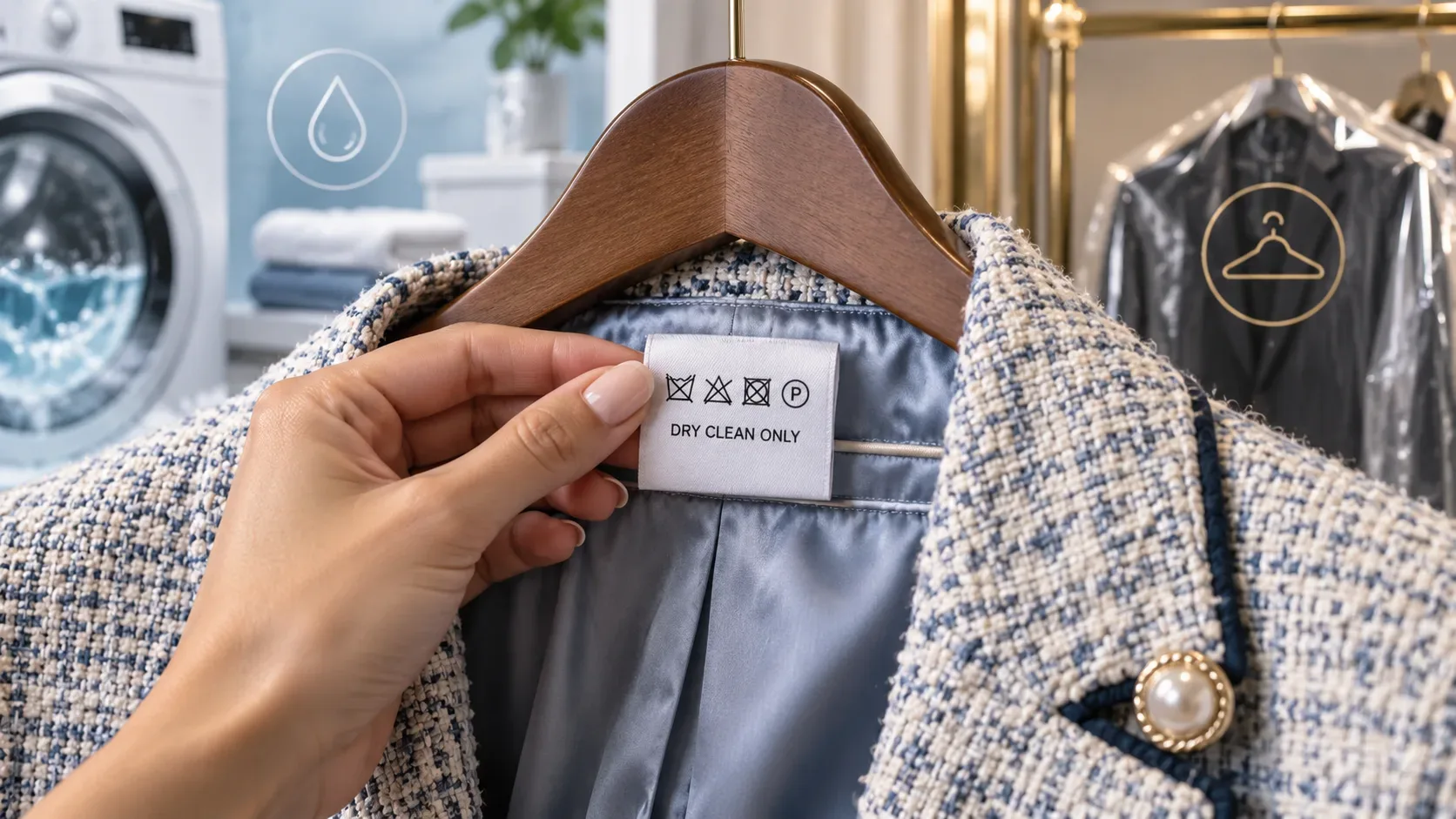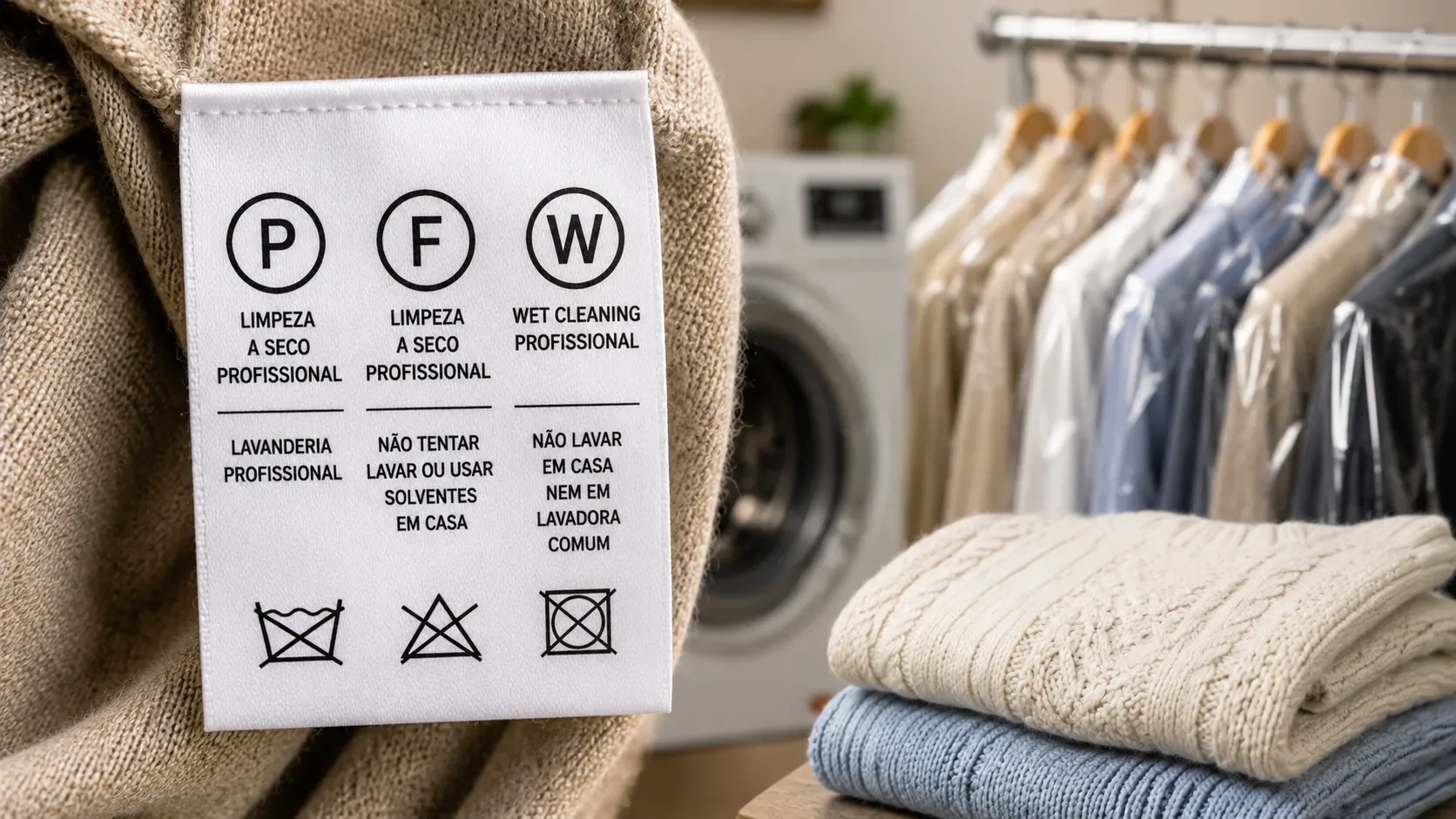
Label symbols should not be interpreted in isolation. They form a sequence: washing, bleaching, drying, ironing and professional textile care. This is the order determined for textile products sold in Brazil, even if the instructions appear horizontally, vertically, with only symbols, only with text or combining both formats.
In practice, the reading answers five questions: can the piece come into contact with water? Can you receive bleach? How should it dry? How much heat can it tolerate when ironing? Do you need or can you receive professional treatment?
The most important rule is simple: check the entire row before washing or treating a stain. Just finding out the water temperature is not enough when, for example, the clothes cannot be placed in the dryer or receive a certain chemical product.
The official order of label symbols
| Order | Basic shape | Group | Question that answers |
|---|---|---|---|
| 1 | Vat or container with water | Washing | Can the item be washed? At what temperature and with what intensity? |
| 2 | Triangle | Targeting | Is any type of bleach allowed? |
| 3 | Square | Drying | Can the clothes go in the dryer or do they need to dry naturally? |
| 4 | Iron | Passadoria | Can the item be ironed and how much heat can it withstand? |
| 5 | Circle | Professional textile care | What professional processes are allowed? |
The symbols indicate the most severe treatment permitted without causing anticipated irreversible damage to the article. This does not mean that it is necessary to always use the maximum temperature, the most intense cycle or the dryer: the limits act as a ceiling that must not be exceeded.
The grammar that is repeated in the five groups
Before memorizing dozens of designs, learn the modifiers that appear in, under, or on the basic shapes:
- An X over the symbol prohibits that specific process.
- A number inside the tub indicates the maximum water temperature.
- A bar below the bowl calls for reduced mechanical action; two bars indicate even gentler treatment.
- Dots inside the dryer or iron represent heat levels.
- Horizontal or vertical lines within the square describe forms of natural drying.
- An oblique line in the corner of the square indicates shade drying.
- Letters inside a circle guide the professional through the cleaning process.
- Bars below the circle impose limitations on professional treatment.
This logic avoids a frequent error: confusing the X with a generic cautionary recommendation. A crossed out triangle prohibits bleaching, but does not in itself mean that the clothing cannot be washed. Likewise, the square with a crossed out circle prohibits drum drying, not necessarily natural drying.
1. Washing: start with the tub
The first symbol informs whether the item can be washed at home and which limits must be respected.
Number inside the vat
The number represents the maximum temperature, in degrees Celsius. A tank marked with 30 °C or 40 °C does not require the exact use of that temperature; it determines the limit that should not be exceeded.
It is important not to choose the temperature just based on the declared composition. Two pieces with the same fiber can have different dyes, prints, linings, interlinings, embroidery or finishes. GINETEX's international guidance is to select the temperature by the label, and not simply by the name of the fiber.
Hand inside the tub
Hand indicates manual washing. In the Inmetro booklet based on the Brazilian reference, the example corresponds to manual washing at a maximum temperature of 40 °C. “Hand wash” does not mean rubbing or wringing hard; the intention is to reduce the mechanical action on the tissue.
One or two bars below
A bar requires a smooth cycle, with less mechanical action. Two bars indicate a very gentle process, common in sensitive parts. On the machine, this requires selecting a compatible program, not just lowering the temperature while maintaining a heavy cycle.
Scratched tank
The tub with an X means do not wash. Not automatic authorization for hand washing or quick soaking. Brazilian regulations itself provide that, when washing is not permitted, an appropriate professional process, dry or wet, must be indicated.
2. Bleaching: read the triangle before treating stains
The triangle is one of the most confused symbols because “bleach” doesn't just mean bleach.
Empty triangle
The triangle without internal marking allows bleaching with chlorine or oxygen-based agents, also respecting the instructions for the product used.
Triangle with two diagonal lines
The two bands indicate that oxygen-based bleaches are allowed, but not chlorine-based products. In the Inmetro booklet, this condition appears as “do not use chlorine-based bleach”.
Striked triangle
The X over the triangle prohibits any targeting. This includes products sold as “chlorine-free” when they still have a bleach function. In this case, you need to look for a detergent without bleaching agents and a stain treatment that is compatible with the clothing.
Don't improvise mixes
Even when bleaching is permitted, the clothing label does not replace the sanitizer label. Anvisa recommends following the instructions for use and dilution and never mixing chemical products, specifically citing the risk of combining bleach and ammonia.
Therefore, do not try to “boost” the treatment by mixing bleach, vinegar, ammonia, disinfectant or other products. In addition to the health risk, the combination may alter the color or structure of the piece.
3. Drying: the square comes before the iron
The square identifies the drying group. When it contains a circle, it refers to drum drying, such as that performed by a domestic dryer.
Square with circle
The dots inside the circle indicate the thermal intensity:
- one point: low temperature or gentle process;
- colon: highest temperature or normal process;
- crossed out symbol: do not tumble dry.
The Brazilian booklet presents one point as drying at a low temperature, two points as maximum temperature and the square with a crossed out circle as a prohibition against drying.
When the drum is prohibited, Brazilian regulations provide for the indication of an appropriate natural drying alternative.
Lines inside the square
The dashes describe the drying position:
- vertical line: hang dry;
- two vertical lines: hang dry without intense spinning or dripping;
- horizontal line: dry horizontally;
- two horizontal lines: dry flat with drip;
- diagonal line in the corner: execute the indicated shape in the shadow.
Horizontal drying is especially important when the weight of water could deform a hanging item. “Do not use a dryer” does not automatically mean “hang in the sun”: the label may require a horizontal position, shade or other conditions.
4. Ironing: count the stitches on the iron
In the reference presented by Inmetro for the Brazilian market, the points correspond to the following limits:
- one point: up to 110 °C and without steam;
- colon: up to 150 °C;
- three points: up to 200 °C;
- scratched iron: do not iron.
The limit must be defined by the label, and not just by the “cotton”, “synthetic” or “silk” position written on the device. Appliques, rubberized prints, embroidery and shiny surfaces may require care even when the main fabric tolerates heat.
Why do some internet tables show different temperatures?
The Inmetro page, updated on April 8, 2026, continues to advise that the Brazilian declaration follows NM ISO 3758:2013. At the same time, there is an international edition ISO 3758:2023, and current GINETEX materials already present other values for ironing.
Therefore, do not combine a Brazilian label with a random foreign table. The instruction printed on the part itself and the reference applicable to the market where it was sold must prevail.
5. Professional textile care: the circle is not a home instruction
The circle is intended for processes carried out by professionals. The letters indicate permitted methods and agents:
- Q: dry cleaning with processes supported for this code;
- F: dry cleaning with hydrocarbons;
- W: professional wet cleaning;
- bar below the circle: smooth process or with limitations;
- crossed out circle: do not perform the indicated professional modality.
The Inmetro booklet exemplifies the F, W and P codes and highlights that the crossed out circle prohibits dry cleaning. GINETEX clarifies that the letters and bars guide the professional regarding solvents, mechanical action, humidity and temperature; are not a recipe for home use.
If more than one symbol appears within the drying or professional care groups, the detailed sequence is: washing, bleaching, tumble drying, natural drying, ironing, professional dry cleaning and professional wet cleaning.
How to turn the row into a safe decision
Read the label as a chain of five decisions:
- Washing: find out if water is allowed, the maximum temperature and cycle intensity.
- Bleach: confirm if you can use any bleach, only chlorine-free product or none at all.
- Drying: check if the dryer is allowed and what the natural alternative is.
- Ironing: check the maximum heat and whether steam should be avoided.
- Professional care: identify restrictions that must be reported to the laundry.
Hypothetical example
Imagine a label with these instructions:
- vat with 40 °C and a bar;
- crossed out triangle;
- dryer with a point;
- iron with a dot;
- crossed out circle.
The full reading is: wash at up to 40 °C on a gentle cycle; do not use bleach; tumble dry only at low temperature; iron at low temperature, according to the label reference; do not dry clean.
The mistake would be to only look at “40 °C”, use a bleach stain remover and then select the hottest drying setting.
What to do when the label is faded or removed
An unreadable label cannot be reliably reconstructed simply by observing whether the fabric “feels like cotton” or “feels synthetic.” The composition is just one part of the product; Finishes, linings, glues, colors, applications and structure also influence the treatment.
1. Try to recover the original information
Before any treatment:
- search for the exact model on the brand's website;
- check the order page, invoice or packaging;
- look for another identical part;
- contact the manufacturer or seller with photos and product code.
If you tend to remove labels due to discomfort, photograph the front and back before cutting and save the image in a folder identified by the name of the piece.
2. Don't assume that cold water and hand washing are always safe
“Cold water” and “hand wash” seem like conservative options, but they still involve moisture, detergent, and moving. This may be unsuitable for pieces that are structured, lined, glued, pleated, painted, embroidered or intended exclusively for professional cleaning.
For valuable, delicate or complexly constructed clothing, suspend treatment until advice is confirmed with the manufacturer or a qualified dry cleaner.
3. Use a strategy proportionate to the risk
In a simple piece, without lining or applications and whose washing history is already known, it may be reasonable to repeat the process that previously did not cause changes. This, however, is a practical decision based on that unit's history, not an official reconstruction of the label.
On a new or unfamiliar garment, a discreet test may reveal an immediate color change, but it does not guarantee that the entire garment will not shrink, deform or suffer from color changes.
4. When faced with a stain, stop before using chemicals
Unless you know whether bleaching, solvents or washing are allowed, do not apply multiple products in sequence. Identify first:
- the spilled material;
- the complete composition of the outfit, when available;
- the sanitizer manufacturer's instructions;
- the washing and bleaching restrictions of the item.
This pause reduces both the risk of setting the stain and the risk of damaging the fabric or producing a dangerous mixture.
5. Observe the situation at the time of purchase
Conservation information is mandatory for textile products covered by Brazilian regulations. The label must be permanent, indelible and resistant to the indicated processes. If a new product is being sold without mandatory information, Inmetro considers the situation to be irregular and advises the consumer to contact their Ombudsman.
Common mistakes when interpreting laundry symbols
Read only the first drawing. Washing may be permitted, but bleaching, drying or ironing may be prohibited.
Confuse limit with mandatory recommendation. “40 °C” is the maximum temperature, not an order to heat the water to that point.
Think that the crossed-out triangle only prohibits chlorine. The triangle with two stripes is what allows chlorine-free bleach; the triangle with X prohibits targeting.
Confuse a dryer with a washing machine. The circle inside a square represents drum drying.
Try to perform the letters in the circle at home. P, F and W are codes intended for professional care.
Choose the iron based on the declared fiber. The label considers the product complete, including paints, prints, linings and applications.
Checklist before washing or treating a stain
- Did I read the five groups, not just the wash symbol?
- Is the number the maximum temperature?
- Are there one or two bars calling for smooth cycling?
- Does the triangle allow chlorine, only oxygen, or no bleach?
- Is the dryer allowed?
- Should the piece dry hanging, horizontally or in the shade?
- How many dots appear on the iron?
- Does the circle provide instructions for professional laundry?
- Did I also read the label on the detergent or stain remover?
- Did I avoid mixing chemicals?
Save this guide and consult the label before treating stains. The few seconds spent reading the entire sequence can prevent fading, shrinking, warping, and damage from heat or incompatible products.