
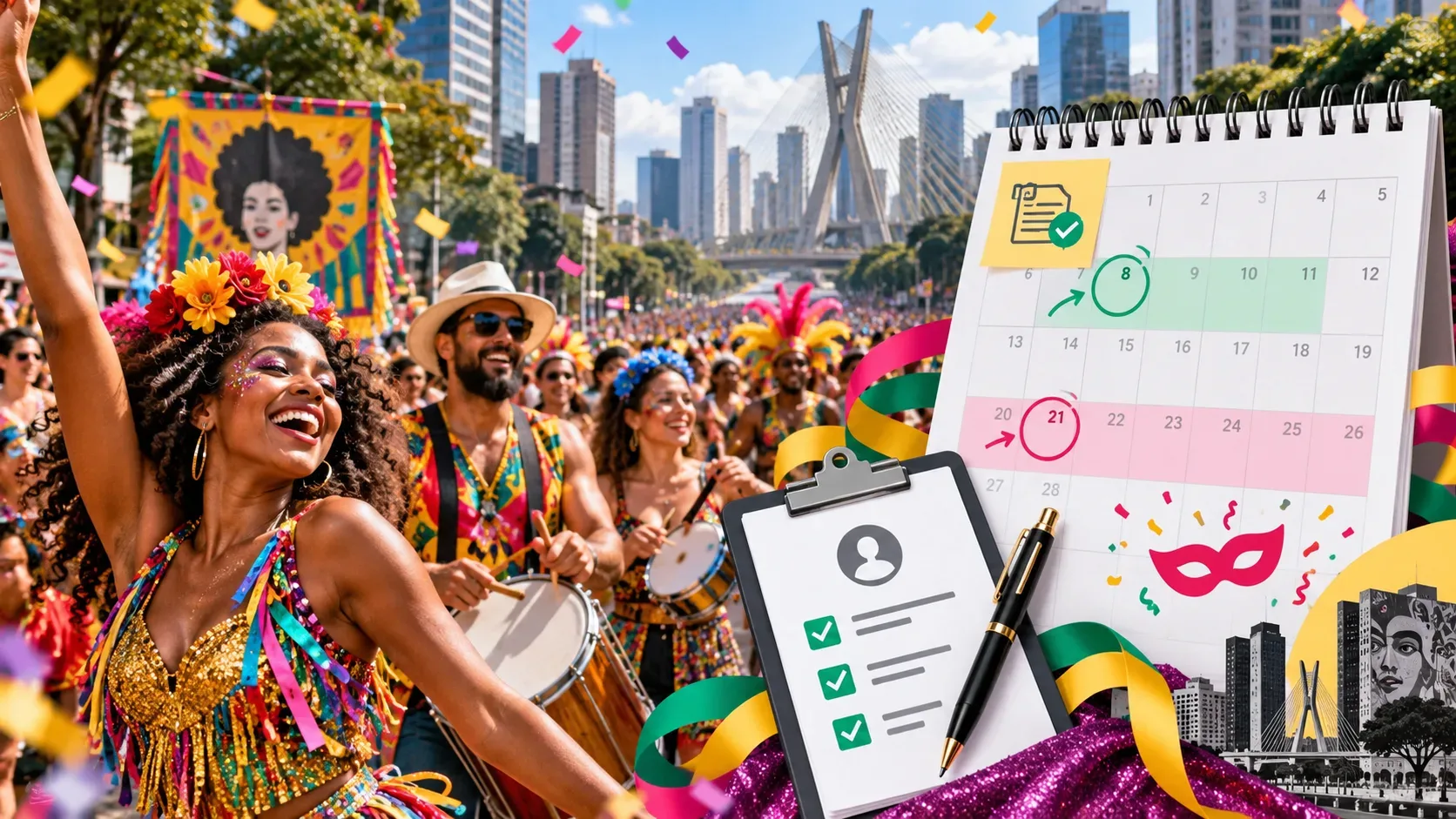
Direct answer: São Paulo's 2027 Street Carnival has two registration windows. From September 1 to 15, 2026, registration is for blocos, bands, cordões and similar groups that actually paraded in 2026. From September 16 to 30, 2026, registration opens to new blocos and other interested groups. For new blocos — and, under the guide's practical rule, for groups that have not yet completed three consecutive years of parading — the available dates are concentrated in the main Carnival period, from February 6 to 9, 2027. New registrations are not accepted for the Pre-Carnival or Post-Carnival periods.
The key point is not to confuse the registration deadline with approval of the parade. The requested date, route and time are reviewed by the Special Organizing Committee for the 2027 Street Carnival, which may request changes or decline to validate the proposal exactly as submitted.
Who registers by September 15 and who waits for September 16–30
| Bloco profile | Registration window | Dates that may be available | Practical note |
|---|---|---|---|
| Actually paraded in 2026 and has a record of 3 or more consecutive years | Sept. 1–15, 2026 | Jan. 30–31, Feb. 6–9 and Feb. 13–14, subject to eligibility and review | The registration link is sent to the email on file so the group can confirm or update its data, date and route. |
| Paraded in 2026 but is new or has not yet completed 3 consecutive years | Sept. 1–15, 2026 | Feb. 6–9, 2027 | The guide says groups without prior authorization for the Pre/Post periods will see only the main Carnival dates. |
| New bloco or other interested group not included in the first stage | Sept. 16–30, 2026 | New blocos: Feb. 6–9, 2027. Other cases depend on the group's history and Committee validation. | No new registrations are accepted for Pre-Carnival or Post-Carnival anywhere in the city. |
The three-year rule matters because the guide states that new blocos registered from 2026 onward may move their parade date to the Pre-Carnival or Post-Carnival periods only from their third consecutive year of parading. The Committee itself determines whether this requirement has been met.
Official dates for the 2027 São Paulo Street Carnival
- Pre-Carnival: January 30 and 31, 2027;
- Carnival: February 6, 7, 8 and 9, 2027;
- Post-Carnival: February 13 and 14, 2027.
For a new bloco, the practical reading is straightforward: registration takes place in the second stage, from September 16 to 30, and the normal choice is among February 6, 7, 8 or 9. Exceptions outside the official calendar or cases tied to a group's origin, history and tradition may be considered by the Committee, but they should not be treated as an automatic right.
One registration for each parade day
If a bloco plans to parade on more than one day, it must submit a separate registration for each requested date. After submission, the system sends a confirmation protocol to the registered email address. That protocol proves the form was submitted, but it does not mean the date and route have already been approved.
Checklist: what to prepare before opening the form
The official form is divided into stages. To avoid rework, prepare the following in advance:
- Bloco details: name, founding year, brief history, estimated attendance and profile;
- Performers and structure: artists, band, other performers, sponsors and sound-equipment information;
- Responsible persons: identification and contact details for the person responsible and, if applicable, a co-responsible person;
- Requested date: within the options enabled for the bloco's profile;
- Gathering and dispersal points: postal code, street number and address for each point;
- Route: an objective description of the streets used by the parade;
- Subprefecture: the municipal district corresponding to the route;
- Times: gathering, parade start, parade end and end of dispersal.
The guide recommends assessing the proposed location before registering. The Committee considers road conditions, physical restrictions, hospital or security areas, zoning, local commerce, estimated crowd size, sound reach, vehicle dimensions and route compatibility. Parades under bridges and viaducts are not allowed, and amplified sound is restricted in Strictly Residential Zones (ZER).
Timing: the bloco must fit within a maximum five-hour window
| Milestone | Guide limit |
|---|---|
| Total duration | Up to 5 hours: 1h gathering + 3h parade + 1h dispersal |
| Parade end and sound off | By 6:00 p.m. |
| Full crowd dispersal | By 7:00 p.m. |
| Full reopening of streets | By 8:00 p.m. |
These limits show why entering only a start time is not enough. The form requests the full sequence, and approval also considers traffic and public-transport impacts.
Blocos with more than 15,000 people have an additional requirement
When the estimate exceeds 15,000 people at the same time, the guide requires an Operations and Safety Plan. The specified documentation must be submitted to SPTuris by January 4, 2027, following Annex 2 and the directions of the relevant public authorities. This is an additional requirement on top of the normal parade registration.
The requested date and route may still change
The Committee may adjust the date, time or route if there is a conflict with another bloco with stronger historical precedence or cultural tradition, a mismatch between crowd size and location, zoning restrictions, safety concerns or other technical limitations. A bloco therefore should not announce a date as final merely because it was selectable in the form.
The list of blocos for the 2027 Street Carnival is expected to be published in the Official Gazette of the City of São Paulo in the second half of November 2026, after the two registration stages have been reviewed and validated.
Where to register and check the rules
- Official São Paulo Street Carnival 2027 portal;
- Registration form;
- Rules and Guidelines;
- Joint Ordinance SMC/SPTuris No. 007/2026.
Before submitting, check three points in particular: whether the bloco is in the correct registration stage, whether the requested date matches the group's history, and whether the route and times are realistic. These are the most important differences between a form that has merely been submitted and a proposal that has a realistic path to validation.