
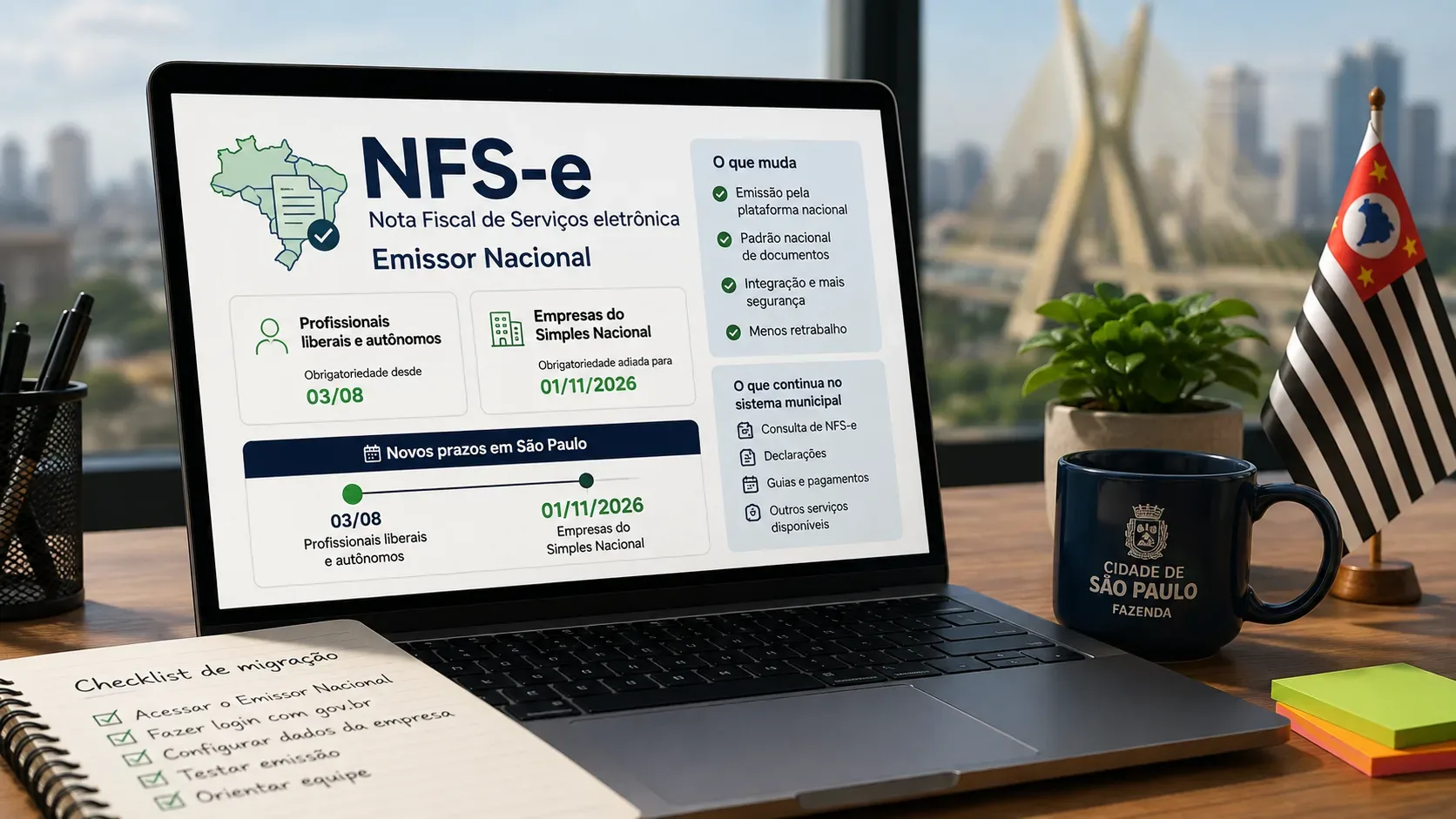
Companies in São Paulo under Brazil's Simples Nacional regime gained two extra months to migrate their NFS-e issuance: mandatory use of the National Issuer, previously scheduled for September 1, 2026, was postponed to November 1, 2026. The change was formalized by CGSN Resolution No. 191/2026 and announced both by the National NFS-e Portal and the São Paulo Municipal Finance Department.
This does not mean that every service provider in São Paulo can wait until November. The most recent and specific municipal Finance Department notice states that independent professionals and self-employed workers moved to the National Issuer on August 3, 2026. Service-providing MEIs have already been using the national-standard NFS-e since September 1, 2023.
Timeline: who changes when
| Profile | Mandatory date | Practical consequence |
|---|---|---|
| Service-providing MEI | September 1, 2023 | Already uses the national standard; the 2026 postponement does not create a new deadline for this group. |
| Independent professional or self-employed worker covered by the municipal rule | August 3, 2026, according to the specific notice published by the São Paulo Finance Department on August 13 | For new invoices covered by the requirement, the National Issuer becomes the issuing channel. |
| Microenterprise (ME) or small business (EPP) under Simples Nacional covered by CGSN Resolution No. 189/2026, as amended by No. 191/2026 | November 1, 2026 | Can use the period through October 31 to complete tests, registrations and issuance-system integration. |
What exactly was postponed
In April, the Simples Nacional Management Committee determined that microenterprises and small businesses under Simples would have to issue NFS-e through the national system starting September 1, 2026. In August, CGSN Resolution No. 191 postponed that start date to November 1, 2026.
The City of São Paulo incorporated the new date into its local guidance. In practical terms, companies covered by this deadline are not required to abandon current issuance through the municipal system until November. The extra period is an adaptation window — especially relevant for companies that issue invoices through an ERP or proprietary system.
Official sources: São Paulo Municipal Finance Department and the National NFS-e Portal.
Who is covered by the November 1 requirement
The São Paulo Finance Department guidance is not limited to companies whose Simples status is already fully settled. The requirement also covers companies that:
- have a pending Simples Nacional election;
- are involved in an administrative dispute that could result in retroactive inclusion in the regime, even if the future outcome is uncertain; or
- are subject to the impediment described in Article 12 of CGSN Resolution No. 189/2026.
Therefore, a company going through enrollment, re-enrollment or an administrative dispute should not assume it is outside the migration merely because its status is not yet shown as final.
What happens to São Paulo's municipal NFS-e system
From the mandatory date applicable to each profile, the City states that the municipal NFS-e systems will remain available only for consultations and retroactive issuance. The key point is that the municipal system does not disappear, but it stops being the normal channel for new invoices subject to the national requirement.
For Simples companies with a November 1 deadline, the practical result of the postponement is that this restriction starts only on that date. Consultation of prior documents and retroactive issuance remain available in the municipal environment as described by the City.
How NFS-e can be issued in the national environment
The National NFS-e Portal documents two relevant channels for MEs and EPPs: issuance through the Taxpayer Portal (Web Issuer) or issuance through ERP/proprietary software integrated by API. The best choice depends on the company's volume and operating model.
- Web Issuer: generally the most direct route for manual or low-volume issuance.
- ERP or proprietary system via API: requires the software provider or technical team to validate integration with the national platform.
The official issuance service and technical documentation are available at Issue an Electronic Service Invoice (NFS-e) — National Standard and the current NFS-e technical documentation.
Migration checklist for Simples companies before November 1
- Confirm the company's status. Check whether it is already under Simples, has a pending election or falls into another situation covered by the rule.
- Map the current issuing channel. Identify whether invoices are issued directly in the municipal portal, through accounting software, an ERP, proprietary integration or an intermediary.
- Choose the national channel. For manual issuance, test the Web Issuer. For ERP issuance, confirm with the provider that the API integration is production-ready.
- Test access and registration data. Do not wait until the first mandatory day to discover credential, representation or registration problems.
- Run validation issues when the environment and taxpayer status allow it. Compare the fields used today, service codes and the internal review flow.
- Review automations. Companies that automatically send NFS-e data, feed finance systems or reconcile invoices through integrations should review these flows in advance.
- Preserve access to the municipal system. It will remain relevant for consultations and retroactive issuance.
- Update internal procedures. Inform billing, accounting, tax and customer-service teams about the new channel and effective date.
This checklist is an operational recommendation based on the change in issuing channel and the existence of Web/API options; it does not replace company-specific tax validation.
What about independent professionals and self-employed workers?
For this group, the postponement granted to Simples companies should not be interpreted as permission to wait until November. The São Paulo Municipal Finance Department notice published on August 13, 2026 sets August 3, 2026 as the start of mandatory use for independent professionals and self-employed workers.
There is, however, an inconsistency across municipal pages: guidance published in July still mentions August 1, 2026 for certain ISS-exempt self-employed workers and independent professionals. Because the specific National Issuer page is later and states August 3, this article uses August 3, 2026 as the most recent operational reference while explicitly preserving the documentary discrepancy. For sensitive individual cases, confirmation with the municipal Finance Department is advisable.
Is the MEI included in this postponement?
Not as a new group migrating in November. Service-providing MEIs have already been required to use the national-standard NFS-e since September 1, 2023. The 2026 rule expands mandatory use of the national environment to other Simples businesses, especially MEs and EPPs.
The official MEI reference is MEI service providers nationwide are required to issue NFS-e.
Who can wait and who needs to act now
Can use September and October as a preparation period: a São Paulo business covered by the ME/EPP Simples requirement whose effective date is November 1, 2026. That does not mean postponing all preparation until late October; it means current issuance is not legally required to migrate before the new cutoff.
Should treat the migration as already effective: an independent professional or self-employed worker covered by the municipal August date, and a service-providing MEI, which has already been on the national standard since 2023.
The main change, therefore, is less about “a new invoice” and more about which system becomes the mandatory issuing channel. For those with a November deadline, the extra two months reduce immediate legal pressure but create a better opportunity to test the process before the municipal system is limited to the residual functions described by the City.