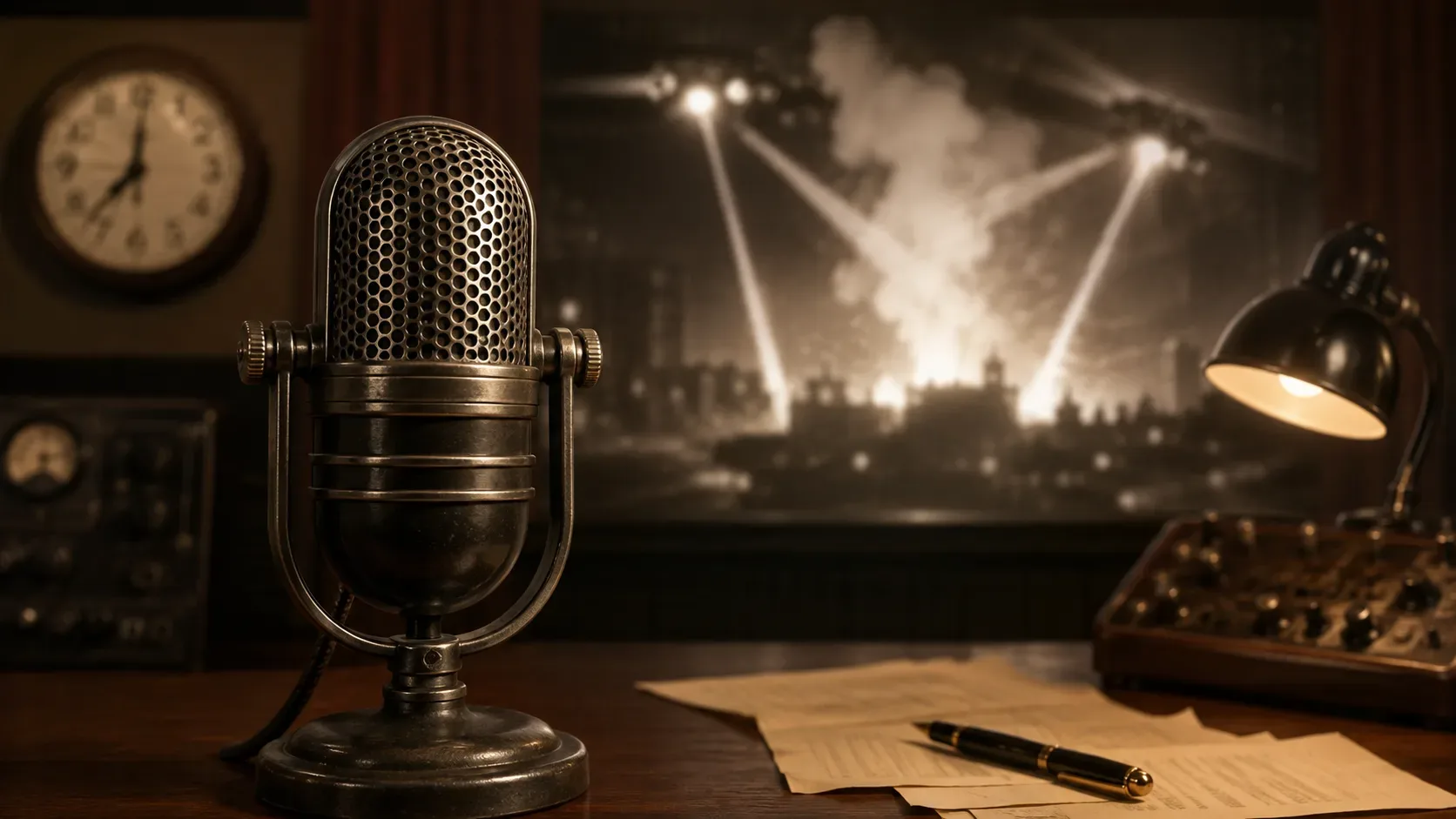
On the evening of October 30, 1938, CBS broadcast an adaptation of H. G. Wells's The War of the Worlds, presented by the Mercury Theater on the Air and directed and narrated by Orson Welles. The next day, newspapers in the United States described terrified people, streets taken over, escapes, prayers and desperate phone calls. The episode entered popular culture as the night millions of Americans believed in a Martian invasion.
The first part of this story is true: some listeners actually believed what they heard, and there were documented episodes of fear, confusion, and overloaded phone lines. The problem is in scale. Audience surveys, contemporary documents, and later reassessments do not well support the idea of a national panic involving millions of people. The episode appears to have been much more uneven and localized than the legend suggests.
What aired that night
The adaptation moved H. G. Wells' original story from England to the United States. After the initial identification of the program, the narrative for long stretches took on the appearance of a common radio broadcast: music from a supposed orchestra was interrupted by bulletins about phenomena on Mars and, later, by the news that an object had crashed into Grovers Mill, in New Jersey. The situation escalated to a fictitious Martian offensive.
This format matters because radio was already a medium used for urgent news. Furthermore, just a few weeks earlier, Americans had followed the European crisis surrounding the Munich Agreement on the radio, with programming interruptions for real bulletins. The National Archives records that this context later appeared in the testimonies of listeners who explained why, upon tuning in to the piece, they initially accepted its format as news.
CBS identified the presentation as a dramatization, including at the beginning, and there were other warnings throughout the broadcast. But anyone who changed stations after the beginning could lose their initial identification. The format of the first act compounded this: according to the historical reconstruction published by the Smithsonian, a late listener could wait almost 40 minutes for a new unequivocal interruption indicating that it was fiction.
Therefore, it is not difficult to understand how a portion of the audience could be confused. This, however, does not answer the main question: how many people were listening and how many actually panicked?
The available audience already weakens the idea of “millions in panic”
One of the problems with the popular version of the story is starting with the supposed number of people terrified without first asking how many were tuned in to the program.
The Mercury Theater faced NBC's popular Chase and Sanborn Hour in that time slot. A Library of Congress summary reports that a telephone survey of nearly 5,000 households that night found approximately 2% of respondents tuned in to The War of the Worlds; Among them, most knew it was fiction. The same institution notes that these numbers are difficult to reconcile with the image of an entire population following the supposed invasion.
Jefferson Pooley and Michael Socolow, researchers in the history of communication, reached a similar conclusion when revisiting audience research and coverage of the time. According to their analysis, available data indicates that about 98% of Americans surveyed were listening to something else or didn't even have the radio on at the time.
That doesn't mean we can get a perfectly accurate audience number today. The 1938 radio surveys had different methods and limitations than modern measurement systems, and some later estimates varied widely. It is precisely this divergence that requires caution with very precise numbers.
Where did the estimate of millions of frightened listeners come from
The work that most influenced the interpretation of the episode was The Invasion from Mars: A Study in the Psychology of Panic, published in 1940 by psychologist Hadley Cantril.
Cantril worked with research carried out after the broadcast and also with in-depth interviews. The National Archives reports that its team interviewed 135 people; about 100 of them were previously known to have been disturbed by the program. This design was suitable for studying how frightened people reacted, but it was not useful, in itself, for measuring what percentage of the country had panicked.
Subsequent reevaluations drew attention to exactly this limitation. Socolow notes that the interviewees were concentrated in New Jersey and did not constitute a representative sample of either the American population or all listeners to the broadcast. The study itself acknowledged sampling limitations.
Audience estimates were also unstable. A survey by the American Institute of Public Opinion, carried out about six weeks later and already under intense journalistic coverage, found 12% of respondents saying they had listened to the program. Cantril combined different data and arrived at an estimate of approximately six million listeners. The problem is that late research could be influenced by enormous publicity afterwards, including people confusing having heard about the episode with having heard the original broadcast.
The survey itself cited in this discussion indicated that about three-quarters of listeners understood that this was not real news. Even among those who believed there was real journalistic content, “being scared or disturbed” does not necessarily equate to running away from home, causing riots or participating in mass hysteria.
This is how different categories—hearing, believing, being frightened, and acting in panic—often ended up mixed together in popular memory.
There was real fear: the documents leave no doubt
Questioning the “mass panic” does not mean concluding that no one was scared.
The Federal Communications Commission files preserved by the National Archives contain hundreds of letters and telegrams sent after the broadcast. There are reports of people who believed the story, frightened family members and requests for the government to prevent similar programs.
One especially concrete document came from Trenton, New Jersey. In a letter sent to the FCC the next day, City Administrator Paul Morton reported approximately 2,000 phone calls in two hours, many from people seeking information about relatives, and said the situation had seriously disrupted the police department's communications.
In New York, newsrooms, police stations and broadcasters also received a large volume of inquiries. The National Archives records 875 calls to the New York Times hotline and numerous contacts with authorities and stations.
These records are strong evidence that there was a disturbance. But calling to confirm extraordinary news is not automatically synonymous with panic either. Some people called precisely because they were checking to see if what they had heard was true.
The documents also reveal something that usually disappears from the summarized versions of the episode: many people listened to the play without believing in an invasion. Of the 1,770 letters received by the flagship CBS station in New York, 1,086 were complimentary. According to the National Archives, 91% of letters addressed to Mercury Theater staff were favorable, and approximately 40% of messages sent to the FCC supported the program.
The archive, therefore, contains at the same time fear, indignation, calls for punishment, fun and defense of artistic freedom.
How newspapers turned scattered episodes into a national story
On October 31, the reaction to the program became front page news. The press described “hysteria”, families fleeing, people praying, traffic jams and crowds in the streets. Some of these reports were based on verifiable events. Others were repeated with little identification of the people involved or with difficult proof.
Pooley and Socolow highlight a revealing detail: Princeton researchers subsequently examined around 12,000 articles about the episode, but had enormous difficulty locating people identified by name in the panic reports. The abundance of published stories did not translate into an equivalent amount of verifiable testimonies.
At the same time, some newspapers did spot checks and found little or no unrest. The Long Island Daily Press, for example, called 50 people that night: four were listening to the broadcast and none were disturbed. Other newspapers published stories noting that their cities had barely responded. These records received much less subsequent attention than the spectacular stories.
There is a recurring hypothesis that printed newspapers had a commercial interest in presenting radio, their new competitor for audience and advertising, as an irresponsible medium. The Library of Congress records this interpretation as a theory of media analysts. It is plausible, but it should not be treated as a proven intention of the entire American press. What the documents allow us to say with confidence is that the sensational coverage contributed to consolidating the narrative of a national panic.
Cantril’s study helped transform the news into “historical fact”
The 1938 coverage could have aged as yet another episode of journalistic exaggeration. What gave the story extraordinary longevity was its incorporation into academic research and communication studies.
Cantril's book became a classic work on collective behavior and media influence. Decades later, Pooley and Socolow revisited the archives linked to the study and argued that its history had been simplified in the memory of the discipline itself. Instead of clean proof that a media outlet could manipulate passive masses, the research contained much more complex results about how different people interpreted the same message.
The irony is significant: the episode remembered as a definitive demonstration of radio's enormous power also provided evidence that the media's effects depended on listeners' context, beliefs, knowledge, and individual decisions.
As the decades passed, however, the simpler version won: Orson Welles made a convincing broadcast, millions believed and the United States panicked.
It's an excellent narrative. It's just not the one that best corresponds to all the evidence.
So The War of the Worlds caused mass panic?
The most defensible answer is no, if “mass panic” means a widespread national reaction, with millions of people fleeing or crowds overcome by hysteria.
There is solid evidence that some listeners were confused. There are documents showing intense fear in individual cases, telephone overload, and real problems for public services in certain locations, particularly in parts of New York and New Jersey. The Library of Congress itself describes the broadcast as causing considerable alarm among listeners.
What is missing is evidence commensurate with the gigantic version that became famous. Viewership surveys suggest that the broadcast reached a relatively small portion of Americans that night; the classic studies used to estimate the number of people scared had important limitations; and many of the more dramatic stories published immediately afterward were difficult to verify.
There is also no good basis for recurring stories of a nationwide wave of deaths, suicides, or medical care caused by the broadcast. Historical reviews have located far less verifiable extreme behavior than the 1938 headlines suggested.
The more precise formulation, therefore, is less cinematic: the broadcast deceived and frightened a part of the listeners, produced real episodes of confusion and immediately became a major journalistic event. The press, subsequent research and decades of repetition magnified these events into the legend of a national hysteria.
This does not diminish the importance of The War of the Worlds. On the contrary. The episode becomes more interesting when it stops being just a story about Americans who believed in Martians. He goes on to show how true reports, uncertain numbers, sensational coverage, and academic authority can combine to produce a version of the past far more resilient than the evidence that gave rise to it.