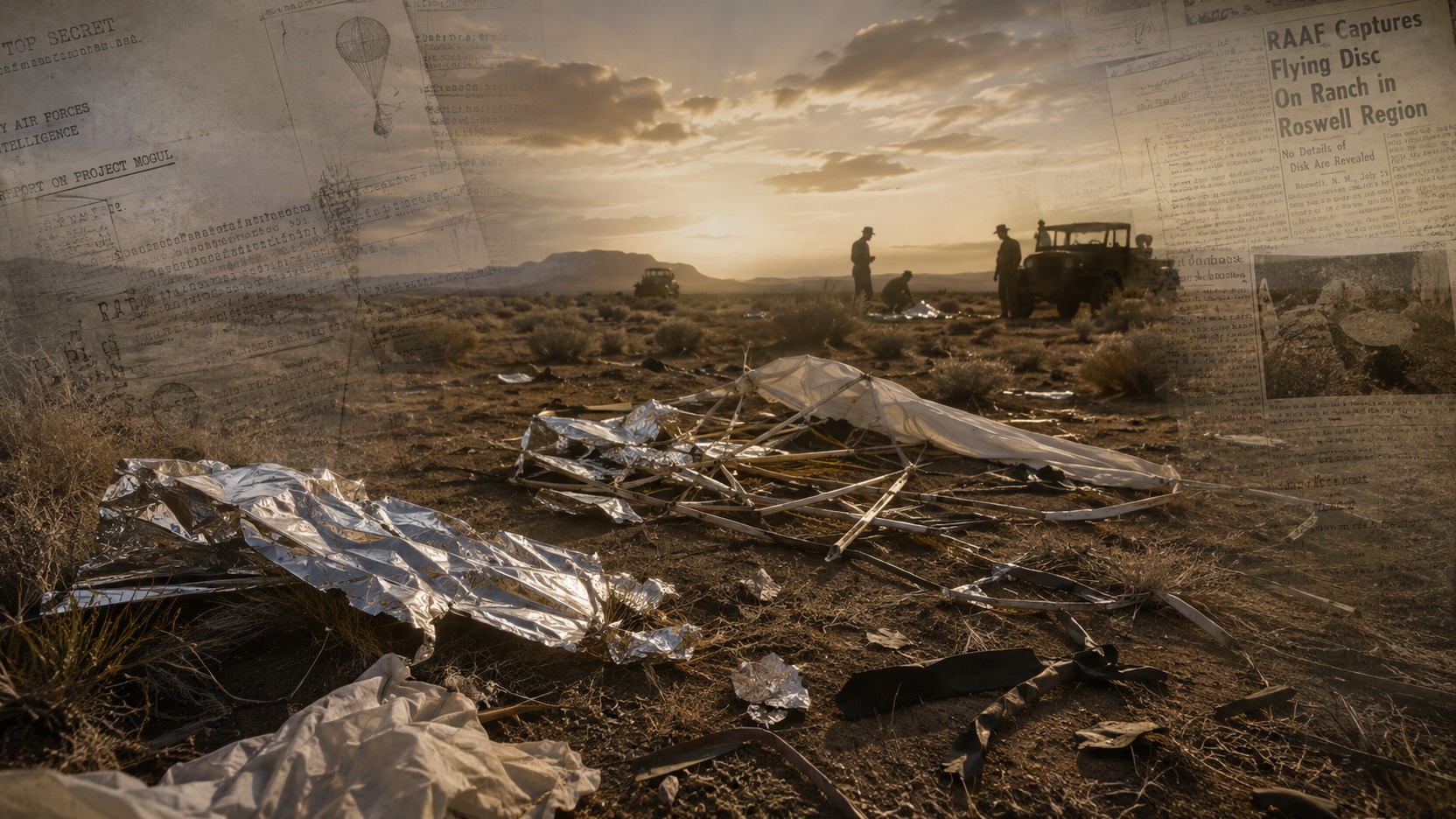
Roswell became synonymous with alien spaceships, recovered bodies and military cover-ups. But the official documentation tells a narrower and, at the same time, more interesting story: in July 1947 there was debris collected near Roswell, the base itself announced the recovery of a "flying disc" and, the next day, the Army began to describe the material as a radar tracking balloon. Almost half a century later, official investigations linked the wreckage to the then-secret Project Mogul. The body stories do not appear in contemporary localized records and were addressed in a separate report, published in 1997.
The safest conclusion is not that every detail of Roswell is resolved by a single document. The surviving records from 1947 point to a balloon device with a radar reflector, while the hypothesis of an extraterrestrial ship with occupants depends on reports and interpretations that took shape mainly decades later.
1947: what happened before the complete legend existed
On July 8, 1947, the public information office at Roswell Army Air Field, the Roswell military base, announced that personnel from the 509th Bomb Group had recovered a "flying disc" on a ranch in the area. The expression is important because it was not invented later by book authors: it appears in the chronology documented by the government itself and was reproduced by the press of the time.
The following day, however, the public version changed. According to the Government Accountability Office report, Eighth Air Force command informed the press that the recovered object was a radar tracking balloon, described in that context as a weather balloon, and not a "flying saucer."
This rapid change helped create the lasting core of the mystery. On one side, there is an extraordinary military announcement. On the other, an almost immediate correction for a much more common object. What later documents add is that the second explanation was also incomplete: the material may have looked like a weather balloon, but it was linked to a secret military program that would not be explained to the public in 1947.
The FBI teletype helps understand what the military was saying that day
One of the few records from 1947 found directly in the GAO search is an FBI teletype dated July 8. The document records that an Eighth Air Force officer informed the FBI office in Dallas about an object recovered near Roswell. The description speaks in a way
hexagonal suspended by cable to a large balloon and claims that the whole resembled a high-altitude balloon with a radar reflector.
The teletype also records that the material would be sent to Wright Field for examination. The GAO subsequently searched the Air Materiel Command archives at Wright Field for records on the analysis of the wreckage and found no documentation that mentioned the Roswell case or an inspection of that material.
This document is valuable because it is contemporary with the facts. It does not alone prove what the equipment's mission was, but it shows that, on the very day of the "flying disc" announcement, a description compatible with a balloon and radar reflector was circulating within the government. In this record, there is no reference to spacecraft, extraterrestrial technology or bodies.
Project Mogul: why the explanation changed decades later
In the 1990s, the United States Air Force reviewed files and interviews in response to an investigation requested by Congress. The resulting report identified Project Mogul as the most likely explanation for the wreckage.
Mogul was a highly secretive effort at the beginning of the Cold War. Its purpose was to use high-altitude balloons equipped with acoustic sensors and radar-reflecting targets to obtain information about Soviet nuclear research and testing. The secret was in the mission and surveillance capability, not necessarily in each physical component used in the balloon trains.
The Air Force reconstruction pointed in particular to a balloon train launched on June 4, 1947, known as Flight 4. Project records indicated that it had not been recovered by the team responsible. The report considered it very likely that this set had ended up in the area where the wreckage was found.
This point deserves precision. Among the public records cited by the investigation, there is no label recovered at the ranch saying "Mogul Flight 4." The identification is a reconstruction based on the chronology of the launches, the fact that a flight was not recovered, the probable direction and, above all, the compatibility of the described materials with balloons, radar reflectors and equipment associated with the project. Therefore, the link to Flight 4 is a documentary and technical conclusion of the investigation, not a direct physical identification preserved since 1947.
Why calling it a "weather balloon" didn't end the story
The public explanation of July 1947 spoke of a meteorological balloon and a radar target. Decades later, the Air Force said the debris came from a classified balloon project. The two versions are not identical, and this difference is one of the reasons why Roswell has remained fertile for suspicion.
The central point is that revealing Mogul in 1947 would mean exposing an intelligence program aimed at detecting Soviet nuclear activity. Thus, the public description of a weather balloon did not explain the true purpose of the set. This provides a historical reason for secrecy without requiring the existence of an extraterrestrial craft.
It also explains why a person familiar with ordinary weather balloons might find the wreckage strange. Mogul sets could include multiple balloons, radar reflectors, and other equipment in a larger configuration than a simple weather balloon. The unusual appearance of the materials and the secret of the mission could coexist.
What GAO Really Found in 1995
The GAO investigation is especially useful because it did not simply accept the Air Force's conclusion. The team searched records from different federal agencies and archives, including the Department of Defense, FBI, CIA and National Security Council.
The GAO reported having located two government records from 1947 directly related to the episode. One was the combined monthly history of the 509th Bomb Group and Roswell Army Air Field. That record said the public information office was busy answering questions about the
"flying disc" and added that the object ended up being identified by the military as a radar tracking balloon. The other was the July 8 FBI teletype, with a description of the balloon and reflector.
The search did not find a plane crash report corresponding to a crashed spacecraft in Roswell. The GAO noted, however, that there was no equivalent requirement to produce a formal report for a weather balloon crash. He also examined military accidents recorded in New Mexico in July 1947 and did not find a plane crash that corresponded to the Roswell episode.
The audit also recorded that searches at the CIA did not produce documents about the crash and that responses from other agencies did not reveal new records of the case. The National Archives, in summarizing this research, states that no document located indicated or even suggested the recovery of alien bodies or extraterrestrial materials.
There are real gaps in the files, and they should not be hidden
Roswell's government documentation is not perfect. GAO itself found that some Roswell Army Air Field administrative records covering March 1945 through December 1949 and base departure messages from October 1946 through December 1949 had been destroyed.
The disposal form consulted by GAO did not say who destroyed these records, when it occurred, or under what specific authority. The archivist consulted explained that flaws of this type in the disposal authority's annotation also appeared in other sets of documents from the time.
This gap prevents an exaggerated claim such as "all Roswell papers have survived and been examined." They didn't survive. But the existence of destroyed files is also not positive evidence that they contained information about extraterrestrials. What can be said is more limited: there are missing records, and the records actually located do not support the narrative of an alien ship with recovered occupants.
What about the supposed Roswell bodies?
Here it is essential to separate chronologies. The two 1947 records found by GAO deal with a "flying disc", balloon and radar reflector. They don't register bodies. The detailed allegations of small corpses, autopsies, body bags, and secret transportation became a central part of the Roswell narrative much later, primarily through testimony and stories gathered decades later.
To respond to this second layer, the Air Force published in 1997 The Roswell Report: Case Closed. The report did not state that anthropomorphic dolls were on the ranch in 1947. This would be chronologically impossible for the tests cited. The thesis of the document is different: later memories would have combined events from different years and moved these episodes to July 1947.
According to the 1997 report, some descriptions of "bodies" in the desert would be compatible with anthropomorphic dummies released by high-altitude balloons in tests carried out in the 1950s. Other stories associated with the Roswell hospital would have been mixed with two later accidents: the crash of a KC-97 in 1956, which killed 11 soldiers, and a manned balloon accident in 1959, in which two pilots were injured. injured.
This distinction is important because a common simplification just says that "the aliens were test dummies". The official report does not use the dummies to explain the 1947 wreckage. It uses them to try to explain why testimony recorded many years later contained scenes of bodies, recovery teams, and balloon operations that do not appear in contemporary documents of the original incident.
What the National Archives says about Roswell today
The National Archives maintains records from the old Project Blue Book and has received inquiries about UFOs and Roswell for decades. On its reference page, the institution makes it clear that it found no documentation about the 1947 incident within the Project Blue Book archives. This makes sense
chronologically: the case precedes the later structure of the UFO investigation program.
In summarizing the search conducted in the 1990s, the National Archives records that the Air Force search found no information indicating that Roswell was an extraterrestrial event and that the materials recovered were consistent with a balloon device of a then-classified design. The same summary states that the records located did not indicate recovery of alien bodies or extraterrestrial materials.
This does not make the National Archives the metaphysical arbiter of the existence of life beyond Earth. The statement is documentary: in the collections and searches described, no official evidence of a spacecraft or extraterrestrial occupants in Roswell appeared.
So the "flying saucer" statement was fake?
The statement existed and is part of history. What does not follow from it is that the military had identified a ship of extraterrestrial origin. In 1947, "flying disc" was a recent and popular expression for unusual aerial objects, and military documentation from the period itself shows that the classification was reversed almost immediately.
The episode reveals, at the very least, an extraordinary failure of public communication. A military base released an expression that suggested something sensational, and a few hours later, command offered a different explanation. As the equipment was linked to a secret project, the public did not receive at that time the complete explanation that would emerge decades later.
This combination of hasty communiqué, legitimate Cold War secrecy, incomplete documentation, and memory reconstructed over decades is enough to explain why Roswell has become such a resilient legend, even without a contemporary document recording aliens.
What files allow you to complete, and what they don't
The documents allow us to confidently state that material was recovered near Roswell in 1947, that the base announced a "flying disc", that the public version quickly changed to a balloon with a radar reflector, and that subsequent investigations identified Project Mogul as the most likely origin of the debris.
They also allow us to assert that the government search in the 1990s found no contemporary records of alien bodies or extraterrestrial materials. The body stories form a back layer of the narrative, and the Air Force tried to explain them as a mixture of memories of tests and accidents that occurred years later.
What archives do not allow is to transform the absence of documentation into logical proof that no secret ever existed. There are destroyed records and normal limitations of any historical investigation. Still, when comparing the quality of the evidence, the balloon hypothesis of a classified program is supported by contemporary documents, technical records, and a known mission. The hypothesis of an extraterrestrial ship with recovered bodies has no documentary equivalent from 1947 in the official archives located.
Roswell, then, is less a case of documents revealing a hidden ship and more an example of how a real event, a confusing military communication and a secret program can, over decades, accumulate new layers until they become a story much bigger than the original records can support.