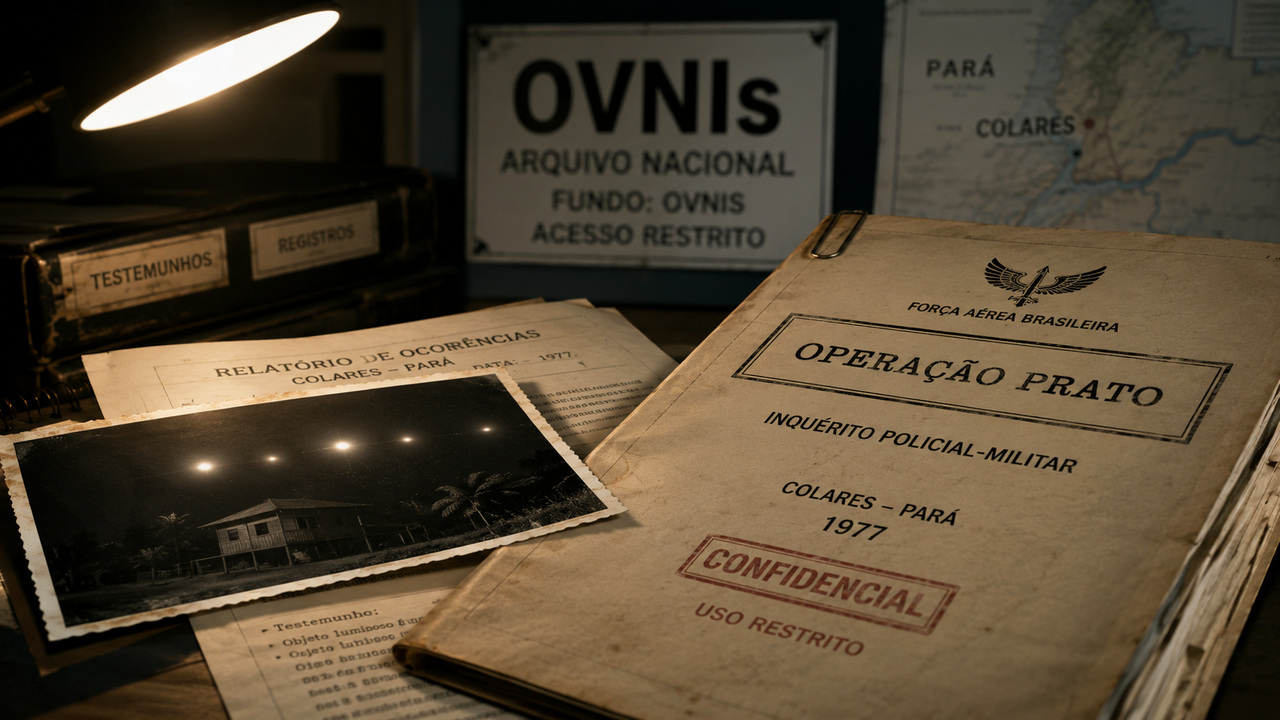
Operação Prato is not merely a story preserved by ufology. Documents that are now public show that the 1st Regional Air Command of the Brazilian Air Force organized, in 1977, a confidential investigation into reports of lights and unidentified objects in Pará. The most important point, however, lies in the limit of that finding: an official document proves that the investigation and the record existed, but it does not automatically turn everything a witness stated into a proven fact, nor does it resolve the origin of the phenomenon. The cover of this article is an illustrative editorial composition; the analysis below is based on real records preserved in public collections.
What can be stated with confidence about Operação Prato
A publication by the Instituto Histórico-Cultural da Aeronáutica records that Major-Brigadier Protásio Lopes de Oliveira, then commander of the 1st Regional Air Command, created in September 1977 a confidential project called Operação Prato and appointed then-Captain Uyrangê Hollanda to command it. The preserved documentation shows that the inquiry reached Colares and other locations in Pará, such as Santo Antônio do Tauá, Vigia, Baía do Sol and Mosqueiro.
Brazil's Arquivo Nacional maintains a collection of documents on unidentified flying objects received from the Aeronautics Command. That collection brings together different types of documents: reports, questionnaires, correspondence, photographs, drawings, videos, audio recordings, as well as newspaper and magazine clippings. This diversity requires caution. A military report produced during the operation, a photograph attached to a form and a press clipping kept in the same collection do not carry the same evidentiary weight merely because they are now in the custody of the same institution.
The observation records examined carry identification from the Ministry of Aeronautics and the 1st Regional Air Command, as well as confidentiality markings. They organize each
occurrence into relatively standardized fields, with location, date, time, description, color, shape, apparent size, movement, speed, altitude, distance, observers, notes and references to sketches. It is a documentation system, not a conclusion about the nature of the objects.
What the military forms actually record
On September 2, 1977, a form concerning Santo Antônio do Tauá recorded the report of a luminous body described as an "inverted saucer," with changes in color, zigzag movement and increasing speed. The form itself identifies altitude and distance as estimates. The document shows that the military team collected and formalized that description; alongside those numbers, it does not provide an independent instrumental measurement that would allow them to be treated as exact physical values.
On October 12, another record, also in Santo Antônio do Tauá, noted that a resident said he had tried to shoot at an object and had been struck by a beam of red light, followed by paralysis and a period confined to bed. On October 16, a form from Paraíso do Ubintuba recorded the allegation that a beam of bluish light struck a man's lower back, accompanied by "physical effects." These papers are important because they preserve what was reported to the investigation. At the same time, the wording of a form is not equivalent to experimentally demonstrating that an object caused the symptoms.
There are also occurrences attributed to members of the mission itself, which distinguishes part of the collection from a simple compilation of rumors. On October 22, a form from Santo Antônio de Ubintuba lists the "A2/I COMAR Team" as the observer of a luminous body described as moving at great speed and without perceptible noise or air displacement. That same night, a Baía do Sol record includes Captain Hollanda and two civilians among the observers of an intensely bright blue light. On November 1, in Colares, another form attributes to the A2/I COMAR team the observation of a luminous body of strong intensity and variable trajectory.
These records support a stronger statement than "the Brazilian Air Force heard stories": military personnel involved in the investigation also stated that they had observed luminous phenomena that they could not identify at the time. Even so, "unidentified" describes a situation of insufficient information. It is not synonymous with an extraterrestrial spacecraft.
Where the "chupa-chupa" fits in
"Chupa-chupa" was the popular name associated, in Pará, with reports of lights that supposedly struck people and were followed by weakness, pain, heat, burns, paralysis or other changes. In the military observation records examined, the most frequent technical language is "luminous body," "UFO," "beam of light" and "physical effects." The popular vocabulary appears linked to how residents interpreted what they said they had experienced, not as an official diagnosis by the Aeronautics authorities.
That difference is decisive. When a form records that someone said they had been struck by a beam of light, the documentary fact is that the statement was written down. Moving from the statement to a causal conclusion would require demonstrating that a particular physical agent produced the injury, ruling out alternative explanations and establishing a chain of evidence consistent with that conclusion.
The name "chupa-chupa" itself can literally suggest suction or the removal of blood. The observation forms examined do not allow that popular association to be turned into a proven mechanism. They preserve reports of symptoms, marks and lights. That is historically relevant, but it is different from proving that an object removed blood from residents.
Official record, testimony, interpretation and conclusion are different levels
Official record
A document produced by the 1st COMAR proves that the occurrence entered the Aeronautics administrative and investigative process. It helps confirm dates, locations, people or teams cited and the way the institution classified and described the episode. It also proves that the phenomenon was considered worthy of observation and recording by a military unit.
Testimony
When a document identifies a resident as an observer and summarizes what that person stated, there is an official source for the testimony, but not automatic confirmation of the testimony's content. The same principle applies to symptoms. The archive can prove that someone reported paralysis, heat or an injury without thereby proving the alleged cause.
Interpretation
Words such as "metallic," "supersonic" or expressions about apparently directed behavior must be read within the method used. In several forms, distance and altitude are explicitly estimated, and the forms do not present, alongside the values, a chain of measurements by radar, telemetry or material analysis. A speed inferred visually carries different weight from a speed measured by a calibrated instrument.
When presenting Arquivo Nacional documents in 2017, Imprensa Nacional itself made an important caveat: neither the Brazilian Air Force nor the other institutions involved state in those documents that the UFOs are of extraterrestrial origin or intelligent beings, although some reports use an expression similar to "intelligent behavior." That wording provides a useful editorial boundary between description and conclusion.
Extraterrestrial origin
No logical leap is more important to avoid. The collection confirms the existence of unexplained occurrences in the available records, but it does not offer an official conclusion of extraterrestrial origin. Photographing an unidentified light, recording a maneuver considered unusual or noting a reported physical reaction does not, by itself, determine who or what produced the phenomenon.
What about the photographs and footage said to have disappeared?
The discussion about material supposedly missing from the collection acquired its own documentary layer. In a proceeding analyzed by the Comissão Mista de Reavaliação de Informações, an applicant argued that later statements attributed to Uyrangê Hollanda indicated the production of hundreds of photographs, films, recordings and reports that were not fully available at Arquivo Nacional.
What can be safely documented is the administrative response given decades later. According to the CMRI decision, the Aeronautics Command stated that it had transferred to Arquivo Nacional the documents from the period 1964 to 1985 and, in response to additional requests for clarification, said it had made available all documents on UFOs from 1952 to 2022 that it held, including everything it possessed about the so-called Operação Prato. The additional specific information requested by the applicant was declared nonexistent in the agency's files.
The CMRI did not conclude that photographs or films had been destroyed, hidden or diverted. Nor did it state that every later report about additional material was false. What the decision records is more limited: the agency reiterated that the requested information did not exist in its files, and the commission said it had found no evidence in the case record that would allow it to verify the existence of the specific information requested.
For that reason, the frequently cited figure of "more than 500 photographs" should be treated as an allegation linked to later testimony and access-to-information requests, not as an inventory that the current public collection allows to be fully verified. The gap between a report about what may have existed and what is located today cannot, by itself, be used as proof of concealment.
What the collection establishes - and what remains open
The documentary set supports the statement that there was a real and confidential military operation in 1977; that the Brazilian Air Force gathered testimony, sketches and observation records; that residents reported lights associated with physical effects; and that members of the military team itself recorded observations of luminous phenomena they could not identify.
The same set does not, by itself, demonstrate that the objects were spacecraft, that there were non-human occupants, that the reports of physical effects had a single cause or that the "chupa-chupa" literally removed blood from people. Nor does it turn every item kept in the Arquivo Nacional collection into an official conclusion, because the collection includes materials of different kinds and origins.
This distinction does not diminish the importance of the case. On the contrary, it makes Operação Prato historically more interesting. Its documentary value lies in the fact that a military institution devoted personnel, time and recording procedures to a wave of occurrences that mobilized communities in Pará. The mystery remains precisely because documenting an observation is not the same as identifying its cause.
How to read Operação Prato without turning gaps into proof
A documentary reading begins with provenance. One must ask who produced each item, on what date, for what purpose and whether it is contemporary with the events or a later recollection. Then comes the type of evidence: a direct observation by the team, a resident's account, a sketch, a photograph, a newspaper clipping or a later comment are not equivalent.
Measurements must also be separated from estimates. The military forms are detailed, but much of the data depends on visual perception and appears as estimated. That may be sufficient to record an occurrence and guide an investigation, but not to reconstruct distance, size or speed with scientific precision decades later.
Finally, the absence of an explanation should not be converted into a preferred explanation. If a record does not identify the object, the correct documentary answer is that it remained unidentified in that context. Any additional hypothesis requires evidence of its own.
What does Operação Prato prove, after all?
The most defensible formulation is simple: the Brazilian Air Force investigated, recorded and treated as confidential a series of reports and observations of luminous phenomena in Pará in 1977. Some records came from residents; others include members of the military team itself as observers. There are notes about beams of light, shapes, colors, trajectories and allegations of physical effects.
That is much more than saying that "nothing happened." But it is also much less than claiming that the Brazilian Air Force proved extraterrestrial visits. The documents support the existence of the investigation, the records and the uncertainty. The next step - identifying the origin of the phenomena - still lacks a conclusive documentary demonstration in the public material examined.