The Varginha ET case is usually told as a dispute between two closed answers: either there was capture of an extraterrestrial creature with military participation, or everything was definitively denied. The records of the Military Police Inquiry no. 18/1997 do not authorize such a simple reading. They are able to answer some questions, especially about the activities of the School of Sergeants at Arms, the movement of vehicles and the existence of a documented military operation. They are much more limited to definitively resolve what three witnesses saw on a piece of land in Varginha or to judge allegations that arose after 1997.
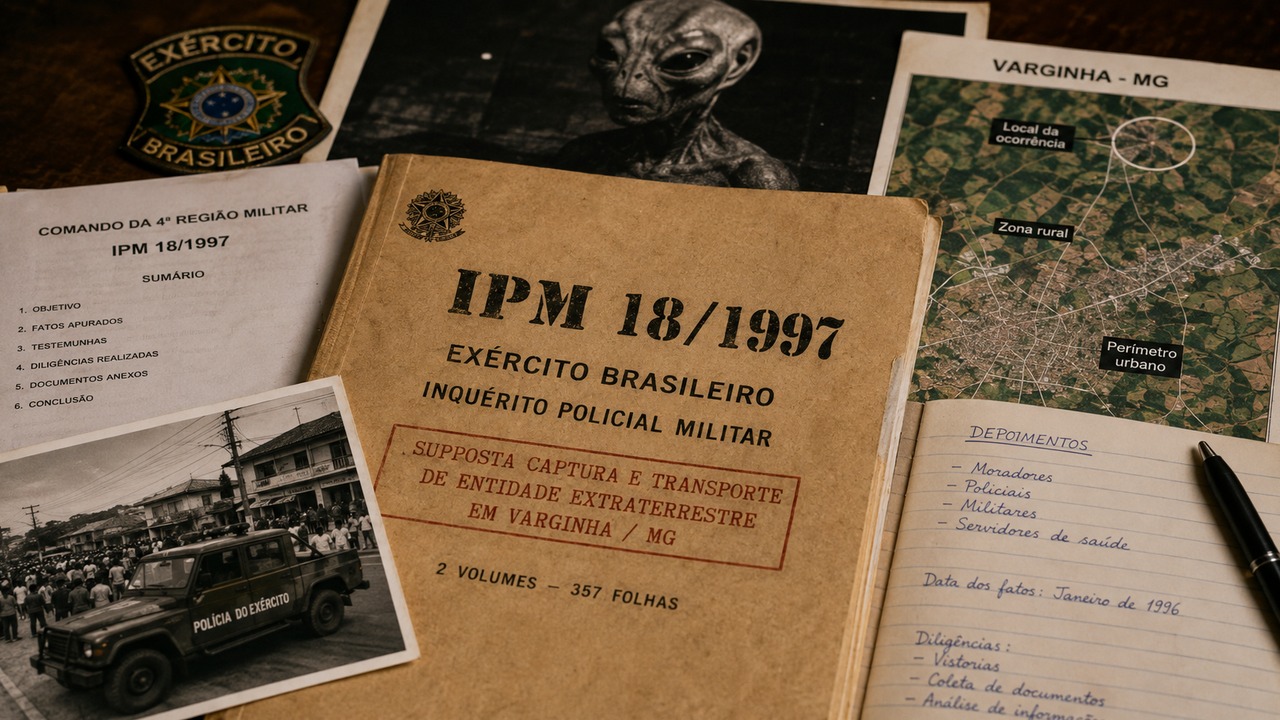
The central primary source of this reading is IPM 18/1997 itself, currently available in the Archimedes collection of the Superior Military Court. The set is cataloged by the STM with 357 sheets in two volumes. The cover image of this article is an illustrative editorial composition; The documents cited below are the official records scanned by the court.
What IPM 18/1997 was opened to investigate
The report from the person in charge of the IPM, on page 330 to 338, start by defining the objective. Ordinance no. 009-AjG.2, of January 29, 1997, determined the investigation of the facts narrated in an internal part of the School of Sergeants of Arms related to the content of the book Incidente em Varginha, published in 1996 by Vitório Pacaccini and Maxs Portes.
This point changes the way you read the document. The IPM was not born as an independent scientific investigation to answer whether extraterrestrial life exists or to reconstruct, from scratch, everything that would have happened in Varginha. It was a military judicial police procedure focused on facts that affected the military and the institution, including the allegation that members of the Fire Department, the Military Police and the School of Sergeants at Arms had participated in the capture and transport of an alleged creature.
The subsequent judicial stage makes this situation even clearer. In the archiving decision, the Audit of the 4th Military Judicial Circuit described the procedure as intended to determine possible criminal offenses in the statements contained in the book. This does not prevent the report from analyzing the sighting, the vehicles and the capture hypothesis. But it prevents treating the IPM as if it were a scientific committee created to test all possible hypotheses about the case.
Documentary timeline of the inquiry
The narrative examined by the IPM was based on an alleged sighting that occurred on January 20, 1996 and allegations of capture and transport associated with military personnel. Still in 1996, before the IPM, EsSA had carried out an internal investigation into news involving members of the School. The 1997 report records that the records of this investigation were added to the investigation and that it had not found any involvement of EsSA military personnel in the episode.
On January 29, 1997, the ordinance establishing the IPM was issued. In March and early April, the person in charge interviewed EsSA military personnel, a Military Police officer, a Fire Department officer, a civilian linked to the School and ufologists Ubirajara Franco Rodrigues and Vitório Pacaccini. The list of deponents appears in the report, especially on page 332.
On April 11, 1997, Lieutenant Colonel Lúcio Carlos Finholdt Pereira signed the report. On April 18, the commander of the School of Sergeants at Arms issued a solution to the investigation, stating that the facts discovered did not constitute a crime and ordering the case to be sent to the Military Court. The document also determined the internal disclosure of the report, photographs and a photographic simulation study attached to pages. 322 to 328.
On June 18, the Military Public Ministry requested the archiving. On July 4, 1997, judge-auditor Telma Queiroz ordered the records to be archived. The STM's archival description informs that the process ended up registered as Autos Findos n. 908/1997.
What was actually gathered as evidence
The IPM gathered more than just opinions on the case. There were formal statements, internal documents, the previous investigation, information on travel and vehicle maintenance, photographs and a photographic simulation. The report also incorporated a copy of the book that gave rise to the procedure and compared excerpts from the work with the statements collected.
At the same time, there is an important limitation. The list of people interviewed in the report does not include the three best-known witnesses to the sighting in Jardim Andere. The IPM also records that ufologists did not reveal the identity of some people who would have provided information to them. This means that part of the narrative was evaluated without direct access to all of the original sources claimed by the book itself.
This difference is decisive in measuring the strength of the conclusions. When the IPM compares a vehicle movement with documentation and statements from those who managed the unit, the basis is relatively straightforward. When you try to explain what a visual witness would have seen without hearing it again at the inquest itself, the conclusion is necessarily less strong.
Documentary matrix: sighting of the creature
Claim
Three witnesses reportedly saw a creature of unusual appearance, crouched next to a wall in a plot of land in Jardim Andere, in Varginha, on January 20, 1996.
What IPM verified
The report records the episode as the point of origin of the book's narrative. It also states that the commander of the 24th Military Police Battalion presented photographs of a resident known as "Mudinho" to the person in charge and that a simulation photographic study was produced. The report considered it more likely that this resident, dirty from heavy rain and crouched next to a wall, had been mistaken for the supposed creature.
Documentary result
The resident's hypothesis is an official explanation proposed by the person in charge, not an expert identification demonstrated conclusively. The IPM text itself uses probability language when qualifying it as the most likely hypothesis.
Degree of evidence
Moderate for the existence of a plausible alternative explanation within the case file. Low to moderate to affirm that the figure seen was definitely that resident, because the three witnesses to the sighting do not appear on the list of people interviewed by the IPM and there was no documented independent identification procedure that eliminates other possibilities.
Documentary matrix: firefighters would have captured a creature
Claim
Firefighters would have participated in capturing the alleged creature and removing it from the scene.
What IPM verified
According to the report, the local commander reported that intense rain and strong wind resulted in several firefighter calls in that region. The document states that no request to seize an animal or strange creature had been registered that day.
Documentary result
The records offer an ordinary explanation for the presence of firefighters in the region and do not record an official operation to capture the creature. This weakens the specific claim that the Fire Department participated in such an institutional mission.
Degree of evidence
Moderate to strong against the existence of an official recorded capture operation. This degree is not equivalent to proving an absolute negative. Institutional records and statements can show what has been documented and explain known displacements; they do not logically demonstrate that no unrecorded action could have occurred.
Documentary matrix: Army vehicles would have transported something from Varginha
Claim
Trucks or other military vehicles seen in Varginha would have been used to transport the creature, including towards the Campinas region.
What IPM verified
The report acknowledges that there were real facts behind some of this narrative. Army trucks were close to a dealership where periodic maintenance was carried out. EsSA vehicles were also moved to Jaguariúna, in São Paulo, to collect fodder for the School's horses. The person in charge cites documents and statements in the file to associate these movements with routine purposes.
Documentary result
The presence of vehicles was not denied. What the IPM contested was the interpretation that these movements were related to the capture and transport of a creature. This is one of the points in which the document is most useful: it separates an observable fact, military movement, from the extraordinary explanation attributed to it.
Degree of evidence
Strong to demonstrate that at least part of the movements mentioned had documented routine military purposes. Moderate to strong against the claim that these same movements prove transportation of a creature. The IPM does not provide a basis for transforming any unidentified vehicle into proof of a secret operation, but it also cannot prove the non-existence of any movement that has never been registered or located.
Documentary matrix: EsSA soldiers participated in the capture and transport
Claim
Soldiers from the School of Sergeants at Arms would have directly participated in the capture, guarding or transportation of the supposed creature and the institutions would have covered up this participation.
What IPM verified
The person in charge listened to the aforementioned military personnel responsible for areas of the School, gathered the previous investigation and asked for internal information about possible contact between EsSA members and the authors of the book. The report states that it did not obtain effective proof that the School's military personnel had carried out capture or transportation. It also records that the authors did not identify some of the sources that would support the accusations.
Documentary result
In the material that reached the IPM, there appears no verifiable evidence of an order, mission, cargo, team, entry record, exit record or chain of custody compatible with an EsSA operation to transport an extraterrestrial creature.
Degree of evidence
Strong for the more restricted statement that the records do not document an institutional operation of EsSA of this nature. Moderate against the broader allegation of clandestine participation by individuals, because the lack of documentation weighs against the hypothesis, but is not mathematically equivalent to proving that no individual acted off the record.
Documentary matrix: there were anonymous military sources confirming the case
Claim
Information provided by military or former military personnel under anonymity would have revealed details about capture, transportation and cover-up.
What IPM verified
The report says that ufologists have refused to identify some sources, invoking informant protection. The person in charge also considered the possibility that someone described as an EsSA soldier could, in reality, be a former soldier or former corporal who had already been discharged, because he was unable to prove the functional identity of the sources attributed to the School.
Documentary result
IPM was unable to test the origin, functional position, access to facts or credibility of these anonymous sources. This does not demonstrate that they were false. It demonstrates that, for evidentiary purposes, the statements were left without a chain of independent verification within the investigation.
Degree of evidence
Down with any claim that relies solely on these unidentified sources. An anonymous source may be true, but without identity, contemporaneous documentation, or independent confirmation, its probative force remains limited.
Documentary matrix: the previous investigation would have been a cover-up
Claim
The internal investigation carried out before the IPM could have been used to protect EsSA or produce a convenient institutional version.
What IPM verified
The investigation from the first half of 1996 was added to the case file. The report states that it found no indication that the document had been forged and records that, in Vitório Pacaccini's testimony, there was no clear intention to use the word "farce" to qualify it.
Documentary result
The records treat the investigation as an authentic institutional document and use it as one of the sources to conclude that there was no participation by EsSA military personnel. This supports the existence and official content of the previous investigation.
Degree of evidence
Strong for the documentary authenticity of the inquiry as incorporated into the IPM. Low to turn this authenticity alone into proof that no cover-up could have occurred. An investigation can be authentic and still be criticized for its scope, methodology or independence; To support this criticism specific evidence would be needed, not just suspicion.
Documentary matrix: the book committed a crime by attributing the facts to the military
Claim
The published statements could constitute a crime for offending the image of the Armed Forces, disclosing untrue facts or inducing military personnel to reveal confidential data.
What the IPM and Military Justice verified
The report concluded that there was no evidence of foul play. The EsSA commander's solution, dated April 18, adopted the same conclusion. On June 18, the Military Public Ministry requested the archiving and considered the fact criminally atypical. On July 4, the hearing judge agreed with the request and ordered it to be archived.
Documentary result
Here the conclusion is legal, not ufological: the procedure ended without criminal liability for the book's authors.
Degree of evidence
Strong and documentally definitive for the outcome of that military criminal procedure. Archiving does not transform the report's scientific arguments into judicial truth about the existence or non-existence of extraterrestrial life.
The most misunderstood point: the "Mudinho" hypothesis
Many reconstructions summarize the official position by saying that "ET was Mudinho". The records are more cautious than this sentence. The person in charge describes the hypothesis as the most likely given the photographs, rain conditions and the simulation carried out by EsSA. This vocabulary matters.
A most likely hypothesis is not the same as a conclusive identification. For strong identification, documentation of recognition by witnesses, systematic comparison of observation conditions and, ideally, direct testimony from witnesses within the procedure itself would be desirable. The list of deponents in the report does not show this path.
Thus, the documents allow us to say that the IPM found a concrete alternative explanation for the sighting. They do not allow this explanation to be elevated, without reservations, to the category of absolute proof of who or what was seen.
What the documents say better about the vehicles than about the creature
The most robust part of the IPM is the allegations of institutional involvement. The report can identify real vehicle movements and link them to routine maintenance and logistics. It also gathers testimonies from military and police officials and finds no record of capture, custody or transportation of the creature.
This is a documentary response directly related to the accusation of a military operation. If someone claims that a certain truck proves the transportation of a being, the inquiry presents a competing explanation supported by records. This evidence does not depend on accepting or rejecting ufology as a topic; depends on comparing an allegation with movement documents and contemporary testimony.
The nature of the figure seen in Jardim Andere is a different question. There, IPM worked more indirectly. Confusing these two levels of evidence is what produces excessively strong headlines, both to claim that "the Army proved it was all a lie" and to claim that "the presence of vehicles proves the capture".
What the IPM does not resolve regarding allegations that emerged later
Any testimony, video, photograph, document or report that emerged after the end of the IPM needs to be evaluated on its own merit. The 1997 inquiry cannot automatically confirm or refute an allegation that did not exist in its body of evidence.
For a subsequent allegation to change the documentary reading, it needs to answer basic traceability questions. It is necessary to know when the record was produced, who preserved it, if the original exists, if the metadata is consistent, if there was a chain of custody, if the person had real access to the fact described and if there is independent confirmation prior to the popularization of the story.
A late report can add information. But the greater the temporal distance and the greater the exposure of the case in the media, the greater the need to corroborate memory with contemporary documents. The same criterion applies to skeptical arguments that are based only on repeating an official version without going back to the records.
What can be concluded with different degrees of confidence
With high documentary confidence, it is possible to state that there was a formal IPM, that it examined published accusations about military participation, that it heard a series of military and civilian personnel, that it gathered documents and that it did not find proof in the records of an EsSA operation to capture or transport a creature. It is also safe to say that the Military Public Ministry requested the archiving and that the Military Court ordered the procedure to be archived.
With moderate to high confidence, the records maintain that movements of vehicles identified as suspicious had documented logistical explanations and that the presence of firefighters in the region could be explained by assistance in the midst of strong rain and wind. This evidence reduces the weight of military movement as proof of capture.
With moderate confidence, the IPM offers an alternative hypothesis for the figure seen in Jardim Andere: a resident known as "Mudinho", seen in conditions that could favor confusion. The strength of this hypothesis drops when trying to transform it into definitive identification, because the report itself uses probabilistic language and does not record the direct hearing of the three witnesses to the sighting.
With low confidence, based on these records alone, it would be possible to assert that every subsequent detail of the case was invented or that no extraordinary event occurred in Varginha. This type of conclusion goes beyond the scope and probative capacity of the document.
The official conclusion is not the same thing as a universal scientific conclusion
The person in charge of the IPM classified the work as having no scientific nature and, in the conclusion, attributed it to the character of fiction. The court decision also used very assertive language about the implausibility of the narrative. These formulations are part of the official position recorded in the records.
Still, it is important to separate levels of assertion. An IPM may conclude that it found no proof of military participation, that certain movements have a routine explanation and that there was no crime. This is different from demonstrating scientifically that a certain phenomenon did not occur or that a species of extraterrestrial origin does not exist.
The most rigorous documentary reading does not require choosing between believing in the case or discarding it completely. It requires asking, claim by claim, what source exists, what that source actually verifies, and how much weight it carries.
Primary sources used in this reading
Superior Military Court, Archimedes collection. Military Police Inquiry n. 18/1997, Files Found n. 908/1997, volumes 1 and 2. The archival description contains 357 sheets in two volumes and links the procedure to allegations of alleged capture and transportation of an extraterrestrial being in Varginha.
Report from the person in charge of the IPM, pages. 330 to 338, signed on April 11, 1997. It is the piece that defines the objective, lists the steps taken, summarizes the statements and presents the conclusions about the sighting, firefighters, vehicles and military participation.
Solution of the Military Police Inquiry, fl. 341, of April 18, 1997. The commander of the Escola de Sargentos das Armas records that the facts discovered did not constitute a crime and orders the case to be forwarded to the Military Court.
Manifestation by the Military Public Ministry, especially fl. 349, of June 18, 1997. The prosecutor requests the archiving because he understands that the fact was criminally atypical.
Audit Decision of the 4th Military Judicial Circuit, fl. 351, of July 4, 1997. The hearing judge agrees with the Military Public Ministry and orders the archiving.