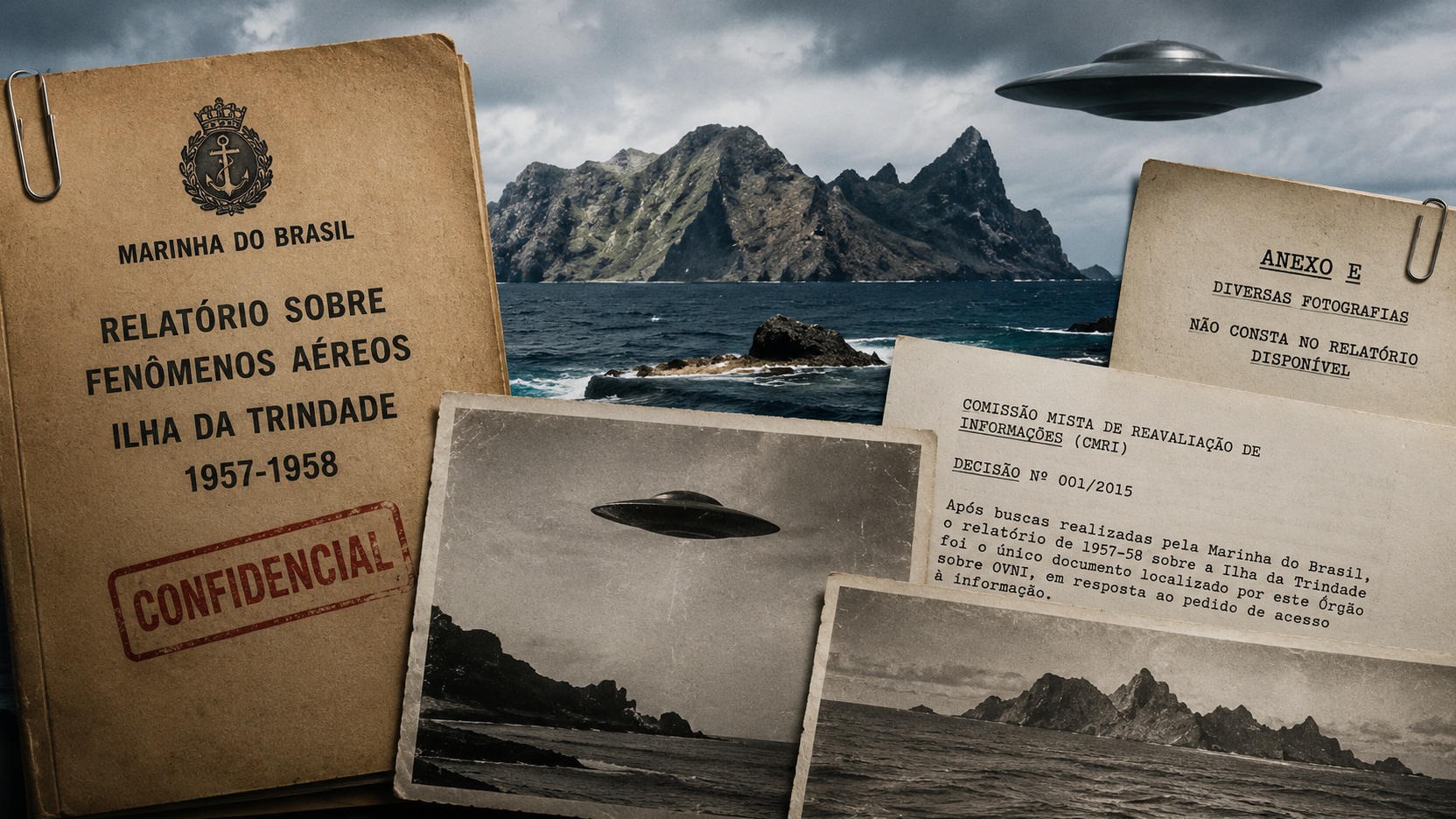
The Trindade Island case occupies an unusual place in Brazilian UFO history because it combines three elements that rarely appear together: testimony associated with a Navy installation, photographs attributed to a professional photographer, and official documentation that can now be consulted. This makes the episode more verifiable than a story based only on oral memory, but it does not automatically turn the famous 1958 images into proof of an unknown craft.
The safest reading of the documents is narrower. The Navy archive confirms that there were reports of unidentified aerial objects during the period of the Trindade Island Oceanographic Post and that the January 16, 1958 episode, linked to Almiro Baraúna's photographs, entered the institutional record. At the same time, the available material leaves important gaps: the photographic annex is not in the report as cataloged today, the film did not remain under continuous military custody, and Commander Carlos Bacellar's account describes, during the initial examination of the negatives, only marks noticed on three frames. None of this amounts to forensic authentication of the photographed object.
The central document exists and is in the Navy Archive
The most important primary item available today is the Relatório de Fim de Comissão do Posto Oceanográfico da Ilha da Trindade (End-of-Commission Report of the Trindade Island Oceanographic Post), covering the period from November 1, 1957, to January 16, 1958. The Navy Archive's own catalog describes the item as containing possible reports of sightings of an Unidentified Flying Object. The wording matters: the archive records the existence of the reports and their connection to the commission, not a conclusion about the extraterrestrial nature of what was seen.
The report had a broader administrative purpose. It covered the post's operation, with sections on radiosonde observations, meteorology, facilities, supplies, health, personnel, equipment, occurrences, and conclusion. Among the planned annexes was Annex E, described as "Diversas
fotografias" ("Various photographs"). The Navy Archive's current catalog, however, carries an explicit note: Annex E is not included in the available report.
This absence is one of the case's most important documentary limitations. It means that a present-day researcher can compare the official text from the period, but does not receive, in the same archival set now offered, the photographic series that the report itself announced as an annex. For that reason, it is not correct to treat copies circulating in books, newspapers, websites, and digital archives as if they were automatically the same materials preserved with the original report, with a complete documentary chain.
The reports began before the January 16 photos
The photographic episode did not arise in isolation. The report records earlier occurrences in late December 1957 and early January 1958. In one, observers on the island described an object with an unusual appearance and gave an altitude estimate. In another, on January 1, about twenty people reportedly watched an object, but Carlos Bacellar himself recorded doubt about the interpretation and considered the possibility that it was a bird, comparing it to a seagull.
This second entry is especially useful for understanding the value of the document. The commander does not turn every strange observation into confirmation of an extraordinary artifact. He records the uncertainty and explains why that occurrence was not forwarded as a firm conclusion. This also helps separate two ideas that are often confused: UFO means that something was not identified in that context; by definition, it does not mean an extraterrestrial spacecraft.
The existence of more than one report therefore shows that the subject recurred among the garrison during that period. What it does not show is that all the observations had the same cause or represented the same physical object.
What happened on January 16 according to Bacellar
The most important passage for evaluating the photographs is Carlos Bacellar's own account of January 16, 1958. By then, he had already handed over command of the post and was aboard the ship Almirante Saldanha. Bacellar wrote that he was in his cabin when he was told that an unidentified aerial object had been seen over the island. When he reached the deck, he found people still agitated by what they said they had observed, including professional photographer Almiro Baraúna.
This detail sets a limit that many popular versions blur: Bacellar does not claim that he saw the object in the sky during that episode. His direct testimony begins after the sighting, when he accompanies Baraúna and the development process.
Baraúna had taken several exposures and, according to the account, even he was unsure whether he had managed to record anything. Bacellar says he stayed close to the photographer, saw the film removed from the camera, and accompanied him to the improvised darkroom. The commander did not enter the developing area because of the heat; he remained outside for about ten minutes and examined the film again when the photographer came out.
The most delicate point comes next. Bacellar wrote that he had noticed a "strange spot" on three negatives, in different positions. The sentence confirms that the commander saw something on the negatives while still in that setting, but it is less strong than saying that he immediately recognized a flying saucer, confirmed four photographs, or carried out a technical
examination. The document does not describe a photogrammetric analysis at that moment, gives no measurements of the alleged object, and does not establish, through that visual inspection, its distance, size, or nature.
There is also a custody problem. The account itself records that the film remained with Baraúna. The photographer agreed to notify the Navy General Staff if necessary, and Bacellar relates that, once in Rio de Janeiro, he spoke about the case with Lieutenant Commander José Geraldo Brandão, after which the matter began to be handled within the Navy structure. This shows institutional interest, but it also shows that the photographic material was not under uninterrupted military control from exposure through all the enlargements that would later circulate.
Three marks on the negatives are not the same as four authenticated photos
The best-known images from the case usually appear as a sequence of four photographs showing an object in different positions relative to the island's terrain. Bacellar's account, however, is specific in saying that, during the initial examination, he noticed marks on three negatives. This difference has to be treated as a documentary issue, not resolved by preference for or against the fraud hypothesis.
There may be benign explanations for the discrepancy, such as difficulty viewing a freshly developed negative, differences between what was visible to the naked eye and what appeared in later enlargements, or simple imprecision of memory and wording. It is also possible to raise hypotheses of later manipulation. The available document, by itself, does not decide between these possibilities.
What it allows us to say is more modest: the presence of something on part of the film was noticed aboard the ship, shortly after development, by an officer who was accompanying the photographer. What it does not allow us to say is that the four images later released were, at that moment, subjected to a chain of verification capable of ruling out compositing, double exposure, alteration of a print, an object close to the camera, or any other mechanism of falsification.
In an investigation of photographic evidence, this distinction is central. "The negative existed" is not synonymous with "the depicted object existed at the claimed dimensions and distance." A fraud can occur before exposure, during exposure, in processing, or at later stages of reproduction. To rule out those hypotheses, the entire chain of the material would need to be known and documented, the originals would need to be available, and methods suited to the technical question would have to be applied. The official set available today does not provide that complete path.
The missing Annex E prevents a complete audit today
The Navy Archive's note that Annex E is not included in the available report carries more weight than it may seem. If the "Various photographs" planned for that annex included Baraúna's images, the absence prevents a direct comparison between what the agency archived at the time and the reproductions that became famous. If the annex contained photographs of another kind, that composition itself would also need to be demonstrated through additional documentation.
Without the annex, the current digital report cannot answer basic provenance questions: which photographs were attached, how many there were, what generation of copy they represented, what captions accompanied them, in what order they appeared, and what technical identification they carried. The gap does not prove fraud, but it weakens any argument that depends on the idea that the official archive preserved and authenticated exactly the sequence known to the public today.
It is also important not to fill that gap with photographs found on the internet. Historical reproductions can have high documentary and journalistic value, but an image digitized decades later does not automatically restore lost information about the original negative, the enlargement process, and the chain of custody.
The Navy investigated the case, but that is not the same as validating a craft
Later official documentation helps explain the administrative path of the subject. In 2012 and 2013, a freedom-of-information request sought a series of records related to the Trindade Island sightings, including communications and documents cited by researchers. A decision by the Comissão Mista de Reavaliação de Informações (Joint Commission for Information Reevaluation, CMRI) shows that the Navy provided the End-of-Commission Report and that there was discussion about the completeness of the response. The Controladoria-Geral da União (Office of the Comptroller General) even recorded that pages of the report had been omitted from the initial response and requested clarification about custody and preservation.
This history matters because it shows that documentary recovery of the case also faced problems of access and completeness decades after the events. It does not mean, however, that every document cited in the request was confirmed to exist and to have been preserved.
In another decision, dated November 11, 2015, the CMRI recorded the Navy's response to a request concerning rules for UFO cases. The agency reported that it had searched its archives and that, on the subject of UFOs in that request, the only document found was precisely the End-of-Commission Report from Trindade Island, already made available in an earlier request.
The sentence must be read within the scope of the request. It does not prove that the Navy never produced any other document about unidentified objects in its entire history. It proves that, in that search and for that request, this was the document located and reported by the agency. The CMRI itself treated the issue as a declaration that the requested information did not exist, without turning the decision into a judgment about the physical reality of the phenomenon.
What about the investigation documents cited by researchers?
Over the decades, researchers have published copies or transcriptions attributed to internal reports that supposedly analyzed the photographs and testimony. Some of this material is relevant to reconstructing how the case was received within the Navy, including references to assessments that considered the possibility of photographic manipulation and the difficulty of ruling it out completely.
The methodological problem is that today's researcher needs to distinguish three levels. The first is the official document directly accessible and cataloged by the agency. The second is a historical copy whose origin may be plausible, but which is not attached to the official item
available today. The third is the interpretation made by later authors. Mixing these levels produces conclusions stronger than the documentation allows.
For that reason, the most conservative audit does not need to deny that there was an internal investigation. There are enough documentary and historical indications that the case drew institutional attention. What the audit must avoid is turning an investigation into official validation of the photographs' content. Investigating a claim means considering it worthy of examination; it does not mean confirming the most extraordinary explanation for it.
The later fraud allegations also have limits
The case acquired a new chapter many decades later. In 2010, a television report echoed in the press presented statements from people close to Almiro Baraúna saying that he had told them he had produced a photographic hoax using household objects. These statements are relevant because they come from people who said they had personal knowledge of the photographer's story and because they offer a concrete hypothesis for how the image could have been fabricated.
But they also need to be classified correctly. They are late, indirect accounts of an alleged confession, not a contemporary record of the method, not a demonstration reproduced with the original equipment, and not a forensic examination of the negatives. They increase the weight of the fraud hypothesis, but do not by themselves resolve all the documentary questions.
The opposite error would be to ignore them because they do not appear in the military archive. The best reading considers both sides: the official record does not provide conclusive forensic authentication of the photos, and the later fraud accounts likewise do not, by themselves, constitute definitive technical proof of how each image was produced.
What the documents allow us to state with high confidence
There were genuine reports recorded by the Navy
It is safe to say that the Trindade Island Oceanographic Post recorded reports of unidentified aerial objects between late 1957 and January 1958. This appears in the commission report preserved and cataloged by the Navy Archive. The existence of the document does not depend on UFO literature or memories published decades later.
Baraúna really does appear in the official account linked to the photographs
Carlos Bacellar's text identifies Almiro Baraúna as the professional photographer present during the January 16 episode and describes the monitoring of the development process. It is therefore not correct to treat Baraúna's connection to the case as a later invention with no official basis.
Bacellar did not directly witness the January 16 object
In his own account, Bacellar was in his cabin when he was notified and reached the deck afterward. His direct testimony in that episode concerns the people he encountered, the photographer, the removal of the film, its development, and the examination of the negatives. The distinction reduces the weight sometimes assigned to him as an eyewitness to the photographed object.
The photographic chain of custody is incomplete
Bacellar accompanied an important part of the processing, but he did not remain inside the darkroom during development, and the film stayed with the photographer afterward. In addition, the photographic annex announced by the report is not in the set currently made available by the archive. This prevents a continuous, auditable chain from being described from the shutter release to the versions published later.
What the available documents do not demonstrate
It has not been demonstrated that the Navy authenticated an unknown craft
The fact that military personnel recorded the episode, accompanied the development process, and took action is not equivalent to a technical certification that the object was an unknown physical aircraft. Still less is it a conclusion of extraterrestrial origin.
It has not been demonstrated that the four famous photos correspond, without alteration, to the material initially observed
The report mentions marks noticed on three negatives. The photographic annex is not available in the current archival item. Without the original series and its complete provenance, it is not possible to establish that equivalence with the level of confidence required by a documentary audit.
It has not been demonstrated that a specific fraud was technically proven
The later statements attributing a confession to Baraúna make the fraud hypothesis more relevant, but they do not replace examination of the original negatives or, by themselves, reconstruct the production process for each photograph. The conclusion "it was a hoax" may be plausible to some researchers, but it is not a conclusion produced by the official documents available today.
There is no documentary basis for concluding extraterrestrial origin
None of the official documents considered establishes that the object had an extraterrestrial origin, non-human technology, or performance impossible for conventional phenomena. Such a conclusion would require additional evidence that the archive consulted does not provide.
Why Trindade Island remains an important case
The historical strength of the episode does not lie in offering a final answer, but in allowing popular claims to be tested against documents. Some survive that test: there were reports, there was military interest, there was an identified photographer, the film was developed in a naval setting, and something was noticed on negatives soon afterward. Others need to be scaled back: in the material currently accessible, the Navy did not leave an unequivocal forensic authentication of the four images or a conclusion of extraordinary origin.
This makes the case more interesting for an evidence-based approach than for a narrative of certainty. It shows how an episode can be well documented historically and still remain weak support for a very specific physical claim. An official document proves that an institution recorded, handled, or investigated a claim; it does not automatically prove the strongest interpretation of that claim.
The main obstacle to a definitive conclusion today is the combination of three gaps: the absence of Annex E from the available report, the discontinuous photographic custody, and the temporal distance of the later fraud allegations. Together, they leave room for competing hypotheses without providing the material needed to eliminate them decisively.
Conclusion: the case is documented, but the photo does not settle the question
What the Navy preserves allows us to conclude that the UFO reports from Trindade Island are part of a genuine official record from the period and that the January 1958 episode did not arise only from a legend published later. It also allows us to confirm that Almiro Baraúna was connected to the photographs and that Carlos Bacellar accompanied part of the development process and observed marks on negatives.
The same set, however, prevents us from safely taking the next step. The photographic annex is not included in the available report, the film remained with the photographer, the initial examination cited by Bacellar speaks of three negatives, and the archive does not contain a complete contemporary forensic examination capable of proving that the four famous images show a distant, unmanipulated physical object.
The most defensible documentary conclusion is therefore limited: the Trindade Island case is a historical UFO episode genuinely recorded by Brazilian authorities, with controversial photographs associated with it. That is different from saying the photographs were authenticated as proof of an unknown craft. It is also different from saying that the official documents demonstrate a fraud. Between those two certainties is what the archive actually offers: an important, investigated, and incomplete case.