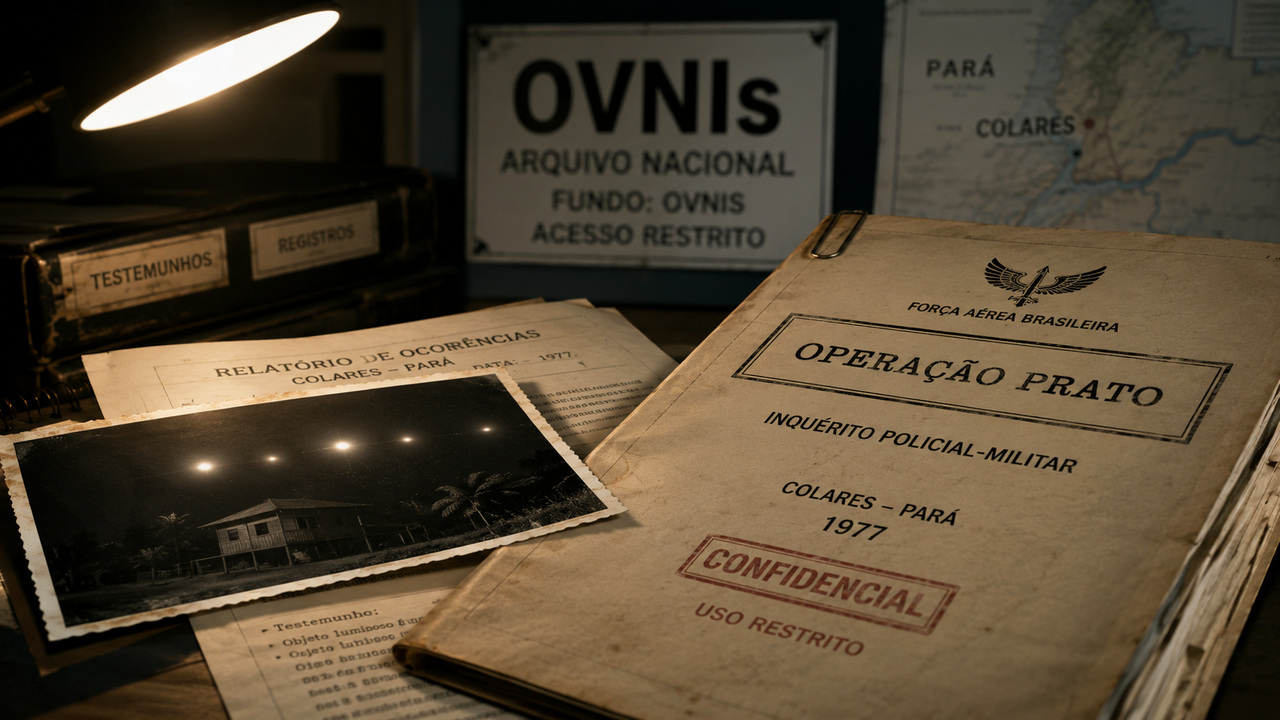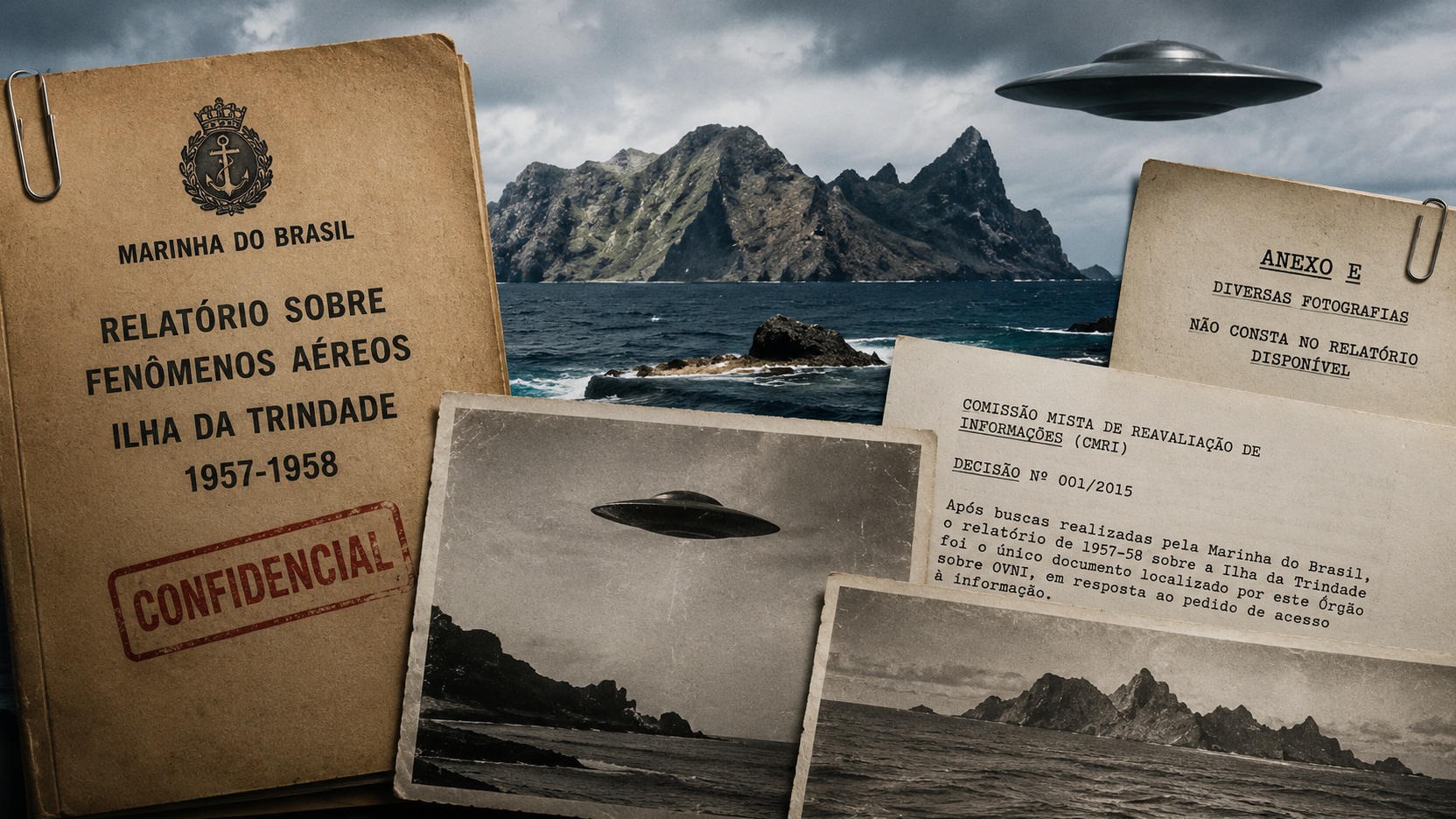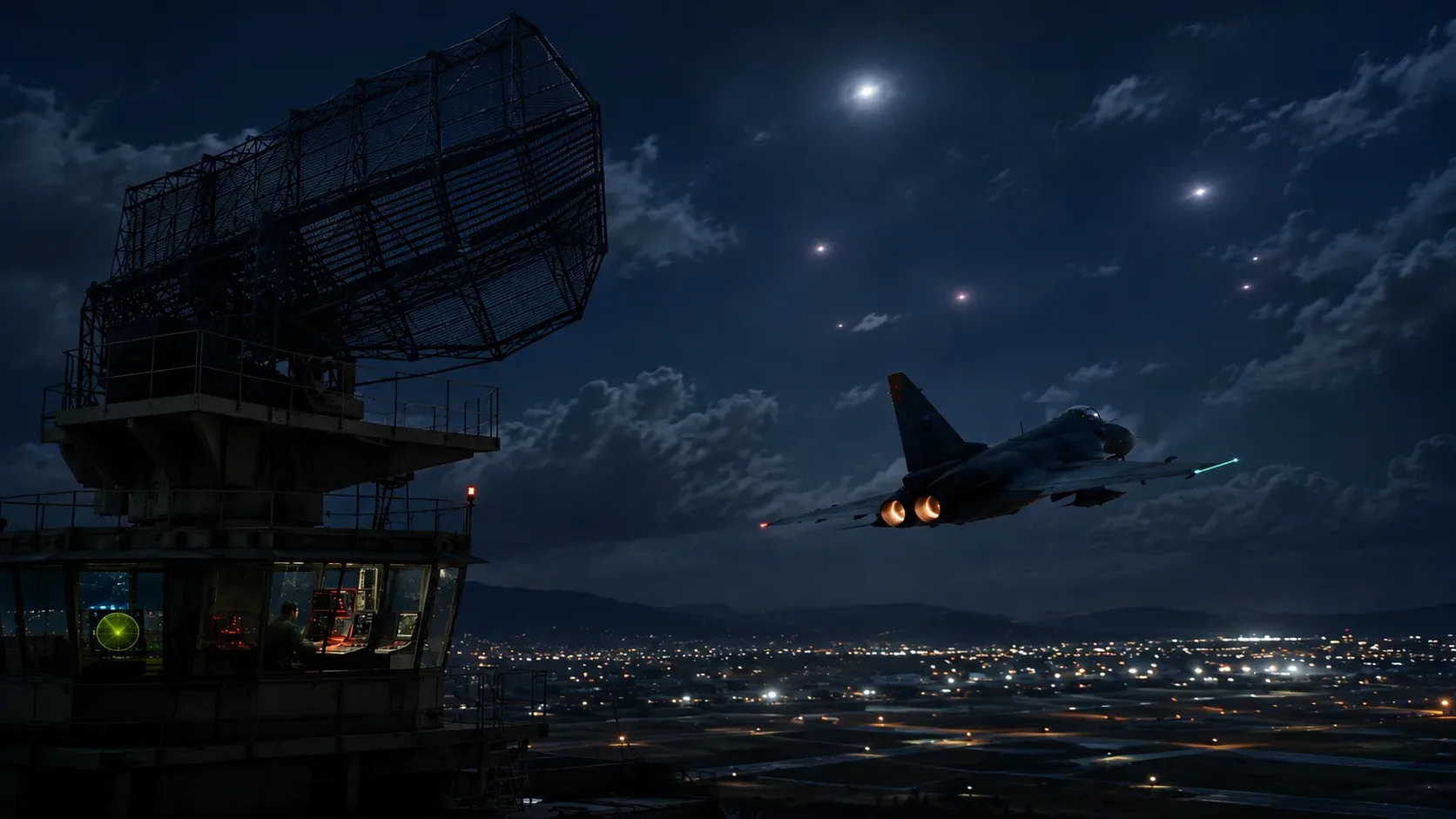
The so-called Official UFO Night doesn't just depend on memories told decades later. There is documentation produced by the Air Force itself, recordings of operational communications preserved by the National Archives and a report sent to the Ministry of Air Force on June 2, 1986. This material maintains that, on the night of May 19, controllers and pilots reported radar lights and contacts, and that military aircraft were called in to try to intercept them.
This, however, is different from proving what the targets were. The report itself records radar limitations, contacts that did not coincide between different equipment and interceptions in which nothing was seen. Its conclusion contains an unusual assessment of the phenomena, but does not identify technology, origin, manufacturer, occupants or extraterrestrial provenance.
The central document: the June 2, 1986 report
The most important document to check the episode is Official Letter No. 008/CMDO/C-138, dated June 2, 1986, from the Air Defense Air Command. He forwards an “Occurrence Report” to the General Air Command and is signed by Air Brigadier José Pessoa Cavalcanti de Albuquerque, then acting commander of COMDA. The National Archive confirms the existence of this report, its date, its signatory and its incorporation into the official collection.
The first caveat appears in the document itself. The Command states that it had limited time and specialized knowledge about phenomena of that nature and that, therefore, it would restrict itself to the operational sphere and the narration of the facts. This is not, therefore, a scientific study designed to determine the physical nature of the targets.
There is another caution that is even more relevant when it comes to radar. According to the report, the equipment then used in the region had as its primary purpose air traffic control, and not specifically air defense. Target initialization depended on manual action by controllers, and some contacts that night were too weak for tracking to be maintained satisfactorily.
These limitations do not erase the detections described in the document. They define the weight that can be given to them.
What the military chronology actually records
The times below follow the Z notation used by the report. The sequence shows why the episode received air defense attention, but also reveals that not all sensors and observers recorded the same thing at the same time.
| Registration | What is in the report | Explicit limitation |
|---|---|---|
| 2315Z | São José dos Campos tower operator reports lights; APP-SP confirms radar contacts in the area. | The excerpt does not identify the nature of the contacts. |
| 0039Z | Santa Cruz alert aircraft is activated due to the detection of some “plots”. | The report says they did not constitute definite radar echoes. |
| 0110Z–0111Z | Anápolis APP reports echoes with heading and speed data, triggering the base alert. | The same echoes did not appear on the COpM equipment. |
| 0134Z | First aircraft from Santa Cruz takes off; pilot reports light and later contact by onboard equipment at 10–12 miles. | Interception ends without target identification. |
| 0148Z | Anápolis aircraft performs five presentations and obtains acquisition on the onboard radar, once arriving at approximately two miles. | The pilot cannot make visual contact. |
| 0150Z | Second Santa Cruz aircraft sees red light in the position indicated by the control; at another point, 13 “plots” appear behind the aircraft. | The 13 plots were not confirmed visually or by the onboard radar. |
| 0217Z and 0236Z | Two more aircraft from Anápolis take off. | Neither of them get visual or radar contact. |
Chronology is particularly useful because it prevents frequent simplification of the case. There were moments of agreement between vision and radar, but there were also radar without vision, vision without equivalent confirmation in all systems and flights that ended without any contact.
On the first flight described from Santa Cruz, for example, the pilot reported a white light that temporarily changed color and an indication of on-board equipment between 10 and 12 miles. The pursuit continued towards the sea and was abandoned when a positive approach was not obtained and the aircraft was approaching its operational fuel limit for return.
In the first intercept of Anápolis, the pilot obtained contact and acquisition on his onboard radar in five approaches, but did not see the target. In one of them, according to the report, it came within two miles of the contact. The document describes sudden variations in speed and loss of contact even during the interceptor's supersonic flight.
What the audios add
The National Archives informs that, in 2015, it made available 16 audios from a shipment from the UFO Fund and that eight of them contained conversations between pilots, controllers and the defense system related to the night of May 19, 1986. This makes the recordings a contemporary source of the event, and not a reconstruction made decades later.
On the official profile of the National Archives on Mixcloud, one of the recordings is cataloged as communication between controllers and pilots who spotted objects in the skies over São Paulo; another records the dialogue between the Jaguar 98 and the Air Defense. There is also a recording in which the National Archives describes the controller's well-known speech about a “flying saucer festival”.
A fourth recording preserves communications with Jambock 17. According to the archival description, the pilot assessed during the flight that the target was apparently not a conventional aircraft, considering the performance observed and the area where it was flying. This is an operational assessment made at that moment, not a physical identification of the object.
This is the main value of the audios: they help to demonstrate that the situation was being handled in real time by air control and defense professionals. The astonishment or interpretation of a controller or pilot, in itself, does not determine the origin of what was being monitored.
Radar is important evidence, but it doesn't close the case
It would be incorrect to say that the Official UFO Night was just a set of lights seen with the naked eye. The report documents contacts on ground radars and, in certain interceptions, also on onboard equipment. In its final considerations, the Command grouped coincidences between echoes, visual observations and behavior attributed to the targets.
It would also be incorrect to transform every “plot” mentioned in the document into a proven unknown aircraft. The report itself differentiates contacts: some were not strong enough for initiation and follow-up; certain echoes appeared in one system and not in another; the 13 plots recorded momentarily behind one of the aircraft were not confirmed visually or by that interceptor's radar.
There is therefore a core of evidence for the strongest episodes with some combination of ground radar, onboard equipment, and visual observation — surrounded by records of uneven quality. Treating them all as if they were independent and equivalent measurements would artificially increase the strength of the case.
This research also did not locate, among the public materials examined, a set of raw radar data sufficiently complete to independently retrace all trajectories, speeds and accelerations cited in the report. This does not mean that such data never existed or that no additional material is in SIAN; it just means that the narrative report and the recordings accessed do not allow the instrumental analysis to be reproduced in full.
Five aircraft took off; seven were available
Another detail that deserves precision is the number of aircraft. The report's chronology records five takeoffs: two from Santa Cruz Air Base and three from Anápolis Air Base. Two of the Anápolis aircraft did not make any contact during their missions.
The number seven also appears at the end of the document, but with another meaning. The Command states that, less than 30 minutes after activation, seven armed vectors were available for use. The text does not say that seven aircraft pursued the targets that night. The official government page published in 2022 also summarizes the episode as an operation in which five fighter jets were called in for interception.
What about the famous 21 UFOs?
The number 21 became part of the episode's best-known narrative. A Federal Government page published in 2022 states that 21 objects were observed and records that, in a press conference on May 23, 1986, the then Minister of Aeronautics, Octávio Júlio Moreira Lima, reported that five fighter jets had pursued 21 UFOs.
There is, however, an important documentary difference: the June 2 report consulted in this research does not present a list of 21 individual targets, each with its own trajectory and identification. He talks about lights, echoes, plots and different presentations throughout the night. Therefore, the figure of 21 can be correctly attributed to the later official report on the press conference, but should not be treated as if the technical report contained 21 independent and auditable radar tracks.
The same caution applies to other information repeated later. The 2022 government page mentions objects that would have reached up to 100 meters in diameter, but this dimension does not appear as a measurement in the June 2 report examined here. Without locating the primary observation or method that produced this value, it should not be given the same weight as directly verifiable information in the report.
What does the conclusion about “intelligence” mean
The strongest passage in the report appears in the final considerations. After gathering characteristics attributed to the phenomena — variations in speed and altitude, accelerations, curves, luminosity and radar echoes — the Command presents the opinion that the “phenomena are solid and somewhat reflect intelligence”, relating this assessment to the apparent ability to maintain distance from observers and fly in formation.
It is an official conclusion contained in the document and should not be erased from the history of the case. But the vocabulary used itself matters: it is an “opinion” constructed from the information gathered by controllers and pilots, not a material identification obtained through object recovery, laboratory analysis or instrument capable of revealing its origin. The text even adds that they would not necessarily be manned.
The strength of this conclusion also needs to be read together with the reservations presented at the beginning of the same report: technical limitations of equipment, impaired monitoring and lack of specialized knowledge about phenomena of that nature.
What the documents don't allow you to conclude
The documentation examined does not support some conclusions often added to the case history:
- does not demonstrate extraterrestrial origin nor does it identify another planet, civilization or technology responsible;
- does not prove that all sightings and echoes had a single cause, because the quality and combination of records varied;
- does not automatically transform each radar plot into an independent physical object, including because the report itself describes weak contacts and discrepancies between systems;
- does not allow reconstructing 21 complete instrumental trajectories from the eight-page report;
- does not establish target dimensions with a measurement methodology presented in the document;
- does not eliminate, simply by remaining unidentified in that report, all possible conventional explanations.
This distinction is compatible with the National Archives' own guidance: “UFO” designates something whose origin has not been identified, and the classification is not equivalent, by definition, to a flying saucer or extraterrestrial vehicle.
What remains solid after stripping away the hype
The case remains documentary relevant even without adding an extraordinary explanation. There was an incident handled operationally by Brazilian air defense; controllers reported detections; pilots carried out interceptions; some episodes involved concordance between visual observation and radar systems; others don't; five aircraft took off; and the Air Defense Command was unable to satisfactorily identify the origin of the phenomena in the report produced weeks later.
It is precisely this limit that makes the documentation interesting. The official record allows us to state that there was a real problem with identification and aerial monitoring. It does not allow you to fill in the identity of targets with a hypothesis chosen later.
To check the case directly, the safest way is to start from the Unidentified Flying Object Fund of the National Archives and search the records in the SIAN. The Ministry of Defense currently informs that the documentation produced by the Air Force on these occurrences is forwarded to the National Archives for public consultation.