A strange image can be real and still not prove what it appears to show. A luminous point may have been recorded by a real sensor, during a real operation, without the isolated video allowing us to determine its distance, size, speed or nature.
This distinction is essential when learning how to analyze UAP video. The first job is not to choose between “ordinary object” and “extraordinary technology”, but to discover what the data actually allows us to measure. Zoom, parallax, platform movement, auto-tracking, compression, and no metadata can transform a mundane event into a visually stunning sequence.
There is also a date correction relevant to the editorial context. The AARO table presents a series of files with the date “05/08/2026”. As the same table records releases on “05/22/2026”, the site is using the North American month/day/year standard. Therefore, “08/05/2026” corresponds to May 8, 2026, not August 5. August 5, 2026 can be maintained as a trigger for editorial recirculation, but not as the publication date for that batch of videos.
What a UAP video can — and cannot — demonstrate
A video can demonstrate that a certain pattern of light, contrast, or shape has appeared in a camera's field of view. Depending on the file, it may also record time, position, camera direction, estimated distance, sensor mode, and platform movement.
But the visual sequence alone rarely reveals all of these variables. An object moving quickly across the frame may be moving at high speed, may be close to the camera, or may appear fast because the camera is in a fast-moving aircraft aimed at a narrow field of view.
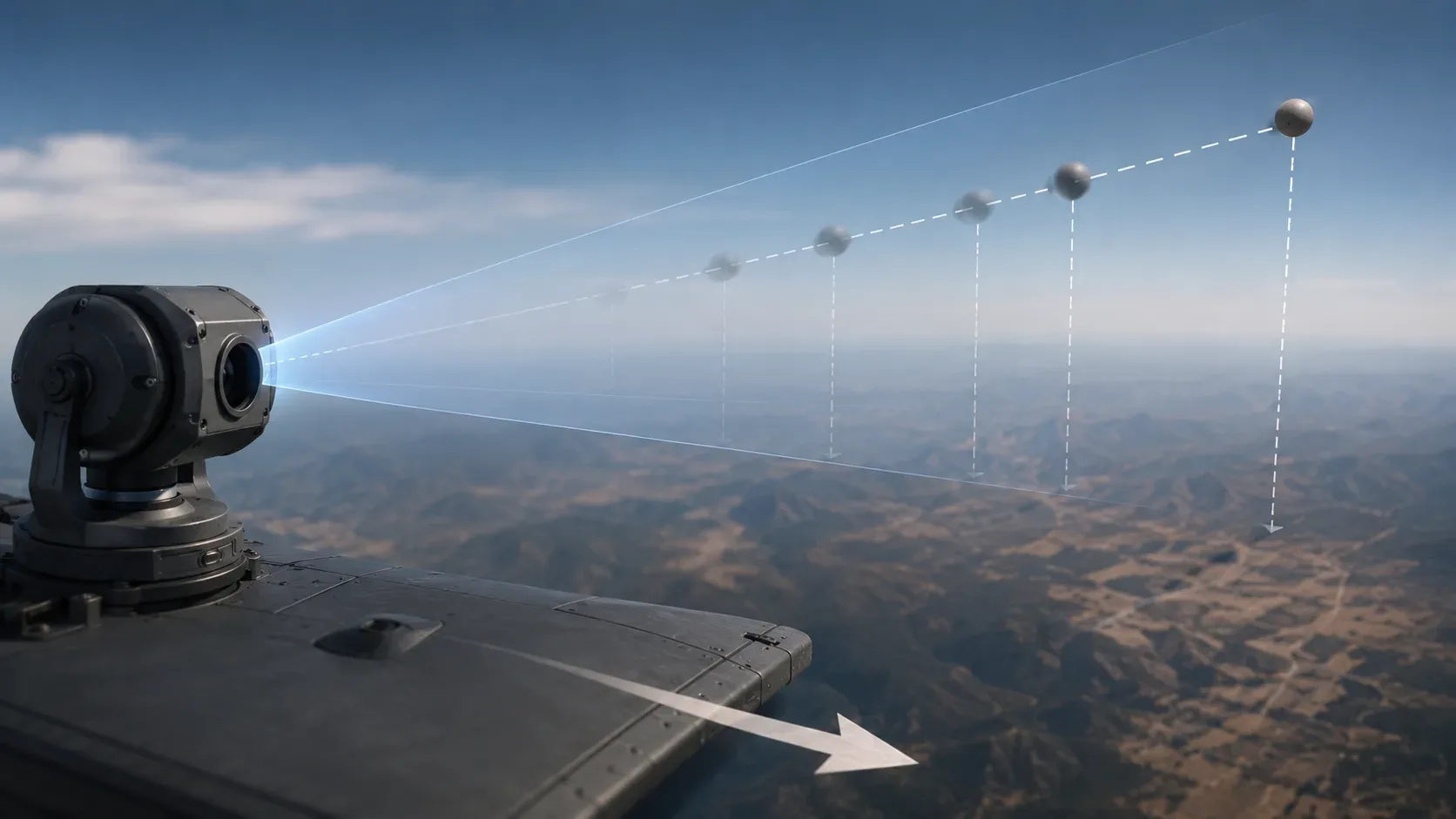
AARO explains that motion parallax can make a stationary or slow-moving object appear fast when viewed from a moving platform. The effect tends to be more pronounced when the object is closer to the observer or when the sensor works with a small field of view.
NASA's independent report, published on September 14, 2023, reached a similar methodological conclusion: UAP scientific analysis is hampered by insufficient calibration, lack of multiple measurements, absence of sensor metadata, and paucity of reference data. The recommendation was not to more aggressively interpret existing videos, but to improve the quality and standardization of future observations.
Five-layer checklist for analyzing UAP videos
1. Check the origin and chain of the file
Start with the file, not the object.
Ask where the video first appeared, who posted it, whether there is an official source page, and whether the available version is the original file, an export, a screen recording, or a social media clipping.
A minimally useful document chain must answer:
- What is the oldest source findable?
- Was the file obtained directly from the equipment or did it pass through other people and systems?
- Is there a full version before and after the viral excerpt?
- Was the video sped up, slowed down, stabilized, zoomed in, or reframed?
- Do captions, circles and crosshairs belong to the sensor or were they added later?
- Are there versions with different durations, resolutions or framing?
- Is there a cryptographic hash or other record that allows you to confirm that two copies are identical?
NIST defines chain of custody as the record of who collected, protected, transferred, and analyzed evidence, with dates, times, and purposes. It also describes hash values as instruments for verifying the integrity of digital files. This does not mean that every public video needs to be criminally treated, but it shows why provenance matters when a conclusion depends on a few seconds of image.
The absence of the original file does not automatically make the video fake. It reduces, however, what can be concluded. In the “Go Fast” case, AARO said it analyzed a 34-second compressed public copy because the original and its metadata were no longer available. The organization was able to estimate altitude and speed ranges using information displayed on the screen, but did not obtain a single solution for all parameters.
Rule of thumb: a clipping without verifiable origin is a clue for research, not ready-made evidence.
2. Reconstruct camera and platform movement
In videos taken from aircraft, drones, ships or vehicles, there are at least three movements that can blend:
- the movement of the object;
- the movement of the platform;
- the movement of the camera or optical assembly.
A tracking system can rotate the camera to keep the target close to the center. When this happens, the object appears relatively stable while the background crosses the screen. At another point, loss of tracking may cause the target to suddenly slip across the frame. None of these behaviors alone proves acceleration of the object.
Search for information about:
- platform speed, altitude and heading;
- inclination or curve of the aircraft;
- camera azimuth and elevation;
- gimbal movement;
- start and end of tracking;
- reticle change;
- electronic stabilization;
- mode or contrast changes.
Descriptions published by AARO on May 8, 2026 show how these actions appear in the records themselves. There are sequences in which the sensor follows an area of contrast, changes zoom levels, changes the field of view, loses tracking or starts to move erratically. AARO cautions on these pages that the visual description should not be interpreted as a conclusion about the nature or relevance of the event.
To claim an “impossible curve”, therefore, it is not enough to trace the path of the point within the frame. It is necessary to separate the angular displacement of the target from the movement carried out by the camera to follow it.
3. Separate zoom, field of view and parallax
Zoom changes the relationship between what is being observed and the visible space around it.
When the sensor narrows the field of view, a small angular change takes up a larger portion of the screen. The background appears to move more quickly, oscillations become magnified, and a small target may appear to change position abruptly.
You also need to distinguish:
- apparent increase in size: the object occupies more pixels;
- real approximation: the distance between object and sensor decreases;
- zoom change: the frame is enlarged without the object necessarily getting closer;
- change in contrast: the signature becomes more visible, but not necessarily larger.
In one of the records published by AARO, the organization noted that the apparent increase in an area of contrast was likely explained, at least in part, by the platform moving closer to the source of detection. In others, rapidly toggling zoom makes areas of contrast appear to rapidly increase and decrease.
Parallax adds another layer. Imagine looking out of a car window: nearby streetlights seem to run backwards, while distant mountains barely move. In a fast aircraft, a relatively slow object may appear to travel across the bottom at great speed, especially when its distance is unknown.
The “Go Fast” case is an official example of this difference between visual impression and calculation. The January 2015 recording appeared to show a fast-moving object near the ocean. In the resolution published on February 6, 2025, AARO estimated that the object was approximately 13,000 feet in altitude and attributed the impression of high speed to motion parallax. The organization did not definitively identify the object, but assessed that it did not present anomalous performance. As the aircraft's exact position and heading were missing, the result was presented as a range of possibilities rather than a single speed.
This is an important lesson: calculated uncertainty is more informative than invented precision.
4. Look for independent metadata and sensors
Metadata is information that gives context to the record. Among the most useful fields are:
- date and time with zone;
- platform coordinates;
- altitude, heading and speed;
- sensor type and model;
- electro-optical, infrared or SWIR mode;
- focal length or field of view;
- frame rate;
- exposure time;
- polarity and thermal scale;
- azimuth and elevation;
- estimated distance to target;
- processing and compression history.
NASA highlights that time, location, observation mode, sensor type, noise characteristics and acquisition information are necessary to characterize both the phenomenon and the instrument. The report also states that several apparent UAPs were recognized as artifacts after calibration and metadata analysis.
In infrared, for example, a light or dark area should not automatically be treated as a hot, solid object. Depending on the mode, calibration, and processing, contrast may represent thermal emission, reflection, environmental difference, or sensor artifact. AARO itself maintains unresolved cases in which it has not been possible to distinguish between a physical source and an instrumental response due to a lack of telemetry and multimodal data.
Independent measurements increase the strength of the analysis. These may include radar, another camera in a different position, meteorological data, aircraft tracking, astronomical observation or a second sensor without the same optical and processing chain.
Two screens produced by the same set of sensors are not necessarily two independent confirmations. They can share lens, alignment, telemetry or processing. The probative value increases when different instruments record the event synchronously and allow position, distance and time to be compared.
5. Do not confuse “unidentified”, “unsolved” and “extraterrestrial”
Terms describe different levels of knowledge.
| Classification | What does it mean | What it doesn't mean |
|---|---|---|
| Detected | A sensor recorded light, contrast, shape, or other signal. | That the signature must necessarily be a physical object. |
| Unidentified | The specific identity has not been determined. | That all common explanations have been eliminated. |
| Unresolved | The available data do not allow a defensible conclusion. | That the case demonstrated extraordinary performance. |
| Anomalous | Some characteristic remains incompatible with the evaluated explanation, within the available data. | May the origin be extraterrestrial. |
| Alien | Hypothesis of origin outside the Earth. | Automatic consequence of previous classifications. |
AARO's transparency page defines its unsolved cases as those in which the government has been unable to definitively determine the nature of the phenomenon, a situation that may simply result from a lack of sufficient data.
An example helps to establish the difference: in 2023, the Department of Defense disclosed a case in which an object remained unidentified, but did not exhibit behavior assessed as anomalous. The file remained open because there was little data, not because an extraordinary technology had been demonstrated.
AARO has also stated, in its public report and official communications, that it has found no verifiable evidence of extraterrestrial beings, activity or technology in the cases examined thus far. This is a conclusion attributed to the organization and limited to the material it analyzed — not a philosophical claim that extraterrestrial life does not exist.
A quick procedure before sharing
When you find an awesome video, follow this order:
- Find the original post.
- Watch the entire sequence, not just the highlighted section.
- Note cropping, zooming, contrast changes, and loss of tracking.
- Find out if the camera or platform was moving.
- Look up distance, heading, altitude, time and field of view.
- Separate witness descriptions from the information shown by the sensor.
- Check if there is another truly independent instrument.
- Look for official reviews and read the methodology, not just the title.
- Record what remains unknown.
- Choose a conclusion proportionate to the data.
A responsible conclusion might be: “the video shows an area of contrast whose identity and speed cannot be determined from the available file.” This phrase is less flashy than “impossible maneuver,” but it preserves the difference between observation and interpretation.
Signs that the publication is exaggerating the evidence
Be suspicious when:
- the video starts at exactly the strangest moment;
- there is no link to the complete file;
- the narrator provides distance or speed without explaining the calculation;
- movement within the screen is treated as an absolute trajectory;
- zoom is presented as an approximation of the object;
- a witness description is confused with telemetry;
- “official” is used as a synonym for “confirmed”;
- “unresolved” is translated as “inexplicable”;
- the absence of data is presented as evidence of concealment;
- there is no margin for error or competing hypotheses.
A file can be officially published and remain inconclusive. The publication confirms that that material was made available by the institution; does not automatically confirm the most extraordinary interpretation made about it.
What would it take to sustain an “impossible maneuver”
The expression should only be considered after establishing, with known uncertainties:
- successive positions of the object in space;
- distance in each measurement;
- precise time interval;
- platform movement and orientation;
- sensor movement;
- calibration errors;
- atmospheric conditions;
- confirmation by independent instruments.
Without these elements, the video may show angular motion, but not necessarily speed, acceleration, or change of direction in three-dimensional space.
Even an official analysis should not be treated as immune to review. New data could resolve a previously inconclusive case or change a previous assessment. The healthy criterion is to ask whether the methodology is reproducible, whether the premises have been stated and whether the conclusion respects the limits of the material.
Frequently asked questions
Does the lack of metadata prove the video is fake?
No. It means that essential information may have been lost, removed or never recorded. The video may be authentic and still insufficient to determine distance, speed or identity.
Wouldn't a military sensor be too accurate to be fooled?
Military sensors can be highly capable, but they are designed for specific missions. Images produced outside of the system's primary purpose may contain compression, resolution limitations, unexpected responses, and incomplete data. The quality of the equipment does not eliminate the need for calibration and context.
Do two sensors confirming the object solve the case?
Not necessarily. It is necessary to know if they are independent instruments, if they were synchronized and if they registered the same physical position. Different modes of the same system may share error sources.
Is an unsolved case more important than an identified case?
It may merit further investigation, but “unresolved” often describes insufficient data quality. Classification does not create new evidence.
What is the correct conclusion when information is missing?
State exactly what was observed, list what cannot be determined and avoid turning gaps into certainties. In serious investigation, “we don't know with these data” is a valid conclusion.
Save this checklist before evaluating the next video and subscribe to the newsletter to follow future UAP documentary analyzes with the same methodology.