Before expanding the light, preserve the video that can respond. Cropping, stabilizing, reframing, or exporting the file too soon can eliminate metadata, change frame cadence, and introduce artifacts right where the information needed to test what appeared in the sky is.
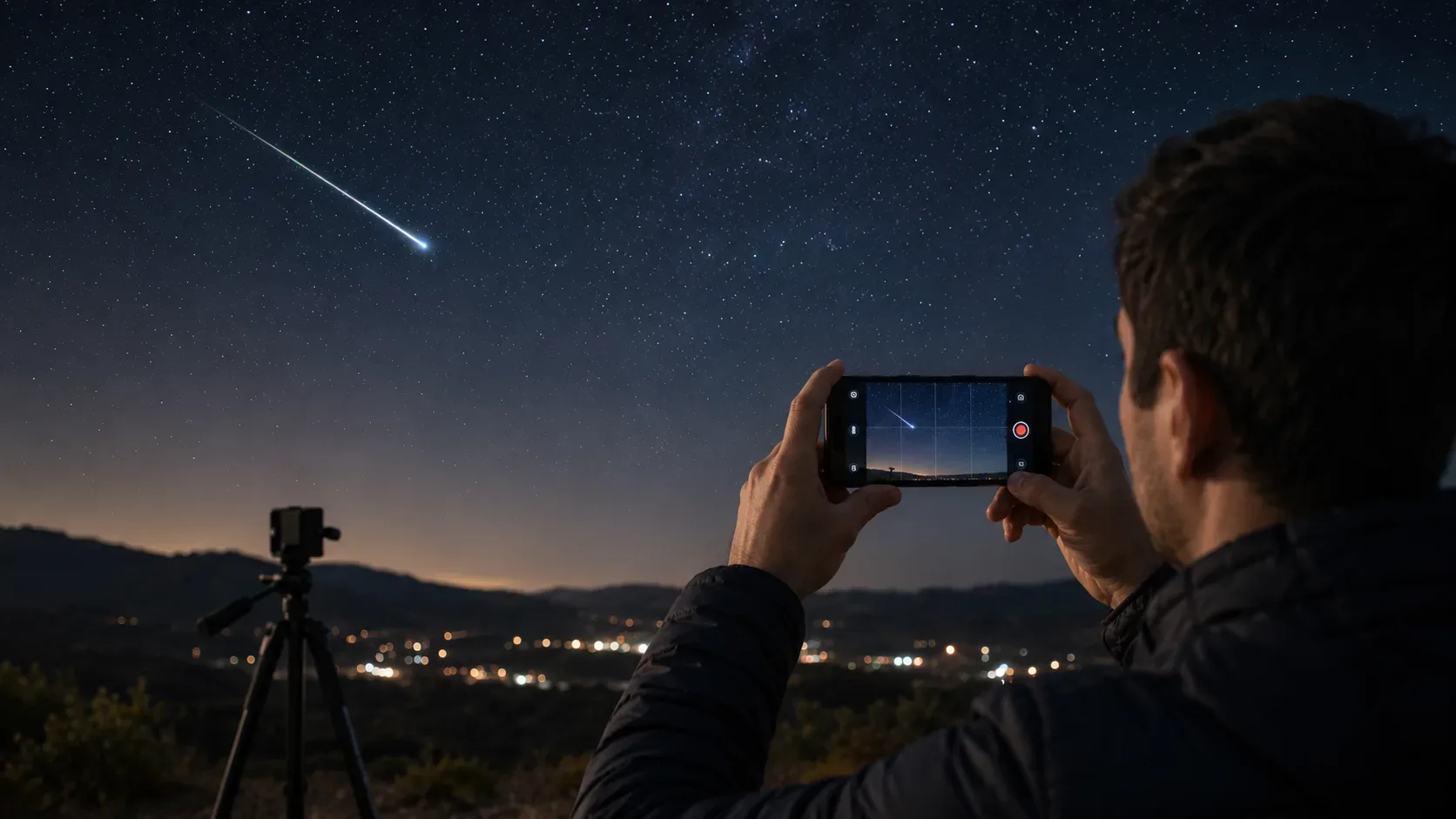
Attention to nighttime videos is expected to increase around August 12, 2026. NASA predicts the peak of the Perseids between the night of the 12th and the early hours of the 13th, under favorable New Moon conditions. The International Meteor Organization calendar places the main maximum between 02:00 and 04:00 UTC on August 13 — between 11:00 pm on the 12th and 1:00 am on the 13th in the UTC−3 time zone — within a wider window of elevated activity.
This context increases the likelihood of real meteors being filmed, but does not automatically turn every fast light into a Perseid. Satellites, solar reflections, aircraft and responses from the camera itself remain possible. Peak rainfall is a contextual hypothesis, not an individual identification.
Preserve the original before searching for details
The first expanded version should not replace the file captured by the cell phone. Technical standards for preserving digital evidence recommend keeping the original unaltered and working on copies. Conversion, compression, and even transferring the video stream to another container can modify creation times, frame timing, and other metadata.
Follow this order:
- Do not crop, rotate, stabilize or enlarge the original file. Create a copy for any processing.
- Save the entire video, including the seconds before and after the light appears and the original audio.
- Record the file name, extension, and size in bytes. This data helps compare copies.
- Take note separately of the capture report: location, approximate time, observed direction, cell phone position, use of zoom and movement made by the operator.
- Make a second copy on another storage medium. A re-uploaded or published version should not be treated as a master file.
- When auditing is required, calculate a SHA-256 hash. The result acts as a fingerprint of the file: any subsequent changes will produce another value.
The hash does not prove that the scene represents a physical phenomenon nor that the recorded time is correct. It only allows you to verify that the contents of the file have remained identical since the time the hash was calculated.
Metadata checklist for mobile videos
Metadata should be treated as contextual evidence, not an automatic seal of authenticity. They may be missing, incorrect, or changed by export. The lack of coordinates, for example, does not prove fraud; it just prevents that information from being used in the analysis.
Register when available:
- date and time of creation, including time zone;
- geographical coordinates and altitude;
- manufacturer and model of the device;
- camera or lens used;
- video resolution and orientation;
- total duration;
- nominal frame rate;
- effective number of frames;
- codec and container;
- software or encoder identified in the file;
- creation and modification dates;
- presence of cuts, filters, slow motion or speed change;
- known submission, editing, or publishing history.
Also preserve information that is not necessarily within the file: time checked on the device's clock, direction in which the camera was pointed, approximate position on the horizon, sky conditions, perceived sounds and appearance observed with the naked eye.
Technical analysis should consider resolution, frame rate, codec, and device settings. When the best available file is not the original, this limitation must accompany any conclusion.
Motion, duration and brightness signatures
The table below brings together screening signals, not absolute rules. Meteors can produce longer-lasting bolides; satellites may fluctuate in brightness; and a moving camera can make a simple trajectory seem erratic. Differences gain value when movement, duration, background and metadata point to the same hypothesis.
| Hypothesis | Apparent motion | Duration in record | Brightness behavior | Test that helps the most |
|---|---|---|---|---|
| Meteor or Perseid | Appears suddenly and quickly travels a short line or arc in the sky | Usually very brief, sometimes recorded in a few frames; bolides can last longer | May intensify, fragment or leave a luminous trail after the meteor disappears | Stabilize the background and extend the trajectory backwards, checking if it is compatible with the radiant of the Perseids |
| Satellite | Smooth and continuous movement in relation to the stars, without sudden changes in direction | Tends to remain visible for many frames and may continue beyond clipping | Relatively stable brightness, with possible weakening upon entering Earth's shadow | Check date, time, location and direction in a passage forecast |
| Satellite flare or glint | Maintains a satellite's trajectory; the main event is the brightness change | The luminous peak may last seconds, within a longer passage | Increases and decreases in intensity, sometimes very sharply | Check if the point continues to advance in the same direction before and after the flash |
| Lens flare or ghost | Moves relative to the frame when the camera rotates and can follow a bright source | Appears or disappears as the framing, angle or light source changes | May have a halo, spot, duplication or unusual color | Compare your position with the Moon, a streetlight or other bright light in or near the field |
| Rolling shutter, stabilization or shaking | Can create tilt, ripple, jump, or apparent zigzag during rapid camera movement | Distortion accompanies frames affected by motion or sensor reading | Shape may stretch or deform without equivalent physical change in the sky | Observe whether stars, clouds, horizon and other lights undergo synchronized displacement or deformation |
A satellite flare and a lens flare are not the same thing. The first is sunlight reflected by an orbiting object. The second is produced within the camera's optical system. NASA notes that satellites can experience a sudden increase in brightness and then disappear as they enter Earth's shadow. Cell phone manufacturers also document light spots and patches generated by internal reflections when there are intense sources close to the frame.
Regular flashes, lights of different colors, sound or displacement compatible with a local route should open the possibility of an aircraft or drone. It is not useful to force all videos into the four main categories when another common explanation fits better.
Frame-by-frame trajectory test
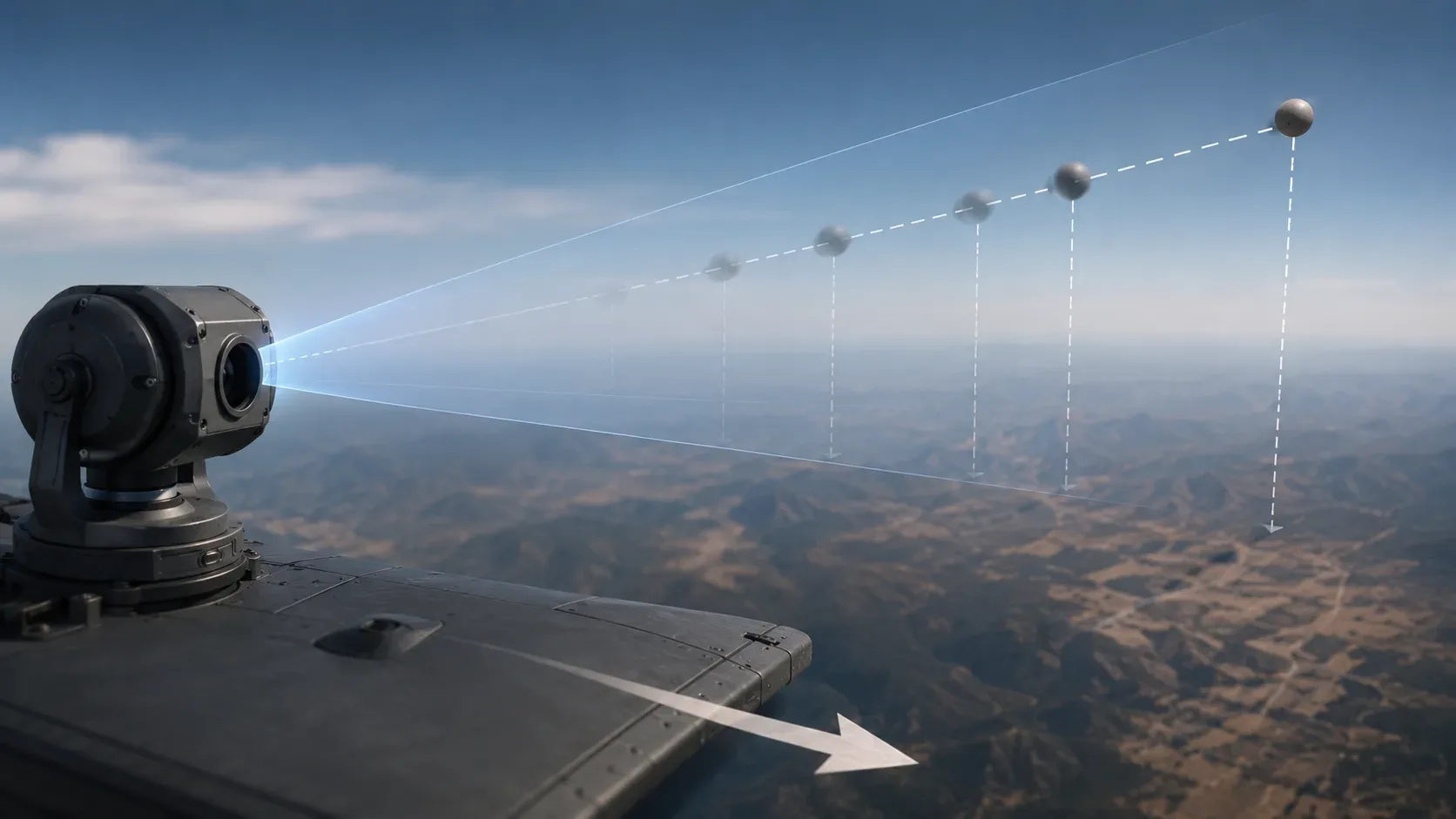
The path drawn by the point within the screen is not automatically the trajectory of the object in the sky. First, it is necessary to remove, as far as possible, the movement of the cell phone.
1. Choose fixed references
Search for stars, building edges, streetlights, mountains, or the horizon. Clouds can help assess relative movement, but they are not fixed references because they also move and change shape.
When the video shows just one point on a completely black background, the ability to reconstruct the trajectory is severely reduced. Without references, it is not possible to reliably separate object movement from camera movement.
2. Mark positions at equal intervals
On a copy of the video, advance frame by frame and mark the apparent center of the light at regular intervals, such as every five frames. Always use the same range.
Then do the same with a star or fixed point in the background. If they both jump in the same direction at the same time, the jump probably came from the camera. If the background remains stable and only the light changes, the displacement takes on more weight as actual movement within the scene.
3. Note the spacing between the marks
Close, regular marks indicate approximately constant angular motion. This is consistent with a satellite pass, although it is not sufficient proof.
A meteor tends to appear suddenly and travel a large angular distance in a short time. A satellite flare tends to preserve trajectory spacing as brightness waxes and wanes. An optical spot can change position according to the rotation of the device, without maintaining an independent path against the stars.
Don't turn differences of a few pixels into extraordinary acceleration. Compression, blur, saturation, electronic stabilization, and progressive sensor reading can shift the apparent center of a small light. Cameras with rolling shutter may produce curvature or tilt when there is movement during frame acquisition.
4. Take the radiant test
Meteors from the same shower enter the atmosphere on approximately parallel trajectories, but the perspective makes them appear to come from a common region of the sky, called the radiant. In the Perseids, this region is close to the constellation Perseus.
Set up a sky map for the recording date, time and location. Identify the stars present in the frame and extend the trajectory of the possible meteor in the opposite direction to the movement.
A trajectory compatible with the radiant increases the plausibility that the record is a Perseid. It doesn't close the case: a sporadic meteor can cross a similar direction by coincidence, and orientation errors can produce a false convergence. Radiant analysis itself requires considering position and angular velocity, not just freely extending lines.
The geometry of 2026 also calls for caution in Brazil. The IMO reports that the best conditions are in the mid-latitudes of the Northern Hemisphere and that rain cannot be observed adequately in much of the Southern Hemisphere. This does not mean a total absence of Perseids in the country, but it reduces the expectation of rates equal to those published for more favorable locations.
5. Compare with satellite passes
The query must use:
- observer coordinates;
- time converted correctly, including zone;
- approximate direction and elevation;
- start and end of displacement;
- orbital elements close to the recording date.
A good match of time, direction and trajectory strengthens the identification of a satellite. A negative result does not alone eliminate this hypothesis. Forecasts based on orbital elements have variable accuracy, depend on updated data and can lose quality after maneuvers or as the orbital set ages.
How to record the conclusion without exaggerating
The conclusion should say what was deleted, what remained compatible, and what data was missing. Useful formulations include:
- Consistent with meteor and geometrically compatible with the Perseid radiant.
- Probable satellite, with compatible passage in time and direction.
- Probable satellite glint, as the brightness varied without changing the trajectory.
- Probable lens flare, linked to camera movement and a light source in the frame.
- Inconclusive: the video does not contain background, precise time or sufficient original file to separate the hypotheses.
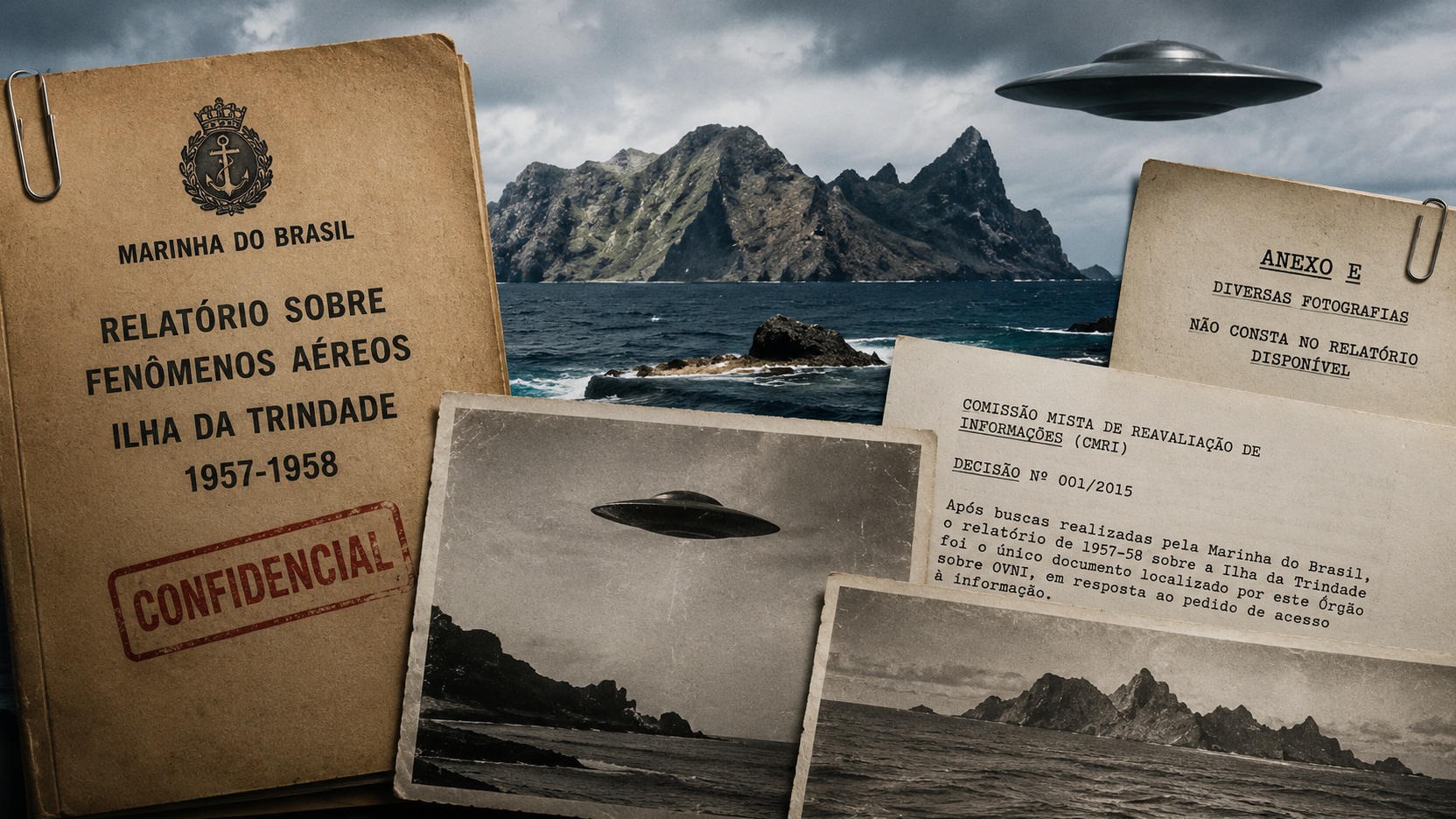
The “UAP” classification does not mean extraterrestrial origin. NASA uses the term for observations that cannot yet be identified as aircraft or known natural phenomena and recognizes that many reports contain data too limited for firm scientific conclusions.
Therefore, “unidentified” should remain a description of the available information, not a reward for lack of context. Before calling a UAP light, the protocol needs to demonstrate which common hypotheses were actually tested — and not just claim that no explanation was found.
This procedure complements the guide UAP in Video: Why Zoom, Parallax, and Lack of Metadata Can Deceive, which delves into apparent motion, field of view, and limits of inference in recordings.
The next step is not to enlarge the point until it takes shape. It's about preserving the original file, documenting the context and running tests that can eliminate hypotheses. When the data does not allow progress, “inconclusive” is a more accurate result than an extraordinary origin.