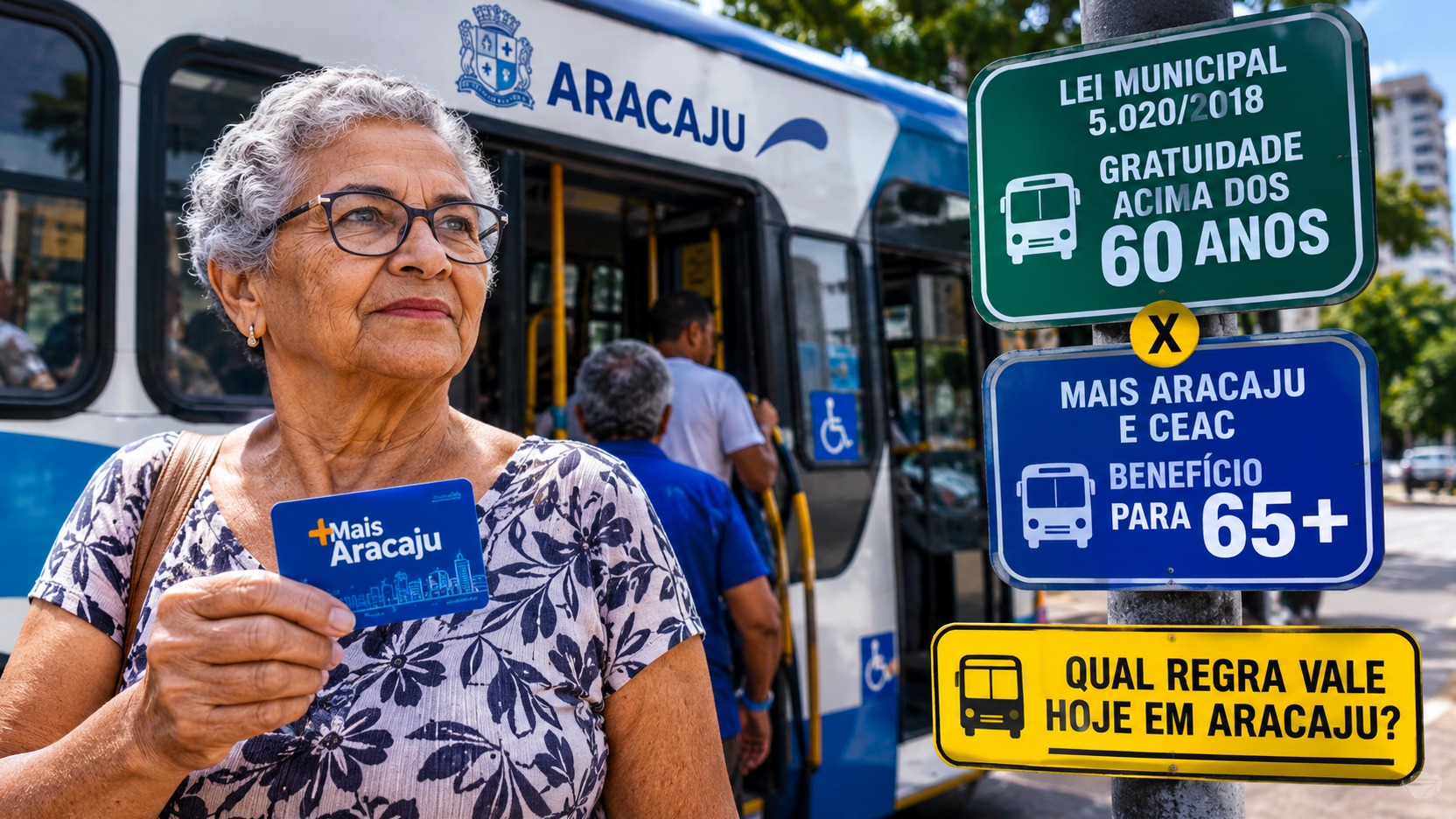
In August 2026, the practical answer for those who use public transport in Aracaju is simpler than the legal history: the current channels of Mais Aracaju, CEAC and Setransp treat free elderly people as a benefit from the age of 65. For those between 60 and 64, there is a 2018 municipal law that sought to expand the right, but the application was hit by a judicial suspension and continues to be surrounded by contradictory institutional messages. Therefore, it is not safe to board in this age group counting on automatic gratuity just because of the text of the law.
What is valid today in practice
Mais Aracaju currently informs that the free card for seniors is intended for people aged 65 and over and requires 65 years of age to register. Aracajucard's FAQ page repeats the same age. CEAC maintains a service called Mais Aracaju Gratuidade Idoso+65. On April 6, 2026, Setransp also published that, in the case of the elderly, the right is guaranteed from the age of 65.
This set is the clearest operational reference found for 2026. It shows how the benefit is being registered and communicated by those who manage the card and by the transport sector. This does not erase the existence of Municipal Law 5,020/2018, but it explains why a person aged 60 to 64 may encounter a fee charge or denial of the benefit even after locating a municipal law talking about free of charge.
Why does the Elderly Persons Statute say 65 years of age
Federal Law 10,741/2003, the Elderly Person Statute, considers an elderly person to be aged 60 or over. For free urban and semi-urban public transport, however, article 39 establishes the national guarantee for those over 65 years of age. To exercise this right, federal law says that a personal document proving age is sufficient.
The same article opens a door for the 60 to 65 year old age group. The third paragraph allows local legislation to establish the conditions for these people to be free of charge. It was exactly this space that the Aracaju Chamber tried to use in 2018.
What Law 5,020/2018 changed in Aracaju
Municipal Law 5,020 is dated April 19, 2018. Official City Hall records summarize its menu as free urban public transport within the Municipality of Aracaju for those over 60 years of age. At the time, the Chamber announced the measure as an expansion of the benefit for seniors over 60.
The Chamber's official release also stated that, according to the approved text, it would be enough to present an official document with a photo proving age upon boarding. The proposal, therefore, did not depend on the Mais Aracaju card to exist: the idea was to make the identity document function as proof of the right.
There is a small difference in language that deserves attention. The menu registered by City Hall uses the expression over 60 years old, while the Chamber's political and institutional communication treated the change as free at age 60. For the everyday doubts of those between 60 and 64, the central point is that the municipal law was created to reduce the 65-year mark provided for as a general rule in the Statute.
The judicial suspension that changed history
Shortly after publication, Law 5,020/2018 was taken to the Court of Justice of Sergipe. In May 2018, the TJSE granted a precautionary measure suspending its effects. The news at the time raised questions about initiative defects, the creation of expenses without indicating the source of funding and the limits of a municipal law in the face of a transport system integrated into the metropolitan region.
The Aracaju Chamber itself returned to the topic in November 2018 and publicly addressed the suspension of the law. A subsequent jurisprudential reference, reproduced in an official decision from another court in 2024, identifies the TJSE process as 0003244-37.2018.8.25.0000 and records the unanimous granting of the injunction that suspended the effectiveness of the rule.
The important point is to distinguish a precautionary measure from a final decision on the merits. In the research carried out for this article, no subsequent final decision was found in the official sources and indexed public decisions consulted that would unequivocally resolve the entire controversy. Therefore, it would be imprudent to simply state that the law has been definitively annulled or, in the opposite sense, that it can be exercised today without any obstacles.
Why the confusion continued after 2018
The divergence was not restricted to the Judiciary. In October 2019, Procon Aracaju itself published guidance saying that Law 5,020/2018 guaranteed free urban public transport and that an official document with a photo would be enough. This manifestation appeared after the precautionary suspension reported in 2018 and shows how different public bodies began to communicate the topic in ways that did not fit perfectly.
Meanwhile, the ticketing system continued to consolidate the free card for seniors aged 65 and over. This difference between what certain municipal pages said about the law and what the transport operation recorded is the practical origin of much of the doubt that still exists.
In 2026, the Chamber once again enforced the 60-year rule
On February 11, 2026, the matter officially returned to the City Council plenary. During the Grand Expediente, councilor Iran Barbosa stated that Law 5,020/2018 would be in full force and criticized the Mais Aracaju material for continuing to inform for 65 years. He also maintained that the Chamber should act to enforce local regulations and recalled that the Statute allows municipal regulation for the age group between 60 and 65.
This statement is relevant because it shows that divergence is still alive within the municipal public authorities themselves. But it needs to be read for what it is: the position of a parliamentarian recorded in an official session. It does not, in itself, amount to a new court decision nor does it automatically change the procedure adopted by the transport operator.
Until the research carried out in August 2026, the operational channels consulted remained at 65 years. No subsequent change was found by Mais Aracaju, CEAC or Setransp implementing the registration of elderly people aged 60 to 64 as a current rule.
Timeline of the standoff, 2018 to 2026
April 2018: municipal law expands the range
Law 5,020/2018 is published with the aim of providing free municipal urban public transport to those over 60 years of age. The Chamber announces that an official document with a photo would be enough to prove age.
May 2018: TJSE suspends the effects
A precautionary measure from the Court of Justice of Sergipe suspends the effectiveness of the law while its constitutionality is discussed. The debate involves legislative initiative, financial impact and funding.
October 2019: the municipal Procon talks about free services over 60
Guidance published by Procon Aracaju treats Law 5,020/2018 as a guarantee of free access and says that registration or card would not be necessary, just a photo ID. Public communication, therefore, already showed signs of conflict with the judicial and operational situation.
February 2026: councilor demands law enforcement
In the Chamber, Iran Barbosa states that the law is in force and contests the 65-year-old disclosure made by Mais Aracaju. The charge is included in the official shorthand notes for the February 11th session.
April and August 2026: the system continues to report 65+
Setransp, Mais Aracaju and CEAC continue to present 65 years as the age for free senior citizens. It is this rule that appears consistently in the service and registration channels consulted.
So, who is 60 to 64 years old pays for the bus in Aracaju?
From 60 to 64 years old
There is a basis in municipal law to question the charge, and the Chamber itself defended this understanding again in 2026. At the same time, there is a history of judicial suspension of the rule and, in the system's current channels, there is no registration of elderly people in this range as a confirmed operational benefit. Therefore, a person aged 60 to 64 should not count on automatic free boarding just by presenting their ID.
In practice, the passenger must consider that the fare may be charged until the discrepancy is resolved clearly and incorporated into the system procedure. If there is a refusal and the person wants to contest it, it is worth registering the incident and seeking administrative or legal guidance, because the discussion goes beyond a simple ticketing rule.
Aged 65 or over
The situation is much clearer. Urban free provision is guaranteed by the Elderly Persons Statute and is recognized by the current channels of Mais Aracaju, CEAC and Setransp. Mais Aracaju accepts the registration of seniors over 65 years of age and informs that the card allows free access to the ticketing system.
Where to confirm before boarding
For a practical decision on the day of travel, the first check should be made on the current Mais Aracaju channels and on the CEAC service page, because they are the ones that inform the card registration criteria. Mais Aracaju maintains virtual service at (79) 3045-2550. In case of specific doubts about the municipal rule or about a denial of transportation, SMTT is the regulatory body that should be consulted.
Those who are between 60 and 64 years old and intend to demand free tuition based on Law 5,020/2018 need to keep in mind that the issue is not presented in a uniform way by the institutions. Before boarding, confirm the procedure to avoid depending on an interpretation that may not be recognized by the driver, the validator or the system's customer service at that time.
What is confirmed and what remains contested
It is confirmed that the Statute of the Elderly Person guarantees free urban assistance from the age of 65 and allows local legislation to deal with the range from 60 to 65. It is also confirmed that Aracaju enacted Law 5,020/2018 to expand the benefit, that the TJSE suspended its effectiveness as a precautionary measure and that the Chamber returned to demand the application of the rule in February 2026.
The current operational data is also objective: Mais Aracaju, CEAC and Setransp continue working with 65 years. What remains contested is the practical enforceability of free tuition for those aged between 60 and 64 in light of municipal law, judicial history and contradictory public messages.
The safest answer, therefore, is to separate written law from actually operationalized law. For people aged 65 and over, free access is confirmed and available on current channels. For those aged 60 to 64, there is a municipal basis that supports the claim, but there is currently no clear operational implementation that allows for the promise of free boarding without dispute.