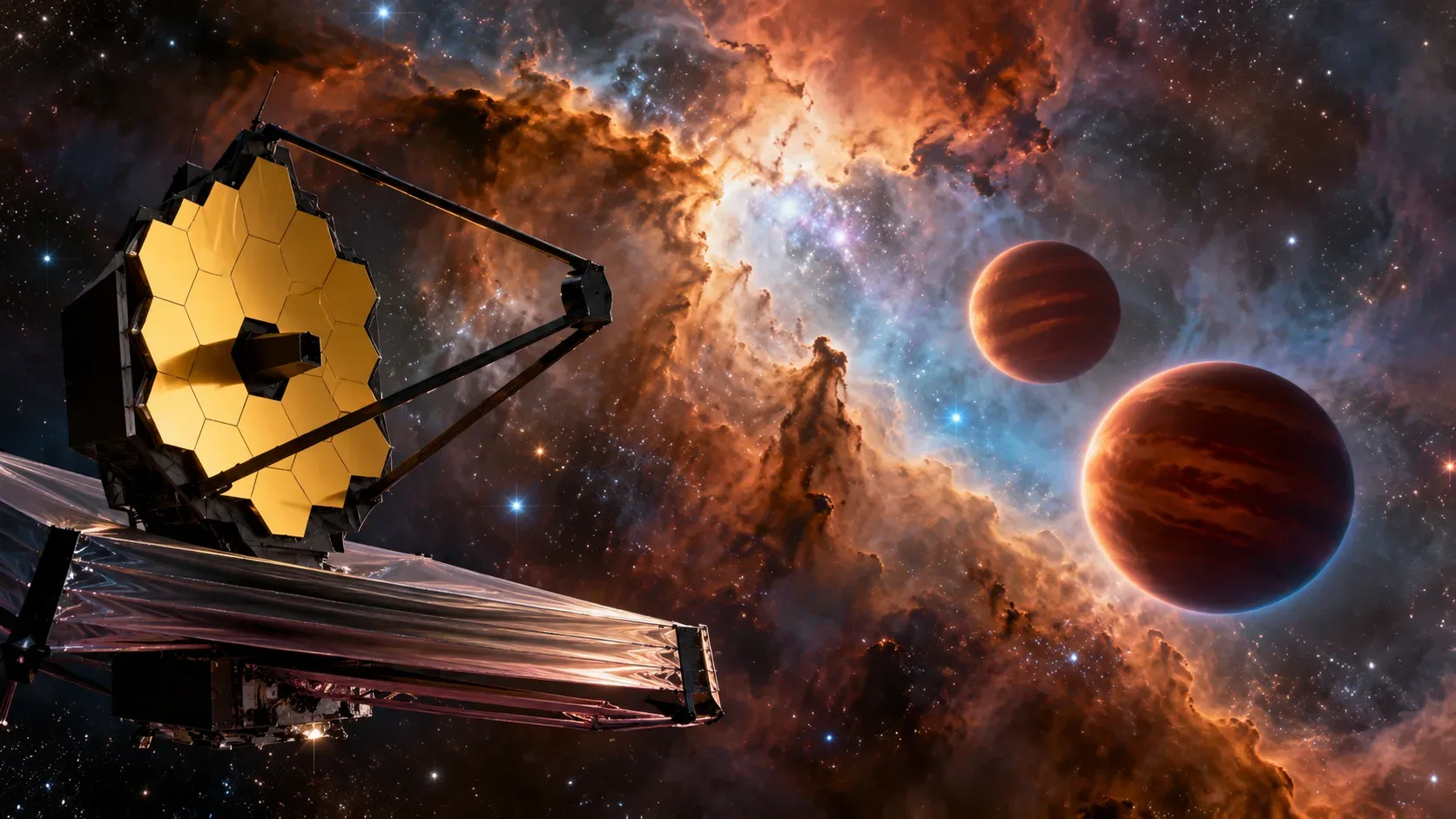
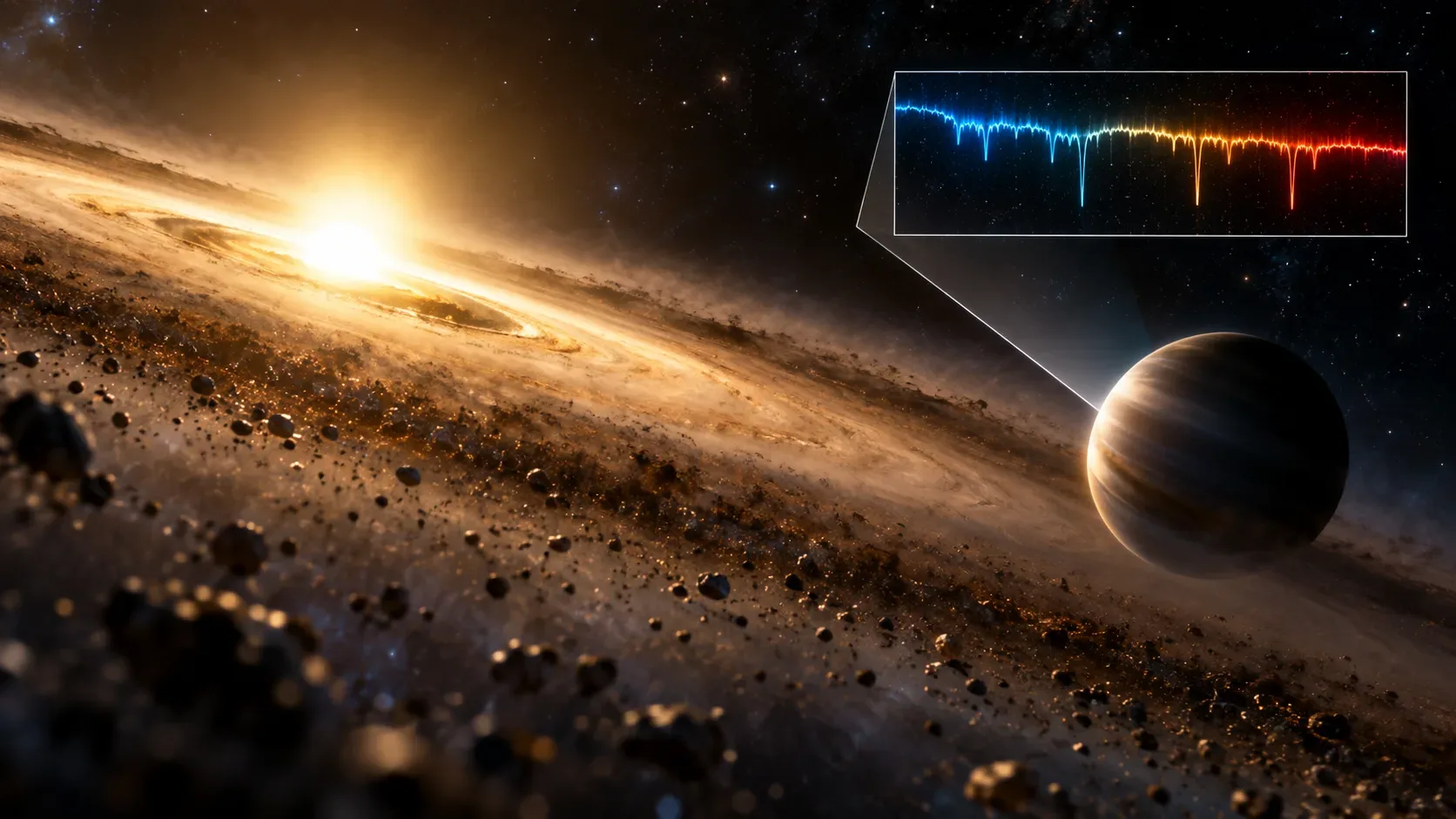
Beta Pictoris d was not first accepted as a trustworthy point of light. While analyzing Beta Pictoris b with the James Webb Space Telescope, the team found a spectral pattern in NIRSpec data that did not match the smooth light expected from dust in the system. The pattern consisted of carbon monoxide (CO) absorption lines, a characteristic signature of gas-giant atmospheres. From there, the reconstructed position and the radial velocity extracted through the Doppler effect showed that the source was consistent with a planet bound to the Beta Pictoris system.
What Webb found in Beta Pictoris
Beta Pictoris is a young star about 63 light-years from Earth, surrounded by a bright disk of dust and debris. Two giant planets, Beta Pictoris b and c, were already known. In July 2026, NASA announced the identification of a third, Beta Pictoris d, making the system only the second known to contain at least three directly imaged planets.
The new planet is estimated at roughly 2 to 4 Jupiter masses in the scientific paper, while NASA's summary describes it as likely at least twice Jupiter's mass. Orbital modeling points to an outer orbit with a semimajor axis greater than 30 astronomical units, roughly the distance regime associated with Neptune in our Solar System. These properties are model-derived estimates and can still be refined.
Why a bright point was not enough
The system is especially difficult for high-contrast imaging because its debris disk is extremely bright. Dust scatters starlight and can produce structures and blobs that resemble point sources. Instrumental artifacts can also appear as bright regions.
The team itself reported an unexpected bright source in the reconstructed NIRSpec image, but did not treat it as sufficient proof. The advantage was having spectral information from the same region at the same time. Instead of asking only “is there a point here?”, the researchers could ask “does the light from this point carry the molecular signature and motion expected from a planet?”.
Step 1: the NIRSpec IFU turns each image region into a spectrum
The observation used NIRSpec's Integral Field Unit, or IFU. This mode combines spatial and spectral information: for each element in the scene, the instrument records how brightness changes with wavelength. The result is a data cube in which each position can be examined through its spectrum rather than only its total intensity.
Astronomers were using this capability to study the atmosphere of Beta Pictoris b. Beta Pictoris d appeared serendipitously in the data. That matters because the detection did not begin with a conventional search for a new bright dot followed by a confirmation spectrum; the spectral pattern itself was the signal that drew attention.
Step 2: the CO “barcode” separated planet from dust
Where the team expected a relatively smooth spectrum of starlight scattered by dust, narrow peaks and troughs appeared. They matched a sequence of carbon monoxide absorption lines. In spectroscopy, molecules absorb light at specific wavelengths; the collection of those lines acts like a chemical fingerprint.
For Beta Pictoris d, the CO pattern was the kind expected in the atmosphere of a warm gas giant. The debris disk can be bright, but it does not reproduce that narrow, organized set of atmospheric lines. Spectroscopy therefore helped separate a planetary source from structures produced by the disk.
The NASA image-and-spectrum release illustrates this logic: the object's signal is extracted and compared with a model, with the CO-dominated absorption region highlighted between roughly 4.3 and 5 micrometers.
Step 3: the Doppler effect showed the source moving as part of the system
Identifying CO alone is not enough to prove that a source belongs to Beta Pictoris. A background star or brown dwarf can also contain molecules in its atmosphere. The next step was to measure shifts in the spectral lines.
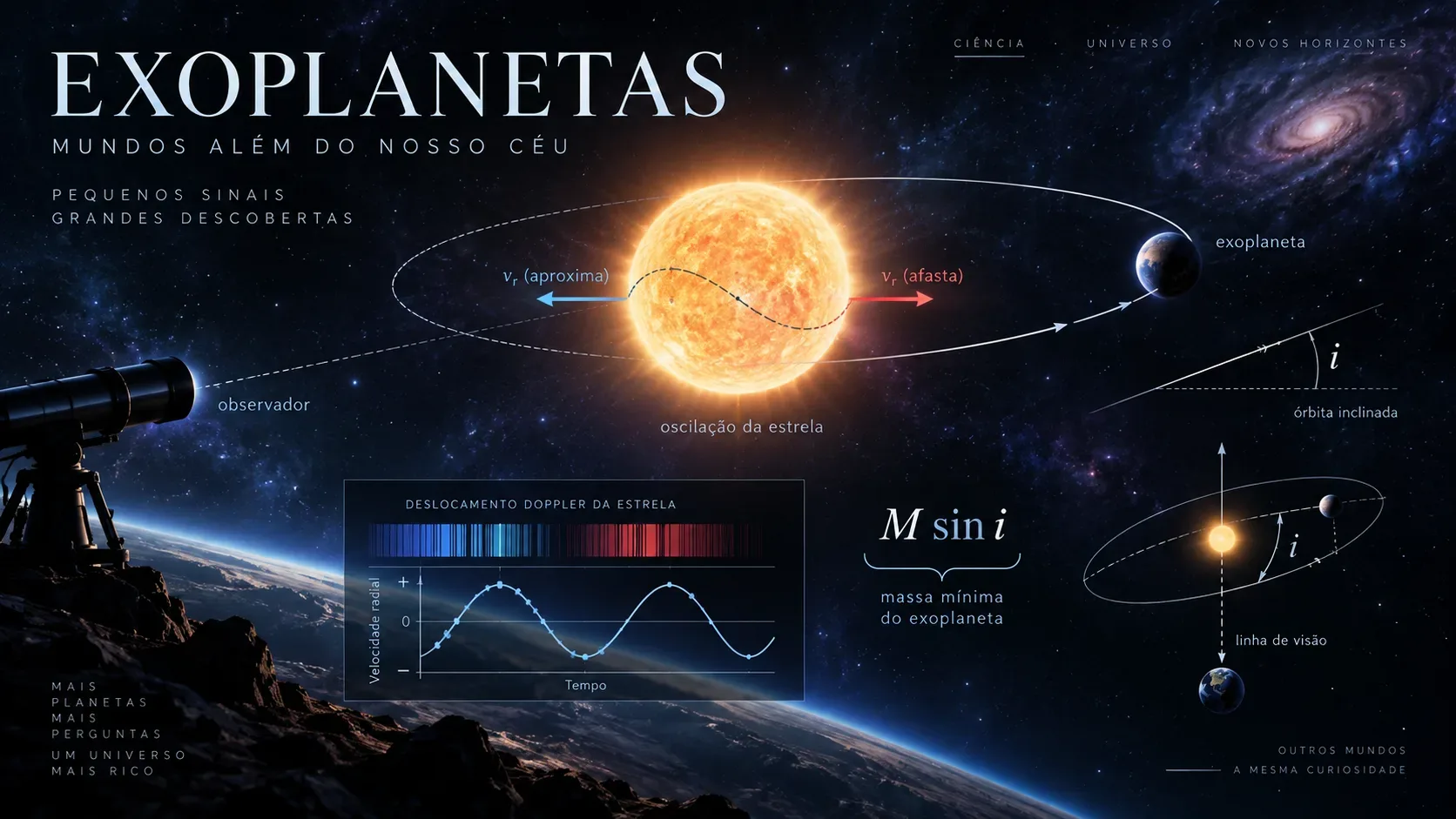
When a source moves toward or away from us along the line of sight, its lines shift slightly in wavelength because of the Doppler effect. That shift provides radial velocity. Beta Pictoris d's radial velocity, combined with its projected position and alignment relative to the disk, was consistent with a body orbiting Beta Pictoris rather than an unrelated background object.
This is the core of the method: the same spectrum that revealed chemical composition also provided dynamical information. The team did not have to rely only on the appearance of the reconstructed blob.
Step 4: new observations strengthened the identification
The initial detection came from NIRSpec observations. A second observing epoch, including NIRSpec and MIRI's Medium Resolution Spectrometer, confirmed the signal. Spectral analysis also found absorption associated with methane (CH4) and water (H2O), in addition to CO, broadening the chemical picture of the atmosphere.
An independent imaging study using data from ESO's Very Large Telescope and Webb's NIRCam also confirmed the existence of Beta Pictoris d. The discovery therefore does not depend on a single visual reconstruction or on one molecular line.
What was observed and what still depends on models
| Result | Basis for the conclusion | Status |
|---|---|---|
| A planetary source is present in the region | Atmospheric spectral pattern, reconstructed position, and later confirmations | Confirmed by observations |
| CO in the atmosphere | Series of absorption lines in the spectrum | Spectroscopically detected |
| CH4 and H2O | Later NIRSpec/MIRI spectra | Detected in follow-up analysis |
| Association with Beta Pictoris | Radial velocity, position, and system geometry | Consistent with a gravitationally bound object |
| Mass of about 2–4 Jupiters | Effective temperature plus atmospheric and evolutionary models | Model estimate |
| Semimajor axis above 30 AU | Radial velocity, astrometry, and orbital stability | Modeled orbital constraint |
| Role in shaping the disk's inner edge | Compatibility between the estimated orbit and disk structure | Plausible hypothesis, not direct proof |
Why this discovery differs from ordinary direct imaging
Direct imaging of exoplanets usually depends on suppressing the star's glare and searching for a faint source around it. Beta Pictoris d shows another route: search inside a confusing field for a molecular pattern that acts as a physical filter for a planet. The scientific paper describes it as the first planet discovered through spectral template matching with moderate-resolution spectroscopy; NASA summarizes the result as the first directly imaged planet discovered primarily through this spectroscopic approach.
This does not eliminate imaging. The IFU preserves spatial position and makes it possible to reconstruct where the signal comes from. The difference is that the object's identity does not first depend on standing out visually. Chemistry and velocity can make the planet emerge even when dust complicates broadband imaging.
What the technique could change in exoplanet searches
The gain is especially relevant for young, dusty systems where disk structures can hide planets or mimic compact sources. Moderate-resolution spectra contain many molecular lines at once; combining those lines improves the ability to distinguish a planetary atmosphere from the background.
Beyond locating a planet, the same dataset already begins to answer other questions: which molecules are present, what the radial velocity is, and which temperature and gravity models best reproduce the spectrum. For Beta Pictoris d, discovery and atmospheric characterization effectively began together.
What is still unknown about Beta Pictoris d
The planet's existence is confirmed, but its physical and orbital parameters still carry uncertainty. The 2-to-4-Jupiter-mass range is model dependent; the orbit still needs refinement with additional astrometric and radial-velocity epochs. It is also plausible that the planet helps carve the inner edge of the debris disk, but that dynamical connection requires further modeling and monitoring.
The strongest part of the discovery is methodological: in an environment where a bright blob could have been dust, an artifact, or another object, the team isolated a molecular atmospheric signature, measured its Doppler shift, and showed that its position and motion matched a planet in the system. That is why Beta Pictoris d is an example of detection in which the spectrum came before confidence in the “point of light.”