Short answer: radial velocity by itself usually does not measure an exoplanet's true mass. It measures the line-of-sight component of the star's back-and-forth motion caused by the planet's gravity. Because that component depends on orbital inclination, the result is commonly expressed as M sin i: a minimum mass. If the inclination i is known from another method, the true mass can be recovered.
What radial velocity actually measures
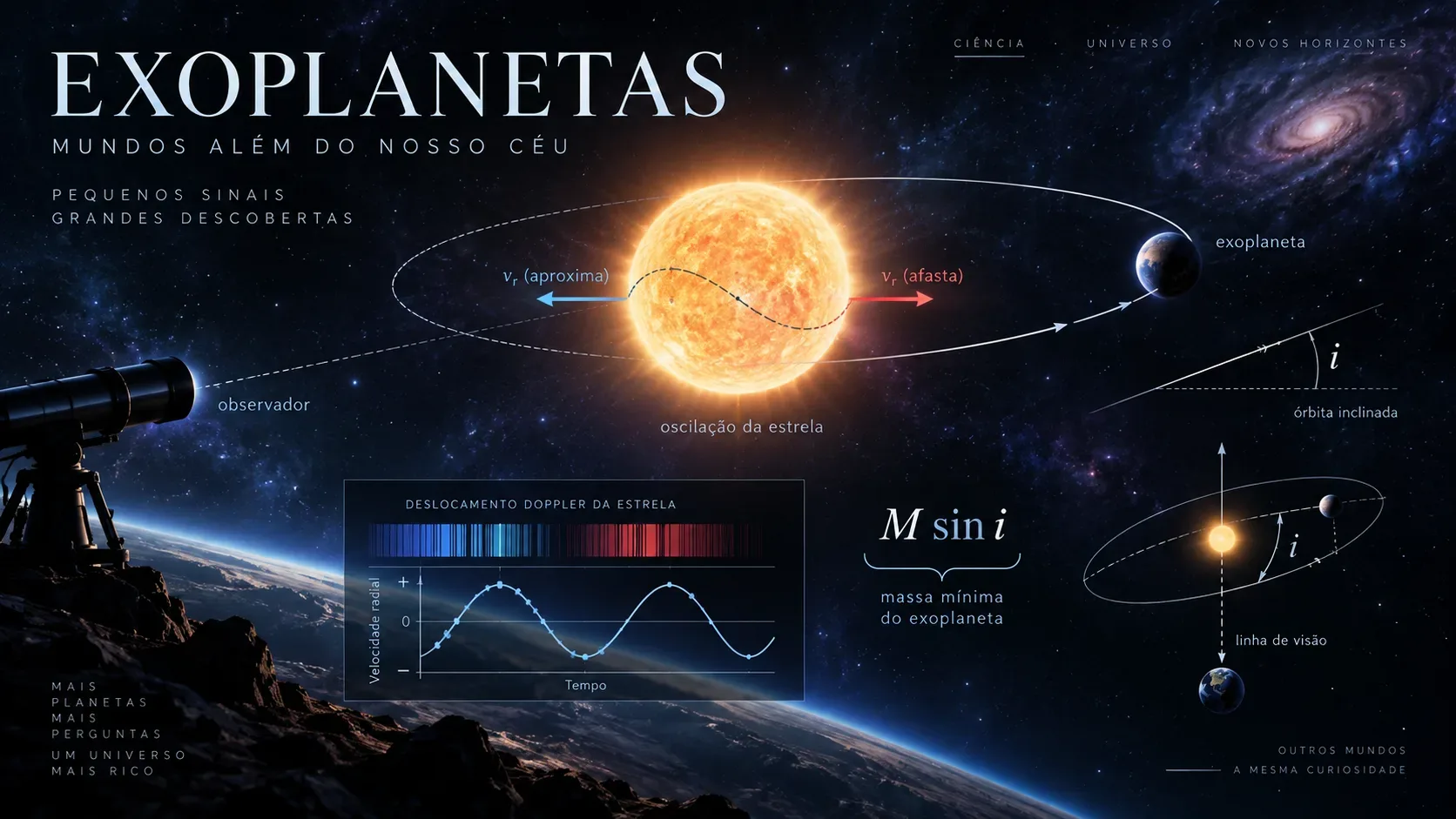
The planet and star orbit their common center of mass. Although the planet traces the larger orbit, the star also follows a small reflex orbit. When the star moves toward us, its spectral lines shift toward shorter wavelengths; when it moves away, they shift in the opposite direction. The radial-velocity method measures this Doppler variation over time.
An orbital fit returns, among other parameters, the radial-velocity semi-amplitude K, which is half the peak-to-peak range of the observed velocity. The NASA Exoplanet Archive keeps separate fields for “Planet Mass” and “Planet Mass*sin(i),” defining the latter as the minimum mass measured by radial velocity.
In the usual approximation where the planet is much less massive than the star, the amplitude grows approximately with M × sin i, decreases for longer orbital periods, and also depends on stellar mass and eccentricity. The NASA Exoplanet Archive documentation for the semi-amplitude K explicitly includes period, planet mass, stellar mass, inclination and eccentricity in the calculation.
Why sin i appears
The sin i factor is geometric. Radial velocity only sees the part of the star's motion projected onto the line connecting the system to Earth. In the convention commonly used for exoplanets, an orbit with i = 90° is viewed edge-on, while an orbit with i = 0° is viewed face-on.
- i = 90°: sin i = 1. The radial projection is maximal, and M sin i equals M.
- Intermediate i: only a fraction of the orbital motion appears in the radial direction.
- i near 0°: the star still moves around its reflex orbit, but almost all of that motion is in the plane of the sky, so the Doppler signal becomes very small.
That is why two physically identical systems can produce different radial-velocity amplitudes simply because they are viewed at different inclinations.
Why M sin i is called a minimum mass
In the usual planetary approximation, if the fit gives M sin i, the true mass can be thought of as M = (M sin i) / sin i. Because sin i is never greater than 1, dividing by sin i never makes the mass smaller. The true mass is therefore equal to or greater than M sin i.
| Inclination i | sin i | Factor M/(M sin i) | If M sin i = 10 M⊕ |
|---|---|---|---|
| 90° | 1.000 | 1.00× | 10.0 M⊕ |
| 60° | 0.866 | 1.15× | 11.5 M⊕ |
| 30° | 0.500 | 2.00× | 20.0 M⊕ |
| 10° | 0.174 | 5.76× | 57.6 M⊕ |
| 5° | 0.087 | 11.47× | 114.7 M⊕ |
The table shows why “minimum mass” is literal. An object with M sin i of 10 Earth masses may be close to that value if its orbit is near 90°, but it can be far more massive if the orbit is nearly face-on. This does not mean every radial-velocity detection hides a huge mass: nearly face-on orientations occupy a small geometric range, and each system must be judged from the available data.
A quick thought experiment for the degeneracy
Imagine the same planet, with the same mass and period, orbiting the same star. First place the orbit edge-on to the observer. The star clearly alternates between moving toward and away from us, so the Doppler signal is strong. Now tilt the orbit gradually until it is almost face-on. The physical orbital speed does not disappear, but its line-of-sight projection shrinks. The spectrograph measures less radial velocity and, without knowing the inclination, cannot tell whether the small signal comes from a genuinely low-mass planet or a more massive object seen at low inclination.
When the true mass can be obtained
Transit + radial velocity
A transit happens when the planet passes in front of the star along our line of sight, which requires a nearly edge-on geometry. The transit light curve can constrain the orbital inclination. EXOFAST, for example, lists i among transit parameters and M sin i among radial-velocity parameters. When both data sets are fitted together, inclination is no longer unknown and the mass can be determined without the projection ambiguity. A transit by itself mainly measures relative size and geometry; it does not automatically replace a mass measurement.
Astrometry
Astrometry tracks the star's displacement across the plane of the sky. That provides the geometric information that radial velocity lacks. With a well-determined astrometric orbit, inclination can be inferred and combined with the Doppler signal to obtain the true mass. NASA highlights astrometry as a technique capable of measuring exoplanet masses and orbital parameters in material from its Exoplanet Exploration Program Analysis Group.
Other orbital constraints
In specific cases, direct-imaging monitoring or dynamical interactions in multi-planet systems can also constrain inclination or mass. The general principle is the same: the M sin i degeneracy is broken when independent information about the orbit's three-dimensional orientation or dynamics becomes available.
How to read a catalog without confusing M sin i with true mass
If a table explicitly lists M sin i or “minimum mass,” treat the number as a lower limit, not as an already known three-dimensional mass. The NASA Exoplanet Archive itself keeps distinct fields for mass, M sin i and a “best mass” whose provenance indicates which kind of measurement is available. This distinction matters because two planets with the same M sin i can have different true masses if their inclinations differ.
It is also worth checking whether the system transits or has an astrometric solution. For a transiting planet, the inclination is usually close to 90°, so the sin i correction is small. For a planet detected only by radial velocity with no additional geometric constraint, the true mass remains degenerate with inclination.
Common mistakes when interpreting radial-velocity mass
- Calling M sin i the exact mass: it is a minimum mass while i is unknown.
- Assuming lower inclination means a smaller planet: the opposite is true; for the same M sin i, lower i requires a larger true mass.
- Equating a small radial velocity with no motion: in face-on orbits, most of the motion can lie in the plane of the sky.
- Assuming a transit alone gives the mass: transit data mainly provide radius and geometry; mass commonly comes from radial velocity, transit-timing variations or another dynamical technique.
- Ignoring other uncertainties: stellar mass, eccentricity, instrumental noise and stellar activity also affect the inference.
How to interpret a radial-velocity result in five steps
- Identify whether the published value is “mass” or “M sin i/minimum mass.”
- Check the period, eccentricity and semi-amplitude K used in the fit.
- Look for an independent measurement of orbital inclination.
- If transit or astrometry data exist, prefer a joint solution that uses that inclination rather than applying an isolated correction yourself.
- Read the error bars and provenance: the minimum mass also carries observational and model uncertainties.
In summary
Radial velocity measures the star's motion projected along our line of sight. The observed amplitude therefore contains the sin i factor and, when inclination is unknown, the method yields M sin i, the exoplanet's minimum mass. For an edge-on orbit, M sin i is essentially the true mass; as the orbit approaches face-on, the true mass required to produce the same signal increases. Transits, astrometry and other orbital constraints can provide inclination and turn a minimum mass into an estimate of the true mass.