The key point in the new James Webb result is not simply that free-floating objects can have masses comparable to giant planets. In IC 348, some of them show the characteristics of young brown dwarfs associated with a star-forming region and have estimated masses of only about twice Jupiter's mass. That pushes the observed lower end of substellar formation downward and forces models to explain how such a small fragment of a molecular cloud can collapse and survive as an isolated object.
What Webb found in IC 348
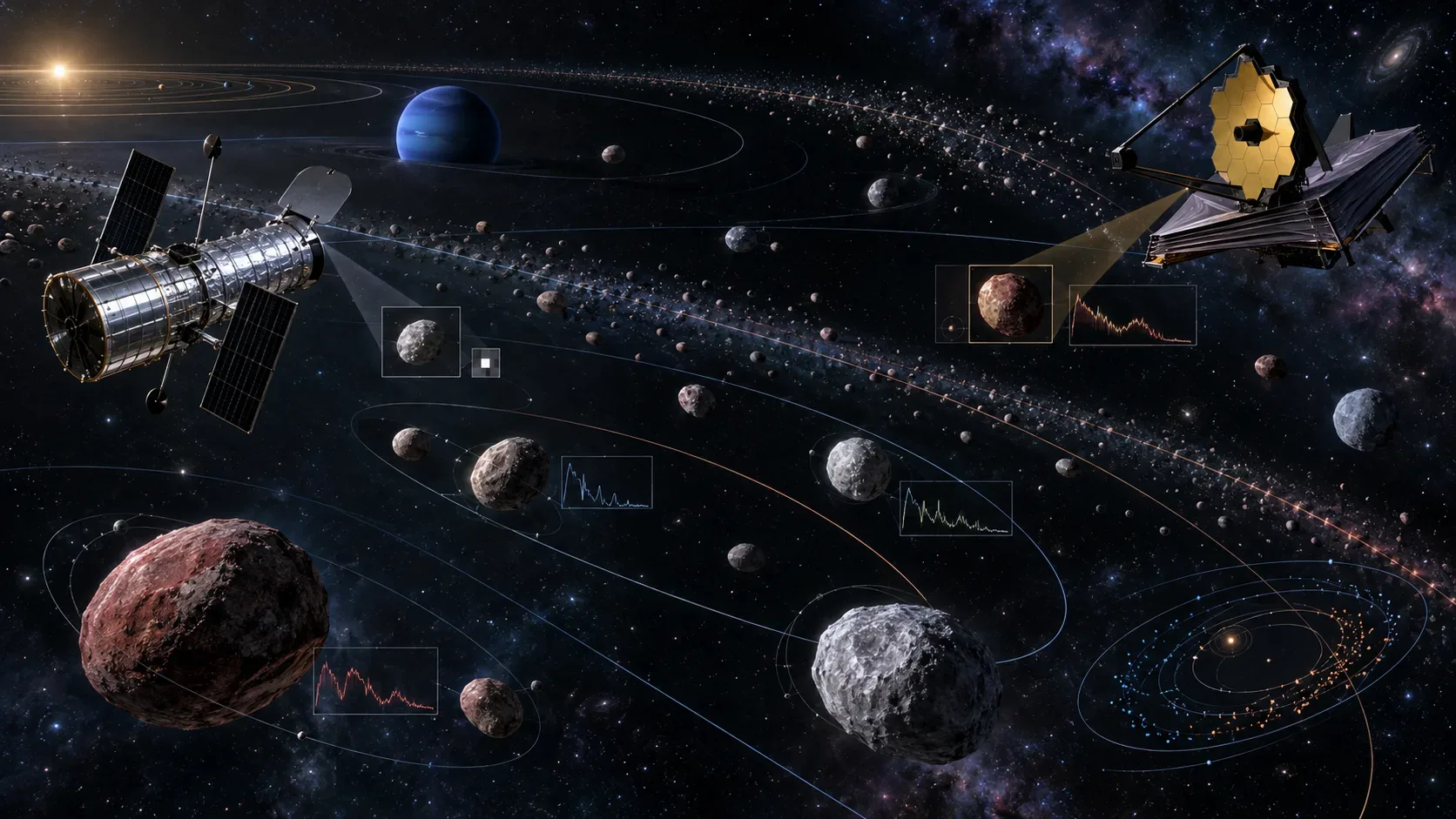
On September 15, 2026, NASA released new observations of IC 348, a star-forming region about 1,000 light-years away in the constellation Perseus. The team used Webb's NIRCam to identify very faint, red candidates and then used NIRSpec to obtain spectra of the most promising targets. According to the NASA release, the least massive objects reach about two Jupiter masses, or roughly 0.19% of the Sun's mass.
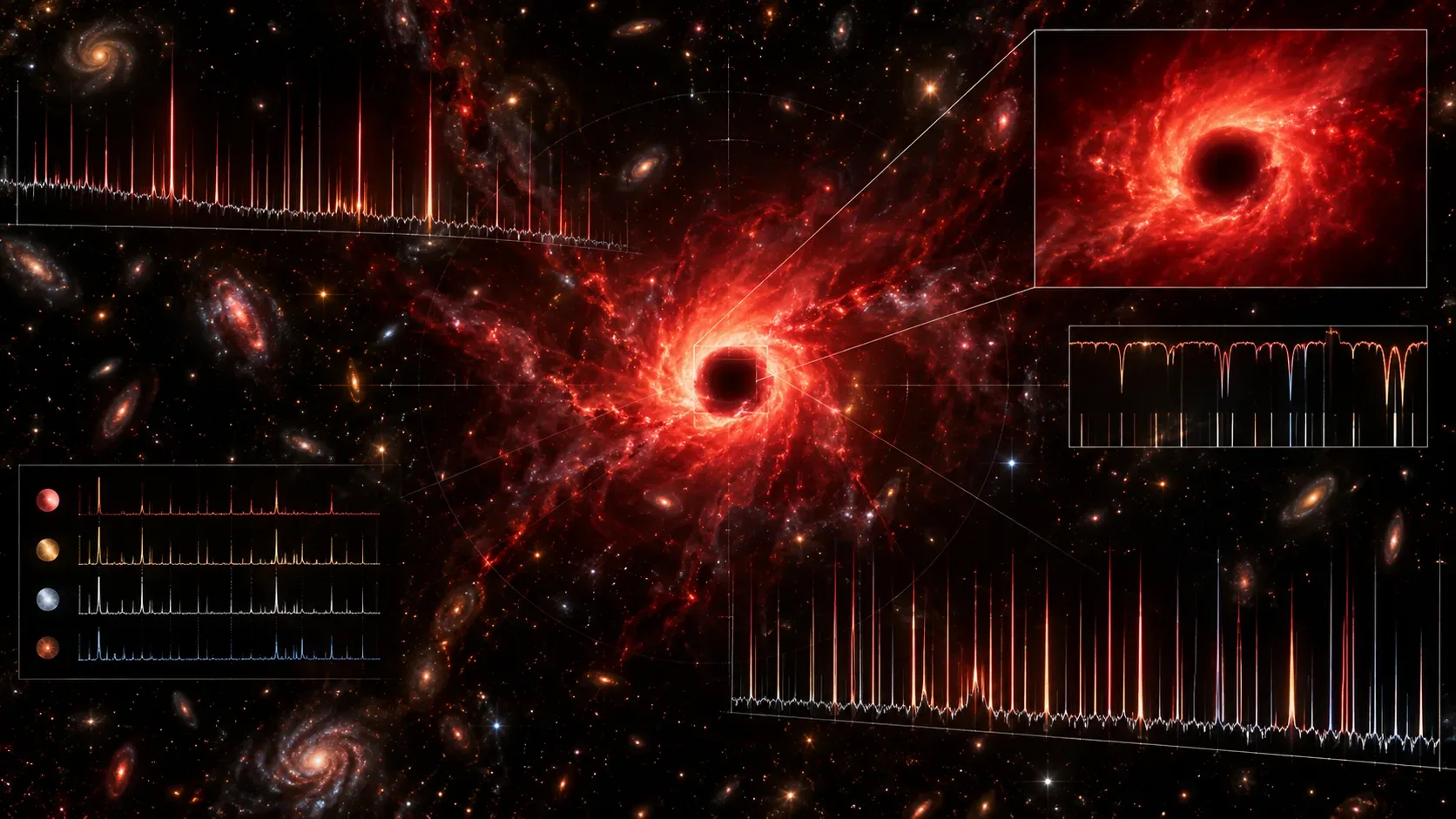
The scientific study by Kevin Luhman and Catarina Alves de Oliveira describes a deeper and wider search than the earlier survey. In the NIRCam images, the researchers selected 39 brown dwarf candidates. NIRSpec provided usable spectra for 15 of them, and nine were classified as new substellar members of IC 348. The faintest have estimated masses near two Jupiter masses, which the authors present as a new observational constraint on the bottom of the initial mass function, the distribution of masses with which stars and brown dwarfs are born.
Why two Jupiter masses is so small for an object formed like a star
Stars and brown dwarfs form when cold, dense parts of molecular clouds lose support and undergo gravitational collapse. At progressively lower masses, however, gravity becomes weaker and it is harder to compress gas against thermal pressure, turbulence, and other effects that resist collapse. At some point there should be a limit below which a fragment cannot keep dividing and collapsing in a star-like way.
That theoretical limit is not a single universal number. It depends on assumptions about temperature, density, gas opacity, metallicity, turbulence, and environment. A 2026 study of the origin of the IC 348 objects notes that classic estimates for the so-called opacity limit for fragmentation in solar-metallicity gas are around 10 Jupiter masses, while other work explores lower values. Finding objects near two Jupiter masses with signs of youth and cluster membership therefore pushes star-like formation into a mass range also occupied by giant planets.
The challenge is not that a law of physics has been broken. It is that models must reproduce stable fragments at masses lower than many predictions expected and explain how often that occurs.
How Webb separates a brown dwarf from a distant galaxy or a background object
Webb's sensitivity is crucial because young, low-mass objects still retain heat from their formation and shine strongly in the infrared. NIRCam can select candidates from combinations of brightness and color, but an image alone is not enough. Distant galaxies, background stars, and cool field dwarfs can mimic some of those colors.
The team therefore used NIRSpec to examine the shape of each spectrum. In the nine new members, water absorption bands and other spectral features are consistent with very cool, young objects. Youth matters because IC 348 is only a few million years old. An object with the observed temperature and luminosity at that age corresponds, in the evolutionary models used by the authors, to a very low mass.
This classification is more robust than photometric selection alone, but it does not turn the mass into a direct measurement. Mass is inferred by comparing luminosity, spectrum, and age with models of substellar evolution.
Why these objects are not automatically planets ejected from their systems
The boundary between a planet and a brown dwarf is not defined by mass alone. A giant planet can have a mass similar to that of an extremely light brown dwarf, but the two may have different formation histories. Giant planets normally form in disks around stars, while brown dwarfs are generally treated as products of molecular-cloud collapse and fragmentation.
One alternative for free-floating planetary-mass objects is that they formed in disks and were later ejected by gravitational interactions. That scenario remains possible in general, but a 2026 study in Monthly Notices of the Royal Astronomical Society compared the spatial distribution of the coolest IC 348 objects with simulations of ejected planets. The authors found that the observed distribution looks more like that of the cluster's stars and brown dwarfs than the more dispersed population expected for planets ejected through dynamical encounters.
That favors a star-like origin for this particular population, but it does not close the case. Other mechanisms, environments, and dynamical histories still need to be tested.
The disk around a two-Jupiter-mass object makes the case even more unusual
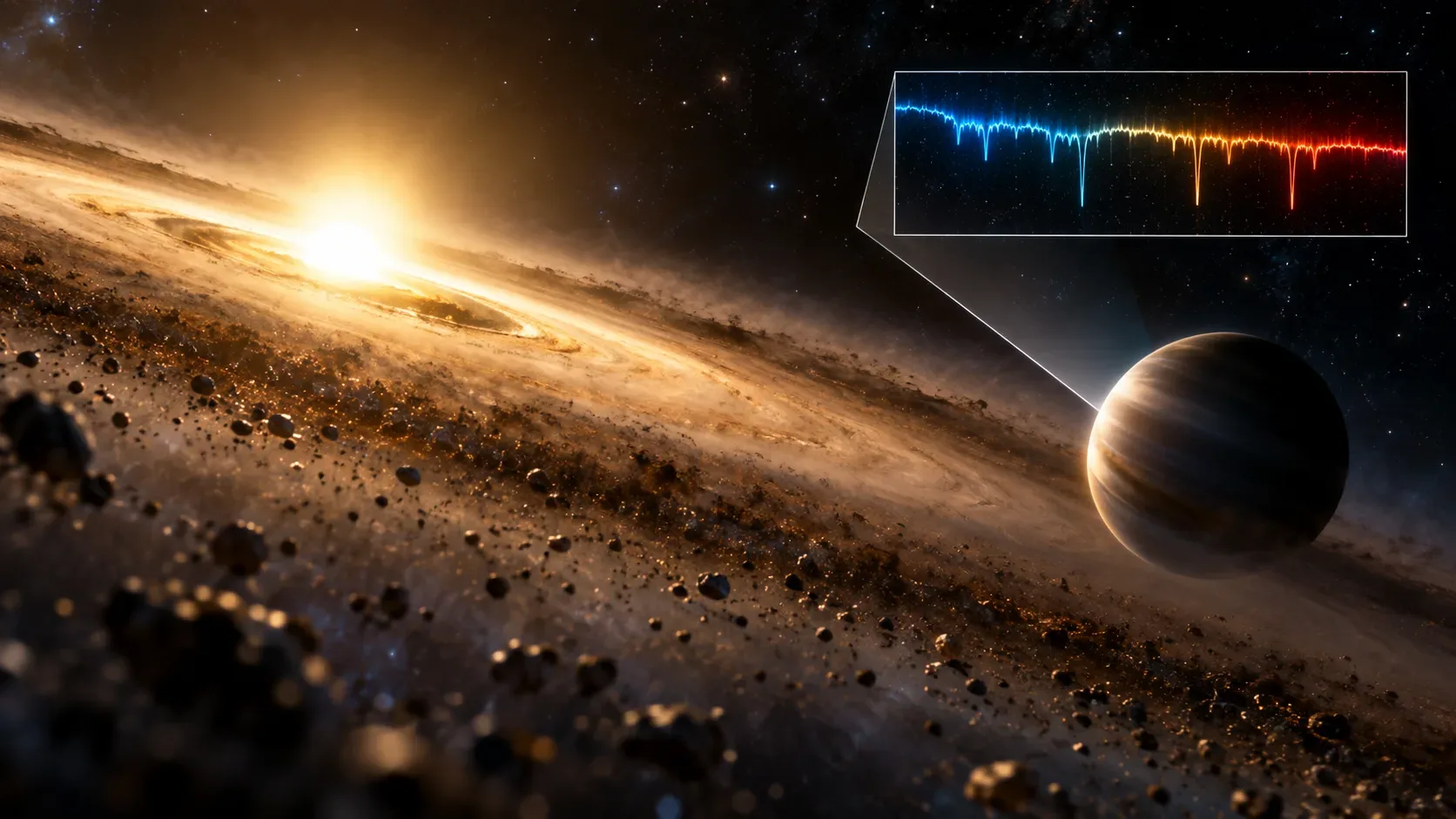
One of the lightest new members shows infrared excess emission associated with a circumstellar disk. The paper by Luhman and Alves de Oliveira reports disks around two new members, one near two Jupiter masses and another near ten. This indicates that even an object in the planetary-mass regime can retain surrounding material soon after formation.
The result matters because disks are reservoirs from which planets, moons, or small companions may form. The presence of a disk does not prove that planet formation will occur, but it extends the mass range of bodies capable of hosting this kind of structure.
The strange hydrocarbon and the proposed H spectral class
NIRSpec also revealed an absorption feature near 3.4 micrometers attributed to an aliphatic hydrocarbon that has not yet been precisely identified. The signal had appeared in objects from the earlier survey and became common among the faintest brown dwarfs in the expanded sample.
The authors found the feature in eight of the nine new members and in another previously known member observed in the new program, in addition to earlier detections. Because the absorption becomes stronger in fainter objects, they proposed the letter H for a new spectral class defined by this band. It is a scientific proposal, not a classification category already established across all schemes.
This detail also affects mass interpretation. If extremely young and cool atmospheres have chemistry that current models do not represent well, part of the relationship among spectrum, luminosity, temperature, and mass may need revision.
Limits of the finding: what has not yet been demonstrated
- Two Jupiter masses is a model estimate. These objects have not been weighed through a binary orbit or another dynamical method. The mass depends on the adopted age of IC 348 and on evolutionary and atmospheric models.
- The minimum formation mass has not been found. The result shows that the initial mass function reaches roughly two Jupiter masses in IC 348. It does not prove that this is the final floor.
- Not every candidate has spectroscopy. The photometric survey produced dozens of candidates, but only a subset was spectroscopically confirmed in the published study.
- IC 348 is one specific region. To know whether the same lower limit applies broadly, similar searches must be repeated in other star-forming regions with different ages, densities, and environments.
- Star-like formation remains an interpretation. Spatial distribution and signs of youth support that scenario for the population studied, but they do not directly reconstruct the birth of each individual object.
What formation models need to explain now
Webb has turned an abstract question, the smallest mass that the star-formation process can produce, into an observational test close to the Jupiter regime. A complete model will need to explain not only the existence of objects near two Jupiter masses, but also their frequency, distribution within the cluster, disks, and unusual atmospheric properties.
If future surveys confirm similar populations in other regions, the effective fragmentation limit may lie below what many classic calculations indicated, or multiple mechanisms may contribute to forming free-floating planetary-mass objects. If IC 348 turns out to be unusual, its local environment may be the key. In either case, Webb's main gain is that theory can now be tested against a sample reaching masses that were previously almost inaccessible to spectroscopy.
In summary
The roughly two-Jupiter-mass brown dwarfs in IC 348 challenge models because they occupy a range where the gravity of a cloud fragment is very weak and the mass overlaps with that of giant planets. Webb provides spectroscopic evidence that some of these objects are young and belong to the cluster, while studies of their distribution favor an origin more similar to stars than to ejected planets. Even so, their masses are model estimates, the minimum formation mass is not yet known, and other regions must be observed before IC 348 can be treated as a universal rule.