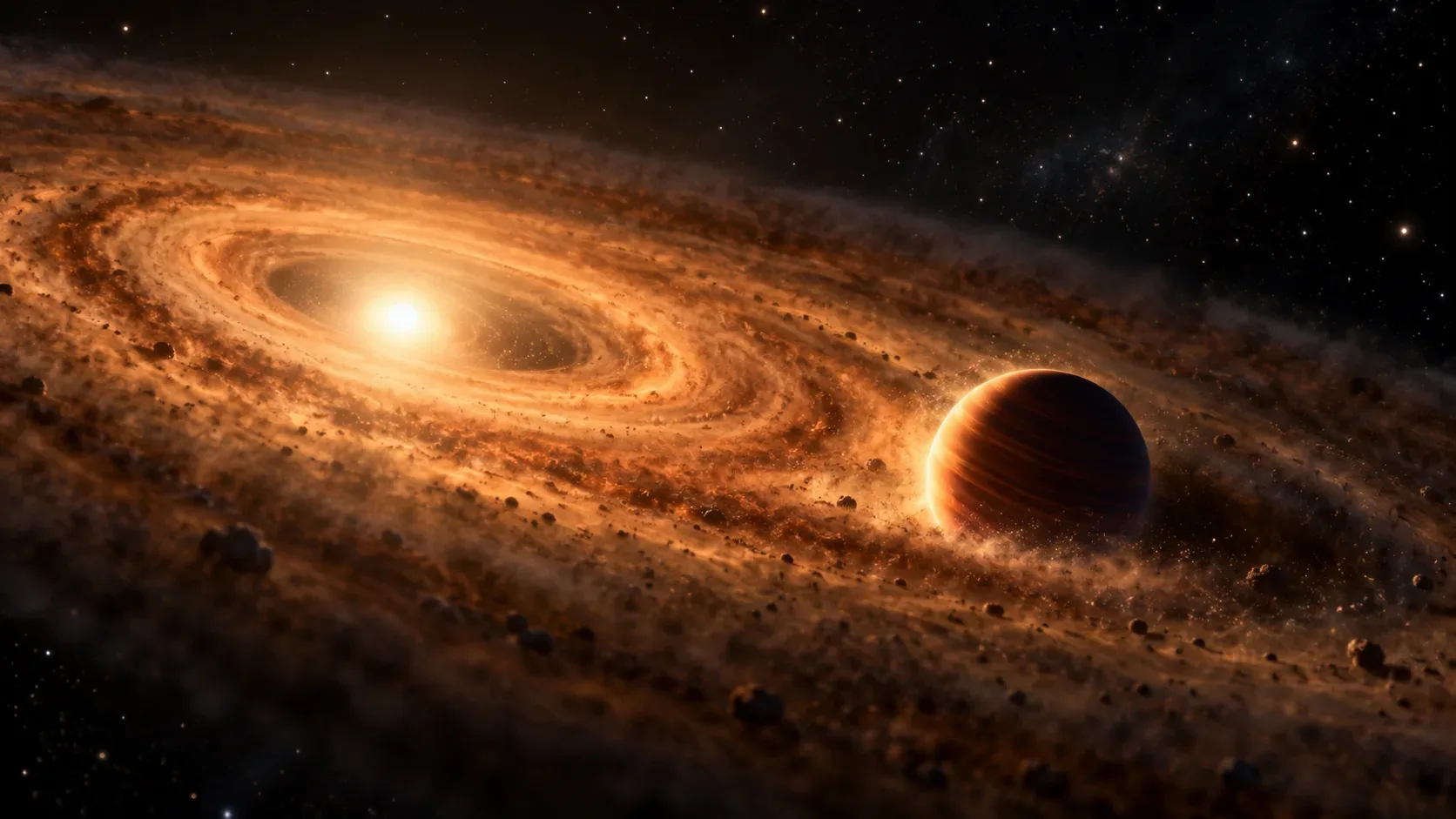
On September 16, 2026, NASA and W. M. Keck Observatory announced the confirmation of Elias 2-24 b, a forming planet embedded in the gas and dust disk of a young star about 450 light-years from Earth. The system is less than 1 million years old according to the age estimates used by the research team, making the object the youngest confirmed planet known so far. The result matters for more than the record: it shows that a giant planet can already exist and still be growing while its stellar system is at an extremely early stage.
What was confirmed in September 2026
The confirmation did not come from a single image. The study led by Andrea Bernardi combined observations obtained in different years and with different instruments. In Keck data taken with the NIRC2 camera and a vortex coronagraph, the team recovered a point of light in the Elias 2-24 disk in observations from 2018 and 2020. By comparing the signal's position over time, the researchers concluded that it behaved like an object physically associated with the star, rather than a distant background star or an image-processing artifact.
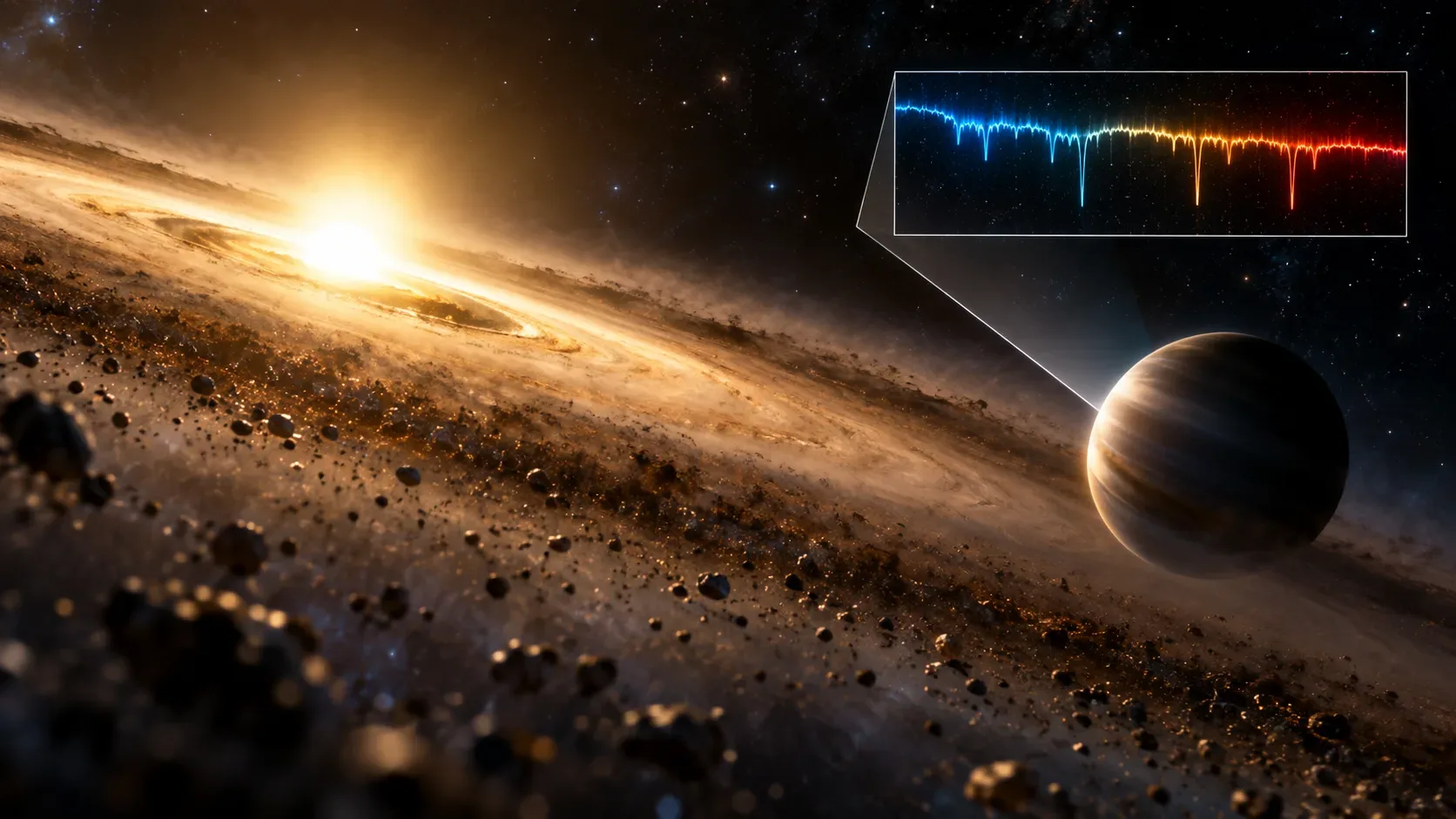
The signal already had strong astronomical context. Earlier ALMA observations had revealed several gaps in the Elias 2-24 protoplanetary disk, including one around 52 astronomical units from the star. The Very Large Telescope later detected a faint source in that same region. In 2023, an analysis published in Monthly Notices of the Royal Astronomical Society: Letters reported velocity perturbations and local heating in the gas near the candidate, signatures compatible with an embedded protoplanet.
The 2026 work brought those clues together and added motion evidence from Keck data. The synthesis led to the confirmation of Elias 2-24 b. NASA describes the planet as roughly comparable to Jupiter in mass and located about 55 times the Earth-Sun distance from its host star. Keck Observatory emphasizes that the object is still gathering material from the surrounding disk.
How the detection was built step by step
- Disk structure: ALMA mapped rings and gaps in millimeter-emitting dust, showing that the disk was not uniform.
- Point source in the gap: infrared imaging with the VLT revealed a faint point near the gap at roughly 52 to 55 astronomical units.
- Gas signatures: analyses of CO emission found kinematic changes and local heating close to the candidate's position.
- Repeat detection with Keck: archival observations from 2018 and 2020 showed the source again with NIRC2 and a coronagraph, which suppresses starlight so much fainter nearby objects can be searched for.
- Consistent motion: the position change over time was inconsistent with the simplest background-star explanation and favored a companion bound to the system.
This sequence matters because a disk gap by itself is not a planet detection. An isolated point of light can also be ambiguous. The strength of the confirmation comes from independent signals agreeing with one another: location inside the gap, infrared emission, gas perturbations, and motion measured across multiple years.
What was directly observed and what still depends on models
| Question | Observational basis | Degree of interpretation |
|---|---|---|
| Is there a compact source in the gap? | Yes. VLT and Keck detected an infrared signal in the gap region. | Low for the existence of the signal; higher when brightness is converted into physical properties. |
| Is the signal associated with the system? | Positions measured at different epochs are consistent with a companion and disfavor a background source. | Low to moderate because the result depends on astrometry and image processing. |
| Does the disk show a local response? | ALMA revealed disk structure, and later studies found kinematic and thermal signatures near the candidate. | Moderate because linking the perturbation to planet mass requires simulations. |
| What is the exact mass? | There is not yet a precise dynamical mass measurement for the planet. | High. Brightness, temperature, age, and accretion all affect mass estimates. |
| What is the planet's age? | The age mainly comes from the estimated age of the star and the system. | Moderate. It is a system timescale, not a clock measured directly on the planet. |
| Is it in rapid accretion? | The luminosity and disk context are compatible with a planet that is still growing. | Moderate to high for the exact accretion rate and internal thermal state. |
Where the less-than-1-million-year age comes from
There is no equivalent of counting growth rings or using radioactive dating to directly measure the age of such a young exoplanet. The age of Elias 2-24 b is tied to the age of its host star and the disk in which the planet is embedded. Studies of the system compare stellar properties such as effective temperature and luminosity with theoretical pre-main-sequence evolutionary tracks. A 2017 study estimated the star at about 0.4 million years old, while later work commonly treats the system as no older than roughly 1 million years.
This method has uncertainties. Very young stars are still contracting, can be actively accreting, and can be heavily obscured by dust, all of which affect apparent luminosity and temperature. The evolutionary tracks themselves are also model-dependent. The more rigorous formulation is therefore that Elias 2-24 b belongs to a system with an estimated age below or around 1 million years. Because a planet forms after the stellar system begins to assemble, that system age acts as an approximate upper limit on the planet's own formation history.
Why this shortens the timeline for giant-planet formation
The scientific tension appears when the age is combined with the planet's location. According to NASA, commonly used formation models can require around 5 million years to produce a Jupiter-size planet at Jupiter's orbital distance, about 5 astronomical units. Elias 2-24 b is already present in a system younger than 1 million years and at roughly 55 astronomical units, much farther from its star.
This does not show that the leading theory is wrong. The 2026 study itself interprets Elias 2-24 b as consistent with core accretion, the scenario in which solid material builds a core that later begins capturing gas rapidly. What the observation pressures is the speed and efficiency of that process in real systems. If a giant planet can appear this early and this far out, models need to reproduce that pace and explain how the planet reaches a strong gas-growth phase within such a short window.
The object also closes part of an observational gap. Before it, the record holders cited by NASA, in the PDS 70 and WISPIT 2 systems, were more than 5 million years old. Elias 2-24 b pushes confirmed planet observations into a much earlier disk phase, exactly where simulations previously had few real planets to compare against.
Does a gap in a disk now count as a planet?
Not automatically. Gaps can be produced or modified by different processes. The initial ALMA study of Elias 2-24, for example, discussed both the gravitational influence of forming planets and the possibility that some structures were related to condensation fronts of molecules such as CO and N2. Confirming a planet inside one gap makes the planetary connection much stronger in this specific case, but it does not turn every observed gap in every disk into proof of a planet.
The methodological gain is different: when a gap coincides with a point source, compatible motion, gas perturbations, and heating signatures, the planetary interpretation is supported by independent evidence. Elias 2-24 b is valuable precisely because it connects disk architecture to a directly detected object.
What still needs to be measured
Keck Observatory notes that the team is seeking additional observations to better constrain the planet's dynamical mass, atmosphere, temperature, and accretion. Those measurements matter because newly formed planets can be very luminous due to internal heat and material falling onto them. Using brightness alone to infer mass can therefore yield different answers depending on the assumed thermal scenario.
Spectroscopy and additional astrometry could better separate the planet's light from disk emission, test atmospheric composition, and track its orbit. A more precise dynamical mass would also show whether the gas perturbations seen by ALMA correspond to the same mass range implied by the planet's luminosity.
What the discovery actually changes
Elias 2-24 b does not provide an exact birth date for giant planets, and it does not settle how all of them form. What it provides is a new empirical limit: a giant planet can be detectable and still growing in a system younger than 1 million years, tens of astronomical units from its star. That forces formation models to account for efficient growth at a much earlier stage than previous observational record holders had shown.
It is also an example of how discoveries can emerge by combining archives. ALMA, VLT, and Keck data taken at different times and partly for different scientific questions made it possible to turn a suspicious disk gap and an uncertain point of light into a confirmed planet. For planet formation research, the main lesson is not only that Elias 2-24 b is extremely young, but that astronomers now have an observational laboratory for testing, close to the beginning of the process, which model predictions work and which still need revision.
Sources
- NASA Science, Newfound 'Baby' Planet Smashes Record for Youngest Known World, September 16, 2026
- W. M. Keck Observatory, Youngest Exoplanet Yet Discovered Found Hiding in Keck Observatory Data, September 16, 2026
- Bernardi et al., The Astrophysical Journal Letters, 2026, DOI 10.3847/2041-8213/ae9bb6
- Cieza et al., ALMA observations of Elias 2-24, 2017
- Pinte et al., kinematic and thermal signatures around the Elias 2-24 candidate, 2023