Short answer: it is still not accurate to call CD-35 2722 B b the “first exomoon” without qualification. The peer-reviewed study published in Nature on July 22, 2026 presents evidence for a planetary-mass exosatellite orbiting the brown dwarf CD-35 2722 B. The best-fitting model includes an object with a minimum mass of about 0.9 Jupiter masses and an orbital period of roughly 170 days. The authors themselves stress that there is no formal definition establishing whether a satellite of a brown dwarf should be called an exomoon.
What exists in the CD-35 2722 system
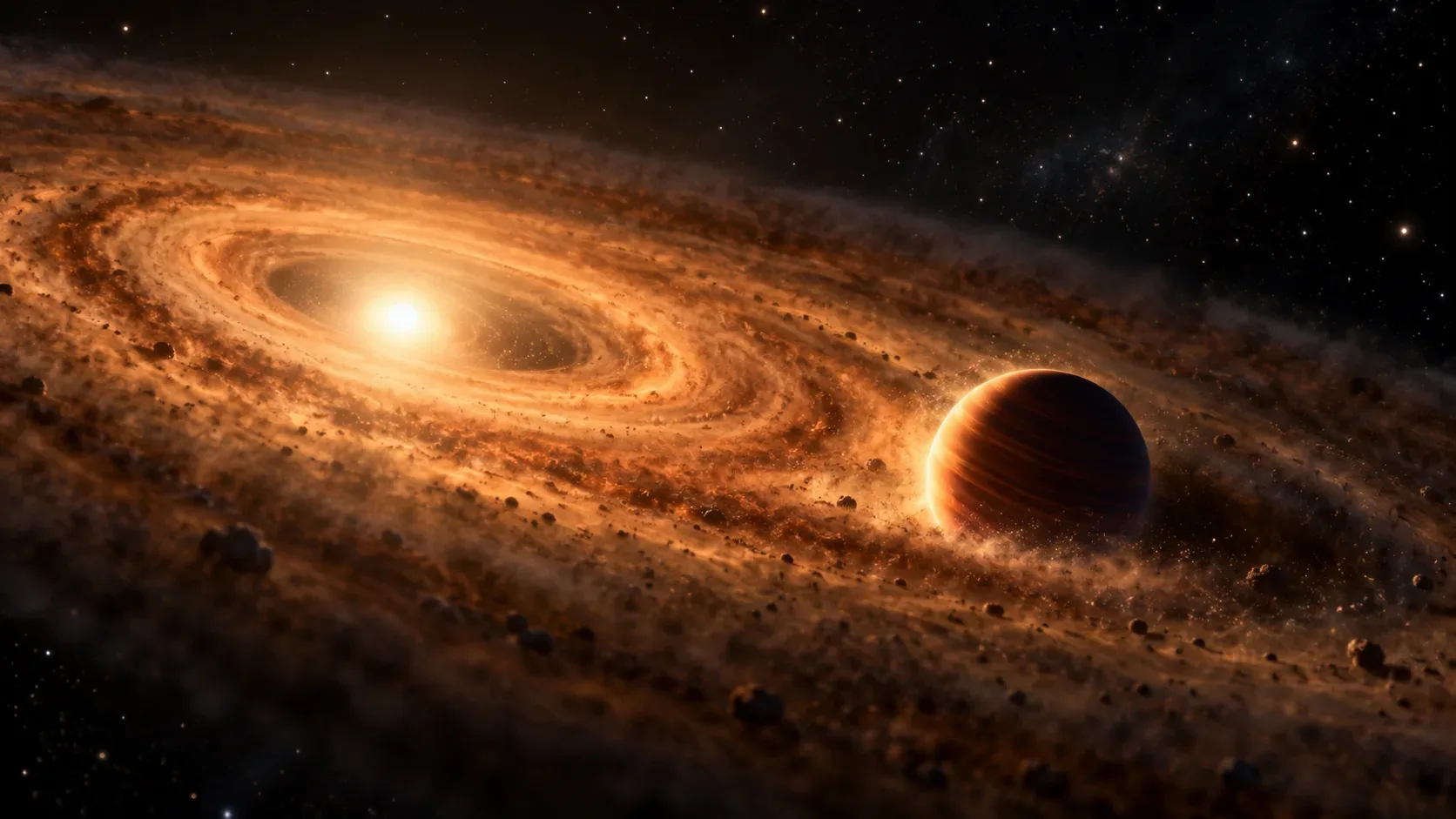
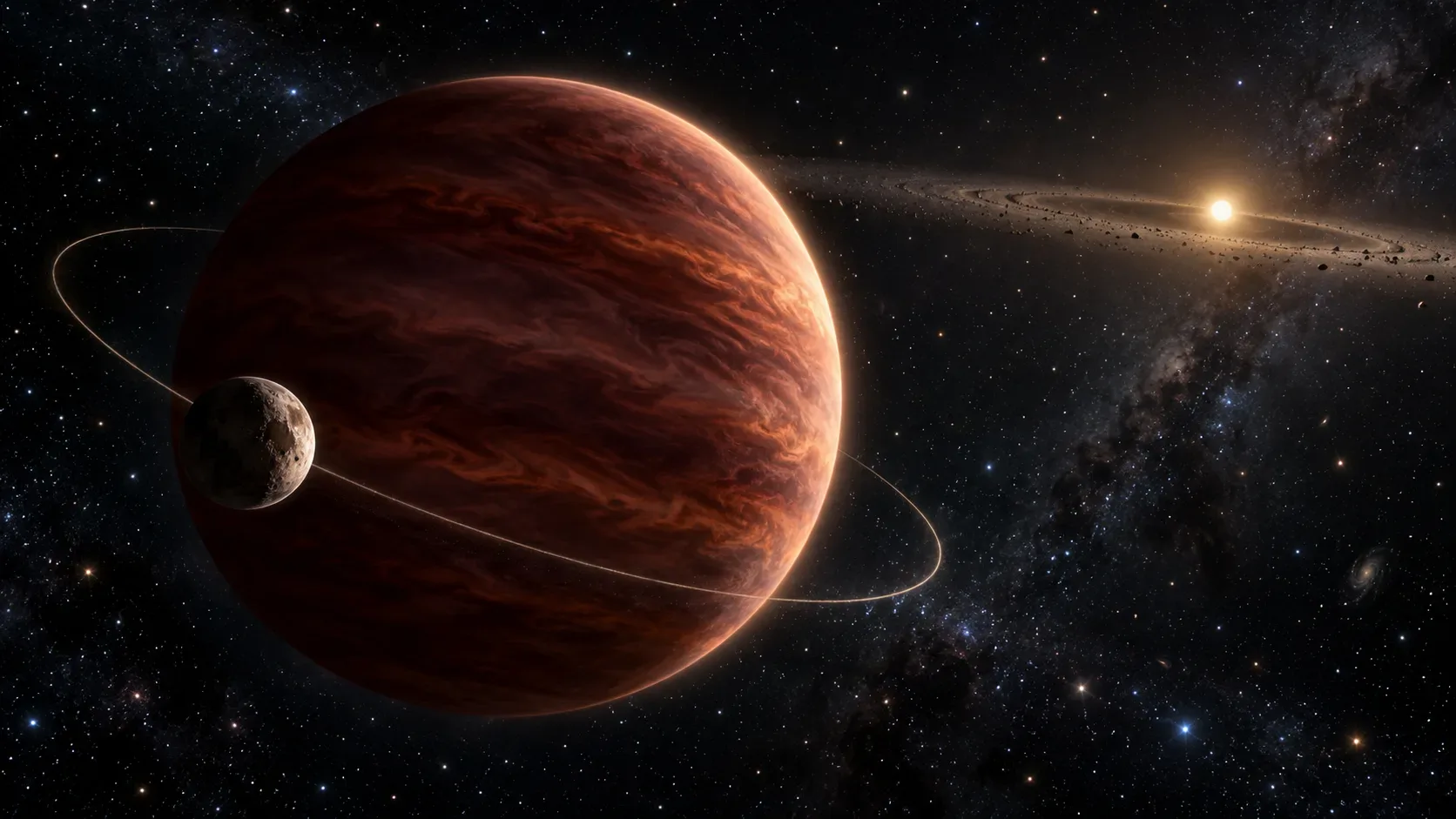
The system is hierarchical. CD-35 2722 is a low-mass star; orbiting it is CD-35 2722 B, a substellar object identified through direct imaging and generally classified as a brown dwarf. The NASA Exoplanet Archive lists this companion at about 29.5 Jupiter masses and an orbital separation of roughly 67 AU from the star. The new evidence adds a third level: a smaller body orbiting the brown dwarf itself.
That architecture — star, brown dwarf and satellite — is exactly what complicates the terminology. In the Solar System, we call a natural satellite of a planet or dwarf planet a moon. In CD-35 2722, however, the central body of the new object's orbit is not a conventional planet.
What the study actually detected
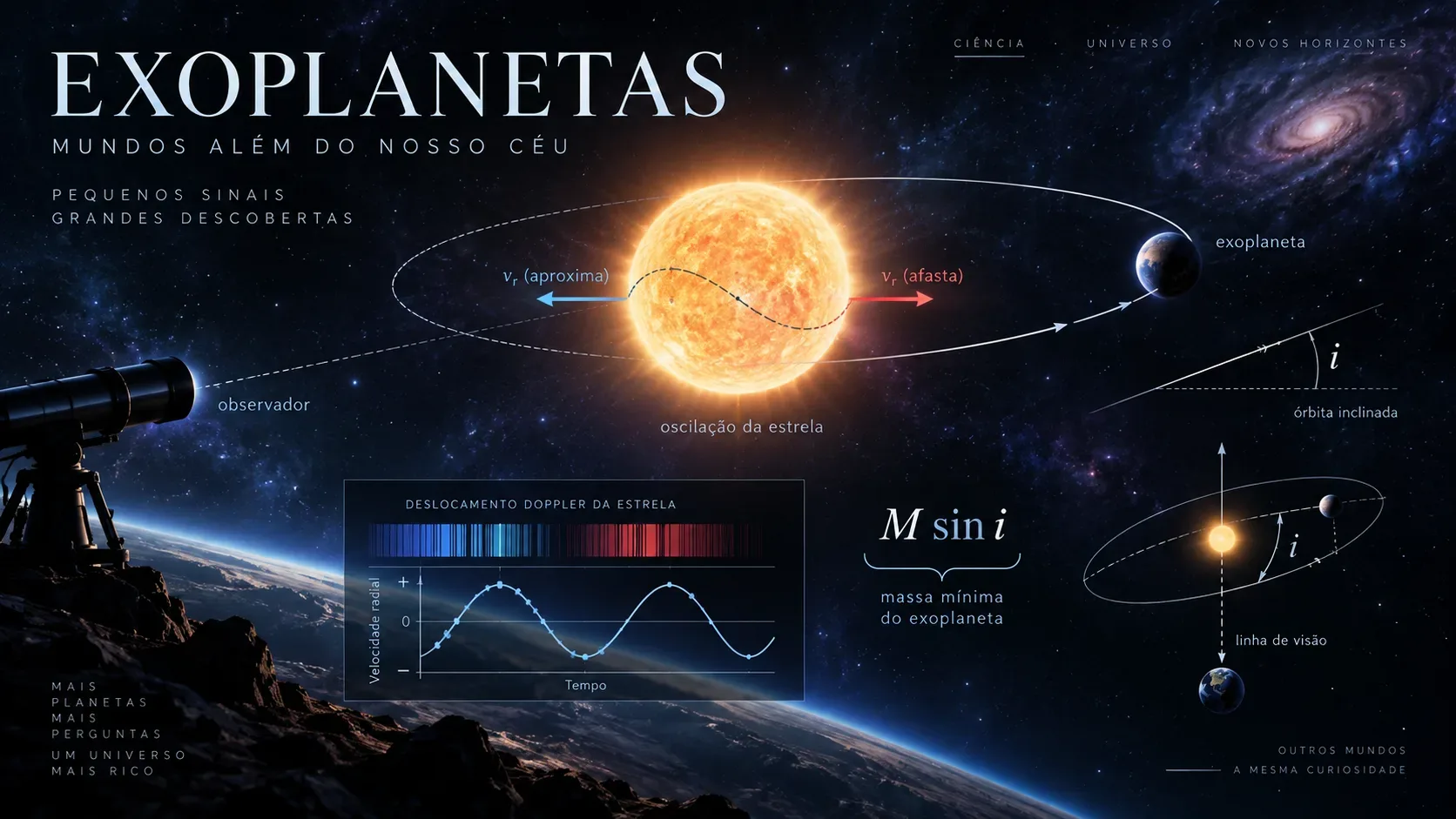
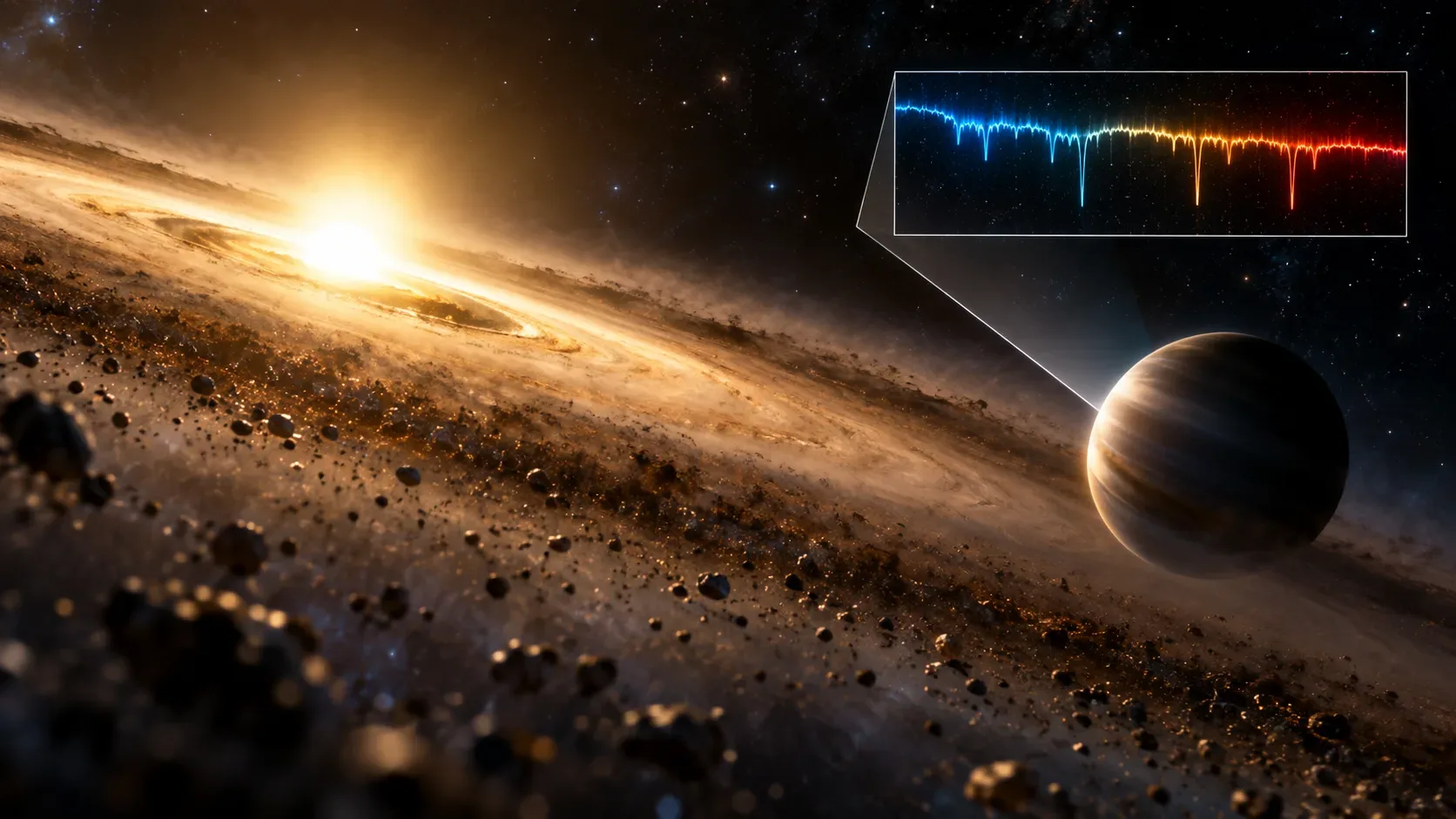
The astronomers did not directly photograph the exosatellite. They measured the radial velocity of CD-35 2722 B itself using spectra obtained with the CRIRES+ instrument on ESO's Very Large Telescope (VLT). Monitoring ran from October 2023 to February 2026. The technique looks for small periodic changes in the spectrum caused by the Doppler effect: if an unseen body orbits the brown dwarf, gravity makes both objects move around a common center of mass, producing a measurable back-and-forth motion along our line of sight.
According to the Nature paper, the radial-velocity series contains what appears to be the periodic signal of at least one satellite. The authors state that, to their knowledge, this is the first time radial velocity has produced evidence for satellites around a brown-dwarf companion to a star.
What parameters were inferred
| Parameter | What is reported | How to interpret it |
|---|---|---|
| Nature of the signal | Periodic variation in the radial velocity of CD-35 2722 B | Indirect evidence of the gravitational pull of an orbiting body; it is not a direct image of the satellite |
| Mass | About 0.9 Jupiter masses in the published best fit | This is a minimum mass because orbital inclination is not determined by radial velocity alone |
| Period | About 170 days | The estimated time for one orbit around the brown dwarf |
| NASA catalog values | 0.92 Jupiter masses, 171.1 days, about 0.2 AU and eccentricity 0.27 | These are the nominal parameters currently displayed for CD-35 2722 B b in NASA's catalog; the catalog taxonomy does not, by itself, settle the “exomoon” versus “exosatellite” debate |
| Host object | CD-35 2722 B, a brown dwarf with tens of Jupiter masses | The fact that the satellite does not orbit a conventional planet is what makes the classification unusual |
Why the mass is called a “minimum”
Radial velocity measures only the component of motion along the direction to Earth. Without fully knowing the orbital inclination, the technique yields a projected mass quantity: if the orbit is not viewed close to edge-on, the true mass can be larger than the minimum value. So “about 0.9 Jupiter” should not be read as an exact size or mass that has already been measured directly.
Why is “first exomoon” controversial?
- The object orbits a brown dwarf, not a conventional planet. The ESO release emphasizes that the discovery challenges familiar astronomical labels.
- The satellite itself has planetary mass. A body with a mass comparable to Jupiter is very different from the moons in our Solar System, even if dynamically it occupies the role of a satellite.
- “Exomoon” still lacks a universal formal definition. The study abstract explicitly says it is unclear whether satellites of brown dwarfs should receive that name.
For that reason, “exosatellite” is the safer term for describing the scientific result. “Possible first exomoon” can work as a journalistic shorthand only if it comes with the caveat that the classification depends on the adopted definition and on continued confirmation of the signal.
Is there one satellite or two?
This is another point where different news stories can seem contradictory. A pre-publication version on arXiv discussed, in addition to the main signal, a possible second body on a shorter orbit. The communication accompanying the published version, however, says that two-satellite models are highly unstable. The final Nature text is deliberately more conservative: it describes a signal compatible with at least one satellite and highlights as the best fit the object at about 0.9 Jupiter masses and ~170 days.
That does not mean every alternative scenario has been eliminated forever. It means that, with the available data, the single-companion scenario is the main and most defensible interpretation for public communication.
What still needs to be confirmed
- new radial-velocity measurements covering more orbital cycles, to test whether the periodicity persists;
- better constraints on orbital inclination, which would help convert the minimum mass into a more precise true mass;
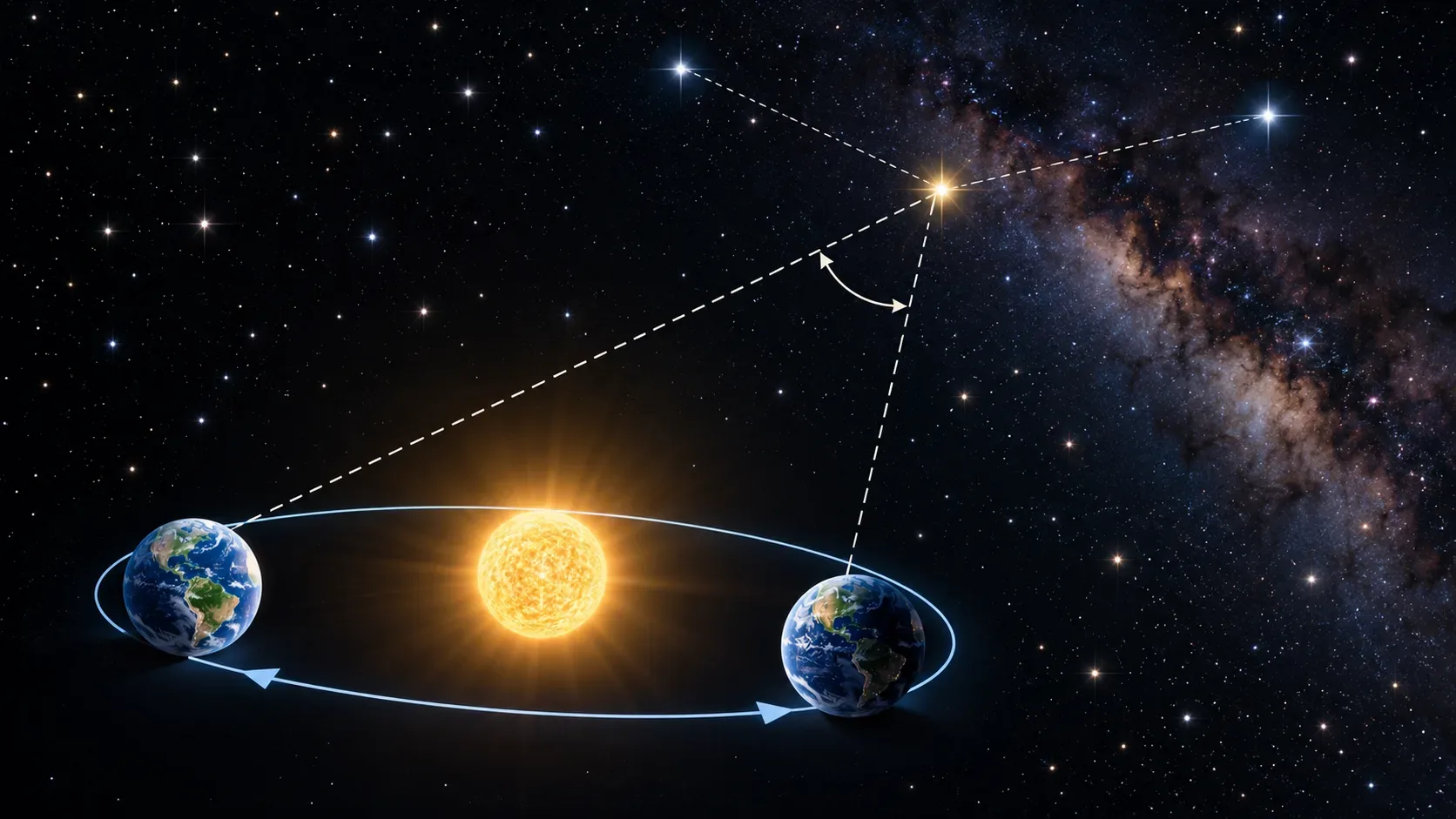
- complementary observations, such as high-precision astrometry, that can test the orbital architecture with another method;
- a classification consensus to distinguish exomoons, exosatellites and planetary-mass companions in substellar systems.
The Nature Portfolio summary itself presents the finding as a possible “first exomoon,” while noting that the object is planetary in mass and orbits a brown dwarf, making the label inappropriate or at least debatable. Meanwhile, NASA Science already maintains a catalog entry for CD-35 2722 B b, illustrating how operational databases can adopt a practical category before the physical terminology is fully settled.
In summary
The strongest advance is not the proclamation of a “first exomoon,” but the demonstration that radial velocity can detect the signature of a satellite around a directly observed substellar object. For CD-35 2722 B, the data point to at least one planetary-mass companion, with a minimum mass close to Jupiter's and an orbit of roughly 170 days. Whether it will be called an exomoon, an exosatellite or something else depends on additional confirmation and, above all, on where astronomy decides to draw the boundaries between planet, brown dwarf and moon.