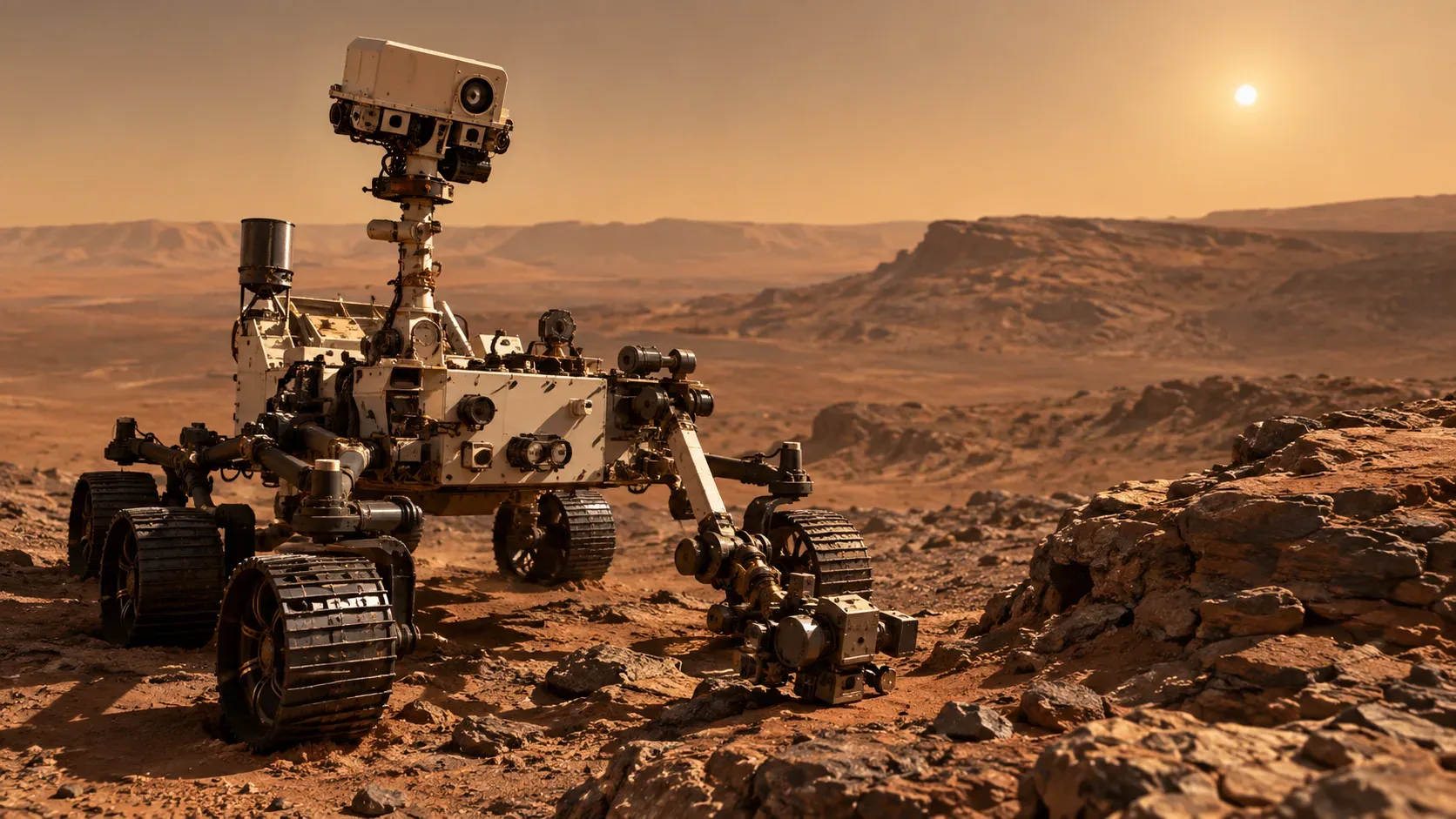
Curiosity's 5,000th sol is more than a round number. It marks the survival of a mobile laboratory that reached Mars in 2012 and kept turning a broad question, "Was Mars ever habitable?", into increasingly specific questions about water, organic chemistry, climate, and geological preservation. NASA recorded sol 5,000 on August 30, 2026, while the rover was parked near a sandy ridge nicknamed Chocolatal. Shortly before that milestone, the team also noted that Curiosity had exceeded 1 kilometer of elevation gain from its landing site. NASA's official sol 5,000 record and the mission blog put the milestone in context.
A sol is a Martian solar day, about 24 hours, 39 minutes, and 35 seconds long. So 5,000 sols do not equal 5,000 Earth days. The milestone represents more than 14 years of surface operations and, more importantly, rare continuity: the same instrument suite has been able to examine successive geological layers while the rover climbed Mount Sharp. NASA gives the mean length of a Martian sol at that value.
What 5,000 sols actually measure
Longevity matters because Curiosity's science depends on context. A molecule, mineral, or fracture means little on its own unless scientists know which layer contains it, how it relates to the units above and below, and whether the environment changed over time. By crossing the floor of Gale Crater and then climbing Mount Sharp, the rover has built a moving stratigraphic column.
That is why the chronology below is not a list of the mission's "greatest discoveries." Each milestone represents a change in the next scientific question: from the presence of water to habitability, from habitability to the duration of wet environments, from the presence of carbon to its preservation, and from a simply wet Mars to a planet with complex climate transitions.
A selective chronology: the discovery and the question that followed
| Period | Milestone | What the discovery changed |
|---|---|---|
| 2012 | Rounded pebbles at Hottah indicate ancient flowing water | The question moved beyond whether water existed to how rivers and sediments reshaped Gale. |
| 2013 | Yellowknife Bay reveals clays, essential elements, and chemical conditions compatible with habitability | The mission gained a decisive answer: the ancient environment could have supported microbes, if they existed. |
| 2014 | Mount Sharp layers point to lakes persisting for millions of years | The mission shifted toward reconstructing the duration and evolution of climate, not just isolated episodes of water. |
| 2018 | Ancient organic molecules and seasonal methane variation are reported | The focus expands to carbon preservation and processes that produce or release gases. Neither result proves life. |
| 2019 | Glen Torridon confirms a highly clay-rich unit | The rover links orbital observations to ground samples and refines the history of water-rock interaction. |
| 2023 | Hexagonal cracks record repeated wet and dry cycles | Gale's past now includes regular alternation between wet and dry phases, relevant to prebiotic chemistry. |
| 2024 and 2025 | Unexpected elemental sulfur and the largest organic molecules detected on Mars | Local surprises and reanalysis of old samples show that the rover's scientific archive continues to generate new hypotheses. |
| 2026 | Extensive polygon fields in Valle Grande and studies of wind-blown sediment | The mission keeps comparing ancient and modern processes to separate effects produced by water, subsurface alteration, temperature, or wind. |
2012 and 2013: from an ancient stream to a habitable environment
The first conceptual leap came only weeks after landing. At Hottah, Curiosity found conglomerates containing rounded pebbles that were too large to have been transported by wind. The interpretation was an ancient stream with vigorous flow. NASA presented the outcrop in September 2012.
Months later, drilling at Yellowknife Bay changed the weight of the evidence. The sample from the John Klein target contained clay minerals and a combination of sulfur, nitrogen, hydrogen, oxygen, phosphorus, and carbon. The chemistry pointed to relatively fresh water, an environment that was neither extremely acidic nor excessively salty, and energy gradients that microbes could exploit. The team's conclusion was carefully limited: the site would have been habitable, but that does not show that life existed. JPL's 2013 announcement established that distinction, which remains essential to interpreting the mission.
2014: Mount Sharp turns the mission into a climate history
After reaching the basal layers of Mount Sharp, Curiosity showed that Gale Crater did not preserve only isolated signs of water. Lake-associated sediments indicated that parts of the mountain were built in a system that repeated for millions to tens of millions of years. NASA's December 2014 interpretation made Mount Sharp the primary archive for investigating how Mars transitioned from wetter environments to today's cold and dry conditions.
This change is central to understanding why the rover kept climbing. Each higher mineralogical band acts like a later chapter. The scientific route stopped being simply "reach the mountain" and became "read the mountain's sequence."
2018 and 2019: carbon, methane, and clays sharpen the chemical history
In 2018, the team reported organic molecules preserved in ancient sedimentary rocks and a repeatable seasonal variation in methane in the local atmosphere. Both observations were scientifically important, but neither was equivalent to a biological signature. Organic molecules can be produced by nonbiological processes, and methane can also have geological sources. JPL's report on organics and methane emphasized how the rover's longevity made the seasonal pattern visible.
The following year, Glen Torridon provided ground truth for a region that orbiters had already identified as clay-rich. The drilled samples became some of the most clay-rich rocks analyzed during the mission, while analyses also detected carbonates. NASA described the clay-bearing unit in 2019. The scientific gain was twofold: confirm what orbital spectroscopy suggested and compare, centimeter by centimeter, how mineralogy changes through the stratigraphic sequence.
2023: wet-dry cycles add a new dimension to habitability
The hexagonal mud cracks observed in the transition zone between clay-rich and sulfate-rich layers record repeated wetting and drying. That pattern is different from simply saying "there was a lake." It points to recurring, possibly seasonal variations over a prolonged period. NASA linked these cracks to conditions that may favor some steps in prebiotic chemistry, because cycles of concentration and drying can facilitate reactions that build more complex molecules.
This result changed the question again. An environment can be habitable for microbes and still not be the setting most favorable for the chemistry that precedes life. Curiosity began providing evidence relevant to both discussions without treating them as the same question.
2024 and 2025: chemical surprises and a new reading of an old sample
In 2024, a rock broken by one of the rover's wheels exposed yellow crystals of elemental sulfur. The finding was unexpected because the region was known for sulfates, compounds in which sulfur is combined with other elements. Pure sulfur requires specific formation conditions that the team still needed to reconcile with the local history. NASA presented the result as a geological surprise, not a settled explanation.
In March 2025, the team extracted more information from the Cumberland sample collected in 2013. The SAM laboratory identified decane, undecane, and dodecane, the largest organic molecules detected on Mars up to that point. They were interpreted as possible fragments of fatty acids, which can arise through both biological and nonbiological chemistry. NASA described the result as evidence for more complex organic chemistry than previously observed. The key point for the mission's continuity is methodological: an old, preserved sample reanalyzed with different techniques can still answer new questions.
2026: Valle Grande polygons show why the mission has not become routine
In July 2026, Curiosity returned images of an area in Valle Grande covered by polygonal fractures on a much larger scale than patches seen before. The team did not immediately assign a single cause. Mud cracking, thermal cycles, and compression during burial are among the processes capable of producing similar geometries. NASA emphasized that the origin of the field was still under investigation.
Near sol 5,000, the rover was also studying the sandy Chocolatal ridge and wind-shaped sediments before moving on. The planning update published on September 16, 2026 shows the current scientific routine: combine contact measurements, imaging, chemistry, and short drives to understand both the ancient record and surface processes still active on Mars.
What still guides Curiosity after 5,000 sols
- Reconstruct the climate transition: identify how Mount Sharp's layers record the shift from lake and river environments to increasingly arid conditions.
- Understand where organic matter is preserved: determine which minerals, depths, and alteration histories protect carbon compounds from radiation and destructive reactions.
- Separate habitability from evidence of life: water, carbon, nutrients, and energy show that an environment could support life; they do not demonstrate that life existed.
- Connect orbital observations to the ground: the rover tests, at rock and grain scale, interpretations made by instruments in orbit.
- Use stratigraphy as a time sequence: climbing Mount Sharp allows comparison of environments of different ages in coherent geological order.
That is why 5,000 sols represent more than mechanical endurance. Longevity allowed Curiosity to change scientific scale: it began by showing that water flowed through Gale, demonstrated that some ancient environments were habitable, revealed that those environments changed repeatedly, and now investigates how water, salts, carbon, fractures, and wind fit into a much longer climate history. The value of the next sol is not only another number on the counter, but the chance to place one more observation inside a sequence that already spans more than a decade of Martian exploration.
Sources and further reading
- NASA Science: Mars Science Laboratory Curiosity mission
- NASA Science: Curiosity's 5,000th sol record
- NASA Science: mission blog for sols 4,995 to 5,001
- JPL: ancient conditions compatible with habitability at Yellowknife Bay
- NASA: mud cracks and wet-dry cycles
- NASA Science: largest organic molecules detected on Mars
- NASA: polygonal fracture field in Valle Grande