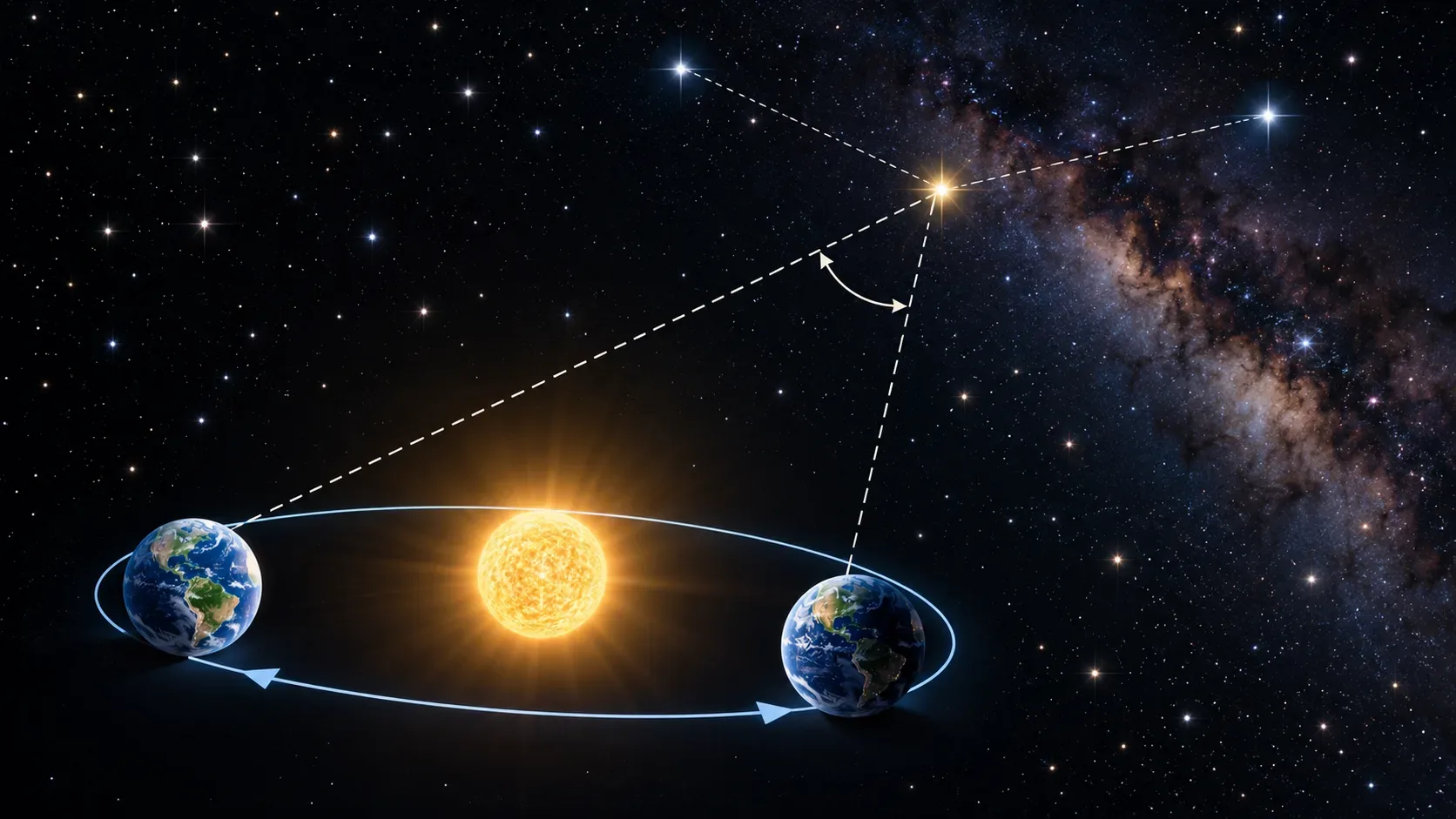
Stellar parallax measures the distance to a star from the change in its apparent position when we observe it from different points along Earth’s orbit. There is no need to travel to the star: we know the separation between observation points, measure a tiny angle in the sky, and apply geometry. A nearer star appears to shift more than a more distant one against the background of very distant stars.
Why does the star appear to change position?
Hold a finger in front of your face and alternate which eye is open. The finger appears to move relative to the background even though it stays in place. Each eye supplies a different line of sight. In astronomy, Earth provides the two viewpoints as it travels around the Sun, as NASA explains.
Observations about six months apart can place the observer on opposite sides of the orbit, separated by nearly two astronomical units (AU). The average Earth–Sun distance, one AU, is the baseline used to define the parallax angle p: the angle that one AU would subtend when viewed from the star. In the most favorable geometry, the total angular shift between opposite positions is approximately 2p. The observed projection depends on the star’s direction, so a pair of images does not always show that maximum value.
How to turn an angle into a distance
The geometry forms a triangle between the Sun, the observer, and the star. Knowing the one-AU baseline and angle p, we can calculate the distance using trigonometry. For the extremely small angles involved, the practical approximation is particularly simple:
distance (parsecs) = 1 / parallax (arcseconds).
One arcsecond is 1/3,600 of a degree. A parsec (pc) is the distance corresponding to a parallax of one arcsecond, about 3.26 light-years. If a catalog reports the angle in milliarcseconds (mas), use distance (pc) = 1,000 / parallax (mas). These simple conversions assume a positive parallax measured accurately enough.
| Measured parallax | Approximate distance | In light-years |
|---|---|---|
| 1 arcsecond | 1 pc | 3.26 |
| 0.5 arcsecond | 2 pc | 6.52 |
| 0.1 arcsecond | 10 pc | 32.6 |
These table entries are mathematical examples, not measurements attributed to specific stars. Compare the first and last rows: when the angle becomes ten times smaller, the calculated distance becomes ten times greater. The telescope measures angular position, not a journey to the star or the travel time of an object.
What a telescope actually records
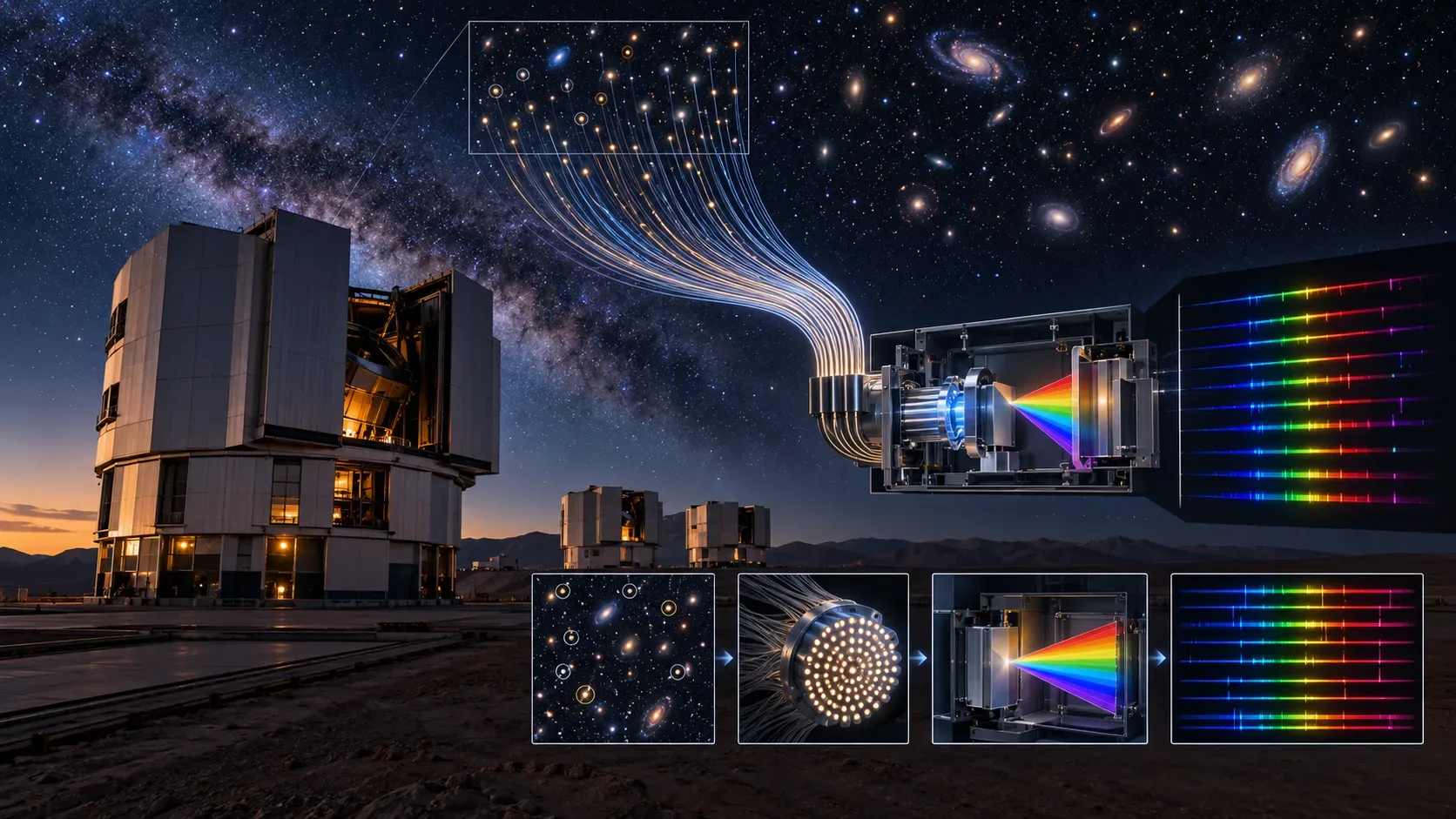
The instrument repeatedly records a star’s position relative to astronomical reference points. During a year, parallax produces a periodic apparent variation; its projected track may be elliptical. But the star may also change position through proper motion, a real, progressive shift across the sky. Astronomers have to model both effects, as well as observational characteristics, to determine parallax.
The European Space Agency’s Gaia mission used repeated astrometric measurements to determine positions, parallaxes, and proper motions for a very large number of stars. The angular precision of space instruments dramatically extended the reach of measurements compared with NASA StarChild’s introductory explanation, which cites approximately 100 light-years in describing its educational method. That figure should not be treated as a universal limit of modern astrometry.
Why does the distance have uncertainty?
The angle decreases as a star becomes more distant and approaches the instrument’s measurement limit. Positional uncertainty, proper motion, calibration, and possible systematic effects all influence the result. Catalogs such as Gaia’s report parallax and its error rather than a single exact distance. The Gaia DR2 documentation also explains why systematic effects must be considered.
For example, a measured parallax of 10 ± 1 mas gives a central calculation of 100 pc, but the angular error is 10% of the measured value: 100 pc must not be presented as exact. This is an illustrative example only. If a parallax is very small compared with its uncertainty, directly converting the measured value with 1/p can give a misleading distance with asymmetric uncertainty. Zero or negative measured parallaxes do not mean a star is at zero or negative distance; they can arise from measurement noise and data fitting. Such cases require appropriate statistical estimation and, depending on the study, additional information. The Gaia@AIP compilation describes this issue in presenting distances for Gaia sources.
How to read a published measurement
- Check whether the figure is an angular parallax in arcseconds or mas, rather than a distance in parsecs.
- Look for its stated uncertainty and any catalog warnings about quality or calibration.
- Use the reciprocal formula as a geometric example or an approximation for positive measurements with relatively small uncertainty; do not apply it automatically to every entry.
- Distinguish the apparent annual parallax shift from the star’s proper motion.
The essential idea is astronomical-scale triangulation: Earth’s orbit supplies a known baseline, the telescope records changes in direction, and geometry yields a distance together with its measurement uncertainty.