On 3 September 2026, MOONS — the Multi-Object Optical and Near-infrared Spectrograph — achieved first light on the Very Large Telescope (VLT) at ESO’s Paranal Observatory in Chile. The headline number is striking: the instrument is designed to point roughly 1,000 optical fibres at about a thousand stars or galaxies in the same field and record their spectra simultaneously. The basic idea is straightforward: instead of taking a picture of the sky, MOONS collects light from many separate targets and splits it by wavelength, turning each target into a spectrum that can reveal chemical composition, motion and other physical properties.
First light, however, does not mean that every aspect of scientific performance has already been certified or that routine operations have begun. It is the first successful on-sky operation of the complete system: a real astronomical target was acquired and the telescope → fibres → spectrographs → detectors chain produced data. After that milestone, the team continues commissioning and calibration before full scientific operations.
What MOONS does in a single observation
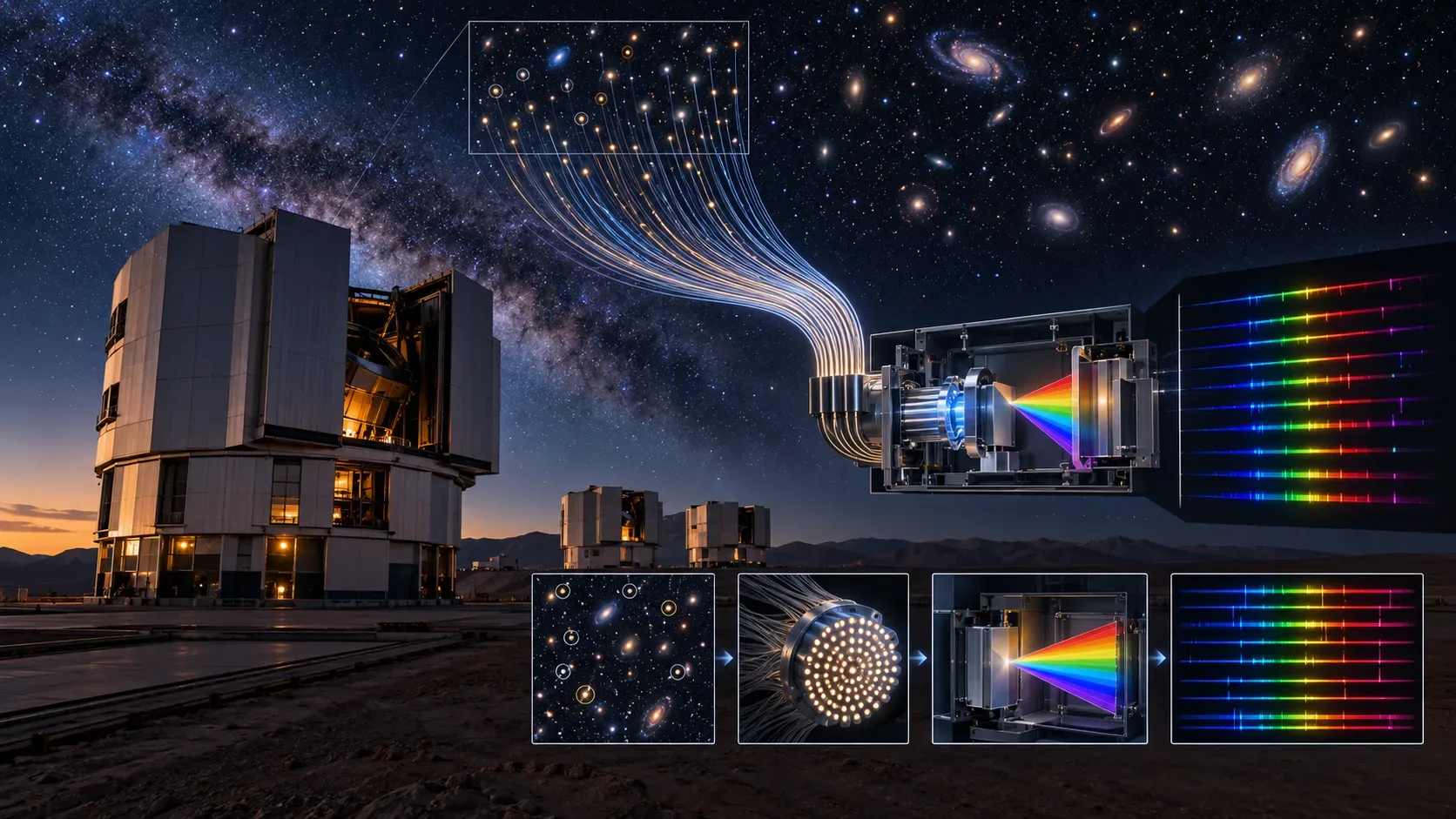
Installed on VLT Unit Telescope 1, MOONS is a fibre-fed multi-object spectrograph. According to ESO, roughly 1,000 fibres can be robotically positioned across a field of about 500 square arcminutes. Each fibre is assigned to a selected target in that field and carries its light to one of two nearly identical spectrographs, each receiving about 500 fibres.
The instrument covers wavelengths from the optical red into the near-infrared, approximately 0.65 to 1.8 micrometres. In medium-resolution mode, a broad portion of this range can be recorded simultaneously; in high-resolution modes, MOONS focuses on selected spectral regions to measure quantities such as radial velocities and chemical abundances. This combination — a large telescope, broad wavelength coverage and high multiplexing — is what makes the instrument particularly suited to surveys with very large samples.
Sky → fibre → spectrograph → spectrum
- Sky: the astronomer starts from a catalogue and selects stars or galaxies that fall within the field observed by the VLT.
- Fibre: robotic positioners move the fibre tips to the targets’ coordinates. Each fibre collects the light of one specific object and carries it away from the focal plane.
- Spectrograph: the fibres feed two spectrographs. The light is separated into wavelength bands and then dispersed, broadly analogous to the effect of a prism, although the real system uses specialised optics.
- Spectrum: detectors record light intensity as a function of wavelength. Absorption and emission lines, the shape of the continuum and shifts in those features carry physical information about each target.
MOONS gains its power by repeating this process for hundreds and, in suitable fields, close to a thousand targets in the same exposure. It is not one fibre “seeing” a thousand objects: it is many fibres working in parallel.
Images and spectra answer different questions
| Product | What it records | Example questions |
|---|---|---|
| Image | Brightness distributed across the sky, position, shape and apparent structure | Where is the object? What is its morphology? Are there neighbours or surrounding structures? |
| Spectrum | Brightness separated by wavelength | Which chemical elements are present? Is the object moving toward or away from us? What is its temperature or physical state? |
This is why MOONS complements large imaging surveys. A camera can identify and measure millions or billions of sources; spectroscopy adds a physical dimension that an image alone usually cannot provide. ESO itself highlights MOONS’s role in spectroscopic follow-up for surveys and missions such as Gaia and major imaging projects.
How roughly a thousand fibres observe so many targets at once
The telescope field is converted into a map of positions. Software decides which targets will be assigned to fibres, and each robotic positioner moves its fibre within a patrol region. The arm design and camera-based control allow the fibres to be placed at the planned positions with high precision.
There are geometric limits: very close targets can compete for positioners, some fibres may be reserved for measuring the sky background, and not every field contains a thousand useful targets with the desired brightness and priority. “1,000 fibres” therefore describes the instrument’s multiplexing capacity, not a guarantee of exactly one thousand science spectra in every exposure.
Why the light goes to two spectrographs
The large number of fibres makes it impractical to concentrate the entire flow into a single compact optical chain. The design divides the fibres between two optically equivalent spectrographs installed inside a large cryostat. Within each spectrograph, dichroic filters split the light into three bands — RI, YJ and H — which are dispersed and recorded by suitable detectors.
Cooling is crucial in the infrared: the instrument itself and its surroundings emit thermal radiation that could compete with the faint light from astronomical targets. ESO reports that the spectrographs operate at cryogenic temperatures, reducing that contamination and helping MOONS reach the sensitivity required for dust-obscured stars and very distant galaxies.
What “first light” really means
In astronomy, first light is the moment when a newly installed telescope or instrument successfully observes an astronomical target on the sky for the first time. For MOONS, that happened on 3 September 2026. The first field released publicly was Baade’s Window, toward the central regions of the Milky Way.
| First light shows | First light does not prove by itself |
|---|---|
| That the full chain can acquire real targets and deliver their light to the detectors. | That every observing mode already reaches its final specified performance. |
| That fibre positioning, optics, the cryogenic system, detectors and controls can work together in an on-sky observation. | That stability, calibration, efficiency and repeatability have been validated in every configuration and condition. |
| That the resulting data can contain recognisable, scientifically interpretable astronomical spectra. | That the instrument has already been released for routine scientific operations. |
This distinction matters because first light is a milestone inside a larger process. The UK Astronomy Technology Centre, which leads the construction consortium, says that after first light the team continues commissioning and calibration before full scientific operations begin. For other ESO instruments as well, commissioning is the phase in which configurations and software are tested and performance is measured systematically.
What the first spectra already showed
In ESO’s released material, the first observations placed fibres on stars toward the centre of the Milky Way. Near-infrared sensitivity is especially useful there because interstellar dust strongly blocks visible light. In a sample of five spectra published by the observatory, features associated with elements such as sulphur, iron, titanium, silicon, chromium and magnesium are visible.
This example shows why a spectrum is more than a “pretty rainbow”. The positions and strengths of spectral lines can be used to estimate chemical and physical properties; shifts in the lines can also reveal velocity along the line of sight. Repeated across large samples, these measurements can reconstruct stellar populations and the formation history of the Milky Way.
Why a thousand targets speed up Milky Way and galaxy surveys
With a single-target spectrograph, many stars or galaxies would require separate observations. MOONS collects hundreds of spectra in parallel during the same exposure. That changes the practical scale of surveys: telescope time can build much larger statistical samples instead of focusing only on isolated objects.
In the Milky Way, the goal is to measure velocities and chemical abundances for millions of stars, including stars in parts of the bulge and disc that are partly hidden by dust. ESO expects MOONS to study stars at distances up to roughly 40,000 light-years and help build a three-dimensional map of the Galaxy. For the distant Universe, near-infrared coverage is essential because cosmic expansion shifts many features originally emitted at shorter wavelengths toward longer wavelengths. Measuring those features in many galaxies helps researchers investigate star formation, chemical enrichment and galaxy evolution.
Over its ten-year design lifetime, ESO expects MOONS to observe up to roughly ten million objects. That figure is not a count already achieved; it is an expectation for the instrument’s scientific capacity across its operational life.
A thousand fibres do not mean “a thousand times faster”
Multiplexing is a major efficiency gain, but it should not be translated automatically into a speed factor. Exposure time is still set by target brightness, the chosen spectral resolution, sky conditions and the required signal-to-noise ratio. There are also configuration, calibration, detector-readout and fibre-allocation costs.
The correct gain is different: when many compatible targets lie in the field, one exposure can produce hundreds of useful spectra in parallel. That makes projects feasible when they need to compare whole populations of stars or galaxies under similar observing conditions.
In one sentence: what did MOONS first light test?
It demonstrated that MOONS could make the complete on-sky chain work — selecting targets, collecting their light with many fibres, feeding it into the spectrographs and recording spectra — while subsequent commissioning continues to measure, calibrate and optimise the performance needed for routine science.