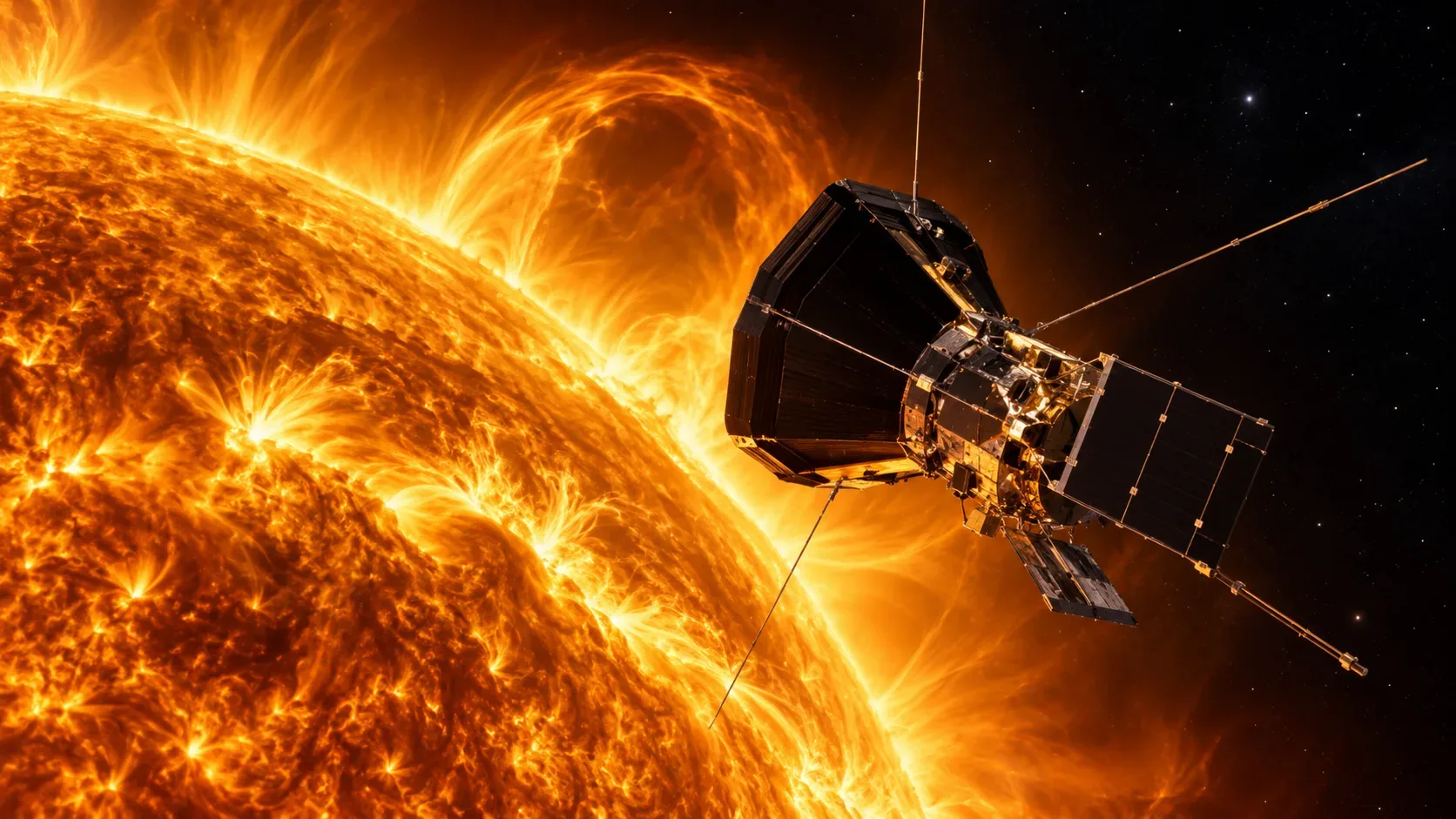
Parker Solar Probe completed its 29th perihelion on September 4, 2026. Spending nine days out of contact with Earth does not indicate a failure: NASA reported that the interruption was planned, centered on closest approach, and occurred while the spacecraft’s trajectory limited communications. During that interval, Parker carried out the encounter autonomously.
A special objective of this pass was to point its camera at structures and activity near the Sun’s north pole. NASA’s September 10 update does not name the camera, but Parker Solar Probe carries only one imaging instrument, the WISPR (Wide-Field Imager for Parker Solar Probe). It is therefore reasonable to conclude that NASA’s reference to the “camera” means WISPR. The agency had not, in that update, published specific scientific results from the polar observations.
What happened during the 29th perihelion
| Date | Stage | What it means |
|---|---|---|
| August 30, 2026 | Solar encounter begins | The four instrument suites enter the encounter observation period. |
| September 4, 2026 | 29th perihelion | Parker matches its distance and speed records and passes through its point of closest approach to the Sun. |
| September 7, 2026 | Beacon received | A radio tone confirms that the spacecraft’s systems were operating normally. |
| September 9, 2026 | Solar encounter ends | The operational window NASA defined for this pass ends. |
| September 11, 2026 | Detailed telemetry | More complete spacecraft health and status data begin returning. |
| September 13–27, 2026 | Science data downlink | NASA scheduled transmission of the science data collected during the encounter. |
Why nine days without contact do not mean nine days “flying blind”
The phrase “out of contact” can suggest loss of control, but the mission is designed around the opposite idea. Near the Sun, Parker must keep its heat shield pointed with extreme precision to protect most of the spacecraft. Communications with Earth do not take priority over this survival geometry.
In the update on the 29th perihelion, NASA was specific: Parker followed a trajectory that limited communications with Earth and, as planned, was out of contact for nine days while operating autonomously. That is not the same as a radio failure or an emergency.
Mission documentation explains why autonomy is essential. NASA notes that Parker was designed to keep itself safe without immediate ground intervention because close to the Sun it is not practical to depend on real-time commands. Sensors along the edge of the heat shield’s shadow detect unwanted sunlight and allow the onboard computer to correct spacecraft attitude. In earlier encounters, NASA also described communications blackouts associated with the Sun’s intense radio emissions and with the need to keep the transmitter subordinate to thermal pointing requirements.
The correct interpretation is therefore that the lack of continuous telemetry is part of the operating profile. The first quick indication that the encounter ended well was the beacon received on September 7; detailed telemetry was scheduled to follow later.
What autonomy has to do during perihelion
Autonomy in this context does not mean the spacecraft independently chooses the mission. Observation plans, command sequences, and protection rules are prepared in advance. During the communications-limited phase, onboard systems execute those sequences and keep the spacecraft within thermal, electrical, and attitude limits.
- Attitude control: keep the heat shield between the Sun and sensitive components.
- Thermal protection: operate solar arrays and cooling systems within expected conditions.
- Fault management: respond automatically to deviations that cannot wait for a decision from Earth.
- Science collection: keep the instruments running the encounter program prepared by the team.
- Storage: retain telemetry and science for later downlink when geometry and communications are favorable.
Which camera targeted the Sun’s north pole
WISPR is Parker Solar Probe’s only imaging instrument. It observes the large-scale structure of the corona and solar wind and records phenomena including coronal mass ejections, jets, and other material flowing away from the Sun. The spacecraft’s design uses the heat shield to block most of the Sun’s intense light, allowing WISPR to see the much fainter corona.
The September 2026 update says the camera was aimed at structures and activity near the solar north pole. This should not be read as a simple “photo of the pole” like a photograph of a solid surface. WISPR looks at structures in the solar atmosphere and solar wind from a very close, side-looking geometry.
It is also important to distinguish fact from inference. It is a fact that NASA selected the region near the north pole as an imaging target during this encounter. It is an inference, supported by the instrument’s official description, that these images can help connect visible coronal structures with local measurements made by Parker’s other instruments as the spacecraft moves through the near-Sun environment. NASA had not yet specified in its September 10 note which polar structure was recorded or announced a discovery resulting from these observations.
Why looking toward the polar region can be scientifically useful
The Sun’s polar regions matter for understanding the organization of its magnetic field and the origins of solar-wind flows. Across different phases of the solar cycle, the distribution of open magnetic-field regions, coronal holes, and coronal structures changes. Parker launched in 2018 when the Sun was near solar minimum; in 2024, NASA, NOAA, and the Solar Cycle Prediction Panel announced that the Sun had reached its solar-maximum period. Parker’s 29 encounters therefore span conditions ranging from relatively quiet to highly active.
For this 29th encounter, however, it is best not to get ahead of the data. The official news item only states that the camera observed structures and activity near the north pole. Any interpretation involving specific jets, coronal holes, magnetic reconnection, or particular sources of the solar wind depends on analysis of the returned data set.
How close and how fast Parker traveled
At the September 4 perihelion, Parker came to about 3.8 million miles from the solar surface and reached roughly 430,000 miles per hour, matching records first set on December 24, 2024 and repeated on later passes. NASA also reported that within a single day of this encounter, the spacecraft raced through and sampled a path equal to almost 40% of the Sun’s circumference.
That combination of speed and proximity is central to the mission: Parker’s instruments can measure plasma, particles, and magnetic fields much closer to their source regions than observatories near Earth. The Parker Solar Probe mission was designed to investigate how the corona is heated, how the solar wind is accelerated, and how solar energetic particles gain energy.
What the September 7 beacon confirmed — and what it did not
The tone received on September 7 indicated that the spacecraft’s systems were operating normally. That is an important operational confirmation, but it is not the same as receiving the full spacecraft diagnostic record or the complete science data set.
NASA’s published timeline separates those stages. The return of detailed telemetry was scheduled to begin on September 11, while science data downlink was set for September 13 through 27. There is therefore a gap between “Parker is talking again” and “scientists know what the camera recorded,” because transmission, processing, calibration, and analysis all take time.
What to verify as the data arrive
- which WISPR sequences were dedicated to the north-polar region and for how long;
- which coronal structures appear in the images and how they evolved during the encounter;
- how those images relate to field, plasma, and particle measurements from Parker’s other instruments;
- whether significant solar events, such as coronal mass ejections or jets, crossed the observed field;
- which results the science team considers new compared with earlier encounters.
Until those analyses are published, the safe conclusion is operational: the 29th perihelion proceeded as planned, the nine-day communications gap was part of the plan, and the spacecraft later signaled normal operation. The specific scientific payoff from the north-pole observations still depends on the data being returned to Earth.
Official sources
- NASA Science — After Latest Swing Past Sun, NASA’s Parker Solar Probe Checks in
- NASA Science — Parker Solar Probe Instruments
- NASA Science — Parker Solar Probe mission overview
- NASA — Traveling to the Sun: Why Won’t Parker Solar Probe Melt?
- NASA Science — Parker Solar Probe Starts First Solar Encounter