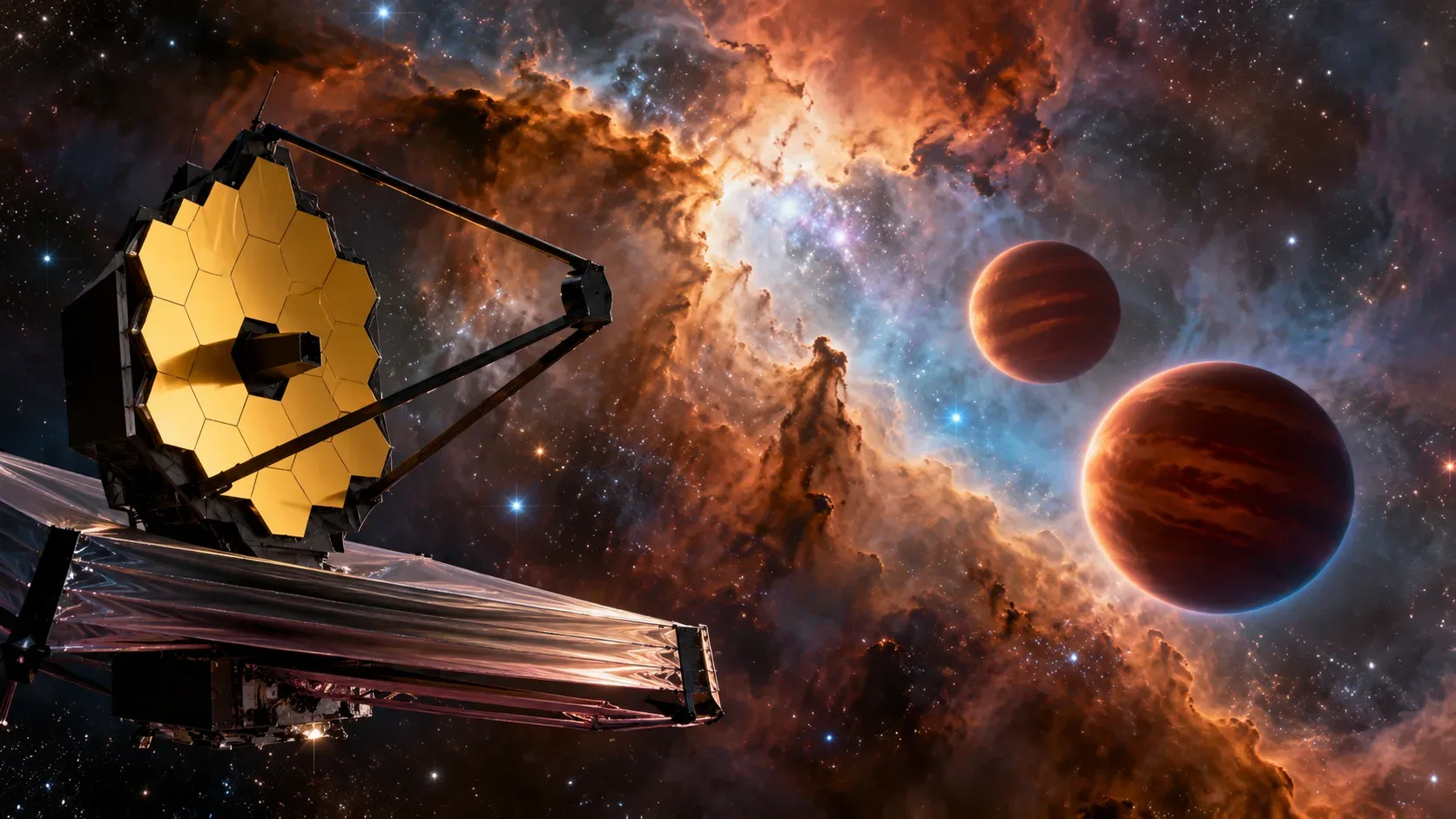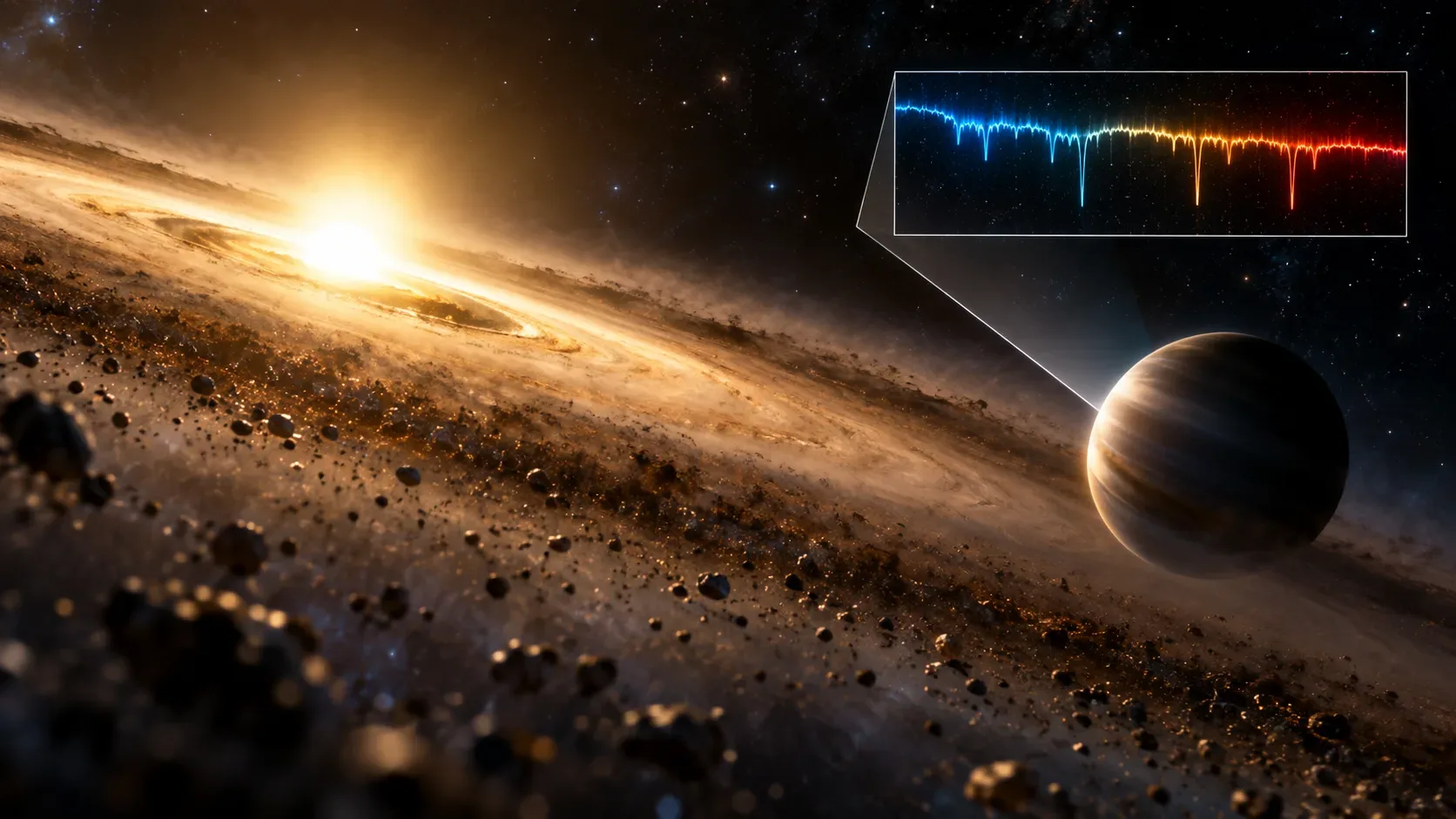
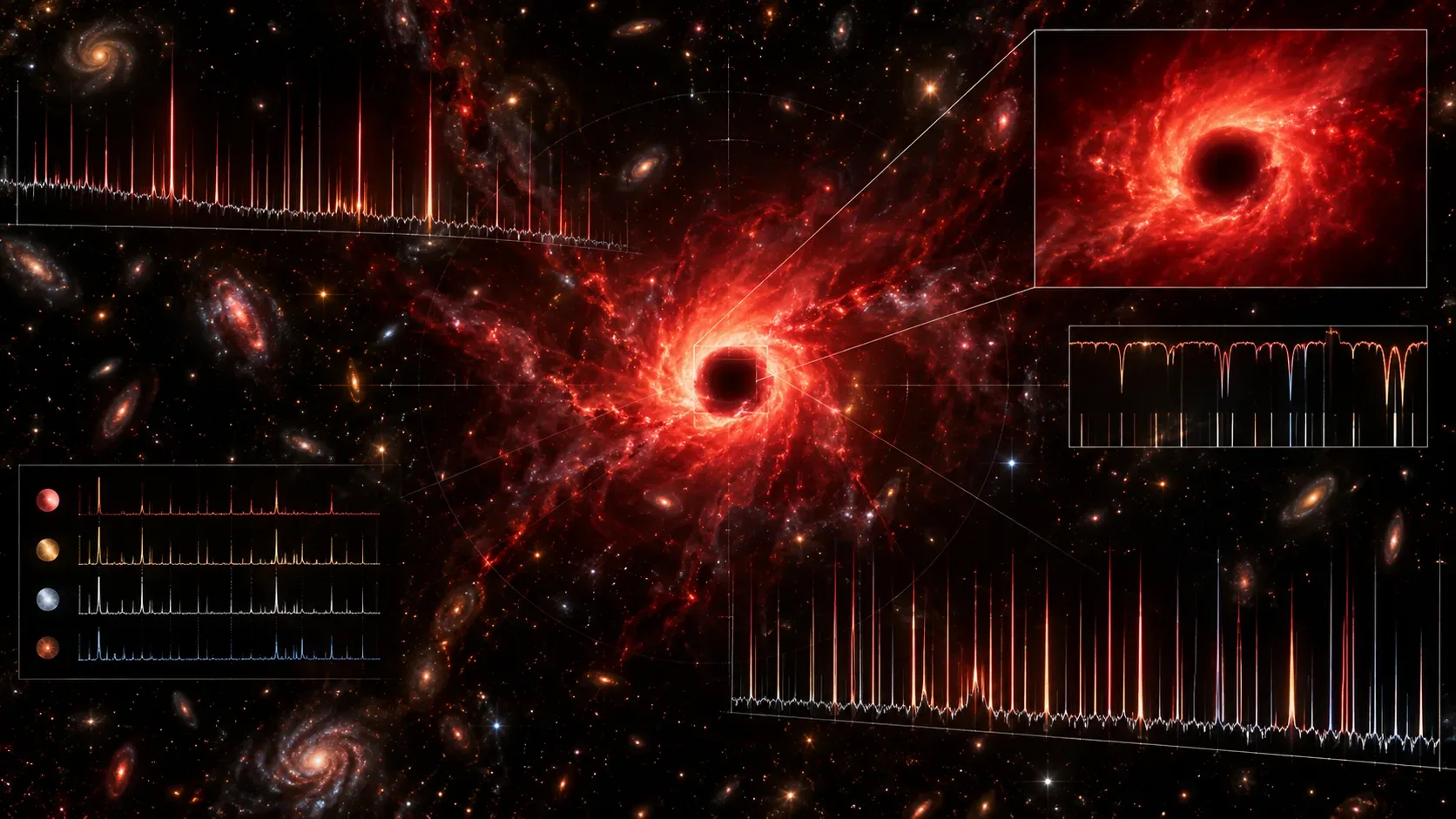
Short answer: the spectrum of GLIMPSE-17775 is, so far, the most complete set of evidence supporting the BH* (“black hole star”) scenario for a little red dot. Webb recorded more than 40 spectral lines; several of them independently point to a highly energetic source wrapped in extremely dense gas. The team’s best-fitting interpretation is a rapidly accreting black hole surrounded by a cocoon of partially ionized gas that reprocesses light produced close to the black hole. This is strong evidence for a model — not a direct detection that rules out every alternative.
The term “black hole star” can be misleading: it does not mean the object is an ordinary star with a black hole at its center. In the result released by NASA and ESA/Webb, BH* is the name of a physical scenario in which a growing supermassive black hole is embedded in a thick gas cocoon. Much of the observed spectrum would then be the signature of radiation from the central engine being scattered, absorbed, and re-emitted by that material.
Why GLIMPSE-17775 is such an informative case
Little red dots (LRDs) emerged as a puzzling class soon after the James Webb Space Telescope began science operations in 2022. They are compact, very red objects seen in the young Universe, and several explanations have been proposed for the origin of their light.
GLIMPSE-17775 was caught serendipitously in observations aimed at the Abell S1063 galaxy cluster. The object lies behind the cluster and is magnified by gravitational lensing. Its cosmological redshift is 3.5, corresponding to an epoch about 1.8 billion years after the Big Bang. Webb obtained roughly 30 hours of spectroscopy; thanks to gravitational magnification, the team estimates that the level of detail is equivalent to about 80 hours of telescope time without nature’s extra boost.
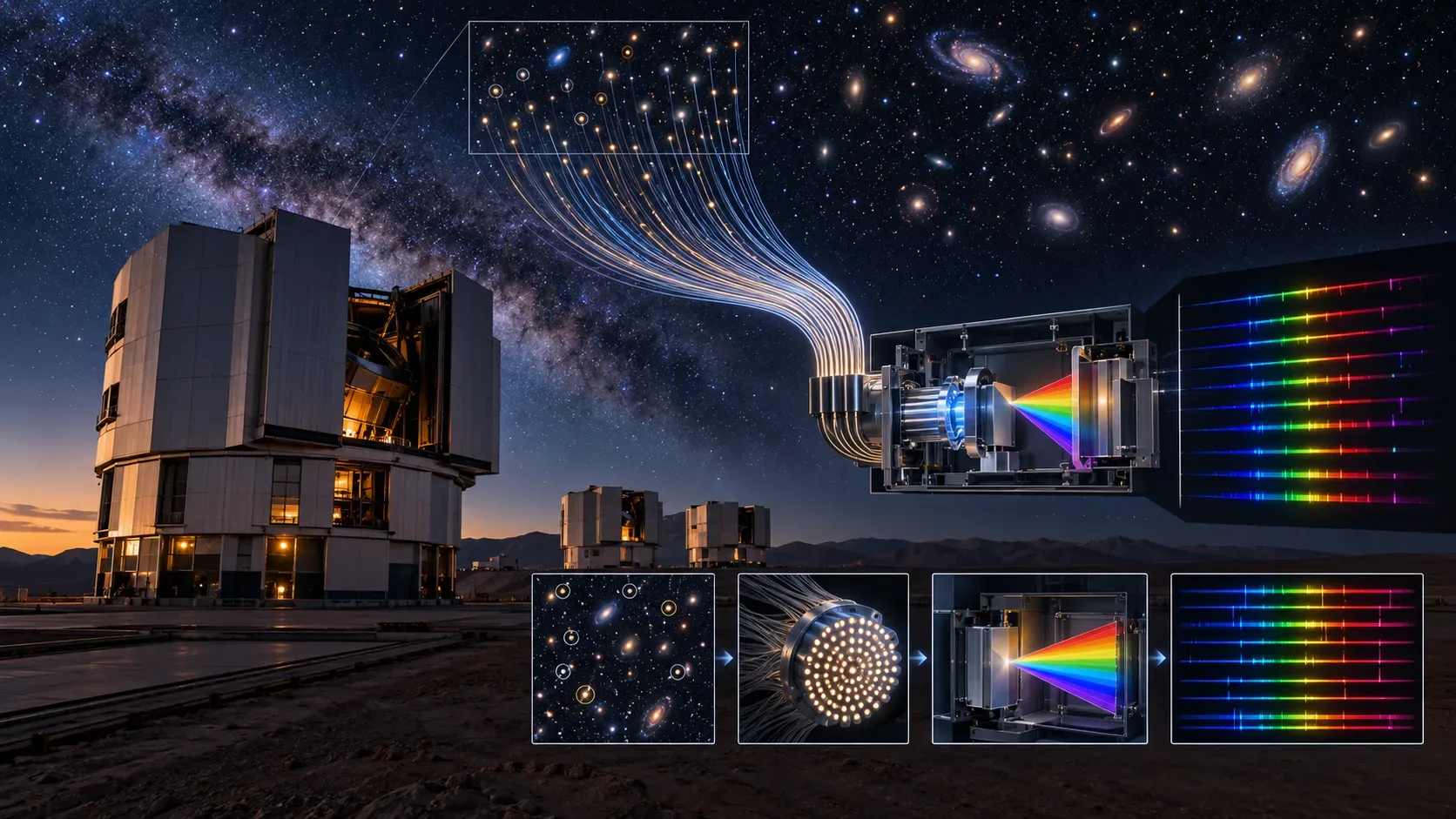
That combination yielded more than 40 identifiable spectral lines — the most detailed LRD spectrum reported as of the June 10, 2026 release. The more independent lines that can be measured, the more ways researchers have to test whether one physical model can simultaneously explain their shapes, strengths, and ratios.
1. The H, O, and He lines do not look like rotating gas alone
A first test is whether the broad lines could be explained by a relatively simple model: gas rapidly orbiting a central source. According to the team, several hydrogen, oxygen, and helium lines are not well reproduced by rotation alone. The best-fitting model includes electron scattering.
In a very dense, ionized medium, photons can be redirected repeatedly by free electrons before escaping. That process changes and broadens the spectral profile. For GLIMPSE-17775, the need for this component is interpreted as evidence for a dense, layered gas cocoon surrounding the source. The key point is that this is not one line “revealing” a black hole; multiple line profiles become more consistent when light transport through this medium is included.
2. The iron “forest” requires an energetic source
Another block of evidence comes from relative line strengths. The team identified 16 iron lines, collectively nicknamed an “iron forest,” along with oxygen lines that are important diagnostics. Producing these strengths and ratios requires a source capable of supplying a large amount of energy to the gas.
A rapidly accreting black hole is a natural candidate: matter falling toward a black hole releases energy before crossing the event horizon and can ionize and excite surrounding gas. The result is not “iron = black hole.” The inference comes from the set of ionization states and line ratios that must be sustained by an energetic source, while the accretion scenario provides that energy in a way that is consistent with the other clues.
3. Helium points to dense material around a powerful source
The astronomers also highlighted two helium signatures: fluorescence and absorption. Each, on its own, favors the presence of dense material surrounding an intense source. Together with electron scattering, they strengthen the picture in which the central radiation does not reach us untouched: it passes through a thick environment that leaves specific marks on the spectrum.
This convergence is why NASA described the result as the “strongest evidence yet” for black hole stars. The weight of the case does not come from a unique signature, but from different indicators pointing toward the same physical architecture.
What each signal supports — and what it does not prove by itself
| Observed signal | What it favors in the BH* scenario | Limit of the inference |
|---|---|---|
| H, O, and He profiles with electron scattering | A dense, layered, ionized gas cocoon around the source | Does not by itself identify the nature of the central engine |
| 16 lines in the iron “forest” plus oxygen lines | A high-energy source capable of maintaining the required excitation/ionization states | High energy alone is not direct proof of a black hole |
| Helium fluorescence and absorption | Dense material surrounding a powerful source | It is environmental evidence, not an image of the central object |
| The typical X-ray faintness of LRDs | The cocoon can absorb X-rays produced close to the black hole | It is a consistency argument for the class, not a stand-alone confirmation |
The model also helps explain why LRDs can be faint in X-rays
A common challenge for accretion-based interpretations is that many little red dots are faint in X-rays, an energy band often associated with active galactic nuclei. The BH* scenario offers a physical explanation: if the black hole is buried behind a very dense column of gas, a significant fraction of the X-ray emission can be absorbed before escaping.
This does not replace the spectral lines as the main evidence for GLIMPSE-17775, but it improves the model’s internal consistency: the same gas structure needed to explain line profiles and absorption can also help explain the weak X-ray visibility seen in many LRDs.
The Balmer break shows why the case is not “closed”
There is one piece that the Webb spectrum used in the study does not directly cover: the region needed to characterize the Balmer break, a strong drop in flux seen in many little red dots. To fill in that part of the picture, the researchers incorporated Hubble data from the Frontier Fields and BUFFALO programs.
The combined data indicate that GLIMPSE-17775 has a weaker-than-typical Balmer break and is associated with a large host galaxy. That does not contradict the dense-cocoon scenario: in the BH* model, some of the excess blue light can come from stars in the host galaxy. Still, the need to combine different datasets is a reminder that not every part of the interpretation comes from a single spectroscopic observation.
“Strongest evidence” is not the same as “definitive proof”
The correct framing is probabilistic: GLIMPSE-17775 gathers more pieces consistent with the BH* model in the same object than earlier cases. Study lead Vasily Kokorev also stresses that the team thinks the central engine is a black hole, while acknowledging that other interesting theories are still being proposed and that future observations can further test the nature of these sources.
In other words, the paper published in The Astrophysical Journal does not turn “black hole star” into a proven observational category. It shows that a model of a rapidly accreting black hole buried in dense gas can simultaneously explain an unusual set of evidence: electron-scattering broadening, the combination of H/O/He lines, the iron forest, helium signatures, and the need for a high-energy source.
How to read the result going forward
The next step is to look for the same combination of diagnostics in other little red dots and obtain more complete spectral coverage to test regions that were missing. If the BH* scenario is truly the dominant explanation, it should work not only for GLIMPSE-17775 but for a larger sample, consistently reproducing the lines, continuum, absorption signatures, and emission at other energies.
For now, GLIMPSE-17775 is a case of converging evidence: several independent clues favor the same physical structure, while none of them alone solves the mystery. That distinction between a strongly supported model and a final proof is exactly what makes Webb’s new spectrum so important.