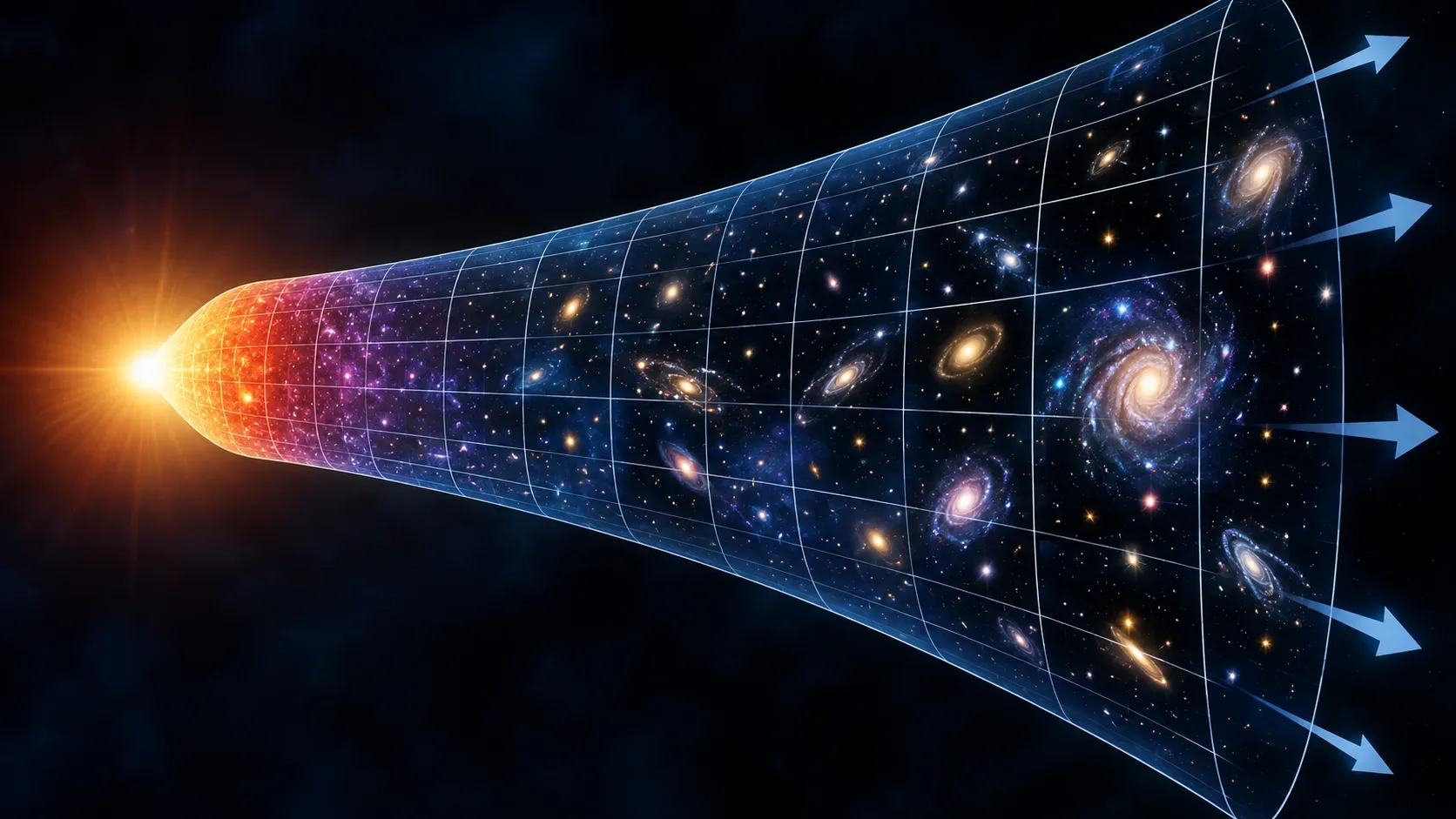
Yes — with an important qualification. In cosmology, the distance between very remote regions can increase at a rate greater than the speed of light without a spacecraft, galaxy, or signal locally crossing space faster than light. The apparent contradiction disappears once we separate local motion through space from recession caused by the evolving geometry of the Universe.
This distinction applies both to primordial inflation, when the scale factor grew extremely rapidly, and to the present-day Universe: in standard cosmological models, sufficiently distant objects can have a recession velocity defined by vrec = H(t)D that is greater than c. That does not provide a way to transmit matter or information locally above c.
First level: an analogy that avoids the false “race” against light
Imagine a gridded sheet that can stretch uniformly. Two ants are standing still on different grid intersections. Neither ant runs across the sheet, but if the grid expands, the measured distance between them increases. The farther apart they are, the larger the increase in distance per unit of time can be.
The analogy is imperfect — cosmic space does not need to expand “into” an external environment — but it captures the key point: a separation rate can become enormous without any nearby object locally outrunning a light beam.
This is why the phrase “the Universe expands at a speed” can be misleading. Cosmic expansion is described by a rate, the Hubble parameter, which has dimensions of inverse time. In the familiar form of the Hubble-Lemaître law, recession grows with distance: vrec = H(t)D. The historical WMAP/NASA page on expansion summarizes this proportionality.
What relativity actually forbids
In special relativity, no massive particle can be accelerated through local space to or beyond c, and no physical signal can carry information locally faster than light. That rule remains valid in general relativity: in a region small enough to treat spacetime as approximately flat, a local observer measures light traveling at c and material objects below c.
The subtle point is that comparing the “velocity” of two very distant objects in curved spacetime is not the same problem as measuring two cars passing the same radar gun. In general, there is no single global relative velocity between cosmologically separated events that works exactly like a special-relativistic velocity.
Second level: the minimum rigor with the scale factor
In the Friedmann-Lemaître-Robertson-Walker models used in modern cosmology, a galaxy following the cosmic flow keeps its comoving coordinate, χ, approximately fixed. Its proper distance at the same cosmological time can be written, in simplified form, as D(t) = a(t)χ, where a(t) is the scale factor.
Differentiating that distance for a comoving galaxy gives:
vrec = dD/dt = H(t)D
Because D can be extremely large, vrec can exceed c. The classic paper by Tamara Davis and Charles Lineweaver on superluminal recession and cosmological horizons shows that this occurs within the standard general-relativistic description and that observable galaxies can be associated with recession velocities greater than the speed of light.
This recession velocity is not the galaxy's local peculiar velocity — its motion through the comoving frame around it. Peculiar velocity remains subject to the local relativistic limit.
Three situations that should not be confused
| Situation | What is being compared | Can a value > c appear? | Does it violate relativity? |
|---|---|---|---|
| Local motion | An object or signal passing nearby observers | No for matter/information | It would be a violation |
| Present cosmological recession | Change in proper distance between distant comoving regions | Yes, at sufficiently large distances | No |
| Primordial inflation | Very rapid growth of the scale factor in the early Universe | Yes, for cosmological separations | It does not require local superluminal transport |
Inflation: “faster than light” in the primordial Universe
NASA describes cosmic inflation as a period, around 13.8 billion years ago, during which the Universe expanded faster than light for a fraction of a second. In more careful language, this means that the scale factor grew so rapidly that the distance between comoving regions could increase at a superluminal rate.
That does not mean individual particles crossed their local surroundings above c. NASA educational material on inflation and the horizon problem makes this distinction explicitly: the expansion concerns the geometry of space, without matter or information being transported locally faster than light.
It is also useful to avoid another simplification: inflation is not merely “the same kind of expansion we have today, only faster.” It is a proposed physical phase of the primordial Universe with its own dynamics, used to explain features such as the near-flatness of the cosmos and the origin of the seeds of large-scale structure. The exact nature of the inflationary mechanism remains an active research topic.
And today: recession can still be faster than light
Yes. Even without invoking inflation, the relation vrec = H(t)D implies that, at a given cosmological time, there is a distance where recession defined this way reaches c; this scale is called the Hubble sphere, roughly c/H(t). Beyond it, recession can be superluminal.
The Hubble sphere, however, is not the edge of the observable Universe and is not, in general, an event horizon. It changes with time. Davis and Lineweaver emphasize that we can observe light from regions that have had superluminal recession; therefore, “faster than light” does not automatically mean “forever invisible.”
How can light arrive if the source recedes above c?
A photon always moves locally at c. But the proper distance between that photon and us also depends on the expansion of space along its path. During some periods, a photon emitted toward us from a region beyond the Hubble sphere can initially have its proper distance from us increase. As H(t) and the Hubble sphere evolve, that same photon can later enter a region where its proper distance begins to decrease and eventually reach us.
This is why cosmological horizons require more care than a simple comparison between a galaxy's “speed” and c. The Hubble sphere, particle horizon, and event horizon are different concepts.
Today's accelerated expansion is not the same as “everything accelerating above c”
Observations indicate that present cosmic expansion is accelerating. NASA summarizes this acceleration in the context of dark energy, whose nature remains unknown. Here, “accelerating” describes the evolution of the scale factor; it does not mean every galaxy is locally gaining speed like a rocket.
Also, the phrase “expansion rate” should not be confused with a single global speed. The Hubble parameter tells us how recession increases per unit distance. Two farther-apart galaxies can have a larger separation rate than two nearby galaxies without either one locally crossing space above c.
The most common mistakes when explaining the topic
- “Nothing can be faster than light, so superluminal recession is impossible.” The c limit applies to local motion and information transfer; cosmological recession is defined from the evolution of distances in a dynamical spacetime.
- “Distant galaxies are projectiles traveling through space above c.” No. For comoving galaxies, the dominant effect is the changing metric that relates their distances.
- “The Hubble sphere is the end of what we can see.” No. In general, it does not coincide with the event horizon or with the boundary of the observable Universe.
- “Inflation and today's acceleration are the same phase.” No. Inflation is a proposed stage of the primordial Universe; late-time acceleration is associated, in the standard cosmological model, with dark energy.
- “The whole Universe has one expansion speed.” It is better to speak of an expansion rate and of recession velocities that depend on distance and on the definition being used.
The idea to remember
Relativity does not say that every distance between every pair of points can never grow faster than light. Operationally, it says that light sets the local causal limit: matter and information do not exceed c in a local frame.
In cosmology, spacetime geometry evolves. That is why the proper distance between widely separated regions can grow at a rate greater than c without creating a local channel for superluminal communication. This is the link that makes both primordial inflation and superluminal recession in an expanding Universe compatible with relativity.