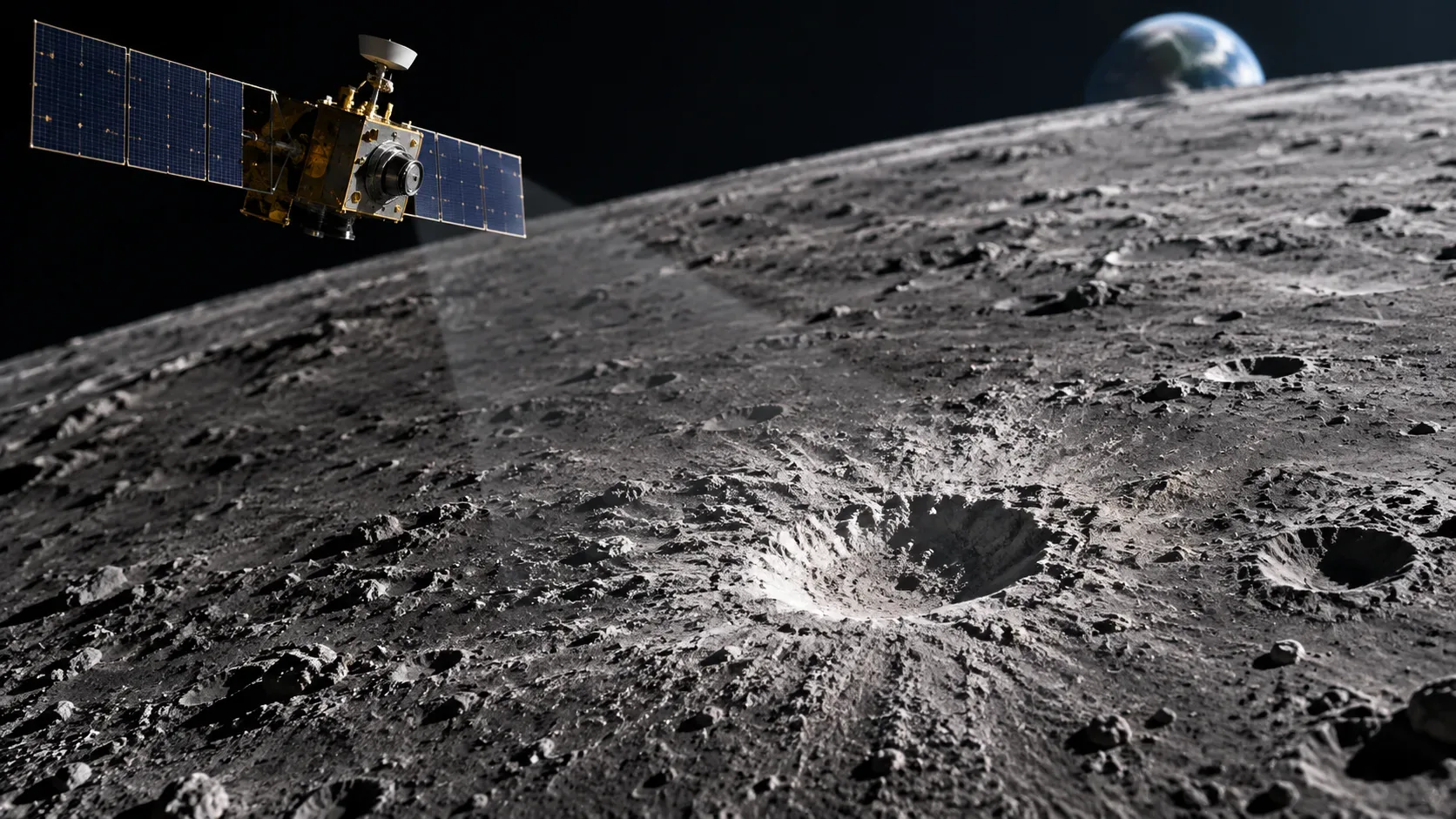
McGetchin crater offers a rare case in which scientists can constrain the formation of a large lunar crater to a window of only a few weeks. Data from the Lunar Reconnaissance Orbiter, or LRO, indicate that it formed between April 11 and May 22, 2024. The impact was not filmed at the moment it happened. Its dating came from comparing images acquired at different times, followed by higher-resolution observations and thermal measurements. NASA released the results on September 16, 2026, alongside studies published in Science Advances.
The crater is about 222 meters across and roughly 43 meters deep. According to NASA, it is the largest newly formed crater ever identified in the Solar System. That does not mean it is the largest crater on the Moon, which contains much larger and older impact structures. The significance is that a recent formation could be recognized within a modern observational interval.
How LRO dated the impact
The method starts with a simple idea: observe the same region at different times and look for change. In practice, the process requires a large volume of data and human verification because differences in lighting, shadows, and viewing geometry can create false signals.
- Global maps were compared. Robert Wagner, an image-processing specialist who works with the Lunar Reconnaissance Orbiter Camera system, noticed the signature on October 24, 2025, during a routine data-quality check. He was using Wide-Angle Camera, or WAC, image sets stacked by software to highlight what had changed between different epochs.
- The change appeared as a broad signature. The software turns stable areas into neutral tones and emphasizes differences as bright or dark regions. The new crater stood out as a large bright patch surrounded by a dark halo associated with ejecta and disturbed regolith.
- The images constrained the date. The available sequence allowed researchers to conclude that the crater formed between April 11 and May 22, 2024. This is an observational bracket: it shows when the change became present in the data, but it does not provide the exact time of impact.
- The narrow-angle camera confirmed the structure. After the discovery in wide-area maps, the team used the Narrow-Angle Camera, or NAC, for much more detailed imaging. An observation from December 5, 2025, at roughly 3 feet per pixel, helped characterize the crater's size, shape, and effects on the terrain. Another oblique view was obtained on March 3, 2026.
- Diviner added the thermal dimension. Follow-up observations revealed a cold region about 4 miles, or roughly 6.4 kilometers, wide around the crater. At night, this area is about 16 degrees Fahrenheit, roughly 9 degrees Celsius, cooler than its surroundings.
What was observed and what was estimated
| Question | What the data support |
|---|---|
| Is there a new crater? | Yes. The change is visible in temporal image comparisons and was confirmed with higher-resolution observations. |
| When did it form? | Between April 11 and May 22, 2024. This is a window derived from available data, not a direct recording of the instant of collision. |
| How large is it? | About 222 meters in diameter and approximately 43 meters deep. |
| What hit the Moon? | The interpretation is an asteroid or comet. NASA compares the likely object's size with a three- to six-story building, but this is an estimate based on the impact effects. |
| Does such an event happen once per century? | That is a statistical frequency estimate for impacts of this magnitude. USRA summarizes the value at about 130 years, while NASA describes it as roughly once a century or even longer. |
| Did the surrounding ground change? | Yes. Diviner detected an extensive nighttime thermal anomaly, interpreted as a consequence of churned and less compact regolith. |
Why a 222-meter crater is considered rare
The Moon is struck continuously. Without a dense atmosphere to slow or destroy small objects before they reach the ground, particles and rocks can hit the surface directly. LRO itself has helped identify at least 1,000 new craters during its mission and about 100,000 other surface changes associated with impacts or ejected material.
The difference is scale. NASA says the smallest craters distinguishable in LRO images are about 30 feet, close to 9 meters, across and estimates that impacts capable of making features of that size produce about 140 new craters each year across the Moon. McGetchin, at 222 meters across, belongs to a very different energy and frequency range. The USRA release summarizing the study estimates that a crater of this size forms, on average, about once every 130 years.
For that reason, "once in a century" should be read as an estimated frequency, not a regular clock. Impacts are probabilistic events. Two could occur closer together, or none might occur for much longer than a century. What makes McGetchin especially valuable is the combination of a statistically unusual event and an image record capable of constraining its recent age.
The discovery did not happen in real time
The timeline helps separate the impact from the discovery. The crater formed in the spring of 2024 in the Northern Hemisphere's calendar. Wagner noticed the signature in October 2025, more than a year later. The team then collected detailed observations in December 2025 and March 2026. The scientific results were released in September 2026.
That delay does not weaken the method. It shows how long-duration missions act as archives of planetary change. When a region is photographed repeatedly, the historical record makes it possible to ask what existed before, what appeared later, and which additional observations are needed to characterize the event.
Why the cold halo matters
The Diviner instrument measures temperatures on the lunar surface. Around McGetchin, the team found a region about 4 miles wide that is approximately 16 degrees Fahrenheit colder at night than nearby terrain. The researchers interpret this as the result of the impact churning and loosening the regolith. Less compact material stores and releases heat differently, producing the thermal signature.
The important point is the scale: physical modification does not stop at the visible rim of the crater. The ground can be altered at much greater distances by ejecta and impact-driven disturbance. For lunar exploration, this matters because regolith properties affect rover mobility, wheel-surface interaction, and the planning of surface infrastructure.
What the discovery supports with confidence
- McGetchin is a recent crater identified in LRO data.
- It formed between April 11 and May 22, 2024, according to the available temporal comparison.
- The structure is approximately 222 meters across and 43 meters deep.
- The team did not directly observe the moment of collision.
- The frequency of roughly one such event per century or longer is a statistical estimate for impacts of this scale.
- Diviner showed that the physical effects of the impact extend far beyond the visible hole.
- The name McGetchin was approved by the International Astronomical Union on May 4, 2026, honoring geologist and planetary scientist Thomas R. McGetchin.
Sources and studies
- NASA Science: NASA's Moon Orbiter Spots New, 'Once-in-Century' Moon Crater
- Universities Space Research Association: NASA's Lunar Reconnaissance Orbiter Discovers a New 222-m Diameter Lunar Crater
- USGS / IAU Gazetteer of Planetary Nomenclature: McGetchin
- Science Advances: A new 222-m diameter lunar crater
- Science Advances: New lunar crater reveals extensive distal regolith modification