Trans-Neptunian objects (TNOs) are small, icy bodies that orbit the Sun beyond Neptune. Because they are remnants of a stage when the primordial disk was still building planetesimals, they act as preserved records of Solar System formation. On September 8, 2026, NASA released the first analysis combining coordinated Hubble and James Webb observations to study some of the faintest and smallest TNOs ever directly detected. The key result is not a detailed resolved image of these worlds — they still appear as points of light — but the ability to connect color, apparent composition, size, and orbit in the same investigation.
The two complementary studies, published in The Astronomical Journal, show that small TNOs preserve color relationships similar to those of larger members of their respective dynamical families. At the same time, the Webb survey found fewer very small bodies than some planet-formation predictions suggested. This strengthens the idea that these populations still retain information about the conditions in which they formed, but it does not settle how collisions, planetary migration, and surface evolution acted over billions of years.
What Hubble and Webb measured together
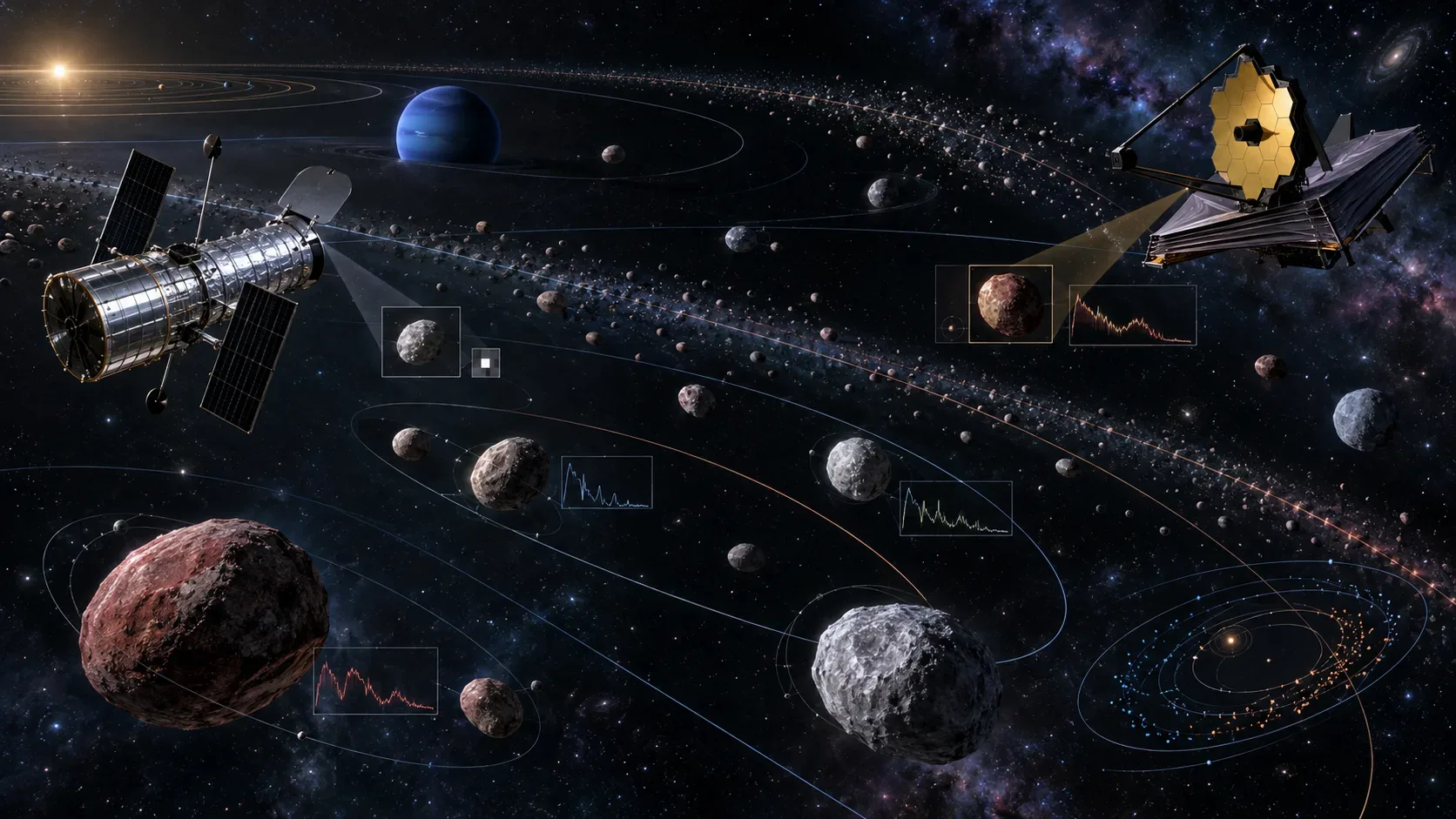
The experiment's strength comes from the telescopes' complementarity. Hubble provides highly sensitive visible-light measurements, while Webb extends the observations into the infrared. In the color analysis, coordinated observations covered roughly 0.35 to 3.2 micrometers for objects recovered in both data sets. In practice, that produces a much broader spectral baseline than either observatory provides alone.
Webb, using NIRCam, carried out the ultra-deep survey that identified 27 new TNOs. The color and composition study recovered 13 of those objects in Hubble images, using optical instruments including ACS and WFC3. The team then combined magnitudes measured through different filters to derive colors, examine light curves, and compare the small objects with color sequences already known among larger TNOs.
“Color” here means more than what a human eye would see. Astronomical color is the difference in brightness between wavelength bands. That difference provides clues about how a surface reflects light and therefore about its composition, texture, and chemical processing. Earlier Webb studies of larger TNOs had already identified distinct spectral classes associated with water ice, carbon dioxide, carbon monoxide, methanol, and complex organic materials. The new work asks whether those relationships persist when researchers move down to bodies only tens of kilometers — or less — across.
Why orbits divide TNOs into “cold” and “hot” populations
The terms “cold” and “hot” are dynamical, not thermal. Cold classical TNOs occupy relatively circular orbits with low inclinations to the Solar System's main plane. Orbital-evolution models indicate that many remained near the region where they formed, preserving a comparatively undisturbed population from the primordial disk.
Dynamically hot TNOs occupy more eccentric and inclined orbits. The leading interpretation is that many formed closer to the Sun, between regions associated today with Uranus and Neptune, and were scattered outward during the early migration of the giant planets. A TNO's present orbit therefore does not necessarily reveal its birthplace: for hot objects, it records a history of scattering and rearrangement.
This distinction is essential because it tests a historical hypothesis. If populations born in different zones of the primordial disk preserve characteristic colors, those colors can act as an indirect signature of their formation region even after their orbits have been altered.
What the colors of the small objects revealed
The study led by Anastasia Morgan found that small cold classical TNOs have a narrow color distribution consistent with a single reflectance sequence already identified among larger cold classical objects. No clear change in that sequence appears at smaller sizes. Dynamically excited TNOs, by contrast, show a broader range of colors consistent with the multiple compositional classes seen among larger objects.
This matters because researchers had good reason to expect small bodies, after fragmentation and collisions over time, to show surfaces that differed systematically from those of their larger “siblings.” The observations do not show such a break. The favored interpretation is that the color pattern has a strong primordial component linked to formation conditions rather than being simply a consequence of present-day size.
That does not make collisions irrelevant. The team itself leaves multiple possibilities open: there may have been fewer surface-altering collisions than some scenarios assume, or fragments may somehow retain surface compositions similar to the original material. The observations establish the pattern; the exact mechanism that preserved it remains under investigation.
What the sizes of the 27 new TNOs add
The Webb survey also measured the luminosity function — how the number of objects changes with observed brightness. With assumptions about distance and albedo, the brightness distribution can be related to a size distribution. The study led by Marielle Eduardo found that the cold and hot subpopulations are consistent, within the uncertainties, with similar slopes in their luminosity distributions.
That is surprising because the two populations are associated with different formation zones. The technical paper discusses presumed formation regions near roughly 25 AU for part of the hot population and 45 AU for the cold population. Even so, the statistical shape of the observed small-body distributions is similar. That suggests that planetesimal formation may produce comparable size distributions under different disk conditions.
The survey also found fewer very small TNOs than some model extrapolations predicted. That shortfall is potentially informative because formation and collisional-evolution models make different predictions for the abundance of small bodies. However, the observed field covers a tiny fraction of the sky, so larger samples will be needed before the discrepancy becomes a definitive constraint on planet-formation physics.
How small did the observations reach?
NASA's release highlights an object about 5 kilometers (3 miles) in diameter, roughly five times smaller than the ground-based detection limit cited by the agency. The abstract of the luminosity-function paper, meanwhile, states that its faintest detection would be about 10 kilometers across if a 15% albedo is assumed. Those figures are not necessarily contradictory: brightness, distance, and albedo all affect the conversion to diameter, and the faintest object need not be the physically smallest object.
This distinction is a useful reminder that size is not measured as a resolved disk for these TNOs. They remain point sources even for Hubble and Webb. Diameter is inferred from brightness together with assumptions about how much light the surface reflects. Change the assumed albedo, and the estimated size changes.
How colors, orbits, and sizes tell a Solar System formation story
The three measurements answer different questions:
- Color and reflectance: show how the surface interacts with light and help distinguish compositional families.
- Orbit: records dynamical history and separates populations that probably formed in different regions.
- Size distribution: records how planetesimal growth and later evolution divided mass among large and small bodies.
Combined, those clues provide a richer picture. Cold TNOs appear to preserve both relatively undisturbed orbits and a narrow color sequence. Hot TNOs had their orbits scrambled by planetary migration, yet their colors still follow relationships seen among their larger counterparts. And both populations show similar small-body distributions within the survey's uncertainties.
This combination is consistent with an early Solar System in which formation location left long-lived compositional signatures, while the planetesimal-building process generated comparable size distributions in different environments. For dynamically hot TNOs, color acts like a form of memory that survived orbital rearrangement.
What the data do not yet allow scientists to conclude
The results provide strong evidence for continuity between small and large TNOs, but they do not justify several stronger claims.
- They do not prove that every surface has remained untouched since Solar System formation.
- They do not determine by themselves how many collisions each object experienced.
- They do not convert broadband color into one unique chemical composition without additional spectroscopy.
- They do not show that the cold and hot populations formed under identical conditions; they show similarities in their small-body distributions.
- They do not resolve the mismatch between the observed number of small TNOs and every model prediction.
The primordial interpretation still depends on comparison with models of planetary migration, planetesimal formation, and collisional evolution. What the new data do is tighten those models: any successful scenario must explain why the color sequences persist to much smaller sizes and why the two populations show such similar luminosity distributions.
Why the Hubble + Webb combination matters
Webb alone is extraordinarily sensitive in the infrared and was crucial for finding the 27 objects. Hubble adds optical measurements that extend the color baseline. That extension is precisely what makes it possible to place the small TNOs on the same reflectance relationships used to study larger populations.
The gain does not come from “adding two pictures” of the same body. It comes from building a multi-band measurement. For targets this faint, coordinated observations also reduce problems caused by rotation and brightness changes between widely separated epochs. It is a clear example of observatories with different sensitivities producing a scientific result that neither could deliver as strongly on its own.
What to watch in future observations
The next tests should expand the surveyed area, increase the number of small TNOs with optical-to-infrared colors, and obtain more detailed spectra when possible. A larger sample will show whether the apparent shortage of very small bodies persists and whether the cold and hot distributions remain statistically similar.
It will also be important to connect broadband colors with the compositional classes Webb has identified spectroscopically among larger TNOs. If the same chemical architecture consistently appears in ever-smaller bodies, the case that these surfaces preserve a memory of their formation region will strengthen. If breaks emerge with size, orbit, or collisional history, they will reveal where that memory begins to be modified.
Main sources
- NASA Science — Hubble and Webb on TNOs, September 8, 2026
- Morgan et al. — Combined JWST and HST Deep Imaging to Characterize the Smallest Known Trans-Neptunian Objects
- Eduardo et al. — The Luminosity Function of Ultra-Faint Trans-Neptunian Objects Detected by JWST
- NASA Science — Webb reveals the ancient surfaces of TNOs