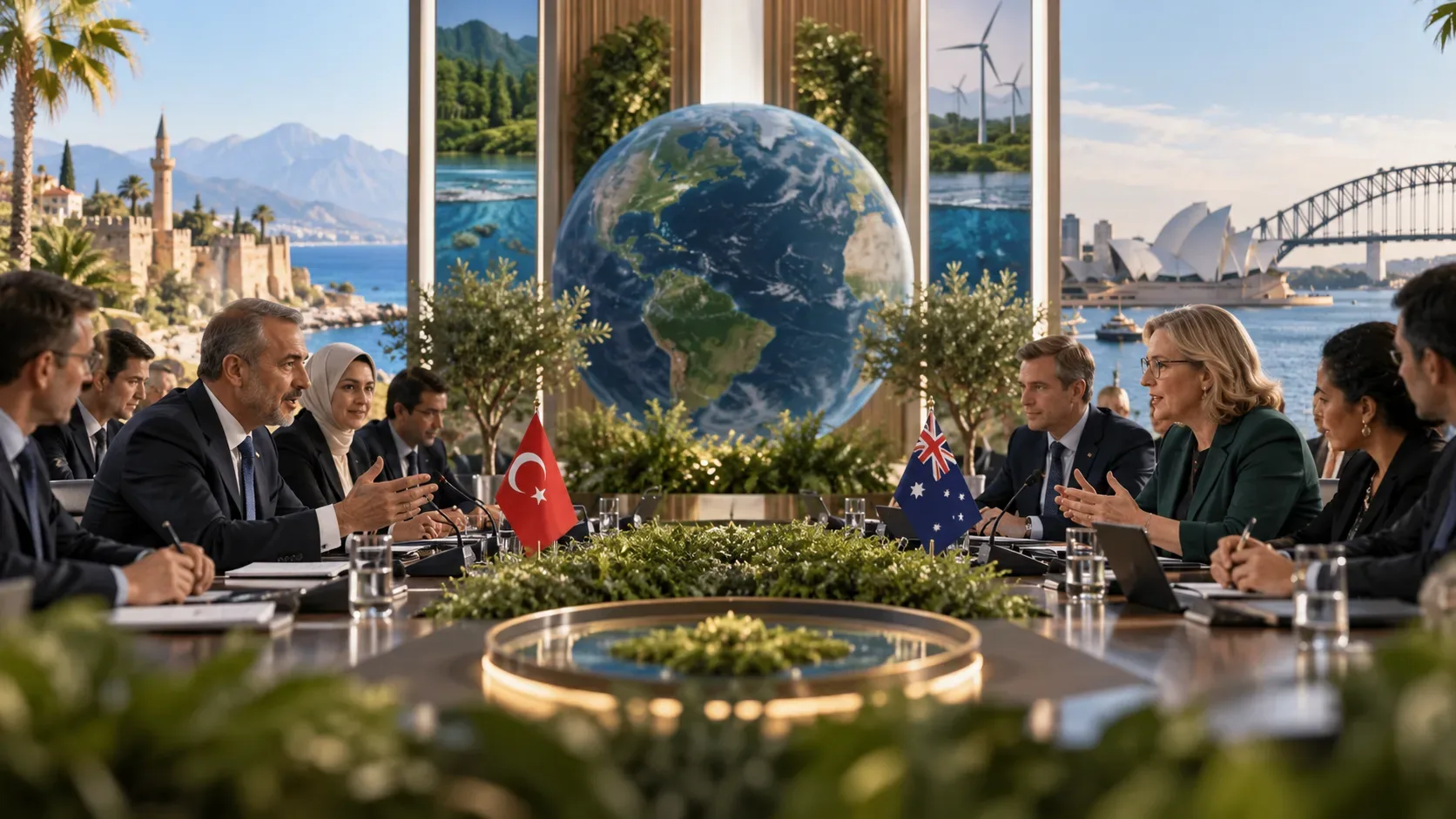
COP31 will use a leadership structure that differs from the model most people associate with UN climate conferences. The meeting will take place in Antalya, Türkiye, from 9 to 20 November 2026, and Türkiye will be nominated to hold the COP Presidency. At the same time, Australia will serve as President of Negotiations, with delegated authority to lead the formal negotiations. The arrangement was welcomed at COP30 and set out in the Türkiye-Australia Partnership Modalities.
This does not mean there will be two COPs or that each country controls half of the conference. The split is functional: Türkiye keeps the institutional presidency, host-country role and leadership of the Action Agenda; Australia leads the negotiating process, including consultations, facilitators and negotiating texts. Decisions still rest with the Parties under the UNFCCC’s consensus-based process.
The simplest view: who does what at COP31
| Function | Responsible party | What it means in practice |
|---|---|---|
| COP31 Presidency | Türkiye | A Turkish representative will be nominated for election as COP31 President at the opening of the session and will perform the institutional functions of the presidency. |
| Host country | Türkiye | Antalya hosts COP31 and the World Leaders Summit; the Turkish government assumes the operational and logistical responsibilities of the host. |
| Formal negotiations | Australia | The Australian representative serves as President of Negotiations and receives delegated authority to lead the negotiating agenda and texts. |
| Action Agenda | Türkiye | The Turkish presidency leads the track focused on initiatives, implementation and mobilizing actors beyond the formal negotiations. |
| Pacific Pre-COP | Australia + Pacific countries | Fiji hosts the preparatory meetings and Tuvalu a leaders component, with support and coordination from Australia and Pacific partners. |
Why does Türkiye preside while Australia leads the negotiations?
The answer lies in the process for choosing the host and presidency. For COP31, the presidency was due to come from the Western European and Other States group (WEOG). Türkiye and Australia had competing bids, and the process needed to reach an outcome accepted by the group. The official COP30 report records that the 2026 presidency would come from WEOG and that consultations had to be concluded; the final decision accepted Türkiye’s offer to host and welcomed the bilateral arrangement with Australia, endorsed by the regional group.
The model can therefore be understood as an institutional compromise: Türkiye retained hosting and the formal presidency; Australia kept a central role by taking charge of the negotiations and bringing the Pre-COP to the Pacific. That interpretation is consistent with the official record, but it should not be turned into a story of geopolitical rivalry that the sources do not establish. The modalities themselves require consultation between the two sides and say that differences should be discussed until a mutually satisfactory resolution is reached.
What remains with the Turkish COP Presidency
The modalities define the COP31 President as a representative of Türkiye who will be nominated for election by the Conference of the Parties at the start of the session. This is the institutional COP presidency. Türkiye is also the host country and therefore must enter into a Host Country Agreement with the UNFCCC and fulfil the organizational, operational and logistical duties of hosting the conference.
Türkiye also leads the Action Agenda. This track is not the same as the intergovernmental negotiating process. It brings together initiatives, implementation and mobilization by governments, businesses, cities, civil society and other actors. The UNFCCC has stressed in 2026 that the Action Agenda and the negotiations are separate, though complementary, tracks.
In practice, this gives the Turkish presidency a broad role in the political and operational architecture of COP31 even though it does not directly run the negotiating table. Antalya will also host the World Leaders Summit, scheduled for 11 and 12 November during the conference.
What exactly Australia controls in the negotiations
The most unusual part of the agreement is the creation of the President of Negotiations role. Under the modalities, the COP31 President delegates to an Australian representative the functions of leading the negotiations, with “exclusive authority” over that process. To make the arrangement work formally, the Australian representative will be nominated as a COP Vice-President for the duration of COP31.
The authority covers concrete tasks: carrying forward mandates from negotiated outcomes, convening consultations throughout the year, communicating on negotiation matters, selecting ministerial and other co-facilitators, leading the negotiating agenda in Antalya, coordinating the production of draft texts and serving as the focal point with the UNFCCC on negotiations.
Australia’s Minister for Climate Change and Energy, Chris Bowen, was appointed to the role. His position does not, however, make Australia an arbiter able to impose outcomes. COP negotiations remain Party-driven and, where decisions are required, continue to depend on consensus or the applicable procedures of the multilateral process.
“Exclusive authority” does not mean the power to decide alone
The phrase is striking, but it has to be read within the UNFCCC system. Australia controls the management of the delegated negotiating process: the consultation calendar, organization of talks, choice of facilitators, circulation and consolidation of texts and the political management of the search for convergence. It does not gain the power to replace national positions or approve decisions without the Parties.
This distinction is essential. A COP presidency can strongly influence the pace and architecture of talks, but the final content emerges from negotiation among governments. In June 2026, UNFCCC communication made the distinction explicit: negotiations are Party-driven, while the Action Agenda follows a different process.
Where does the Pacific fit in?
The Pacific is the third political and organizational element of the agreement. The 2026 Pre-COP will take place from 5 to 8 October: Fiji will host the preparatory meetings and Tuvalu will host a special leaders component. Australia, working with Pacific island countries, is involved in setting the agenda and organizing these events.
The stated aim is to put the climate impacts already experienced by small island states, as well as locally led solutions, directly in front of ministers and leaders. Priorities include keeping 1.5°C within reach, improving access to climate finance and elevating the ocean agenda. The agreement also provides visibility for the financing needs of Small Island Developing States and the Pacific Resilience Facility.
This gives the Pacific influence before the formal opening in Antalya. The Pre-COP does not replace the COP31 negotiations, but it can help test possible areas of agreement, narrow differences and prepare issues for the November conference.
Why the model is described as unprecedented
Official Turkish, Australian and Pacific sources describe the structure as new or unprecedented: two countries split central functions of a single COP presidency framework, while the Pacific hosts a major part of the political preparation. What is unusual is not cooperation between COP presidencies — that happens regularly — but the formal separation of the COP Presidency from the leadership of negotiations through an explicit delegation of authority.
The real test will be operational. The agreement requires Türkiye and Australia to consult each other and, if disagreements arise, to keep consulting until they reach a mutually satisfactory solution. That is designed to reduce the risk of two competing public chains of command, but it also requires continuous coordination between the institutional presidency, the negotiating track and the Action Agenda.
COP31 dates that help explain the structure
- 5-8 October 2026: Pacific Pre-COP, with preparatory meetings in Fiji and a leaders component in Tuvalu.
- 9-20 November 2026: COP31 in Antalya, Türkiye.
- 11-12 November 2026: World Leaders Summit in Antalya.
The calendar mirrors the logic of the agreement: the Pacific gets its own moment for political preparation; Türkiye concentrates the conference and leaders summit; and Australia leads the negotiating track from the preparatory period through the close of COP31.
What to watch to see whether the split works
For readers, the best indicator will not be which country gets more stage time, but whether the three moving parts connect. Watch whether Australia-led consultations produce texts with enough convergence, whether Türkiye’s Action Agenda stays coherent with the negotiated priorities and whether the Pacific Pre-COP succeeds in carrying regional priorities into the Antalya debate.
It is also important to separate announcements from decisions. Action Agenda initiatives can generate important commitments and coalitions without becoming formal COP decisions. Negotiated texts, by contrast, must pass through the intergovernmental process. The strength of the Türkiye-Australia model will depend on coordinating those two tracks without confusing them.
Official sources for following COP31
- Official COP31 page at the UNFCCC
- Türkiye-Australia Partnership Modalities
- The Road to Antalya, UNFCCC
- Australian government page on COP31 and the Pacific partnership
- Joint letter from the COP31 Presidency and President of Negotiations
In short, COP31 will not have a simple “co-presidency.” Türkiye presides and hosts; Australia leads the negotiations by delegation; and the Pacific hosts the Pre-COP and gains a formal channel of influence in the preparation. The model distributes functions while keeping the conference within UNFCCC multilateral rules and the need to build consensus among Parties.