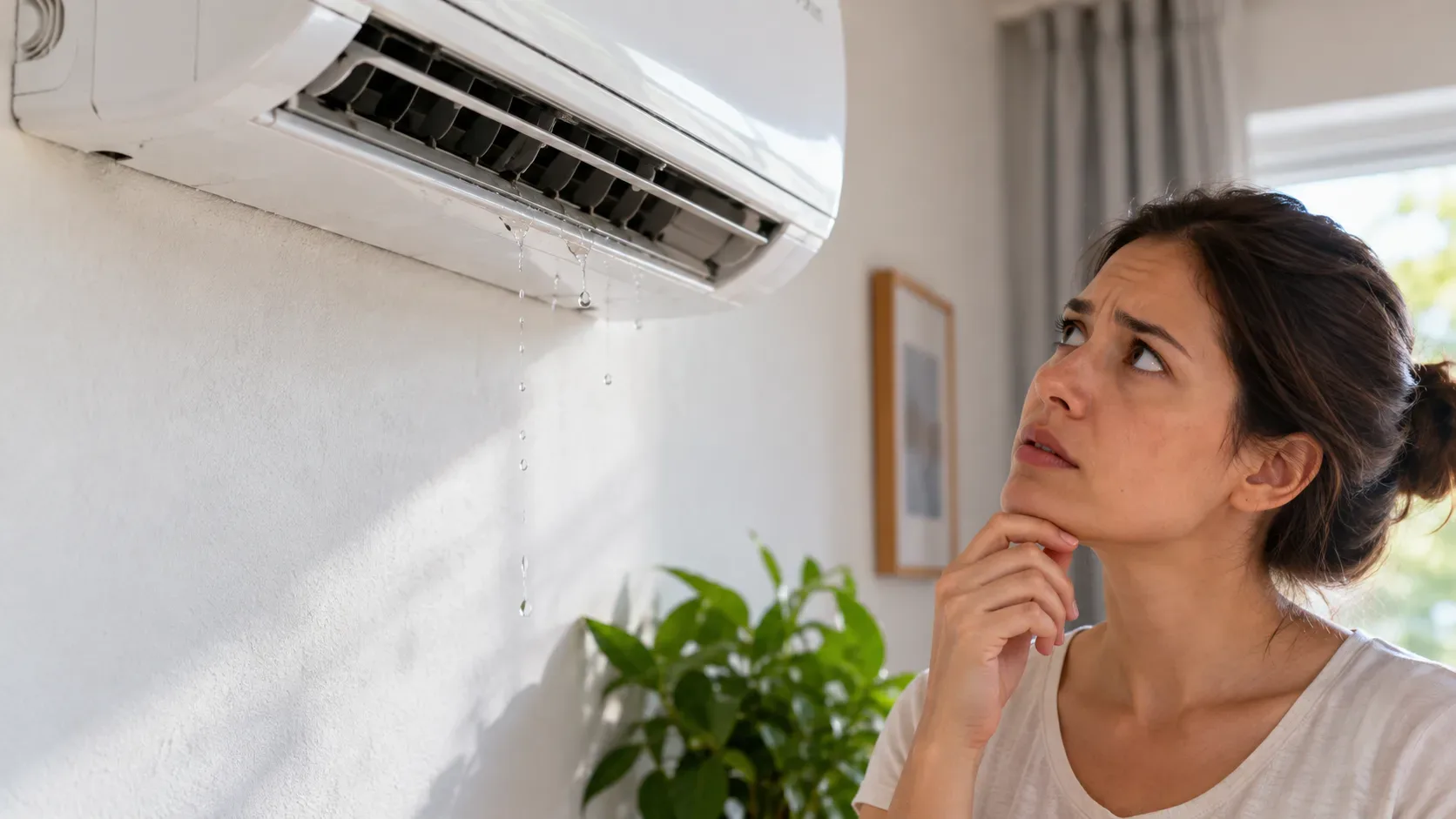
If the indoor unit of your air conditioner starts dripping water inside the house, the useful question is not only “where is the leak?”, but which part of the water path has stopped working. In a split system running in cooling mode, moisture from the air condenses on the coil, falls into the drain pan and should leave through the drain line. When that path fails, three problem families explain many cases: a blocked or poorly routed drain, ice formation, and installation/leveling errors. The dripping pattern can help separate these possibilities without opening the casing.
Before diagnosing: treat water near electricity as a priority
If water is reaching an outlet, extension cord, light fixture, electrical panel, ceiling with wiring, or the unit’s own electrical feed, stop using the air conditioner. If you can do so safely, switch off the unit and the corresponding circuit at the breaker panel, then call for service. Do not keep testing the system while it is energized.
For a household check, limit yourself to what the manufacturer allows the user to do: observe where the dripping starts, inspect a user-removable filter according to the manual, and look at the outdoor drain outlet only when it is reachable without a ladder or other risk. Do not dismantle the indoor unit, push wire or objects into the hose, use compressed air, or try to “top up refrigerant”.
Quick diagnosis: compare the symptom pattern
| Observed sign | Most likely family | What you can check | Next step |
|---|---|---|---|
| Water comes from the front/bottom; the outdoor drain outlet produces little or no water | Blocked, kinked, or poorly draining line | Observe the outdoor drain end, if accessible, and note whether the leak increases after the unit has been running for a while | If it persists, call a technician to clear and inspect the drain route |
| Airflow became weak; ice is visible; water appears or increases after shutdown | Coil freezing / restricted airflow | With the unit off, inspect the removable filter and look for visible ice without touching the fins | Clean the filter only as the manual directs; if ice returns, call a technician |
| It always leaks from the same corner or started soon after installation/service | Leveling, drain slope, or installation issue | Consider the history and, only if visible, check whether the hose has an upward section, severe bend, or pinch point | Request an installation review; do not shim the unit yourself |
1. Clogged drain: look for signs that water is not leaving
The indoor drain pan collects condensation and sends it through a hose. Dust, slime, biofilm, bends, or a poorly draining section can reduce flow until the pan overflows. A technical article from DYA Ar Climatização lists drainage problems among the recurring causes of indoor dripping and advises against inserting objects or using compressed air in the hose because doing so can push debris inward or cause damage.
The most useful clue for a homeowner is the combination of two observations: water is entering the room while little or no water reaches the outdoor drain outlet. This does not prove a clog by itself — the drain may be concealed or discharge elsewhere — but the suspicion becomes stronger if the system worked normally for months and the problem appeared later.
On very hot and humid days, a partially restricted drain may seem normal for a while and overflow only when condensate production increases. For that reason, a leak that happens only on certain afternoons does not rule out a drainage restriction.
2. Ice on the coil: the timing of the leak is a clue
When airflow across the coil is insufficient, the coil can become cold enough to freeze moisture. LG’s support documentation explains that ice or frost behind the front grille is commonly associated with blocked or slow airflow; a heavily soiled filter is one possible cause. When that ice melts, the temporary volume of water can exceed the drainage capacity and show up as dripping.
Signs that point to this family include weaker-than-usual airflow, visible ice behind the filter or on the fins, and leaking that starts or becomes heavier after the unit is switched off. If the user-removable filter is heavily loaded with dust, clean it only as the manual specifies, let it dry completely, and reinstall it only when ready.
However, a dirty filter is not the only cause of freezing. Indoor fan problems, a heavily fouled coil, sensors, or the refrigeration circuit can also produce ice. Therefore, if ice returns after the filter has been cleaned correctly, do not keep running the unit: it needs technical evaluation.
3. Installation error: consider the history and which side gets wet
A drain line needs to let water move by gravity, without sections that create backflow, severe bends, or improper high points. In a maintenance guide, LG recommends checking that the drain hose is free of bends and slopes downward. When the problem has existed since installation or began soon after the unit was moved, construction work was done, or service was performed, installation becomes a stronger hypothesis.
Also note whether the drip always appears at the same corner of the indoor unit. That can be consistent with a unit that is not aligned as intended by the manufacturer, a drain pan that is not emptying correctly, or a drain line with reverse slope. The correction should be performed by someone who knows the installation procedure for that model; do not compensate with improvised shims, forced tilting, or drilling.
Safe at-home checking flow
- Observe where the water starts. The front or center of the unit, one specific corner, the wall below it, or the insulated piping each suggest different paths.
- Observe when it starts. Right after startup, after hours of operation, only after shutdown, or from the first day after installation.
- Turn the unit off before touching the filter. Remove only the filter that the manual identifies as user-removable.
- Look for visible ice without touching the fins. If ice is present, leave the unit off so it can thaw; do not use tools or direct heat to speed the process.
- Check the drain outlet only if it is easy to reach. Do not climb façades, roofs, or makeshift ladders. Observe whether water is flowing while the air conditioner is cooling.
- Match the symptom to the history. A new issue on an older unit favors dirt/drainage; a problem present since installation favors setup; recurring ice after a clean filter calls for technical diagnosis.
When to stop checking and call a technician
- Water is reaching any electrical component, outlet, light fixture, or wired ceiling area.
- Ice returns after the filter has been cleaned and reinstalled correctly.
- The drain appears not to discharge, or leaking continues after the only user maintenance allowed by the manual.
- The leak began right after installation, reinstallation, construction work, or service.
- The unit is visibly misaligned, or the drain hose, pump, or piping is concealed and inaccessible.
- Strong odor, unusual noise, poor cooling, or error codes occur together with the dripping.
What to tell the technician to speed up diagnosis
Before the visit, note four things: where the water appears, how long the unit runs before it drips, whether you saw ice, and whether installation or service was recent. If you could safely observe the drain outlet, also report whether water was flowing. This information helps separate a drainage blockage, a freezing problem, and an installation fault more quickly.
In short: use the pattern, not a single clue
Water from the front of the indoor unit with little outdoor drainage points first toward the drain; visible ice, weak airflow, and dripping after shutdown point toward freezing; a leak concentrated on one side or present since installation points toward leveling/drain slope. No single sign closes the diagnosis. The purpose of a household check is to identify the likely problem family and avoid risky interventions — not to replace professional inspection when the leak persists.