If a refrigerator makes an isolated crack, “pop,” or short series of creaks and keeps cooling normally, the sound may be part of normal operation. Manufacturers explain that walls and plastic parts expand and contract as temperatures change, especially during initial cooling and defrost cycles. The diagnosis changes when the noise is repetitive, much louder than usual, or appears together with poor cooling, strong vibration, electrical fluctuations, a burning smell, or abnormal heating at the outlet.
Why a refrigerator can pop without being faulty
A refrigerator alternates between compressor operation, refrigerant flow, ventilation, and defrost cycles. These processes change the temperature of panels, tubing, and internal parts. Consul attributes small cracking sounds to the expansion or contraction of a panel caused by temperature changes. Samsung likewise describes snapping, crackling, and popping as the result of plastic parts contracting and expanding, often during defrosting.
Other sounds can occur alongside these pops. The compressor produces a motor sound; refrigerant can cause hissing or gurgling; a relay may click when a component switches on; and on models with an ice maker, ice ejection and falling cubes can cause knocks. Whirlpool lists these among possible normal operating sounds.
What the timing of the noise can tell you
Instead of judging by volume alone, look at four things together: the type of sound, when it happens, whether another symptom appears, and whether cooling remains normal. That combination is more useful than trying to identify a part by ear.
| Sound and timing | Possible explanation | Associated sign | Safe action |
|---|---|---|---|
| An isolated crack or “pop” after startup, after a temperature change, or during/around defrosting | Expansion and contraction of panels and internal parts | The refrigerator holds temperature; there is no smell, overheating, or electrical failure | Observe the pattern. If it is occasional and performance is normal, it generally does not require intervention. |
| A single click when the compressor or ventilation starts or stops | Thermostat/relay switching or a normal cycle change | The motor starts and stops in cycles and cooling remains stable | Compare it with the appliance’s usual behavior and check the model’s manual. |
| Vibration, shaking, or rattling that changes when you touch nearby furniture | Leveling, contact with a wall/cabinet, items on top of the refrigerator, or poorly seated internal parts | Mechanical noise without loss of cooling | Without dismantling anything, check that the floor is firm, the feet are level, and nothing is touching the cabinet. Manufacturers highlight leveling as a way to reduce noise. |
| Clicks or pops repeating in sequence, especially during attempts to start | A protective device may be operating, or there may be a power-supply, start-system, or compressor problem | The compressor tries to start and stops, or the refrigerator no longer cools properly | Do not keep power-cycling the appliance. Check only external conditions and contact appliance service. |
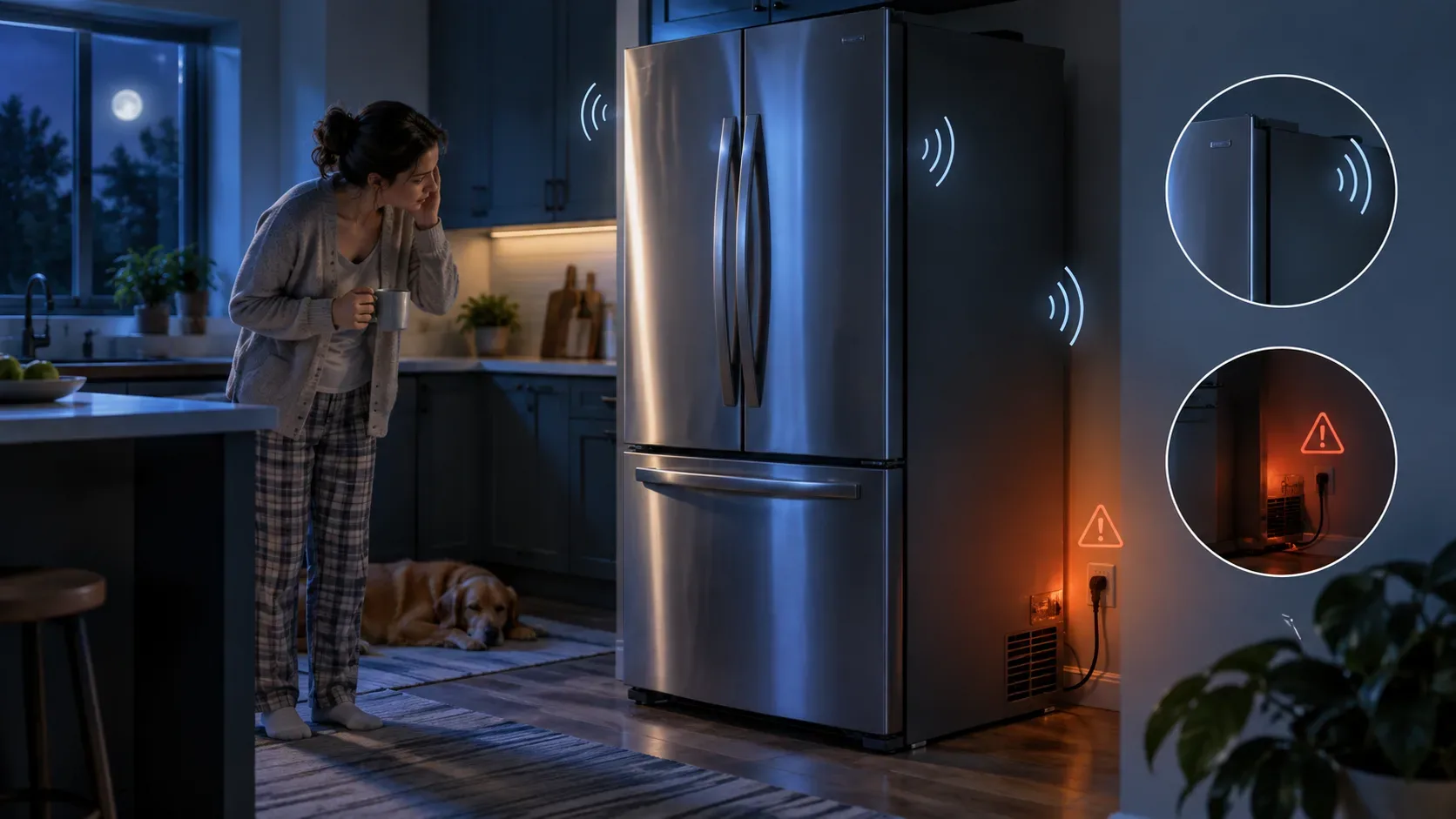
| A pop accompanied by flickering household lights, a hot outlet, a burning smell, sparks, or a damaged cord | Possible electrical problem with the outlet, circuit, plug, or appliance | There is an electrical sign in addition to the noise | Treat it as a safety issue. If it can be disconnected without touching hot or damaged parts, stop using it and call a qualified electrician and/or authorized service. |
Why it seems worse at night
A refrigerator does not enter a special “night mode” that automatically makes popping abnormal. What often changes is the environment: less conversation, traffic, television, and other background noise makes short sounds seem louder. Samsung notes that normal refrigerator noises can be more noticeable when surrounding noise levels are lower. Compressor and defrost cycles also continue while the home is quiet.
So hearing a “pop” at 2 a.m. is not, by itself, evidence of a fault. What matters is whether the pattern is new, very frequent, progressively louder, or accompanied by a temperature change or electrical symptoms.
A household checklist that does not require opening the refrigerator
- Confirm that it is still cooling. Loss of cooling changes the priority of the diagnosis.
- Note the exact timing. Does the sound happen just after the motor starts, when it stops, after opening the door, during defrosting, or when the ice maker works?
- Rule out external vibration. Check for bottles touching, objects on the cabinet, poorly seated shelves, or contact with a wall or nearby furniture.
- Check leveling and installation clearance. Whirlpool and Brastemp recommend proper leveling and ventilation; poor installation can increase noise and affect operation.
- Inspect the outlet externally without dismantling anything. A loose plug, damaged outlet, heating, discoloration, sparks, or a burning smell are not signs to simply “watch for a few days.”
- Avoid improvised extension cords and adapters. Brastemp recommends a suitable outlet in good condition and warns against extensions and connections that can overload the electrical circuit.
- Record the pattern. A short audio clip, the time, frequency, and whether the compressor was trying to start can help service technicians understand the symptom.
When popping calls for service
Contact appliance service when the noise comes with poor cooling, repeated start-and-stop attempts, very strong vibration, a noise that appeared suddenly and does not resemble the appliance’s usual operation, or persistent repetition without a simple external explanation. Consul states that clicking from the compressor’s thermal protector can occur when there is a power-supply problem or improper installation, which warrants evaluation of both the electrical context and the appliance.
It is also reasonable to request an assessment when a newly installed refrigerator remains excessively noisy after leveling, clearances, and transport materials have been checked, or when the appliance was recently moved to a different outlet, circuit, extension, adapter, or location.
Electrical warning signs take priority over diagnosing the sound
If there is a burning smell, sparks, a very hot plug or outlet, a damaged cord, repeated circuit-breaker trips, or obvious lighting fluctuations when the refrigerator tries to start, the issue is no longer just “what is that noise?”. The electrical installation needs to be checked. Do not open the compressor cover, handle the relay, capacitor, or internal wiring, or try to bypass the symptom with adapters.
When there is no immediate safety sign, the most useful rule is simple: an occasional pop with normal cooling is generally compatible with expansion/contraction and normal appliance cycles; a repetitive pattern together with poor cooling or electrical signs deserves professional service. Sound alone rarely identifies a component safely.