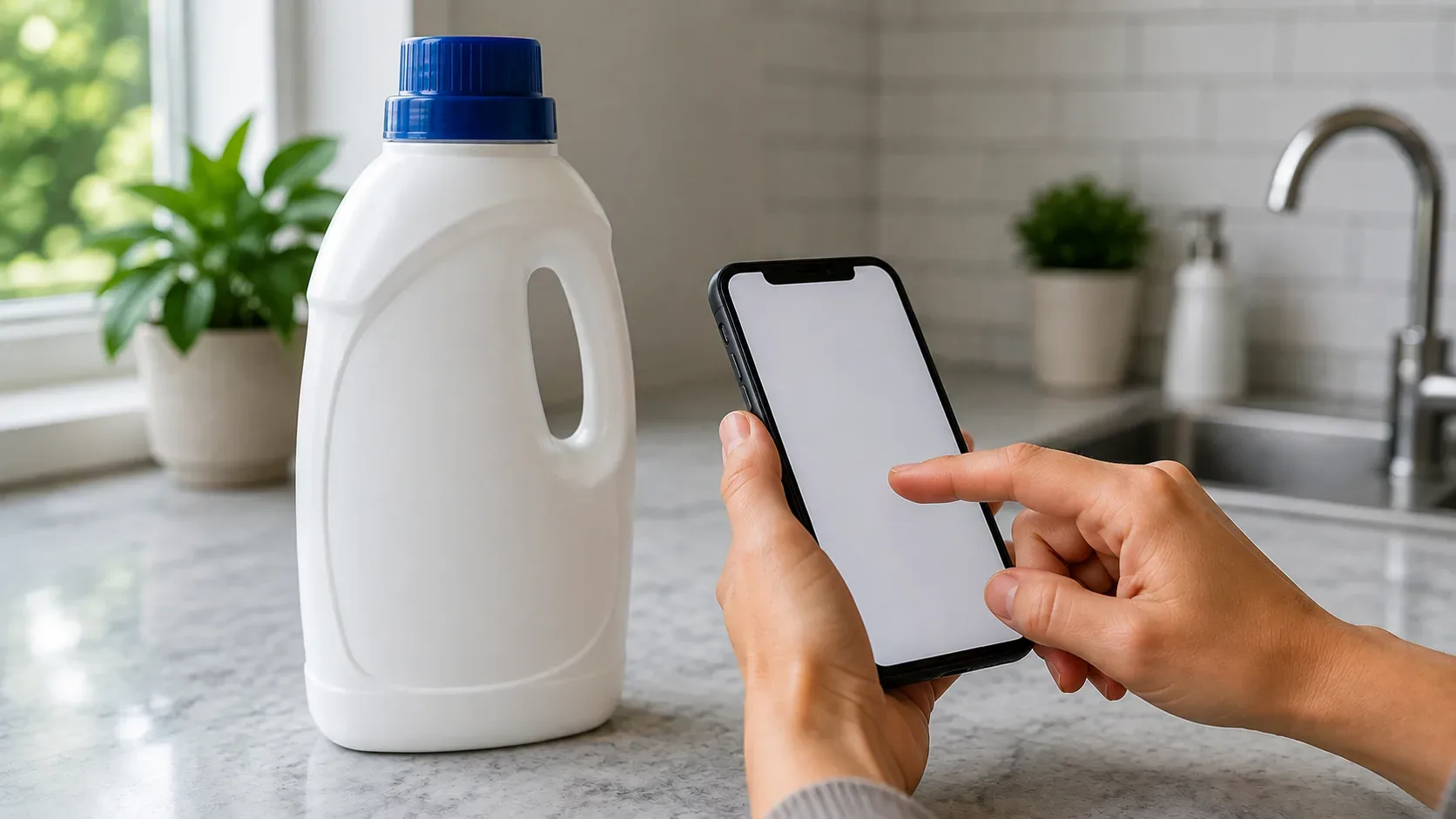
Before using a product against mold or intended for heavy cleaning, it is not enough to find the word “Anvisa” on the packaging. The most useful check is to cross-check the information on the label with the Agency's official consultation and confirm whether the sanitizer is regulated.
Since August 2025, the main standard for regularizing sanitizing products is RDC 989/2025, accompanied by IN 394/2025. The rules replaced the old RDC 59/2010 and maintain two regularization routes: risk 1 products are regularized by notification, while risk 2 products require registration.
This is important because a regular product does not necessarily need to present the word “registration” as the only form of identification. Depending on the risk classification, he may be regularly notified.
“Removes mold” and “heavy cleaning” alone do not define the classification
The name used on the shelf does not determine, in itself, whether the product is risk 1 or risk 2. Regulation considers factors such as purpose, composition and associated hazards.
RDC 989/2025 includes in risk 2, among other cases, sanitizers with antimicrobial action, certain pH extremes and products classified as corrosive or capable of causing serious eye damage. Therefore, two products commercially presented for “heavy cleaning” may be subject to different forms of regularization.
For those who buy, there is no need to try to do this classification at home. The safest way is to correctly identify the product, consult the official database and check whether the data found corresponds to the packaging in hand.
How to check a sanitizing agent at Anvisa
The query can be made through Anvisa's own public system, which maintains a specific area for sanitizing products. The Agency also informs that the system gathers data coming directly from its regulatory databases.
Use this sequence:
- Read the label before opening or using the product. Write down the name or brand, manufacturer and available regulatory information. Under current regulations, the label must bear the product's identification number when it is risk 1 or the registration number when it is risk 2, in addition to other mandatory information.
- Enter the official Anvisa sanitizing consultation area. Use Anvisa product consultation system and access the category corresponding to sanitizing agents.
- Search using the data available on the packaging. Depending on the screen and type of query, name or brand, process or regularization number, CNPJ or company data may be used. Anvisa itself advises that this information be compared with that presented on the packaging.
- Open the result and compare the data. Don't stop when you find a similar name. Check whether the product and company correspond to what is on the label and observe the situation presented by the system. Anvisa's guidance is to consider the product that appears to have a valid or active status in the applicable consultation to be regularized.
- If there is a discrepancy, do not improvise. Product that does not appear, presents an incompatible situation or has data that does not correspond to the packaging must be clarified before use. It is also possible to check the Anvisa's official consultation of irregular products.
The appearance of packaging, the location where the product was purchased, or an advertising claim are not a substitute for this inquiry.
The label also needs to match the intended use
Confirming regularization is only part of the decision. RDC 989/2025 determines the presence of information such as category or purpose, instructions for use, composition, batch, expiration date, warnings and data from the responsible company, among other elements.
In practice, this means that a product regulated for one purpose should not be used freely for any other task. If the proposal is to remove mold from a certain surface, for example, use must be in accordance with the instructions and restrictions on the packaging itself.
The indication for professional use also deserves attention. The standard provides a specific warning for sanitizers intended exclusively for professionals and whose direct sale to the public is prohibited. A product in this condition should not be treated as a domestic alternative simply because it appears stronger or more concentrated.
Shelf life, packaging integrity and readability of instructions also need to be considered. Consultation with Anvisa does not replace the safety guidelines provided for that specific product.
Not finding the product does not automatically mean counterfeiting
An unsuccessful search deserves attention, but is not sufficient, alone, to confirm that a package is counterfeit. There may be an error in the information entered, a difference in the way of searching or another problem that needs to be clarified.
The practical point is different: if it is not possible to confirm the regularization or if the official data conflicts with the label, the most prudent thing is not to use the sanitizer until the situation is clarified.
Inspection is not a distant hypothesis. On July 27, 2026, for example, Anvisa ordered the seizure and prohibited the sale, distribution, manufacture, advertising and use of irregular products; Among them was a sanitizer marketed as “Mofo Eurodecor”, which was manufactured by an unknown company and without a health record informed by the Agency.
This type of measure reinforces why the query must be made through the official channel, especially when the product is little known, its origin is difficult to identify or presents incomplete information.
Regularized product is not authorization to make mixtures
Regularization also does not mean that different cleaning products can be combined. Anvisa warns that homemade mixtures of sanitizers can form toxic substances and cause accidents, including serious poisoning. The official recommendation is to use regulated products and follow the instructions and care described by the manufacturer on the label.
Therefore, when faced with mold or difficult dirt, the decision should not be to “strengthen” the product by adding another sanitizer. Only use the product for the purpose and under the conditions described on its packaging.
In case of accident or poisoning, follow the emergency instructions on the label and seek appropriate assistance. Anvisa also publishes the Poison Hotline on the number 0800 722 6001.
Before the next heavy cleaning, the check can be summarized in three questions: are the packaging details complete, does the product appear regularized in the official consultation and does the intended use correspond to what is written on the label? If any of these answers are unclear, it is best to clarify before using.