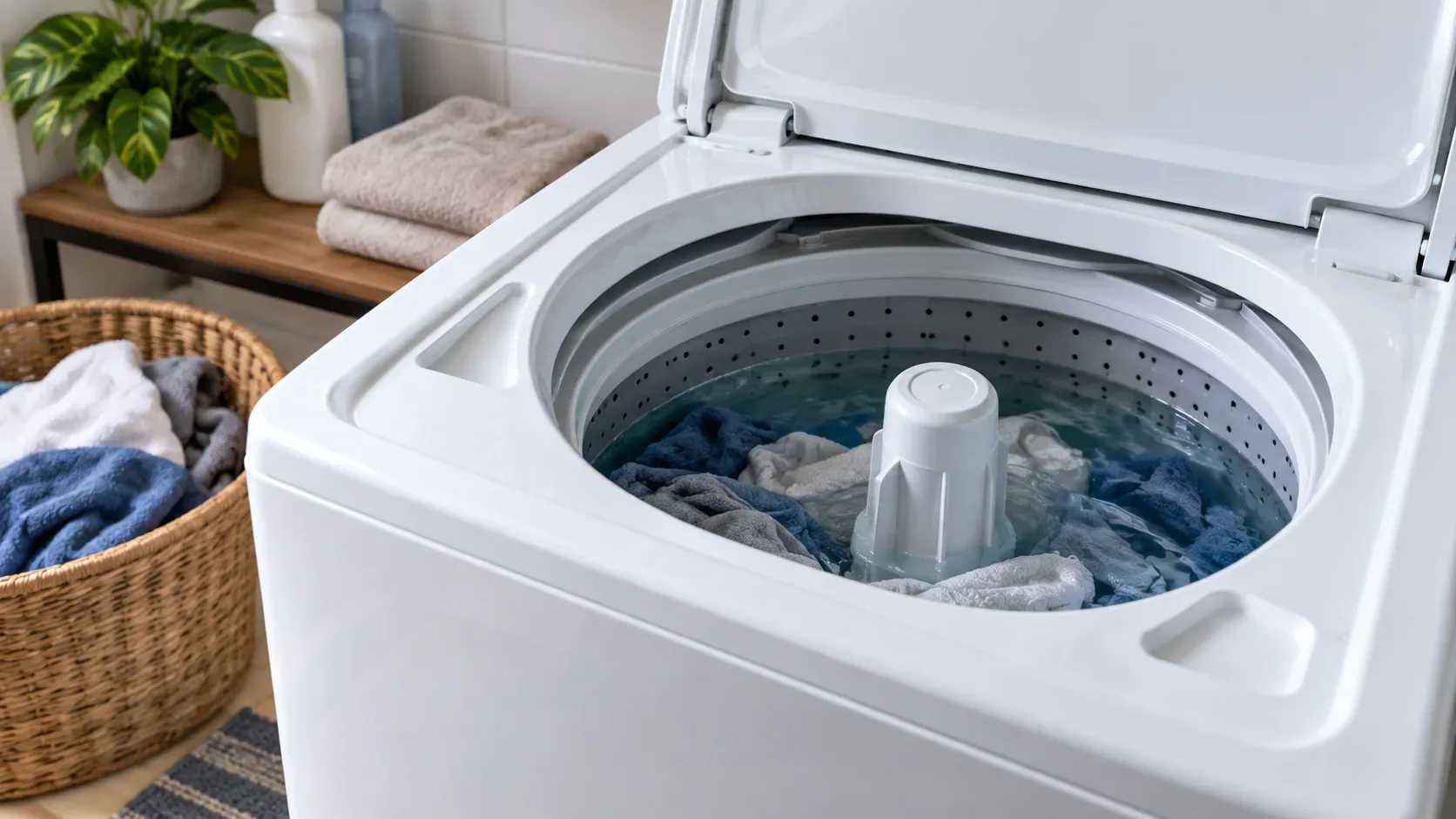
When a washing machine fills with water but does not seem to agitate or spin, the problem is not always a failed motor or transmission. Modern washers may pause for sensing, wait for the lid to lock, reduce spin speed when a load is unbalanced, or stop the spin stage if they cannot drain properly. The safest approach is to test in an order that does not require disassembly.
Before testing, observe what the washer actually does
The first step is to separate three different situations: the machine is simply in a normal stage of the cycle, it is reacting to the load, or it has stopped advancing because of a fault. With the washer stopped and without putting your hands into a moving basket, observe:
- whether the lid or door is fully closed and, when applicable, locked;
- whether the panel shows a pause, lock, error light, or an error code;
- whether water remains in the basket after the wash stage should have ended;
- whether there was strong vibration, banging, or an attempt to redistribute the laundry;
- whether the load is tightly packed, concentrated on one side, or contains a single heavy, absorbent item.
These signs help determine the next test without guessing which part needs replacement.
Test 1: confirm the cycle, pause status, and lid lock
Some washers fill first and only then engage the drive system. On certain models, there is also a sensing pause before the clothes begin to move. GE, for example, states that some newer models may take about 20 to 30 seconds to engage the drive system after filling stops. Soak cycles can also remain still for several minutes before the main wash begins.
Check that the selected cycle is not a soak cycle, that Start/Pause was not pressed accidentally, and that the lid is completely closed. Whirlpool notes that, depending on the model, a washer may even fill without the lid being locked but may not advance to wash, drain, rinse, or spin until the safety condition is satisfied.
If the control panel appears stuck for no clear reason and your model's manual allows it, a simple power reset can be tried: unplug the washer for a few minutes and reconnect it. Do not use a model-specific reset sequence found for a different machine; procedures vary by product line and manufacturer.
Test 2: reduce and redistribute the load
An unbalanced or overloaded wash load can make the machine reduce spin speed, extend the cycle, or even stop spinning. Whirlpool explains that some washers try to correct an imbalance automatically, including by making gentle movements or adding water again to redistribute the clothes.
With the machine paused and safe to open, loosen items that are tangled together, distribute the contents around the basket, and remove some laundry if it is tightly packed. Avoid testing with one large, highly absorbent item, such as a rug or heavy blanket, because it can concentrate weight on one side. If the washer works with a small, evenly distributed load but repeatedly fails when full, load size or distribution is an important clue.
Test 3: check drainage before blaming the spin system
If water remains in the basket, the washer may never reach the final spin. If the control panel offers Drain & Spin or an equivalent option, use it after redistributing the load. Whirlpool itself recommends this step to remove extra water and also advises checking drain-hose installation when water remains in the tub.
Without taking the machine apart, inspect only what is externally accessible: check whether the drain hose is kinked, crushed, or clearly blocked and whether it has been moved away from the installation position recommended by the manufacturer. If the water will not drain, do not keep running repeated cycles: the pump, a sensor, an internal blockage, or another component may require professional diagnosis.
How to interpret the test results
| What happens | What it suggests | Next step |
|---|---|---|
| It fills, waits a few seconds, and then begins to move | A normal sensing or cycle pause | Compare with the manual and check whether the rest of the cycle finishes normally |
| It works with a small load but fails with an overfilled basket or laundry concentrated on one side | Possible overload or imbalance | Reduce and redistribute the load |
| It drains the water but still will not agitate or spin | The problem is less likely to be only drainage-related | Check the lid/lock and error code, and seek service if it persists |
| It does not drain and water remains in the basket | The hose, household drain, or washer drainage system needs attention | Inspect the hose externally and seek service if that does not solve it |
| There is loud grinding, a burning smell, leaking, or a tripped circuit breaker | There is a safety sign that should not be investigated through repeated testing | Stop using the washer, disconnect power, and request professional evaluation |
When it is time to call for service
After confirming the cycle, lid, load distribution, and drainage, professional service becomes the more sensible next step if the machine continues to fill without moving or spinning. Testing should also stop when the lid lock will not engage, error codes keep returning, water will not drain, there is severe abnormal noise, a burning smell, leaking, or an electrical trip.
Do not bypass a lid sensor, remove panels, or handle energized wiring to “confirm” a theory. Those actions go beyond simple household diagnosis and can expose you to moving and electrical parts. With the exact model information, a technician can distinguish problems involving the lock, pump, sensors, drive system, motor, or control board without relying on guesses.
A quick, safe sequence
- Close the lid or door correctly and confirm that the cycle is not paused or soaking.
- Wait for the normal sensing time described in the manual.
- Redistribute the laundry and reduce the load if it is tightly packed or unbalanced.
- Use Drain & Spin if your model provides that option.
- If water remains, inspect the drain hose externally.
- If the manual allows it, perform only a simple power reset.
- If the symptom persists or a safety warning appears, stop testing and call for service.
Sources and limits of this diagnosis
The guidance above is based on official support material from Whirlpool on washers that do not agitate, Whirlpool on spinning and drainage problems, Whirlpool on top-load lid locking, and GE Appliances on top-load washers that fill but do not agitate. Cycles, locks, error codes, and procedures vary by brand and model, so your washer's owner's manual takes precedence over generic instructions.