When the freezer still freezes food but the refrigerator compartment is warm, the appliance is still producing cold. In many designs, especially frost-free refrigerators, the first thing to investigate is how that cold air leaves the freezer and reaches the fresh-food compartment. Manufacturers list blocked air outlets, ice buildup in the duct or evaporator area, and an internal fan problem among common causes.
That does not mean one of those three causes is confirmed by the symptom alone. The goal is to use simple signs — temperature, airflow, food placement, visible ice, and ventilation noise — to decide what can be corrected without disassembly and when to stop checking and call for service.
First: confirm that the freezer is actually freezing properly
Before blaming airflow, confirm the pattern. The freezer should keep food firmly frozen while the refrigerator compartment is clearly warmer than normal. If both compartments are warming, the diagnosis changes and may involve temperature settings, door sealing, power, the compressor, or other components.
If you have an appliance thermometer, it helps separate a temperature impression from a real cooling failure. As a food-safety reference, the USDA recommends keeping the refrigerator at 40 °F (4 °C) or below. Perishable food held above 40 °F for more than two hours may no longer be safe; do not rely on smell or appearance alone.
Decision tree: blockage, defrost-related ice, or fan?
| Observed sign | Most compatible hypothesis | Next step without disassembly |
|---|---|---|
| Freezer is normal, refrigerator is warm, and packages are pressed against grilles/air outlets | Blocked airflow | Clear the vents and leave room for air to circulate; then monitor temperature recovery. |
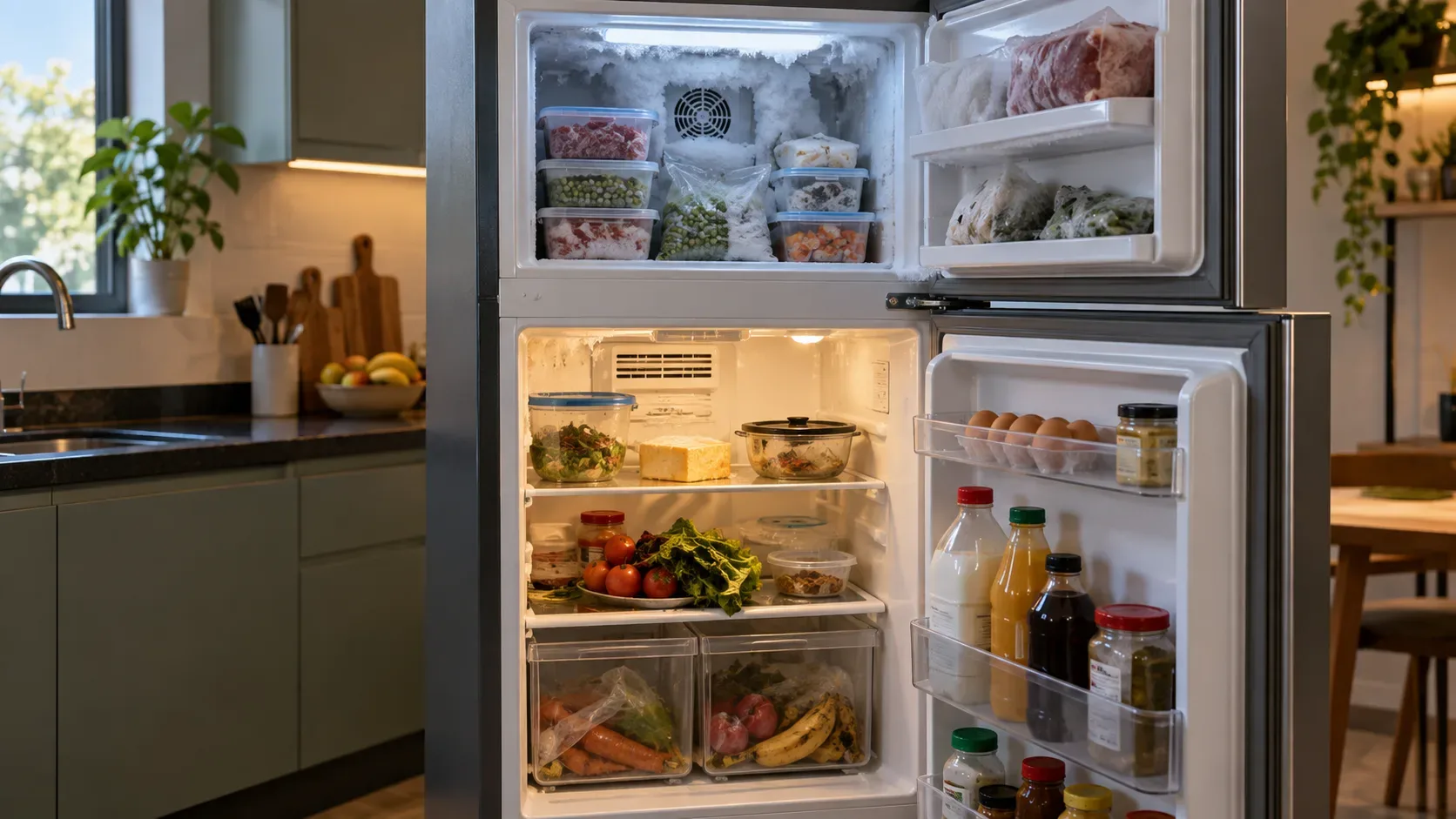
| Freezer is cold, but there is a sheet or mass of ice near the rear wall, duct, or air outlet | Air passage restricted by ice or a possible defrost issue | Do not chip or heat the ice with tools. Follow the defrost procedure in the manual; if ice returns quickly, request service. |
| There is no obvious blockage or major ice, but little or no air seems to reach the refrigerator | Internal fan or airflow-control issue | Do not open service panels. If the model should be moving air and airflow is absent, professional service is appropriate. |
| Both compartments are weak | Not the classic “freezer works, refrigerator does not” pattern | Check settings, door closure, and basic appliance conditions; if it persists, broaden the diagnosis with service. |
1. How to recognize a blocked air outlet
In many refrigerators, a fan pushes cold air through openings that connect the freezer with the fresh-food compartment. Whirlpool advises locating vents in both compartments and keeping food, containers, and bags away from them because a blockage reduces airflow and can create uneven temperatures.
The easiest sign is visual: large packages, flexible bags, or containers pressed against the rear wall or directly in front of a grille. An overfilled refrigerator can also create poor air paths even when no single vent is completely covered.
- Move items away from grilles and the rear wall.
- Avoid placing large containers directly in the airflow path.
- Make sure drawers and shelves are correctly installed and the door closes without resistance.
- After reorganizing, give the appliance time to stabilize before deciding that nothing improved.
This is the most favorable scenario for a household fix because it requires no disassembly and the cause is directly linked to the symptom.
2. When ice points toward the defrost system
In a frost-free refrigerator, excessive ice should not form a permanent barrier. TCL explains that ice buildup can block air outlets and also links recurring frost to problems in the automatic defrost system. Therefore, a thick layer or mass of ice near the duct, air outlet, or freezer rear panel matters more than a few occasional crystals.
The safe test is observation only. Do not insert a knife, screwdriver, or other object to break the ice, and do not apply direct heat with a hair dryer or heat gun. Doing so can damage plastic parts, tubing, or wiring and turn a simple diagnosis into a larger repair.
If your model's manual provides a manual-defrost procedure for certain situations, follow it exactly, including power-off instructions and water protection. The key comes afterward: if ice returns soon and the refrigerator loses cooling again, the symptom looks less like a one-off event and more like a reason to have the defrost heater, sensors, or electronic controls evaluated — components that should not be tested by dismantling the appliance at home.
3. How to suspect the fan without opening the appliance
The evaporator fan is one of the parts that distributes cold air in many designs. If the freezer is cold, the outlets are clear, and there is no meaningful ice barrier, but little or no cold air reaches the refrigerator, the fan becomes a stronger hypothesis.
Home checking should stay at the behavior level. On some models, the fan stops when a door is opened, so not hearing the fan with the door open does not confirm a failure. The model manual is the best reference for how the system operates. What matters more is the combination of signs: a freezing freezer, apparently clear ducts, little perceptible circulation, and a persistently warm fresh-food compartment.
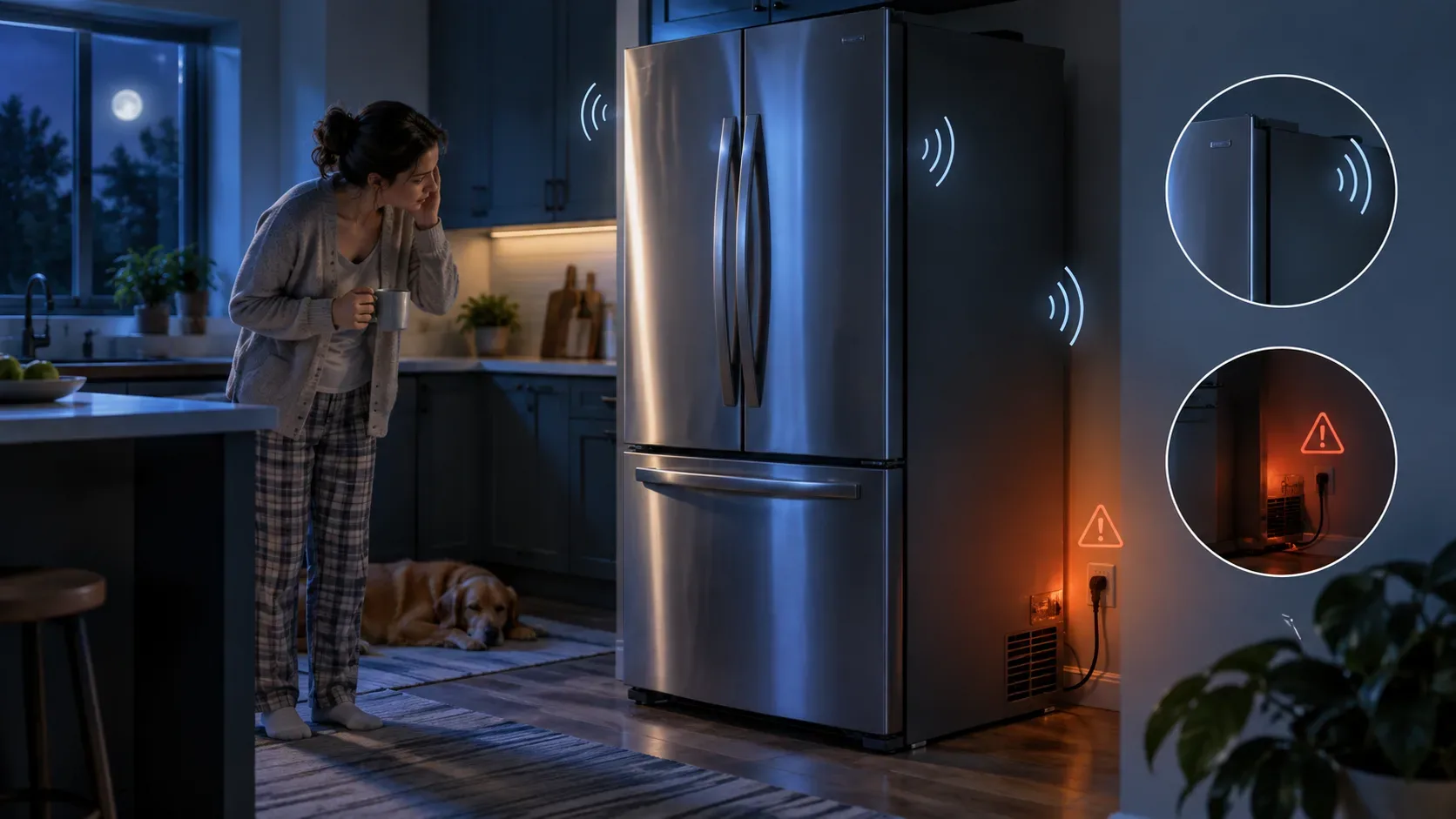
Scraping noises, abnormal buzzing, or the sound of a fan blade hitting ice also support a service call, especially when cooling performance is affected. Do not remove an interior panel to reach the motor, wiring, or evaporator.
Other simple checks that prevent a false diagnosis
Before concluding that the defrost system or fan has failed, rule out basic causes that can create similar symptoms:
- Temperature setting: confirm that the controls were not changed accidentally. In recent guidance, LG recommends keeping the refrigerator compartment around 34–37 °F (1–3 °C) when it is not cold enough.
- Door and gasket: misplaced packaging, a poorly seated shelf, or a gasket that does not seal can continuously admit warm air.
- Overloading: a crowded compartment that blocks vents harms circulation even when the cooling system is operating.
- Frequent door openings: repeatedly opening the door extends temperature recovery and can hide the result of a test.
When to stop checking and call for service
The boundary is simple: stop at external diagnosis. Call for service when there is thick ice that returns after proper defrosting, persistent lack of airflow with clear vents, abnormal fan noise, a burning smell, sparks, excessive heat, recurring leaks, or any step that would require removing panels.
Service is also appropriate if reorganizing food and checking the temperature setting and door seal do not restore proper cooling. The fact that the freezer still freezes does not rule out a fault; it simply helps place the problem closer to airflow distribution and the defrost cycle than to cold production itself.
What to do with food while the refrigerator is warm
Do not let the repair decision compromise food safety. Keep the door closed as much as possible and use a thermometer to determine whether the compartment is actually above the safe range. The USDA advises keeping refrigerators at 40 °F (4 °C) or below and discarding perishable foods that have remained above that temperature for more than two hours.
If you do not know how long meat, milk, eggs, seafood, prepared foods, or leftovers have been warm, prioritize safety. Correct freezing in the upper compartment does not protect perishable food that has spent time in an insufficiently cooled refrigerator section.
In short: the symptom is an airflow clue, not the name of a failed part
“The freezer works but the refrigerator does not” is a useful pattern because it shows that the appliance can still make cold. The efficient sequence is to confirm the pattern, clear air outlets, look for abnormal ice, observe whether air is circulating, and stop before disassembly. A blockage is the simplest hypothesis; recurring ice shifts suspicion toward defrosting; absent airflow with clear ducts makes the fan or airflow control more plausible.
Sources consulted: TCL Brazil — common refrigerator problems; TCL Support — ice and frost buildup; Whirlpool — checking refrigerator air vents; LG — refrigerator not cold enough; USDA — refrigeration and food safety.