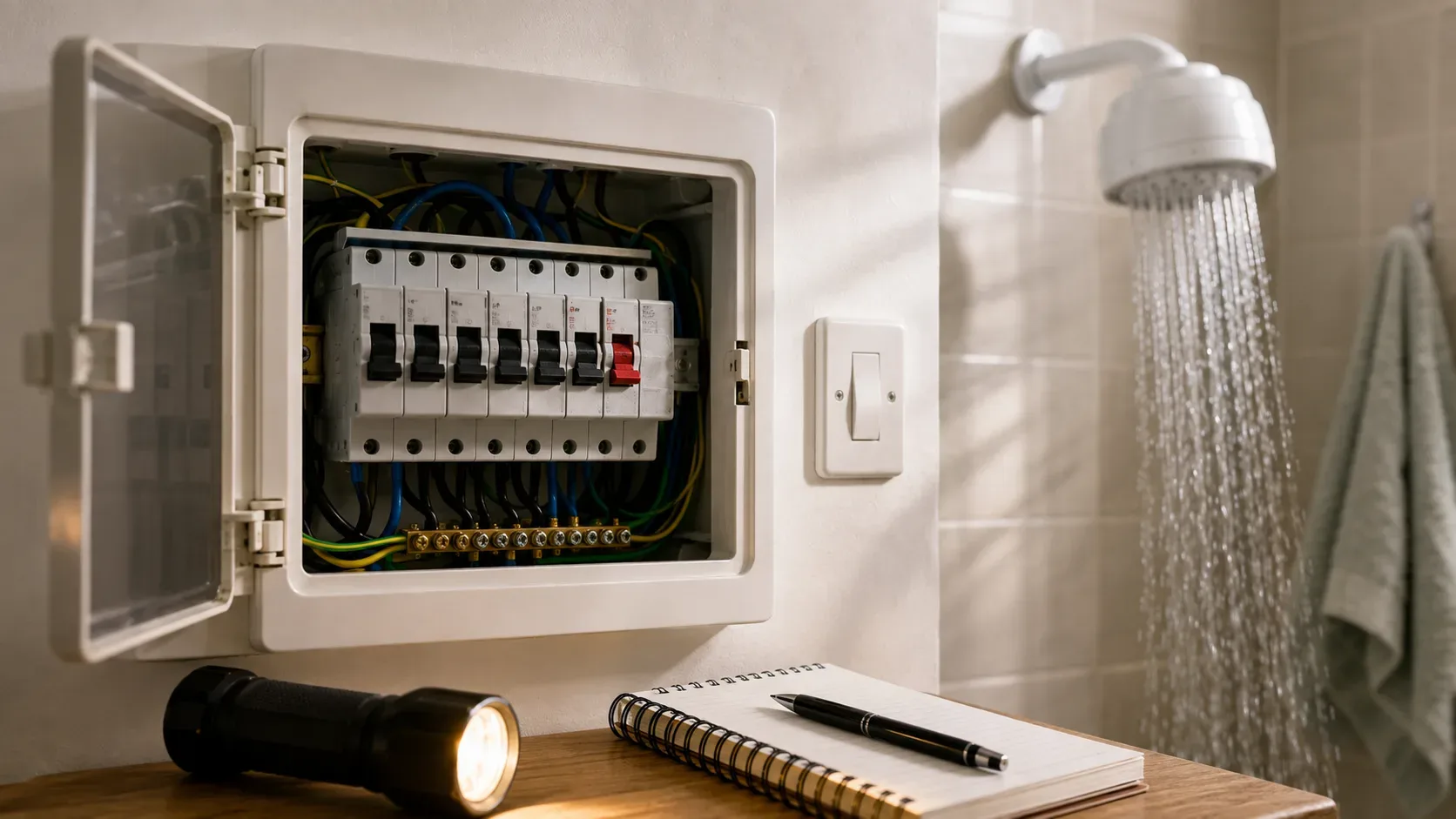
If the shower trips the circuit breaker during the shower, do not turn the problem into a sequence of tests. Leave the box, dry yourself and keep the device out of use until you can safely observe the situation. If the trip is immediate, repeated or accompanied by a burning smell, noise, spark, smoke or small shock, contact a qualified electrician without attempting to reconnect the circuit.
The circuit breaker is not an obstacle that needs to be overcome. It protects the installation. In residential circuits, the thermomagnetic device interrupts the flow of current in the event of conditions such as overload or short circuit. Therefore, a trip may be related to the shower, the connections, the circuit sizing, the protection device itself or more than one problem at the same time. Only technical inspection can confirm the cause.
Attention tends to increase in winter, when hotter and longer showers increase the time the device is used. The Technological and Research Institute of the State of Sergipe also advises that voltage, nominal power and adequate installation be considered, in addition to the efficiency indicated on the product label.
Before checking, respect these blocks
Notes below do not include disassembly, measurement or repair. Before you begin:
- do not open the shower, electrical panel or connection boxes;
- do not touch wires, connectors, screws or apparently burned parts;
- don't run the bath again just to “see if it drops again”;
- do not increase the circuit breaker current, do not deactivate the DR and do not improvise splices;
- do not approach the painting with a wet body, barefoot or walking in a damp area.
Insisting on a circuit breaker that trips again is not a safe way of diagnosing. Guidance published by Neoenergia on July 2, 2026 recommends not insisting when the device falls again, as this may indicate internal failure and increase the risk of shock, overheating and short circuit.
1. Record the shower voltage and power
Look, without removing any cover, for the external label, packaging, invoice or manual of the device. Note:
- make and model;
- indicated voltage, such as 127 V or 220 V;
- rated power in watts;
- temperature position used at the time of disarming.
Do not try to calculate by yourself which circuit breaker or which wire should be installed. This data must be compared by the electrician with the real conditions of the property, the distance to the panel, the conductors, the connections and the type of power supply.
Manufacturer manuals advise that the product voltage corresponds to the network voltage and that wires, circuit breaker, DR and circuit are defined considering voltage, power and distance. Showers are also among the equipment that require high current, so a change in model or power may require reevaluation of the installation.
If the information is inside the device or is unreadable, do not open the housing to look for it. Only photograph what is visible and inform the professional of this limitation.
2. See which protection disarmed
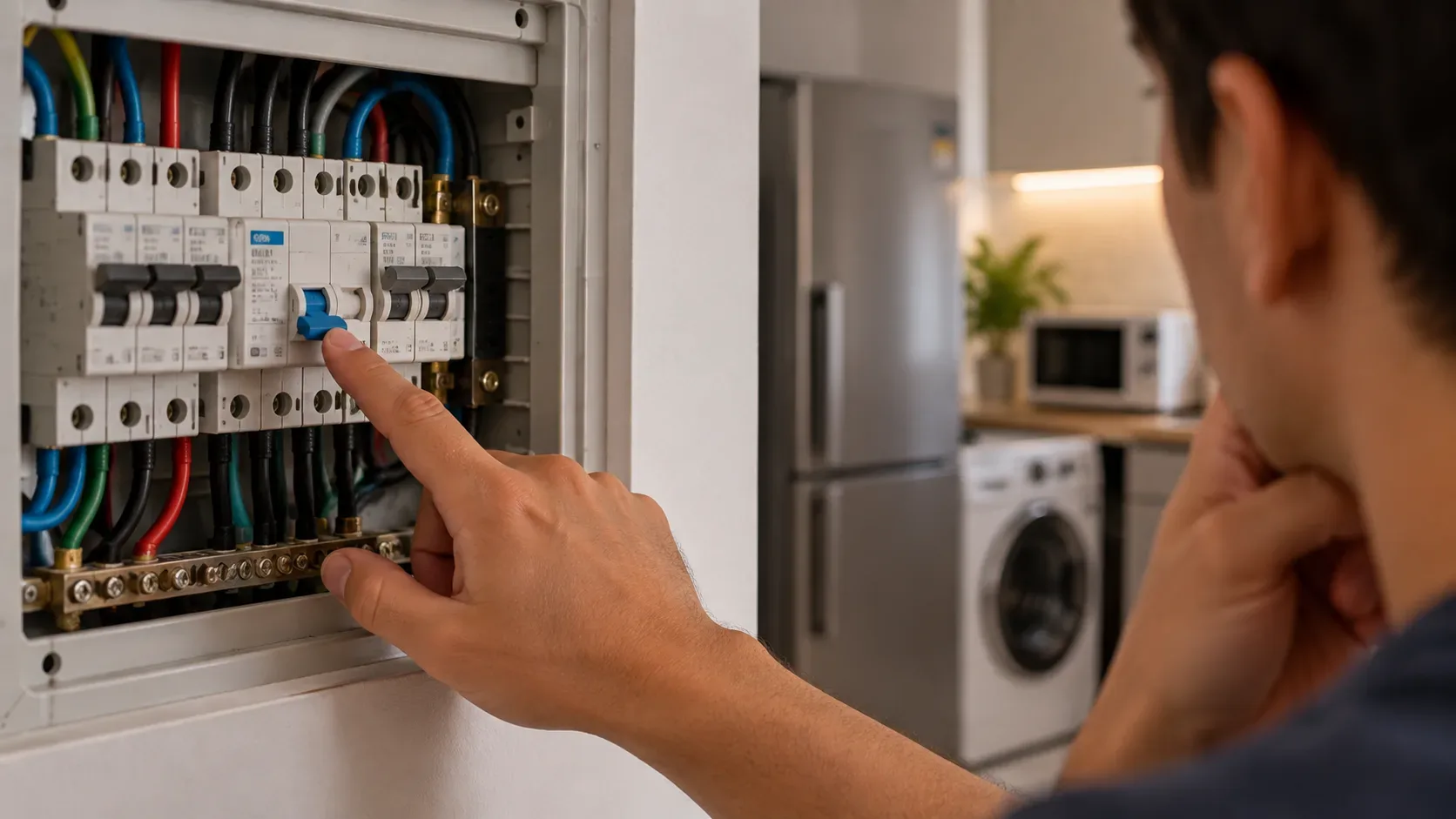
Only observe the outside of the board, without removing its cover. Try to identify:
- if the circuit breaker identified as “shower” has tripped;
- if the main circuit breaker has tripped;
- if a device identified as DR or IDR crashed;
- if other rooms, outlets or appliances also lost power.
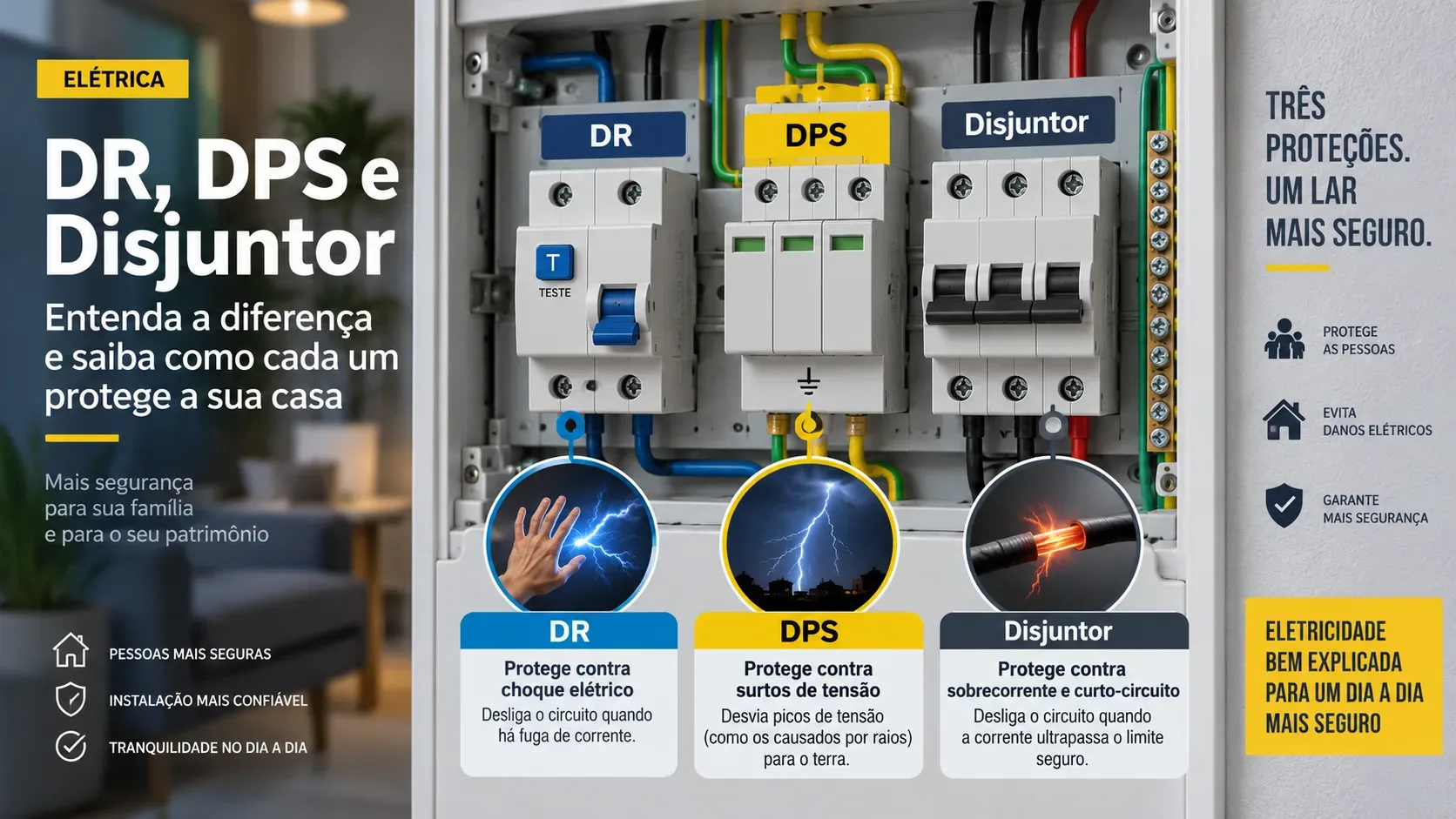
Identification helps the electrician to delimit the circuit, but does not confirm the cause. The thermomagnetic circuit breaker, the residual current device and the general protection perform different functions within the installation.
Also check if the frame has clear identification for the shower. Do not move other circuit breakers to find out which one powers the device. If there is no identification, record “unidentified circuit”.
Shower manufacturers advise the use of a direct and exclusive line from the frame. If the shutdown also affected sockets, lighting or other equipment, write down this information so that the professional can check whether there is sharing or identification failure.
3. Look for visual signs of heating without touching
Do not use your hand to find out if the shower, wire or circuit breaker is hot. Look for only visible changes, keeping your distance:
- yellowed, darkened or deformed plastic;
- wrinkled or melted wire coating;
- dark marks on the wall or board;
- cracked or burnt appearance connector;
- color change around the cable entry;
- steam, smoke, or unusual glow near connections.
Melted wires and other signs of heating need immediate correction. The Military Fire Department of the Federal District also warns that circuit breakers that are damaged, poorly sized or prevented from operating correctly can reach dangerous temperatures and contribute to fires.
Do not photograph at close range if this requires leaning on the shower, placing the cell phone close to the cables or entering a wet area.
4. Observe smell, noise, spark or smoke
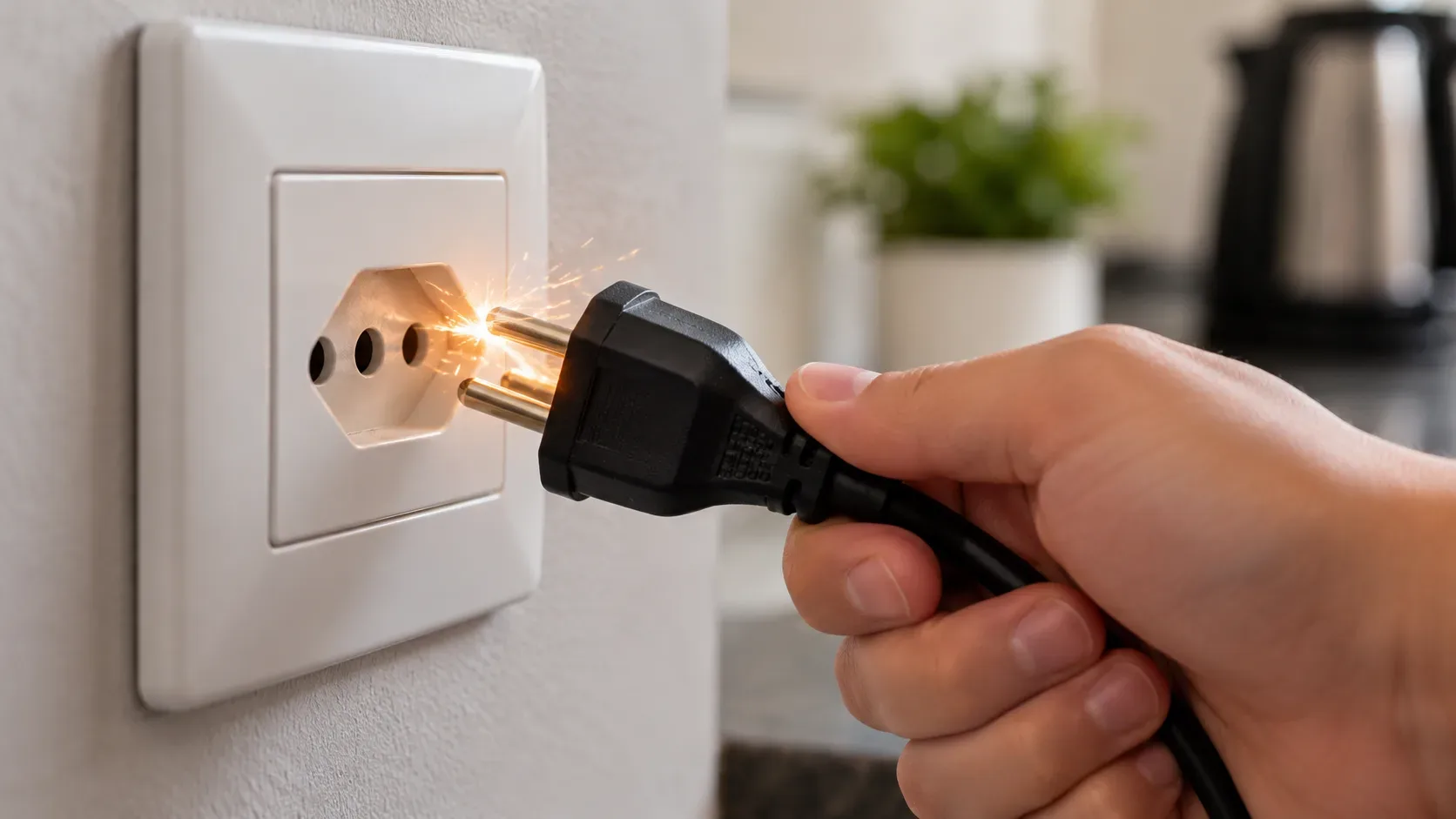
Smell of burning plastic or insulation, popping, hissing, crackling, sparking and smoke are not normal operating details. These signs may accompany overheating, faulty connections or electrical failures and justify immediate interruption of use.
If there is active smoke, flame or sparks:
- keep people away from the bathroom;
- turn off the main power only if the switch is in a dry, accessible place and outside the risk area;
- don't throw water;
- leave the property if the smoke increases;
- call the Fire Department by calling 193.
The Minas Gerais Military Fire Department advises that you leave the area safely, call 193 and never throw water on energized electrical equipment.
5. See if there are any apparent signs of poor contact
Without pulling or moving any part, observe the region where the cables enter the shower and the points that are already exposed to vision. Search:
- loose or bare wire;
- insulating tape forming an apparent seam;
- blackened, deformed or broken connector;
- cable that is pressed, twisted or has damaged insulation;
- soot marks;
- water running towards the electrical connection;
- plug, socket or adapter used to power the shower.
An irregular connection can cause voltage drops, unstable operation and heating of the conductors. Installation manuals determine the use of suitable connectors, connection by a qualified person and compatible circuit; some models also expressly prohibit plugs and sockets.
Do not tighten screws, do not redo seams, do not apply insulating tape and do not try to dry the connection with a cloth or hairdryer. Even with the circuit breaker apparently turned off, circuit misidentification or other failure can keep parts energized.
6. Rebuild history without repeating the test
The time at which the trip occurred is useful information, but should not be reproduced deliberately. Note:
- date and time;
- if it fell when the shower was turned on or after a few minutes;
- if it was in the highest heating position;
- approximate duration of the bath;
- if the problem happened once or if it was recurring;
- if another high-power device was connected;
- if there was a recent replacement of the shower, resistance, circuit breaker or wiring;
- if the property has undergone renovation, infiltration or power fluctuations;
- if there has been a smell, noise, flashing light or small shocks.
The sequence helps the electrician to formulate hypotheses, but does not allow us to state, for example, that a quick trip is necessarily a short circuit or that a drop after several minutes is just an overload. Different faults can produce similar symptoms.
When the interruption appears after the use of equipment with greater load, concessionaires point out overload, short circuit or defects in the internal installation as possibilities. Confirmation depends on adequate inspection and measurements.
Use the traffic light as an indication of urgency
Green — just collect information: you were able to read the model, voltage and power, identified which device fell and did not observe any smell, apparent heating, noise, spark or damage. The green color does not mean authorization to repeat the test. If the tripping happens again, keep the shower out of use and request an evaluation.
Yellow — stop use and call an electrician: the trip is repeated, it occurs immediately after opening the shower, it appeared after changing the device or resistance, the circuit is not identified, other points in the house turn off together or there are heating marks without active smoke.
Red — move away and treat as emergency: there was shock or tingling, strong burning smell, persistent popping, sparking, smoke, melting or fire starting. Do not touch the shower, the victim, or the wiring. Only turn off the main switch if it can be done safely and call 193 or EMS via 192 when there is a victim.
Occurrence form to send to the electrician
Fill in without doing new tests:
- Disarm date and time:
- Shower brand and model:
- Indicated voltage:
- Indicated power:
- Device that fell: shower, general, DR/IDR or unidentified
- Time of disarming: immediate, after a few minutes or not observed
- Selected temperature:
- Other connected equipment:
- Other rooms that lost power:
- Number of occurrences:
- Recent replacement of shower, resistance or circuit breaker:
- Recent installation renovation or change:
- Burning smell: yes or no
- Clacking, hissing or sparking: yes or no
- Heating or melting marks: yes or no
- Shocking or tingling: yes or no
- Photos taken from a dry location and at a distance: yes or no
- Additional notes:
Send the form before the visit. It does not replace inspection, but helps the professional to understand the urgency and to bring compatible instruments and materials.
What the professional should evaluate
The inspection may involve compatibility between shower voltage and power, conductor section, exclusive circuit, sizing and condition of the circuit breaker, connections, grounding, DR, electrical panel, available voltage and possible internal failures of the device.
These elements work together. Installing a higher current circuit breaker without checking the cables and the rest of the circuit can remove important protection from the installation. The CBMDF recommends correctly sized circuit breakers and projects or installations carried out by qualified professionals; Manufacturers also relate sizing to voltage, wattage, and distance to the frame.
Fill out the form, keep the shower out of use when there is a recurrence or any sign of risk and hire a qualified electrician to make the diagnosis. The purpose of the visit is not just to prevent the circuit breaker from tripping, but to find out why the protection was triggered.