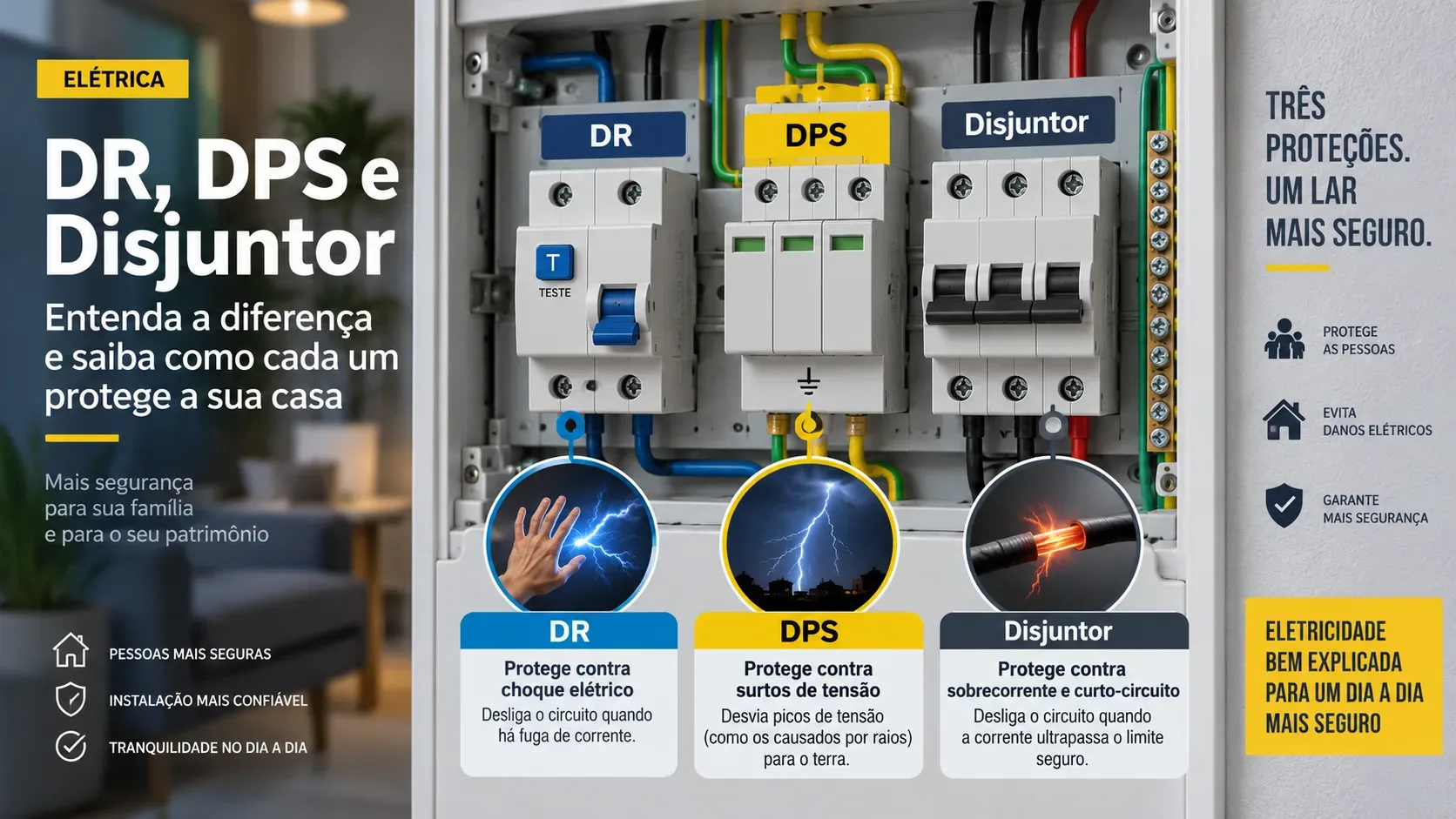
RCDs, SPDs and circuit breakers are not three names for the same protection. They respond to different electrical phenomena and can therefore appear side by side in the same distribution board. In practical terms, an RCD monitors leakage or residual current and is associated with additional protection against electric shock; an SPD limits or diverts transient voltage surges; and a circuit breaker interrupts the circuit in overcurrent conditions, especially overloads and short circuits. Replacing one function with another leaves a protection gap.
This distinction is more than a teaching device. Brazil's ABNT NBR 5410 addresses low-voltage electrical installations and recognizes specific protection functions, while manufacturers and technical documentation distinguish residual-current devices, surge protection and overcurrent protection. The central point is simple: electric shock, a surge and overcurrent are not the same fault.
RCD, SPD and circuit breaker at a glance
| Device | Mainly protects against | Should not be confused with | Warning sign that deserves assessment |
|---|---|---|---|
| RCD (residual current device) | Leakage/residual current caused by an imbalance between current flowing out and returning; high-sensitivity applications provide additional protection against electric shock. | Ordinary overload and short-circuit protection. An RCCB does not replace a circuit breaker; combined devices can provide both functions. | Repeated tripping, especially when an appliance is switched on or in damp conditions, may point to leakage, insulation failure or a defective appliance/circuit. |
| SPD (surge protective device) | Transient overvoltages and surge currents, including events associated with lightning and switching in the power network. | Protection against electric shock, sustained overload or a short circuit in a final circuit. | An end-of-life indicator, damage after a surge event, or protection that is not suitable for the installation calls for inspection according to the manufacturer and the design. |
| Circuit breaker | Overload and short circuit, according to the device technology and trip curve. | An RCD for small leakage currents or an SPD for transient surges. | Repeated trips, abnormal heating, a burning smell or charring require diagnosis; simply fitting a higher-rated breaker can make the installation unsafe. |
What an RCD can detect that an ordinary breaker may not
An RCD compares the current flowing through the active conductors with the current returning. In a circuit without leakage, those values balance. If some current takes another path — for example through damaged insulation or, in certain circumstances, through a person's body to earth — residual current appears. The RCD is designed to detect that imbalance and disconnect the circuit when its operating threshold is reached.
Schneider Electric's explanation of RCD operation describes it as detecting the difference between outgoing and returning current. In high-sensitivity devices used for additional personal protection, 30 mA is a common rated value. That does not make an RCD absolute protection: the standards themselves treat this function as additional protection, not as a substitute for earthing, equipotential bonding, insulation, correct sizing and other safety measures.
Similar names also need to be separated. An RCCB provides residual-current protection but does not necessarily include the overcurrent protection of a circuit breaker. An RCBO combines residual-current and overcurrent protection in one device. Seeing a device with an RCD function therefore does not prove that the circuit-breaker function is already covered unless the type and specifications confirm it.
Why an SPD does not “trip like a breaker”
An SPD works with another kind of event: a voltage surge, usually a very fast transient. Its purpose is to limit the overvoltage reaching equipment and conduct surge current along a path intended by the protection system. Technical documentation on SPDs describes the device as intended to detect and divert transient overvoltages, including those associated with lightning.
This is why a perfectly functioning circuit breaker does not replace an SPD. A breaker responds to current and its trip curves; a surge can be brief and have characteristics that require a dedicated voltage-limiting device. The reverse is also true: an SPD is not designed to take over circuit overload protection or residual-current detection.
An SPD is also not synonymous with “complete lightning protection.” Lightning protection involves the installation as a whole, including risk assessment, earthing, equipotential bonding, an external lightning protection system when applicable, and coordinated SPDs. The ABNT catalog shows that the ABNT NBR 5419 series specifically addresses lightning protection. Installing a single SPD in a distribution board, by itself, does not justify claiming that the entire building is protected from every effect of a lightning discharge.
What the circuit breaker does: overload and short circuit
The circuit breaker is the most familiar protection because it interrupts the circuit when current exceeds expected conditions. In thermal-magnetic breakers, the thermal mechanism responds to overload while the magnetic mechanism operates on the high currents typical of short circuits. Curves and interruption capacities vary by device and application.
Schneider's documentation on trip curves explicitly separates overload and short-circuit protection functions. It also shows why “the breaker is tripping” is not a complete diagnosis: there may be excessive load, a short circuit, a faulty appliance, incorrect sizing or another condition that requires measurement and inspection.
A dangerous mistake is to treat repeated tripping as a nuisance and increase the breaker rating without checking conductor size, load, interruption capacity and the design. The breaker must protect the circuit under technical criteria; oversizing it can leave conductors overheating before the protection operates.
Three situations that make the difference easier to see
- A metal enclosure becomes live because of an insulation fault: the main concern is leakage current and electric-shock risk. Residual-current protection is relevant; an ordinary breaker may not see a small leakage current as a short circuit.
- A nearby lightning discharge induces a fast overvoltage in the supply: the event is a surge. An SPD is the dedicated device for limiting this type of overvoltage within a surge-protection strategy.
- Too many loads raise circuit current for long enough, or a short circuit occurs: the breaker's overcurrent protection is the relevant function.
In real installations, more than one phenomenon can exist at the same time. That is why a distribution board should not be assessed as a collection of independent parts. Coordination between protective devices, the earthing arrangement, conductor size, circuit division and supply characteristics all influence the result.
When tripping is a warning, not a defective device
When an RCD or circuit breaker trips repeatedly, the first assumption should not be “the protection is faulty.” Often the device is doing exactly what it was designed to do: signaling an abnormal condition. An RCD can reveal leakage from an appliance, moisture, deteriorated insulation or a circuit fault. A breaker may be responding to overload or a short circuit. An SPD can also reach the end of its service life after absorbing events and, depending on the model, display a visual replacement indicator.
Without instruments and knowledge of the circuit, it is unsafe to identify the cause from the appearance of the board alone. Intermittent trips, faults that occur only with certain appliances and moisture-related problems are examples where technical measurement matters.
When a question should become a call to an electrician
Work inside a distribution board, replacing or changing breakers, adding RCDs or SPDs, altering earthing and diagnosing faults are not good candidates for improvised DIY. Brazil's NR-10, an occupational electrical-safety regulation, reinforces the need for risk controls, procedures and qualification when work is carried out on electrical installations.
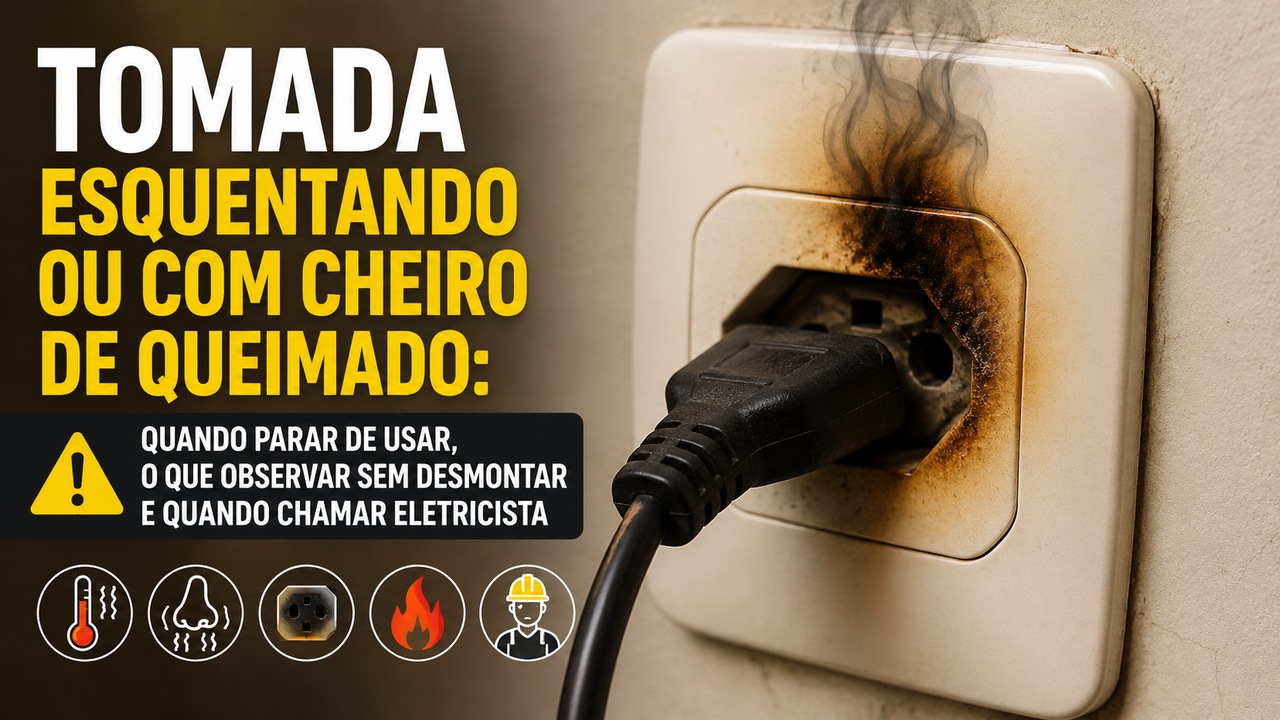
Seek professional assessment if there is an electric shock when touching equipment, repeated unexplained tripping, a burning smell, darkening or melting of components, abnormal heating of the board, unusual noises, signs of arcing, damage after a storm, or uncertainty about whether the protection devices are present and coordinated. In these situations, “trying another breaker,” bypassing an RCD or bridging a protective device can turn a symptom into a serious hazard.
The practical rule: think in complementary functions
To keep the three devices straight, associate each one with the phenomenon it monitors: RCD — leakage/residual current and additional shock protection; SPD — transient surge; circuit breaker — overcurrent, especially overload and short circuit. Some devices combine functions, but that combination must be explicit in their specifications.
A safe installation does not depend on a single “stronger” device. It depends on proper design, sizing, earthing, coordination and maintenance. Once the question changes from “what does each device do?” to “which model, rating, class or connection should be used in this board?”, the answer depends on the actual characteristics of the installation and should be validated by a qualified professional.