The debate about El Niño and energy gained urgency in July 2026, but it needs to be translated without alarmism. On July 22, the Electricity Sector Monitoring Committee approved the anticipation of contracts that add around 1.8 GW to the National Interconnected System from September 1st. A day earlier, ANEEL had announced a technical event on extreme weather and sector resilience for August 20th. The two initiatives deal with planning and strengthening the system; they are not an official blackout prediction.
Domestic preparation remains valid because intense heat, storms, trees over the network, lightning strikes, flooding or local failures can interrupt the supply or affect equipment. The effects of El Niño vary by region and by episode: climate documents from June 2026 indicated a greater chance of above-average rain in the South, reduced rainfall in parts of the North and Northeast and higher temperatures in areas of the Central-West and Southeast, but this does not allow us to attribute a specific local event to the phenomenon in advance.
The central rule of this checklist is simple: preparing the house does not mean messing with the electrical panel. The resident can organize contacts, supplies and priorities; can check documents and observe external signs; but opening panels, testing circuits, choosing protection or changing the installation requires a qualified professional.
Before the checklist: identify where the problem is
A power outage can have three different origins:
- System or region: several streets or neighborhoods are left without power.
- Local network: a pole, transformer, cable or branch has a fault.
- Internal installation: the problem only appears in the property, in a room or when certain equipment is used.
This distinction avoids two mistakes: treating an internal failure as if it were the exclusive responsibility of the distributor or, in the opposite sense, trying to “fix” an incident that is on the public network at home.
Without going near wires, damaged poles or flooded areas, check if neighboring properties are also without power and check the distributor's app, website or telephone number. If there is a downed cable, a tilted pole, a spark in the street or water near the installation, keep your distance and call the distributor and emergency services. Any broken cable must be considered energized, even without noise or sparks.
Level 1: actions the resident can do now
Save channels and consumer unit data
Save on your cell phone and also on paper:
- name and emergency telephone number of the distributor;
- number of the consumer unit, available on the invoice;
- access to the application or client area;
- ombudsman telephone number;
- contacts of a trusted electrician;
- numbers 193, from the Fire Department, and 192, from Samu.
In case of interruption, register it first with the distributor and save the protocol. If there is no solution, ANEEL's guidance is to contact the company's ombudsman and then the Agency itself, presenting the previous protocols.
List what is really critical
Write down which items affect safety, health or basic functioning of the home:
- circulation lighting;
- fridge and freezer;
- router and phone;
- electronic gate;
- water pump, if applicable;
- health equipment used at home;
- means of charging cell phones;
- ventilation required for people vulnerable to heat.
The list helps you decide priorities without cluttering extensions, adapters, or emergency sources. For medical equipment, do not improvise electrical power: confirm with the healthcare team and the manufacturer what the contingency plan is, the battery life and the procedure for prolonged outages.
Assemble a kit that doesn't depend on the socket
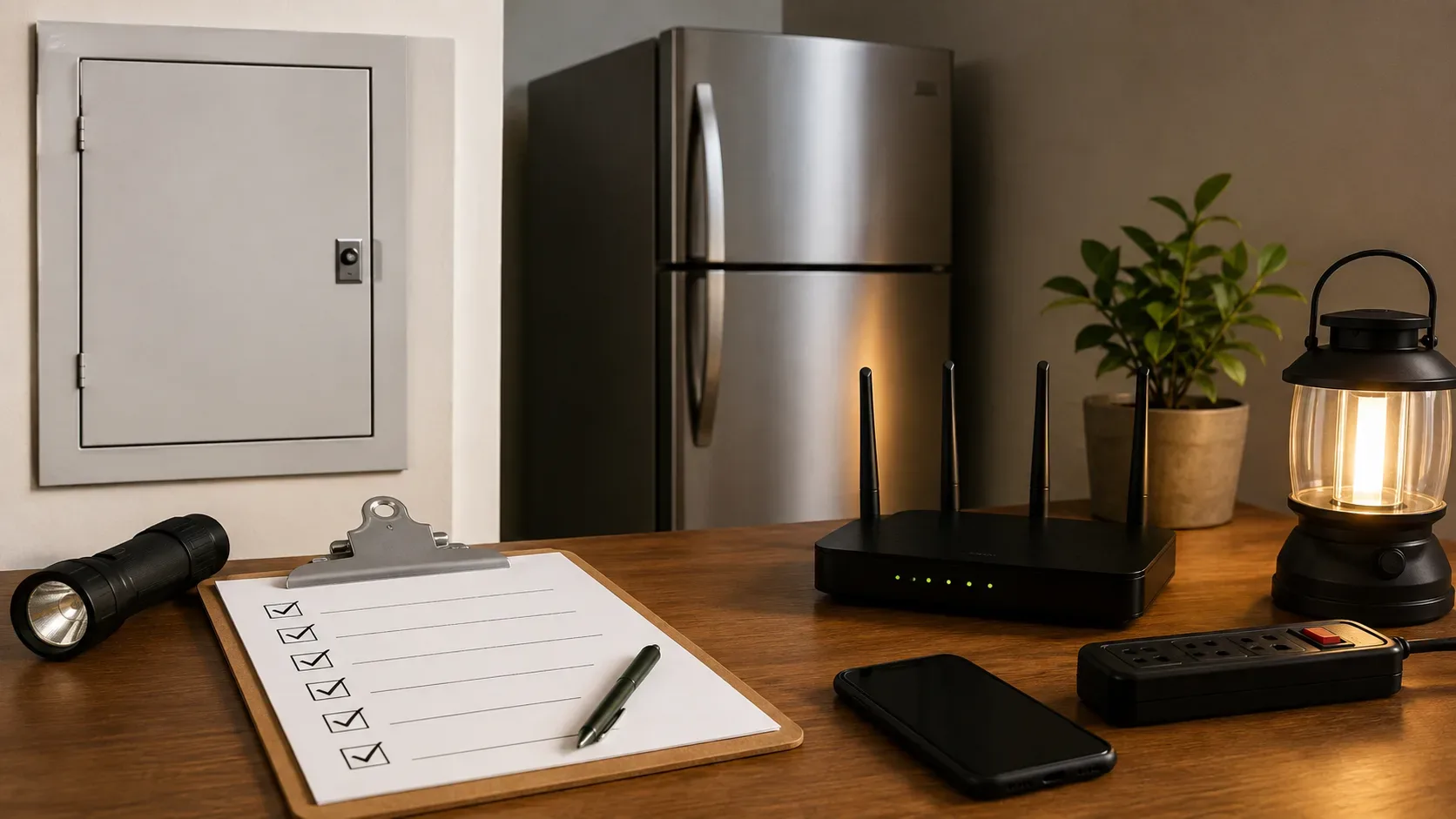
Have flashlights, compatible batteries, charged portable chargers, water, food that does not require immediate cooking, a manual opener and a printed list of contacts. Choose a candle lantern, as an open flame increases the risk of fire in an already unstable situation.
Periodically test flashlights and chargers. The objective is not to buy a lot of accessories, but to ensure that the basics work when the internet, gate or lighting stops working.
Prepare the refrigerator before you need it
A thermometer suitable for refrigerators and freezers reduces doubts about food safety. It's also helpful to keep reusable ice packs frozen and a clean cooler.
During power outages, keep doors closed. As a safety reference, a closed refrigerator preserves food for up to approximately four hours; a full freezer, for up to 48 hours; and a half-full freezer, for up to 24 hours. After that, evaluate temperature and type of food. Never taste a food to decide if it is safe. Perishables that have been left without adequate refrigeration must be discarded.
Refrigerated medicines should not automatically follow the same rule as food. Consult leaflet, manufacturer, pharmacist or health service.
Protect electronics without creating another risk
In storms with electrical discharges or during an outage, unplug computers, televisions, chargers and other sensitive electronics only when this can be done in a dry place with no signs of damage. Do not touch wet sockets, hot cables, broken parts or equipment affected by infiltration.
Keep the refrigerator and freezer closed and normally connected, unless instructed by the distributor, there is a risk of flooding or visible damage. When power returns, reconnect the electronics gradually and following the manufacturer's manual, instead of turning on several devices at once.
Eliminate visible improvisations
Without dismantling anything, remove damaged extension cords, darkened adapters, loose plugs and sockets showing signs of heating from use. Avoid “T”, cascading benjamins and provisional connections. Overloading, heating and old wiring are among the signs that justify technical inspection.
Level 2: items to check without interfering with the installation
This step is documentary and visual. The resident checks what exists, registers doubts and submits the assessment to a professional.
Circuit identification
See, with the panel closed, whether there is legible identification of the circuits and whether it corresponds to the current use of the house. Renovations, new air conditioners, showers, cooktops, dryers, or vehicle chargers may render an old identification incomplete.
Do not open covers, do not remove barriers, and do not attempt to discover circuits by trial and error. Only photograph the exterior and note what needs to be confirmed.
Installation history
Gather, when they exist:
- project or electrical diagram;
- renovation notes and reports;
- manuals for higher power equipment;
- maintenance records;
- grounding or discharge protection reports;
- ART when the service required technical engineering responsibility.
Resolution No. 1,156, of October 24, 2025, consolidated the competencies of electrical engineers. In services involving design, reporting or engineering responsibility, technical documentation improves traceability and accountability.
Protections that need to be confirmed by a professional
Request assessment on the existence, status and compatibility of:
- circuit breakers for each circuit;
- residual differential device, when applicable;
- surge protection devices;
- grounding and equipotentialization;
- separation of circuits for relevant loads;
- installation capacity for new equipment;
- protection and power of gate, pump, router or other critical loads.
The list is not an installation script. Selection, coordination, testing and sizing depend on the property, network, equipment and current standards. NR-10 establishes control measures and preventive systems for work and interaction with electrical installations; on August 4, 2026, the current version remains valid until May 31, 2027.
Outlet protectors and line filters may have a specific function, but do not replace the assessment of installation, grounding and panel protections.
Level 3: exclusive services from a qualified professional
Call a qualified electrician or legally licensed professional to:
- open and inspect the frame;
- measure voltage, current, insulation or grounding;
- check connections for heating;
- size conductors, circuit breakers, DR or DPS;
- create or separate circuits;
- install air conditioning, shower, cooktop, pump or vehicle charger;
- assess damage after flooding, lightning or burning smell;
- design generator, transfer system, batteries or other backup source.
Portable generator should not be used inside the house, garage, closed porch or near doors and windows, due to the risk of carbon monoxide. It must also not be connected to the residential installation by improvisation or “reverse power supply”. The solution needs to be predicted by a professional, depending on the equipment and installation.
Immediate call signals
Stop using the affected point or equipment and seek assistance when available:
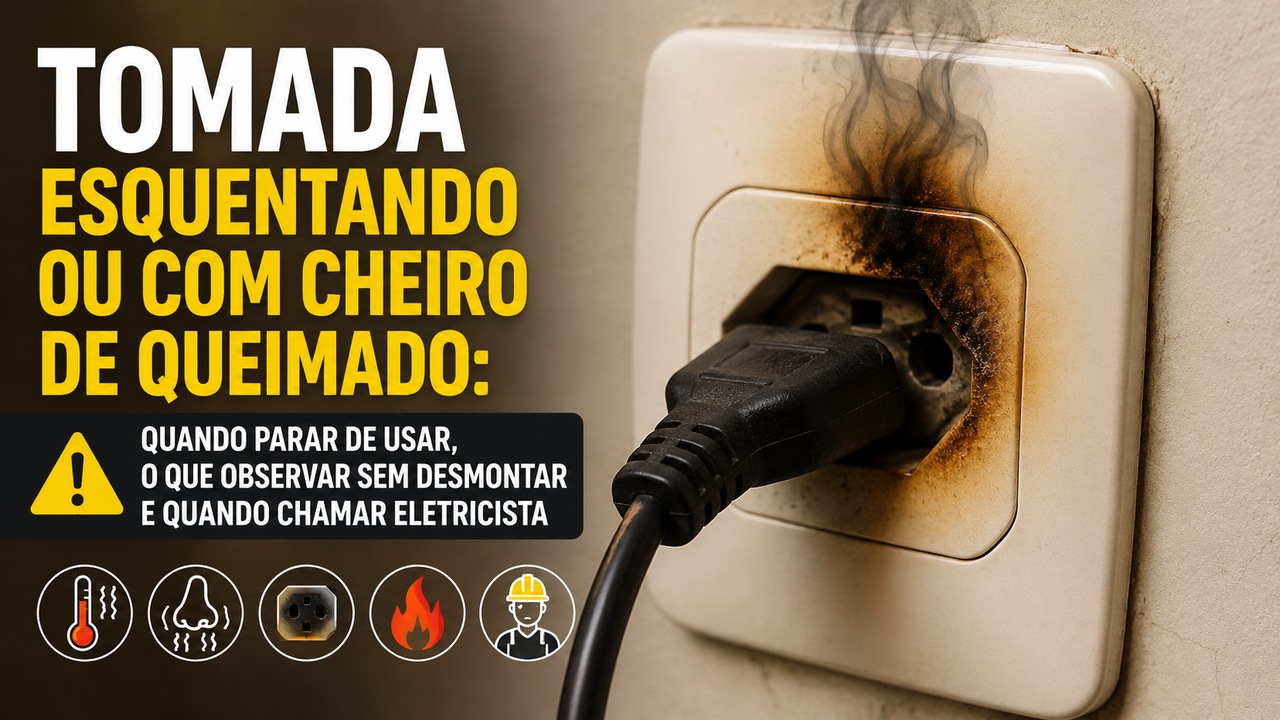
- burning smell;
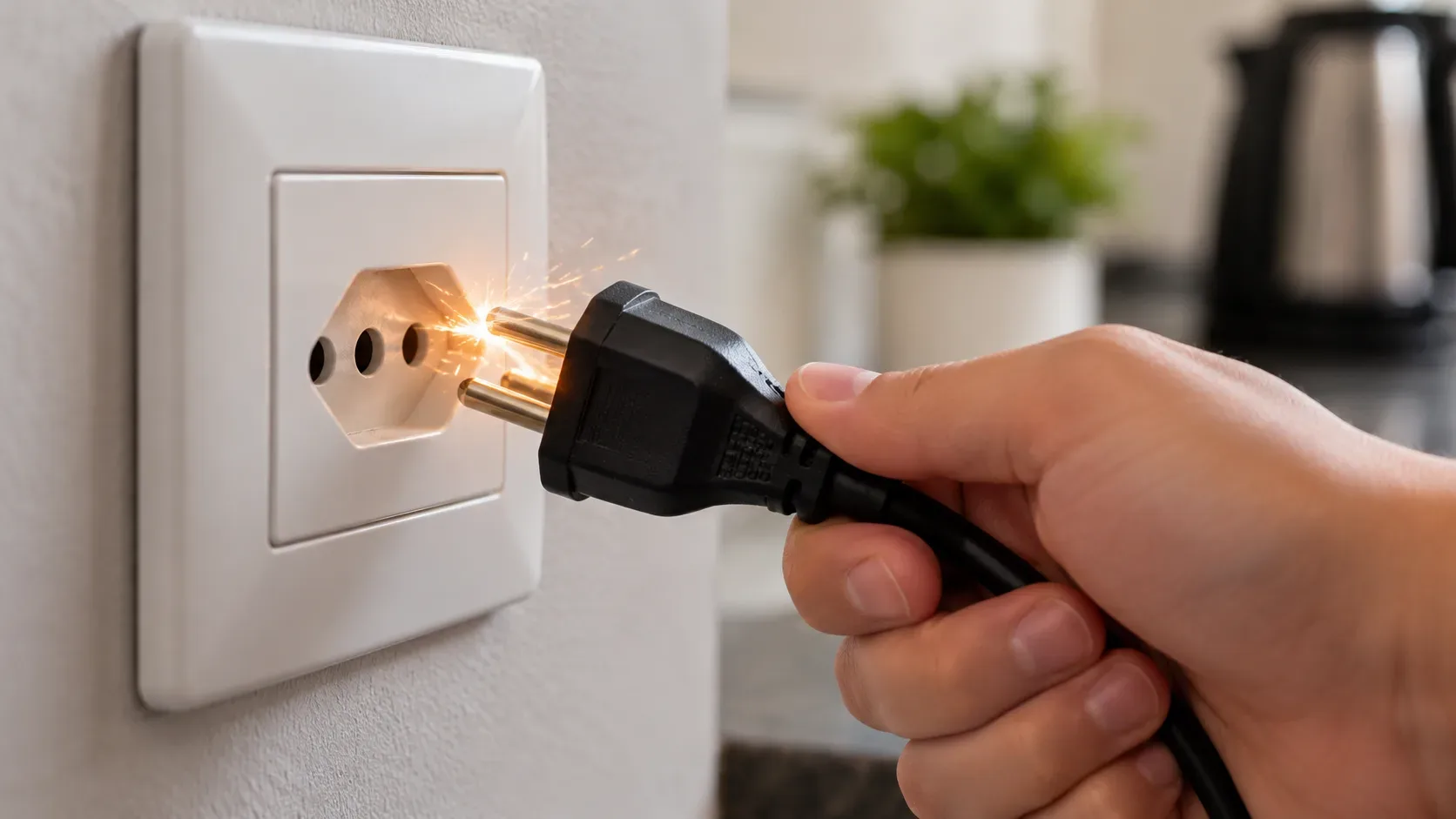
- sparks;
- heated socket, plug or cable;
- darkening or deformation;
- unusual noise;
- circuit breaker that trips repeatedly;
- shock when touching equipment;
- infiltration or flooding near the installation;
- frequent burning of appliances or fuses.
Do not insist on reconnecting a circuit that trips again. Repeated tripping is a symptom to investigate, not an obstacle to overcome. Firefighter guidelines also recommend a qualified technician in the face of constant opening of protective devices, heating and exposed wiring.
What to do when the power goes out
- Look for safety first. Do not go near fallen cables, damaged poles, water near sockets or wet boards.
- Record the time. This helps you track the occurrence and any subsequent request.
- Notify the distributor. Use the consumer unit and keep the protocol.
- Preserve communication and lighting. Use a flashlight and save cell phone battery.
- Keep the refrigerator and freezer closed.
- Disconnect sensitive electronics if the environment is dry and safe.
- Do not make a temporary connection. Do not open the switchboard and do not use a generator improvisedly.
- On return, observe. If there is a smell, noise, spark, persistent oscillation or heating, stop using the affected equipment and call a professional.
If a device is damaged due to a supply failure, ANEEL informs that the consumer can request compensation from the distributor within five years; Orders made within 90 days have a simplified procedure. Preserve invoices if available, photos, reports, proof of repairs and protocols.
Heat and consumption peaks: review before buying more load
The MME linked higher temperatures to system load growth. Inside the home, the safest answer is not to plug powerful equipment into any socket, but to check whether the installation can accommodate the new demand.
Before installing another air conditioner, shower, electric oven or dryer, request an evaluation of the circuit and follow the power and voltage indicated by the manufacturer. In daily use, reduce waste by maintaining filters according to the manual, sealing air-conditioned environments, shading and turning off what is not in use. Efficiency helps with the bill, but does not correct improper installation.
Quick checklist to save
| Situation | What the resident does | Who should take over |
|---|---|---|
| Street or neighborhood without power | Consult channels, record occurrences and save protocols | Distributor |
| Only one room fails repeatedly | Stop using the affected load; Don't insist on resetting | Electrician |
| Smell of burning, spark or hot plug | Keeps people away and stops use without touching damaged parts | Electrician; emergency if there is fire |
| Down cable or damaged pole | Keeps distance and isolates approach | Distributor and emergency |
| Water near sockets or switchgear | Do not enter the area or attempt to operate the switchgear | Firefighters, distributor and electrician |
| Equipment burned after interruption | Records protocols, photos and documents | Distributor; ANEEL if necessary |
| Desire to use a generator or fixed battery | Do not improvise connection | Qualified professional |
| Purchase of high-power appliance | Check the manual and request a prior evaluation | Electrician or engineer, depending on the service |
Preparation without alarmism
El Niño is a reason to monitor forecasts and reinforce prevention, not to announce a blackout that official sources did not predict. The best household checklist combines three attitudes: organizing what depends on the resident, recording what needs to be checked and leaving electrical interventions to those who are qualified.
Save this checklist and review it before hot periods or storms. To complete your planning, also read Yellow Flag in August 2026 and The true impact of the 2026 Super El Niño on your life. Internal links must be inserted into the CMS after confirming the URLs.