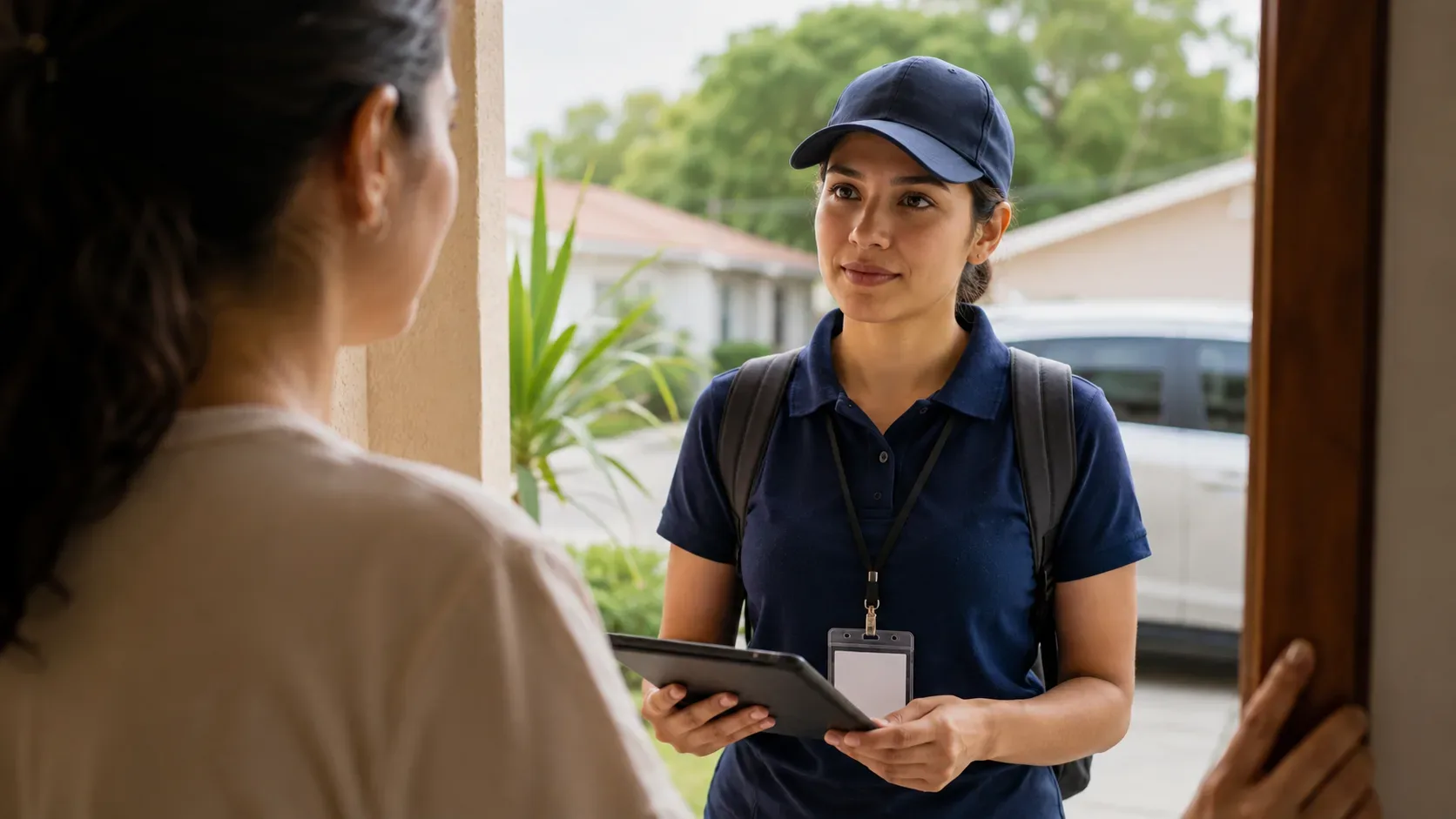
The National Electric Energy Agency's residential survey is real, but that doesn't mean anyone mentioning ANEEL should be received without verification. The 2026 edition of the ANEEL Consumer Satisfaction Index, the IASC, provides for face-to-face interviews in homes in 630 municipalities, conducted by Qualitest Intelligence in Research. The national period reported by the Agency runs from May 18 to August 16, 2026.
Before opening the door, confirm three points yourself: if the municipality is on the official list, if the identification corresponds to the contracted company and if the visit is recognized by ANEEL or the local distributor. Do not use the telephone number or QR Code presented by the visitor as the only reference.
Be aware of an important distinction: the legitimate questionnaire contains some personal and socioeconomic questions, including approximate income, bill amount, address and telephone number. On the other hand, there is no justification for requesting a password, authentication code, bank details, payment, transfer or access to a financial application.
What ANEEL confirmed about the 2026 survey
ANEEL reported that the 27th edition of the survey should produce 29,368 face-to-face household interviews, covering the 103 electricity distributors evaluated in the country. Collection is the responsibility of Qualitest, with monitoring and validation of the steps by the Agency.
| Item | Information confirmed |
|---|---|
| Search | ANEEL Consumer Satisfaction Index — IASC 2026 |
| National period released | May 18 to August 16, 2026 |
| Scope | 630 municipalities |
| Interviews planned | 29,368 |
| Evaluated distributors | 103 |
| Field company | Qualitest Intelligence in Research |
| Format | In-person home interviews |
| Identification announced | Badge, institutional uniform and vehicle featuring the company logo |
This information is contained in the statement published by ANEEL on April 28 and updated on April 29, 2026. The Agency also made available the documents with the drawn municipalities and the questionnaire applied to consumers.
There is a caveat about the end date
The national statement establishes August 16, 2026 as the end of the period. However, notices from some distributors and licensees mention the possibility of extension for up to 15 days or indicate activities until August 31st.
Divergence may reflect local operational forecasts. Therefore, an approach after August 16th should not automatically be classified as fraud, but requires additional and specific confirmation with ANEEL and the distributor responsible for the address.
Checklist to confirm the team without opening the door
1. Keep the door closed during the first conversation
Ask, through the door, intercom, window or camera:
- interviewer's name;
- research company name;
- purpose of visit;
- number or code visible on badge;
- distributor that will be evaluated.
The expected presentation is from an interviewer from Qualitest, carrying out an assessment of the city's electricity service. This identification appears at the beginning of the official questionnaire.
It is not necessary to open the door to hear this information or to confirm before continuing.
2. Check if the municipality appears in the official list
The research is not being applied without distinction in all Brazilian municipalities. ANEEL published a document with the selected locations, the corresponding distributor and the expected number of questionnaires.
In the document, look for the name of the municipality and confirm that the distributor indicated is the same one that serves the property. The official list brings together locations from all regions and differentiates concessionaires and permit holders.
If the city does not appear in the list, do not proceed before obtaining an explanation directly from ANEEL.
3. Observe the three identification elements published by ANEEL
According to the Agency's central statement, researchers should use:
- ID badge;
- institutional uniform;
- vehicle featured with the company logo.
The presence of a badge alone is not enough. Check whether the three elements are consistent with each other and whether they identify Qualitest or the IASC survey.
An unmarked vehicle, a person in street clothes or an improvised badge are reasons enough to interrupt contact until the visit is confirmed.
4. Look for the confirmation channel yourself
The safest point in the process is to use a contact that has not been delivered by the visitor.
ANEEL maintains the 167 telephone number, open from Monday to Saturday, from 8am to 8pm. It is also possible to search for the distributor's channel on the energy bill or on the Agency's official service page.
Inform the attendant:
- municipality and neighborhood;
- name presented by interviewer;
- company indicated on the badge;
- time and location of the approach;
- possible identification code.
The legitimate visitor must accept that the resident carries out this verification. Haste, irritation, or attempts to prevent the connection should increase caution.
5. Treat the QR Code only as a complementary element
Some cooperatives and distributors reported that interviewers' vests may contain a QR Code directed to the ANEEL page. This detail, however, does not appear among the three identification elements described in the Agency's national statement.
In addition, a QR Code can be reproduced or replaced. The practical recommendation is not to treat it as sufficient evidence. If you decide to scan, check the address displayed before opening and confirm that the domain belongs to the official portal.
CERT.br security materials advise the user to check whether the contact, application or website are official and recommend caution when accessing QR codes.
6. Only then decide if you want to participate
With their identity confirmed, the resident can choose to participate. Coprel, when publicizing the campaign in its area, classified participation as voluntary.
Confirming the legitimacy of the team does not oblige anyone to answer the questionnaire or allow the interviewer to enter. If you don't feel comfortable, politely inform them that you will not participate.
What the legitimate interviewer might ask
The questionnaire published by ANEEL is extensive and contains filters to define who can respond. He preferably looks for the person responsible for the household, his spouse or a first-degree relative who is familiar with the home's electricity service.
Among the topics covered are:
- participant age;
- time of residence in the property;
- relationship with the person responsible for the household;
- name of the distributor serving the city;
- exclusively residential use of the property;
- meter location;
- receipt of the Social Tariff;
- existence of solar energy cards or credits;
- education;
- approximate household net income;
- number of people living in the house;
- experiences with supply, interruptions and service;
- evaluation of account and services;
- approximate invoice value;
- previous complaints and contacts with the distributor.
Survey may ask for income and bill amount
Yes. The questionnaire presents family net income ranges and asks the approximate value of the energy bill. These requests may seem unusual, but they are included in the official 2026 document.
Care must be taken before responding: confirm the team and check that the questions follow the context of a statistical survey, without migrating to billing, commercial offers or financial transactions.
Name, address, zip code and telephone number also appear in the document
At the end, the questionnaire contains a section identifying the respondent. She predicts:
- name and, whenever possible, at least a surname;
- address and number;
- neighborhood;
- CEP;
- a telephone with area code, configured in the form as mandatory;
- additional phones, if any.
This is one of the reasons why confirmation must occur before the interview. A request for a phone number or address does not prove that the visit is legitimate; it just means that these fields exist in the official questionnaire when administered by the correct team.
The fact that the system considers a field mandatory also does not eliminate the voluntary nature of participation. Anyone who does not wish to provide the data can terminate or refuse the interview.
Which is not part of the legitimate approach
In the official questionnaire consulted, no field was identified for the respondent's CPF, password, security code, card, bank account or access to a financial application.
Local communications about the IASC also reinforce that researchers should not request:
- bank details;
- passwords;
- confirmation or authentication codes;
- payment of any amount;
- access to banking applications;
- transfers or financial operations.
The word “Pix” appears in the questionnaire only as an example of a means of paying the electricity bill, within a satisfaction question. The interviewer asks for an assessment of the ease of finding ways to pay the invoice; does not ask the resident to make a Pix.
Signs to stop the conversation
End the approach and look for official channels when the visitor:
- do not present badge or uniform;
- arrive in a vehicle without the announced characterization;
- state that the resident cannot call to confirm;
- provide only one number for “validation”;
- try to create urgency or fear;
- ask for money or any form of payment;
- request password, code received by SMS or authorization on cell phone;
- request access to bank, application, card or digital account;
- trying to sell product or service during the supposed research;
- insist on entering before identity is confirmed;
- address a residence in a municipality not on the official list.
The rule of thumb is simple: a legitimate search can wait a few minutes; a fraudulent approach often attempts to prevent independent verification.
What to do when faced with a suspicious visit
Do not confront the visitor or reveal additional information. Keep the door closed, end the conversation, and write down only what you can safely observe, such as the time, vehicle description, and identification displayed.
After:
- see the list of municipalities published by ANEEL;
- call 167 or the distributor using the invoice or a website you searched for;
- inform the approach and ask if there is a team working in that region;
- if there has been a request for money, password or code, treat the case as a possible fraud attempt;
- if there is a threat, attempted invasion or immediate risk, contact the security authorities.
Frequently Asked Questions
Can staff show up without individual notice?
The research is sample-based and takes place in person in the selected municipalities and sectors. ANEEL's central material does not promise individual prior notice to each residence. Therefore, the lack of an appointment does not prove fraud, but it makes city and identity verification even more important.
Does the interviewer need to be an ANEEL employee?
No. Field collection is carried out by Qualitest Intelligence in Research, a company contracted for the activity. The visitor must introduce himself as an interviewer for the research company, not necessarily as an employee of the Agency.
Can I confirm by calling 167 while the person waits?
Yes. Distributors who have published the IASC expressly recommend confirmation via 167. Look for the number yourself and keep the door closed during the call.
Does a badge with QR Code guarantee that the person is genuine?
No. The QR Code is an additional element mentioned in some local communications, but does not replace confirmation via the official list, by calling 167 or via the distributor's channel.
Can the search charge a fee?
No. The IASC is an assessment survey. Requests for payment, transfer or confirmation of a financial transaction are incompatible with the questionnaire and security guidelines published by the distributors.
What to do after August 16th?
Confirm again before answering. The national date published by ANEEL ends on August 16, but some distributors mentioned a possible local extension. A subsequent visit requires specific validation for the municipality and the team.
Confirm before participating
Before meeting the interviewer, consult the list of municipalities and search for ANEEL or distributor channels on your own initiative. Don't just use the contact, link or QR Code presented at the door.
The research is legitimate and can contribute to the evaluation of the electricity service. Independent confirmation protects the resident without preventing the participation of those who wish to respond.