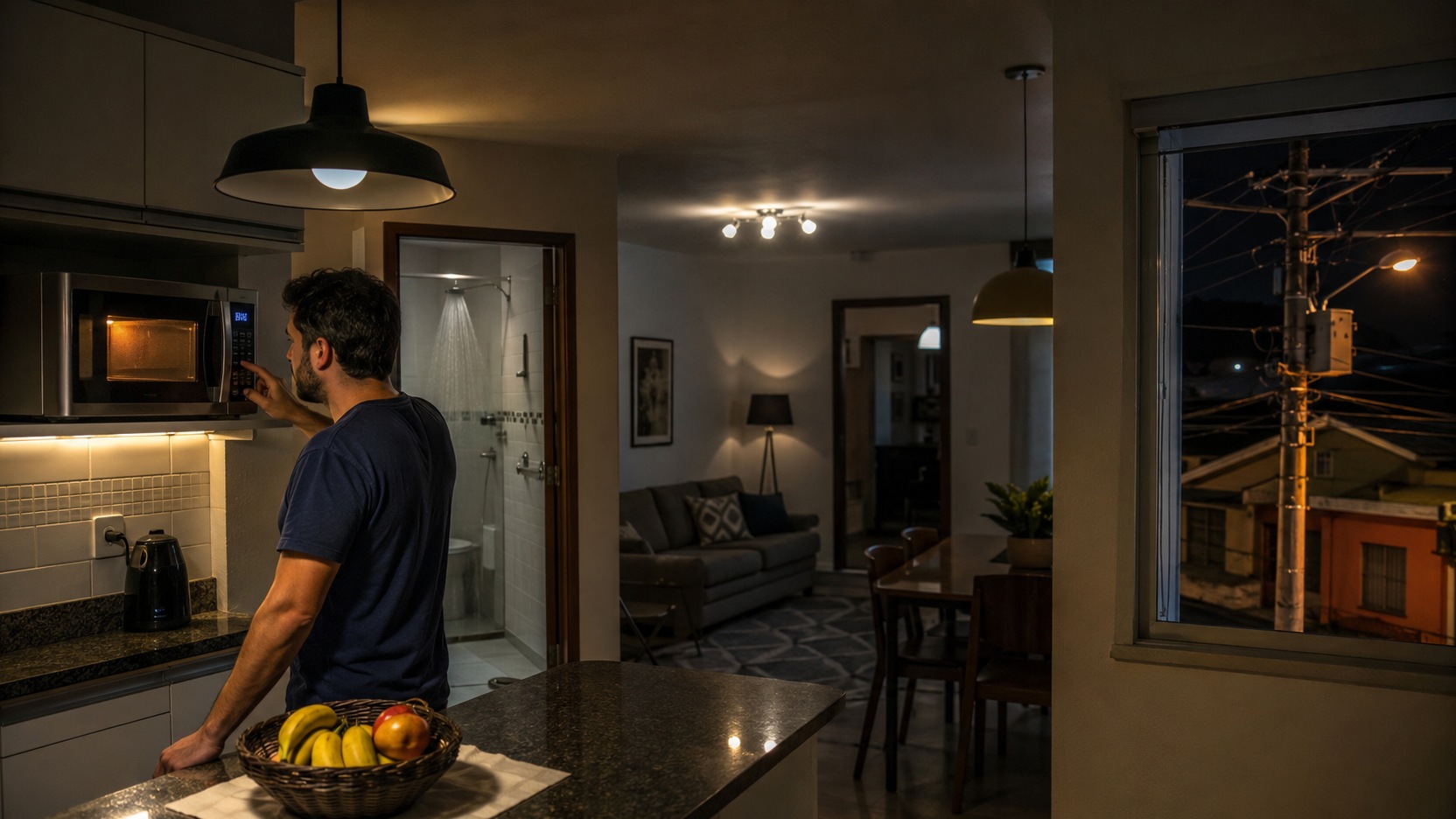
If the light blinks, loses brightness or appears “pulled” at the exact moment the refrigerator, microwave, shower, air conditioning or other appliance comes into operation, the symptom does not alone point to a cause. A very brief oscillation may accompany the entry of a heavier load; A heavy, frequent, prolonged or widespread fall throughout the house deserves investigation. The safest way, without a multimeter and without opening a frame, is to observe the scope of the effect, the device that triggers it and the signals that appear along with it.
Why a load can make the light vary
The voltage reaching the lighting points may suffer a momentary drop when a load requires a lot of current. This is particularly noticeable when starting motors and compressors, such as those in refrigerators and air conditioners, because the starting current is greater than the normal operating current. The resistance and impedance of the conductors and network cause this higher current to produce a temporary voltage drop, which the lighting may show as a small flicker or reduction in brightness.
The electric shower requires a slightly different interpretation. It does not rely on a motor to start, but can represent a high load while it remains on. If the lighting is significantly dimmer throughout the bath, and not just for a fraction of a second when it is turned on, the pattern deserves attention for installation, power input or supply.
A discreet and instantaneous blink does not prove a defect. What changes the level of concern is the intensity, duration, repetition, number of environments affected and the presence of other symptoms.
First filter: does it happen in a lamp, in a room or in the whole house?
Just a light bulb or lamp changes
When only one point of light flashes and the others remain stable, suspicion begins near that point itself. The lamp, the driver of an LED luminaire, the socket, the switch or a connection in that section may be involved. This is not a remote diagnosis, but it is a scope that is not compatible with a general failure of the distributor.
The resident does not need to disassemble lights, open the box or test wires. Just observe whether the oscillation is really restricted to the same point and whether it also occurs when no heavy load device comes into operation. If it persists, an electrician can check the circuit and lighting point.
A room or set of points oscillates
If several lights in the same room or part of the house change together, while other places remain normal, the possibility increases that the problem is in an internal circuit, in a shared connection or in the way the loads are distributed. An appliance connected to the same circuit can aggravate a voltage drop that previously went unnoticed.
In this scenario, it is worth noting which points are affected and which devices were connected. There is no need to identify circuit breakers, remove covers or try to tighten connections. The inspection must be carried out by a qualified professional.
Several rooms or the entire house change at the same time
When the oscillation appears in many rooms, the cause may be higher up in the power supply: input connection, main board, input pattern or distributor supply. The symptom continues without proving which side the fault is on, because an internal connection common to the home can also affect the entire home.
One piece of information helps a lot to separate paths: do neighbors notice something similar at the same time? If nearby houses also show variation, especially unrelated to a specific appliance in your home, external supply becomes a stronger hypothesis. If only your property presents the problem, the installation and entry of the unit need to be considered with more weight.
Second filter: does the oscillation only appear when a specific load enters?
The temporal pattern is often as useful as the scope. If the light gives a small blink only when the refrigerator or air conditioning compressor starts and immediately returns to normal, the event may be linked to the starting current. If the behavior appeared recently, became stronger, lasts longer or started to occur with lower loads, the situation is no longer just a visual detail and deserves evaluation.
When the trigger is a shower, electric oven, dryer, or other high-powered appliance and the lighting remains dim while it is on, observation suggests a sustained voltage drop under load. This may involve sizing, connections, input capacity or the supplied voltage itself. The distinction requires professional measurement; What the resident can do safely is record the pattern.
It is also important to understand whether the device that triggers the symptom works normally. Difficulty starting, unusual noise, shutdowns, router, television or computer restarts and electronic clocks resetting indicate that the variation is not being noticed
just for the lamps.
Signals that change the priority for safety
Burning smell, crackling, strong buzzing, sparks, darkening marks, heating socket or board, small shocks and frequent trips should not be treated as a simple “light outage”. Distributors and electrical safety materials advise that heating and burning odors are signs of a problem in the installation and require professional evaluation.
In these situations, do not open the panel, do not touch the meter, do not remove socket mirrors and do not try to tighten wires. Stop using the device associated with the symptom if this can be done by normal equipment control, keep away from hot spots, smoke or odor and call a qualified electrician. If there is a fire or immediate risk to people, the priority will no longer be diagnosing the source of the oscillation and will become an emergency.
There is another behavior that deserves speed: lights that are very weak in some points and, at the same time, excessively strong in others. Variations like this can be associated with connection failures and imbalances that require inspection, and should not be “tested” by connecting more loads to see what happens.
When to call an electrician first
The electrician is the most logical first contact when the problem is restricted to a lamp, a room or part of the house; when only your residence presents the symptom; when the oscillation always appears with a specific equipment; or when there are signs of heat, odor, noise, circuit breaker tripping or altered socket.
It also makes sense to start with the internal installation when the oscillation is old and repetitive under certain load combinations. ANEEL Normative Resolution No. 1,000 establishes that the consumer is responsible for maintaining the technical adequacy and safety of the installations under their responsibility, while the distributor operates and maintains the system up to the point of connection. In practice, this legal boundary does not allow visually diagnosing the defect, but it explains why problems within the property usually require a private professional.
The objective of the inspection is not simply to “change a bigger circuit breaker” or reinforce a workaround. The professional must locate where the voltage is dropping, evaluate connections, circuits, power input and compatibility between the installation and existing loads.
When the distributor joins the investigation
ANEEL treats voltage quality as part of supply quality. Prodist Module 8 monitors steady-state voltage compliance and also other quality phenomena, such as fluctuation and short-term voltage variations. This means that a voltage complaint is not a matter outside the distribution company's hands, but it also does not mean that every blinking light bulb is the fault of the public network.
The distributor gains priority when the variation affects the entire house, appears without a clear relationship with internal loads, occurs at similar times over several days or is also noticed by neighbors. If an electrician checks the installation and does not find the source of the problem inside the property, registration with the distributor also becomes a natural step.
According to Resolution No. 1,000, the quality complaint must inform at least the days, probable times and the description of the problem. In cases of complaints about permanent voltage, the rule provides for inspection and, when necessary, measurement for 168 hours to assess compliance. ANEEL's supply quality page explains that these temporary measurements may arise from consumer complaints and that the results are evaluated in relation to adequate, precarious and critical voltage ranges.
It is useful to know that a split-second blink is not the same thing as proving inadequate steady-state voltage. The regulatory measurement of this regime works with values paid in ten-minute intervals, while rapid events belong to other quality categories. Therefore, the better the description of the behavior, the more useful the protocol will be.
What to register before requesting service
Without touching the installation, do a simple registration for a few days. Write down the date and time, which device came into operation, whether the outage was instantaneous or continued, which rooms changed, whether any equipment restarted and whether neighbors noticed the same. A short video taken from a safe location can help demonstrate the pattern, as long as it does not require close proximity to a switchboard, meter, heated outlet, or wiring.
This history avoids a generic description such as “the power is low” and helps both the electrician and the distributor to reproduce the problem. It also allows you to understand if the situation is getting worse, if it started to occur with smaller loads or if you are no longer dependent on a specific device.
A practical decision without opening anything
If only one lamp flickers, start thinking about the lighting point itself and ask for evaluation if the behavior persists. If a room or part of the house fluctuates, the internal installation becomes the main focus. If the entire house varies, see if it's related to a large load and ask neighbors if they notice the same. If the effect also appears outside your home or occurs independently of internal loads, file a complaint with the distributor.
In any scope, burning smell, heating, sparks, loud noise, shocks, circuit breakers repeatedly tripping or appliances restarting change the priority: do not continue causing the oscillation to “test”. Observation serves to safely address the problem; electrical diagnosis requires measurement and technical access carried out by a qualified professional or, when the origin is in the supply, by the distributor itself.