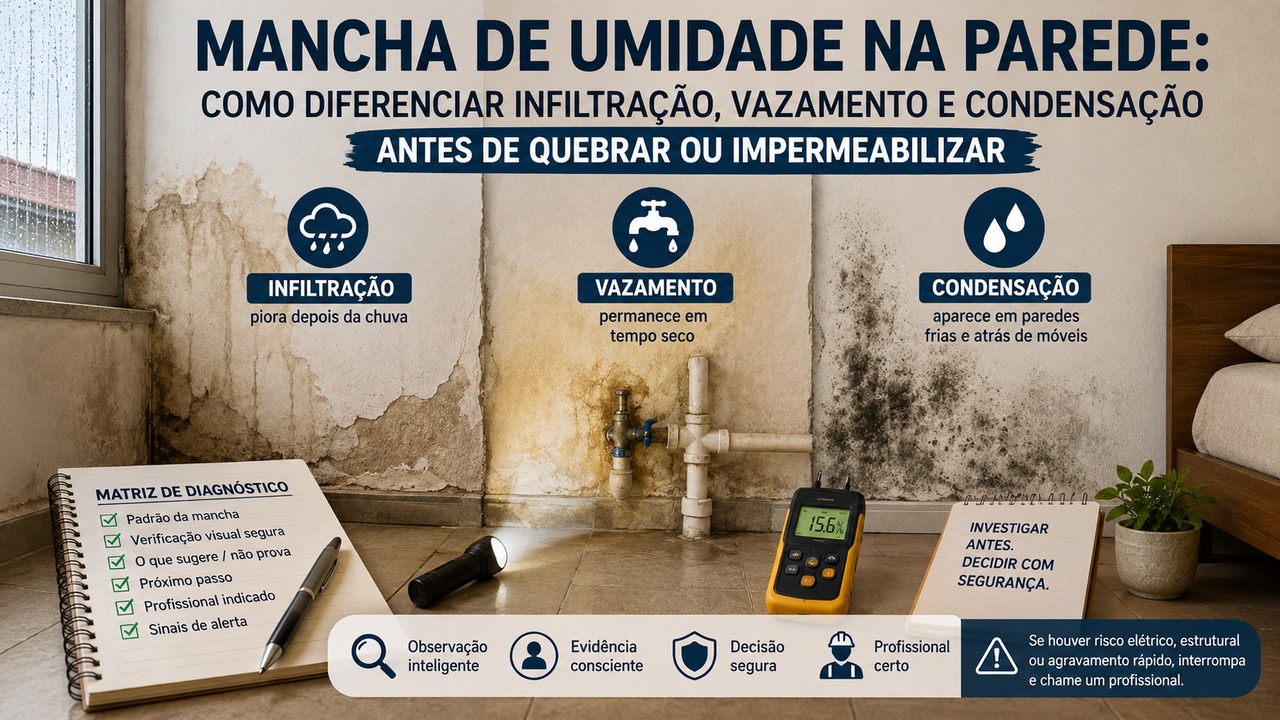
A wet spot is a symptom, not a diagnosis. Swollen paint, darkened plaster, mold and peeling can appear when water enters the roof or facade, when there is loss in a pipe, when air vapor condenses on a cold surface or when humidity arrives through drainage and contact with the ground. Therefore, choosing waterproofing, opening the wall or changing a pipe before understanding the pattern can treat the place where the water appears without reaching the place where it comes from.
The safest way is to cross four types of evidence: when the stain changes, where it is, what event it relates to and what happens around it. A repeated correlation with rain points in one direction. Persistence in dry weather near hydraulic installations points to another. Surface moisture on cold walls, corners and behind furniture displaces the hypothesis for condensation. None of these signs alone confirm the diagnosis.
First, observe the pattern before testing solutions
Always photograph the area from the same point and record what happened in the previous hours: heavy rain, bathing, using a washing machine, washing floors, air conditioning running or a long period of time with doors and windows closed. The objective is not to set up a homemade investigation, but to discover whether there is a consistent relationship between the stain and some event.
Also look at the other side of the wall, the room above and the area immediately below. Liquid water can follow gravity, travel through joints, voids and fissures and appear far from the entry point. A stain on the baseboard, therefore, does not prove that the water started on the floor; just as a stain near the ceiling does not prove that the defect is directly above it.
The home inspection must be in what is visible and accessible without disassembly. Do not open sockets, do not drill into walls to look for pipes and do not climb onto a roof or facade without adequate equipment and knowledge. If the origin is not clear with observation, the next step is to target the right professional, not to increase the invasiveness of the test.
When the stain gets worse after rain
A stain that grows or darkens repeatedly after rain reinforces the hypothesis of water entering the building envelope. The origin may be in tiles and flashings, gutters and conductors, facade joints, cracks, window sills, frames or points where water accumulates near the construction. The EPA includes rain, surface water, and ground water among the main sources of moisture that can enter through gaps in roofs, walls, windows, doors, and foundations.
The most useful visual check is to look, from ground level and without exposing yourself to height, for signs that match the likely path: overflowing gutter, obstructed conductor, failed window seal, external crack, poorly protected junction between roof and wall or water accumulated near the base of the facade. Repeating the problem in rain with wind from a certain direction can also help
locating a more exposed face.
What this pattern doesn't prove is the exact entry point. Water can penetrate further up, walk through a cavity and only become visible in another area. Technical moisture investigation guides highlight that gravity and capillarity can displace water within the wall. Therefore, waterproofing only the internal surface where the paint has stained can mask the symptom and, in some construction systems, make drying difficult.
When the relationship with rain is strong, the first professional tends to be someone who can evaluate the roof, facade, frames and drainage as a system. In a simple and clearly localized case, it may be a professional who specializes in the defective component. When the origin is diffuse, recurrent or involves more than one floor, it makes sense to have an assessment by civil engineering or architecture with experience in pathologies and watertightness before contracting the repair.
When the wall remains damp in dry weather and is close to pipes
If the stain does not depend on rain and remains active during dry days, a hydraulic installation gains weight in the investigation, especially near a bathroom, kitchen, laundry area, plumbs, tap points or wall shared with appliances that use water. Small losses in supply pipes can remain hidden in walls and ceilings for some time. Leaks in sewage, siphons, appliance connections, boxes and drains can also wet the building, but not all of them behave in the same way.
Before cracking, try to relate the change in stain to use. If it intensifies after bathing, there may be a loss linked to the shower, the shower, the pipes or the drainage. If it grows even when no one uses that environment, a continuous loss in a pressurized line becomes more plausible. This reasoning serves to prioritize tests; does not identify by itself which connection is faulty.
The water meter helps detect flow, not locate the leak
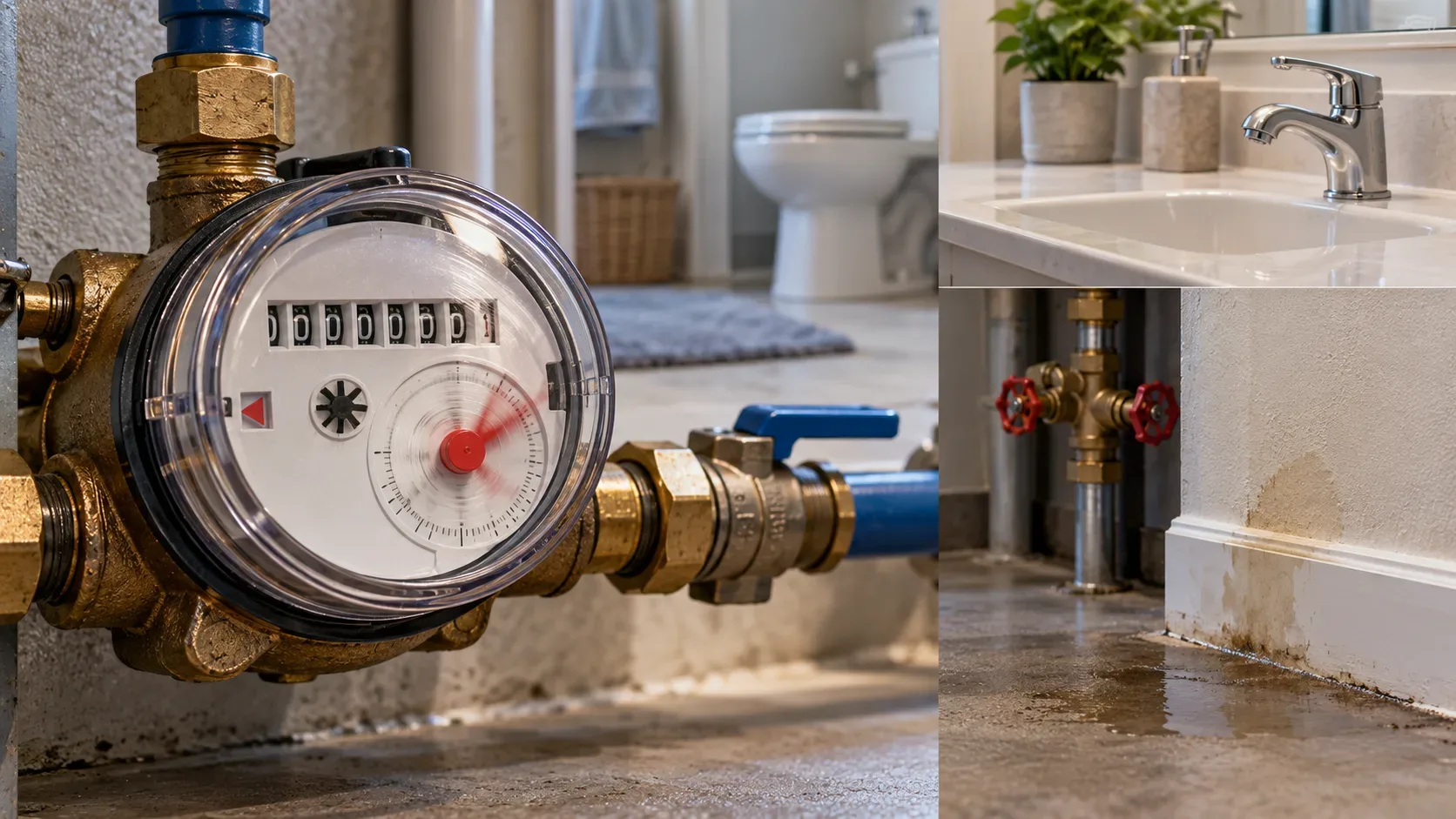
The water meter is useful auxiliary evidence when there is a suspicion of tap water being consumed unintentionally. The guidance from public water services is to stop using water in taps, showers and equipment and observe whether the flow indicator or reading continues to change. Movement without intentional consumption suggests that there is water passing through the system and deserves investigation.
This test does not tell you which wall the problem is on. It also does not exclude all other sources when the meter is stopped. A loss in the sewer, a waterproofing failure in the box, rainwater, air conditioning condensate or external infiltration can wet the wall without producing a continuous flow detectable on the water meter. Intermittent leaks can also escape short notice.
An unexplained increase in consumption reinforces the suspicion of loss in the supplied network, but it needs to be read together with the stain pattern and the property's habits. If there is evidence of continuous flow, the appropriate professional is plumbing installations or leak detection. The purpose of professional testing is to reduce the search area before opening liners, not to turn the water meter into a pipe finder.
When moisture appears on a cold wall, corner or behind furniture
Condensation happens when water vapor in the air encounters a surface cold enough to reach the dew point. In a house, this can occur on glass, cold external walls, corners with thermal bridges, cold water pipes and surfaces with little air circulation.. The EPA also points out that walls behind furniture can concentrate condensation and mold growth when the surface is cold and poorly ventilated.
The pattern is usually different from a continuous leak. Humidity may appear more superficially, vary with temperature, ventilation and activities that generate steam, and be more evident at certain times or seasons. In porous materials, however, condensed water can be absorbed and leave a stain similar to infiltration. Appearance alone does not resolve the issue.
A safe check is to move the furniture a few centimeters away, improve air circulation and see if the area dries out again and if the recurrence decreases. A hygrometer can show if the environment has long periods of high relative humidity, but an isolated reading will not identify the cause of the stain. The EPA uses less than 60% relative humidity as a practical reference for indoor mold control, ideally between 30% and 50%, but climate, temperature, and building characteristics need to be considered.
If the problem is concentrated on cold surfaces and clearly improves with ventilation, vapor control and increased circulation, the condensation hypothesis gains strength. If the area remains wet despite these changes or forms a very localized boundary that grows, consider liquid water entering the building or facilities again. In persistent cases, the assessment may involve a building professional and, when there is a related air conditioning or exhaust system, an air conditioning technician.
When the stain appears on the baseboard
Low humidity in the wall usually leads many people directly to the diagnosis of rising damp. This is a dangerous shortcut. Investigation guides show that the base of the wall can also get wet due to poor external drainage, water accumulated near the foundation, pipe leaks, splashes, failures in rainwater conductors and even condensation in a colder region.
Seek the context first. On the outside, is there land, a garden or a high floor touching the wall? Does gutter water discharge near the foundation? Is there puddling after rain? There is piping
Water or sewage running in that lane? Is the stain continuous along several walls or extremely localized? These questions help separate a broad ground-bound source and drainage from a point defect.
Whitish salts, known as efflorescence, indicate that there was water mobilizing soluble salts and evaporating on the surface, but they do not identify where this water came from. The Civil Defense of Maceió, when analyzing cases of efflorescence, related the phenomenon to the presence of humidity and observed that the origin may involve infiltration and terrain conditions. Therefore, salt is a trajectory and evaporation clue, not a diagnostic stamp.
If the baseboard is damp in several spots and there is no clear relationship to rain or consumption, a technical assessment of the drainage, external levels, foundation and installations is more useful than applying a waterproofing product tentatively. Correct treatment depends on whether the water comes from outside, from below, from a pipe or from the indoor air itself.
What a Moisture Meter Can Really Tell You
Handheld meters are useful for mapping moisture differences, but the number displayed should not be treated as a universal limit for walls. In masonry and coverings, the reading may vary with density, porosity, salts, texture, reading depth and device calibration. Historic England's technical guidance highlights that electronic readings alone do not necessarily reveal the cause, magnitude or extent of a problem and do not in themselves justify expensive and invasive repairs.
In practice, the best home or preliminary use of a meter is comparative. It is more informative to compare several spots of the same type of material, including an apparently dry area, than to look at a single percentage. A higher reading can help draw the outline of the affected region and track whether it is drying out or worsening, but it still needs to be interpreted along with rainfall, water use, temperature and position of facilities.
Thermal cameras also do not see water directly. They show temperature differences that may be consistent with evaporation, thermal bridging, airflow, or humidity. Therefore, they are investigative tools, not verdicts. A professional can combine observation, measurement, hydraulic testing and monitoring over time to reduce uncertainty before opening the wall.
Why waterproofing can go wrong the first time
Waterproofing is a treatment for a specific water ingress mechanism, not a universal answer to any stain. If the cause is a leaky pipe, the membrane will not repair the pipe. If it's condensation, a waterproof layer may just change where moisture accumulates. If there is drainage failure or rain ingress from a higher point, covering the internal side will not correct the water path.
In addition, some very impermeable coatings can reduce the drying capacity of porous walls. This does not mean that waterproofing materials are unsuitable in general; This means they need to be chosen for the construction system and applied after identifying the source and side from which the water should be controlled. Repair must stop the cause and allow the affected area to dry before repainting and finishing.
When to stop home investigation
Stop investigating on your own if water reaches sockets, switches, light fixtures, appliances or the electrical panel. The Ministry of Mines and Energy advises not to use electrical devices in places with water or excess humidity due to the risk of shock and short circuit. Do not disassemble wet electrical components; keep your distance and call an electrician or the responsible service depending on the situation.
Also stop if there is a bulging or sagging ceiling, heavy plaster coming off, rapid deformation, cracks that appear or increase with humidity, floor sagging or any sign of instability. Accumulated water can increase loads and deteriorate materials. In a situation of immediate risk, remove people from the area and call the local emergency service or Civil Defense; To evaluate the building, look for a professional qualified in engineering or architecture.
Water with a sewage odor, backflow through drains, contamination from flooding or a large area of mold also change the level of risk and require a professional approach. The same goes for any inspection that requires climbing a roof, accessing a facade, opening unstable ceilings or breaking coverings near pipes and cables whose position is unknown.
How to choose the next professional without hiring a job in the dark
When the stain accompanies rain, the initial focus should be on the roof, facade, frames and drainage. When dry weather persists, water usage is monitored or the water meter indicates flow without consumption, start with hydraulic installations and leak detection. When the pattern is superficial, appears in cold areas and improves with ventilation, investigate condensation, insulation, ventilation and air conditioning.
If the signs contradict each other, the stain crosses several floors, reappears after repairs or there is doubt about the safety of the construction, it is worth prioritizing an independent diagnostic assessment before hiring waterproofing, painting or breaking the wall. A good diagnosis must explain what signs support the hypothesis, what alternatives are still possible, and what minimal test or intervention can separate one cause from the other.
The first step, therefore, is not to choose the product that will hide the stain. It's about finding out which mechanism puts water at that point and gathering enough evidence for the repair to reach the conclusion
origin. The better the pattern reads, the less chance there is of breaking in the wrong place, waterproofing the wrong side, or redoing the finish while the wall continues to receive moisture.