Short answer: a ceramic tile floor that bulges, lifts or “tents” deserves more attention than a tile that only sounds hollow. A hollow sound is compatible with voids or loss of bond at some interface in the system, but by itself it does not show the extent or the cause. A visibly raised or moving tile, or one pressing against neighboring tiles, means the finish has lost local stability and may break or create a trip hazard.
The key is not to jump straight to replacing the tile. Ceramic finishes can debond because of installation defects, insufficient bonding, poor substrate preparation, missing or ineffective movement joints, movement of the assembly, incompatible materials and moisture. Technical studies also show that debonding can occur at different interfaces, which changes the diagnosis. The useful question is therefore not only “which tile sounds hollow?” but “is this an isolated defect or part of a larger pattern?”.
Hollow sound and a bulging floor are not exactly the same thing
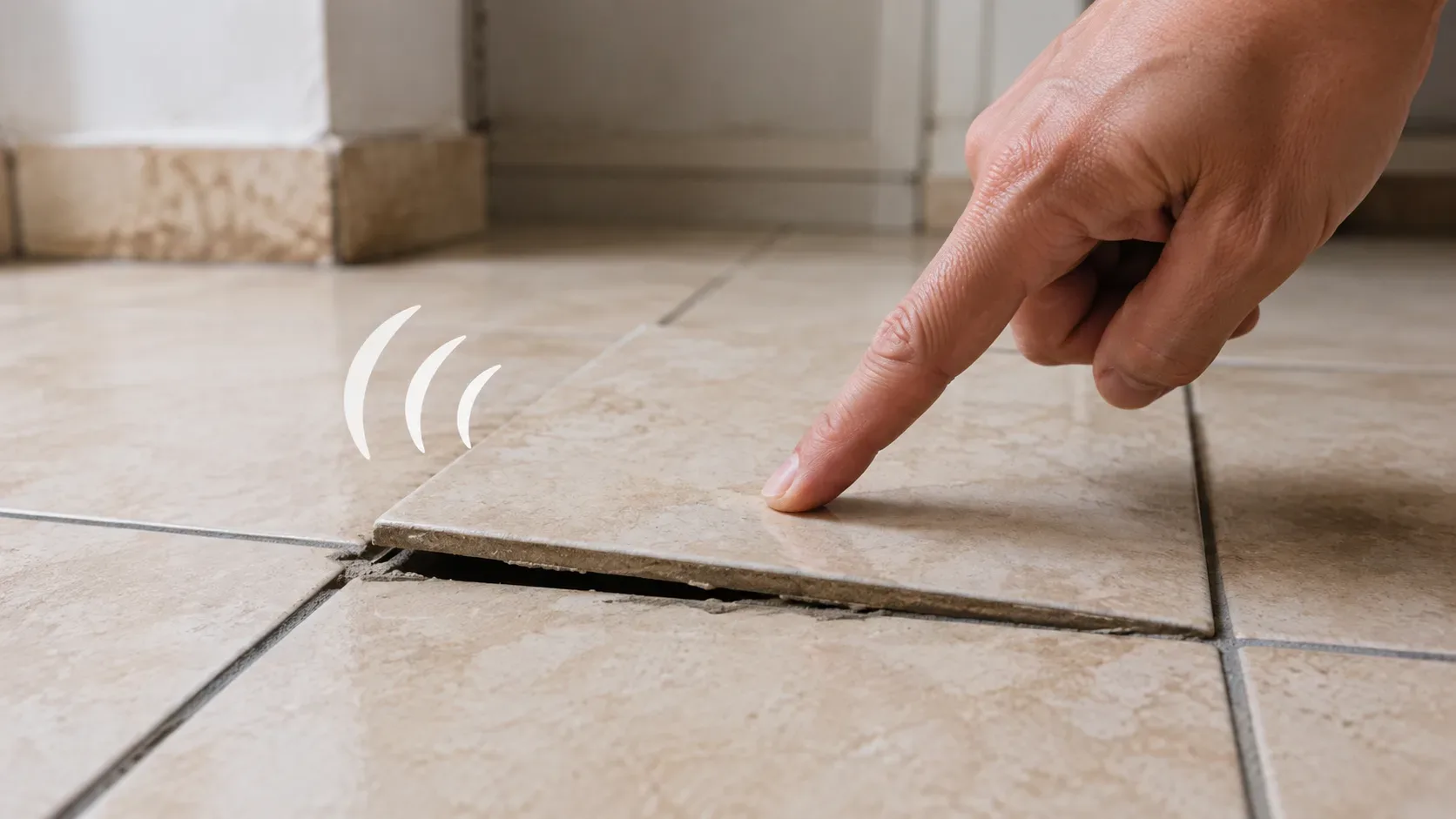
A hollow sound is noticed when one tile responds acoustically differently from well-bonded tiles around it. Technical inspections use percussion to locate suspect areas. Engineering studies associate this sign with bonding failures and incomplete coverage, but it must be interpreted together with other evidence. A tile can sound different without being raised, and the test alone does not reveal which layer has failed.
Bulging or tenting, on the other hand, is a visible geometric change: edges rise, tiles press against each other, grout opens or breaks, and a ridge can appear where the floor used to be flat. This stage usually requires faster action because the finish has already moved physically.
How to tell whether the problem looks local or widespread
Before removing any tile, make a systematic observation. The goal is not to diagnose the cause without a professional, but to gather signs that indicate the scale of the problem.
- Look at continuity: one isolated tile surrounded by a stable floor is different from a continuous band of hollow-sounding or raised tiles.
- Check the grout: long cracks, crumbling grout, widening joints or lines that cross several tiles suggest movement beyond a single spot.
- Look for movement: a tile that rocks, gives underfoot or changes level is more concerning than a different sound with no displacement.
- Compare rooms: if the same pattern appears in adjacent rooms, corridors or broad areas, a systemic issue involving installation, substrate or movement becomes more likely.
- Track progression: photos and a simple marked plan make it easier to see whether new spots appear over days or weeks.
- Look for water-related signs: stains, permanently dark grout, a damp smell, efflorescence, a nearby leak or a problem from the floor above changes the priority of the investigation.
On flat, intact tiles, light tapping with a wooden handle can be used only to compare sounds between tiles. Do not strike hard, do not use blunt metal tools, and do not test tiles that are already raised, cracked or loose. Manufacturers and inspection studies use the acoustic response as an indication of bond condition, not as a complete diagnosis.
What can cause hollow sounds, debonding or tenting
1. Bonding or installation failure
This is one of the most common hypotheses. It can happen when the substrate is dusty, weak or poorly prepared; when the adhesive was wrongly specified or mixed; when its open time was exceeded; or when coverage on the back of the tile was insufficient. The result can be voids, hollow sounds and, later, detachment.
2. Movement and insufficient joints
Floors and substrates change dimension. When the system cannot accommodate that movement, compressive stresses develop. Missing, poorly positioned or ineffective movement and perimeter isolation joints can contribute to tiles lifting. This is an important reason not to “lock” the floor again with a spot repair before understanding what happened around it.
3. Problems in the substrate or screed
The tile itself may not be the weak point. If the leveling layer or screed has low cohesion, cracks, contamination, shrinkage or poor adhesion, the system may separate at a deeper interface. In debonding studies, observing where the adhesive remains after a tile is removed helps identify the failure plane.
4. Moisture, leakage or moisture expansion
Moisture can be part of the problem, especially in wet areas, balconies, places with leaks or compromised waterproofing. But it should not be treated as the automatic cause. Some cases have linked tile moisture expansion to tenting, while others were driven by bond, joint, substrate or installation problems. The investigation needs to distinguish active leaks, environmental moisture, waterproofing performance and material behavior.
5. More than one cause at the same time
Finish failures rarely follow a single-cause explanation. An installation with voids may remain stable for years and become visible only after movement, thermal variation or water entry. A useful diagnosis therefore compares the damage pattern with the history of the property.
When to isolate the area
You do not need to wait for a formal report when there is an obvious physical hazard. Restrict traffic over the area if there are raised, rocking or broken tiles, sharp edges, popping sounds accompanied by movement, or several neighboring tiles beginning to lift. At that point there is already a risk of tripping, cuts or sudden breakage.
If there is only a hollow sound in a flat tile, with no movement, crack or grout change, this usually allows a scheduled assessment rather than an emergency response. Even so, avoid dragging heavy furniture or applying impacts over the area until the extent is understood.
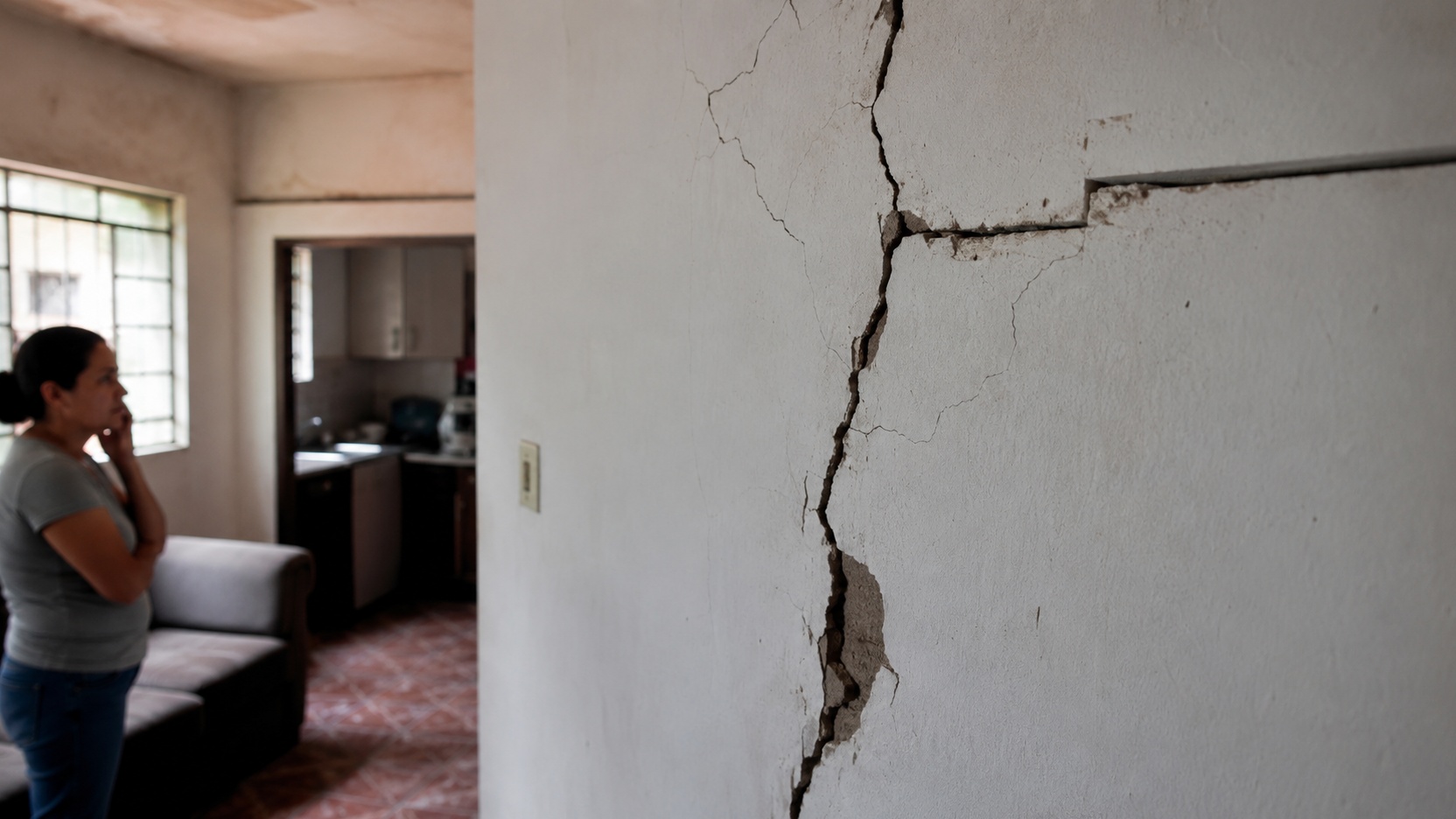
If the lifted floor appears together with significant cracks in walls or the slab, doors that recently started sticking, visible deformation, recurrence in several rooms or other signs of building movement, the priority should be a broader technical assessment. In that scenario, the floor may be only one symptom.
Who to call in each situation
| Observed situation | Best professional to call | Why |
|---|---|---|
| One or a few tiles with a clearly local defect, with no moisture or other symptoms | Experienced tile installer or maintenance contractor | They can remove the tiles, check adhesive coverage and substrate condition, and reinstall correctly. |
| Large area, recurring problem or uncertain cause | Civil engineer or architect experienced in building pathology | They can map the pattern, assess joints, substrate, interfaces and movement, and decide whether testing or sample openings are needed. |
| Stains, persistent dampness or suspected leak | Plumber/leak-detection service and, when appropriate, waterproofing specialist | The water source should be eliminated before the finish is rebuilt. |
| Problem in a common area, corridor, garage, shared balcony or possible interface between units | Property manager/condominium management and a technical professional hired by the condominium | The cause and responsibility may involve common building systems. |
| Raised floor together with other signs of building movement | Civil engineer for a technical inspection | Cosmetic replacement should not precede an assessment of the overall behavior. |
Why replacing only the tiles can make the problem return
A spot replacement solves the finish only when the cause is also local. If the origin is lack of movement accommodation, a weak substrate, leakage, failed joints or widespread loss of bond, the new tiles may loosen again or simply transfer stress to another area.
Removing a defective tile can provide useful clues. If adhesive remains on the substrate while the tile back comes away almost clean, the failure occurred at one interface; if the adhesive comes with the tile and leaves the substrate exposed, the failure occurred at another. If the screed itself crumbles, the problem lies deeper. The person carrying out the repair should read these clues because they help select a solution instead of merely hiding the symptom.
What a technical diagnosis may include
- percussion mapping of areas with a different acoustic response;
- survey of loose tiles, cracks, failed grout and level changes;
- checking movement, isolation and perimeter joints;
- controlled removal of one or more tiles to observe the failure interface;
- assessment of the screed and substrate surface condition;
- investigation of leaks, dampness and waterproofing when signs are present;
- comparison with project documents, adhesive specifications and manufacturer recommendations when available.
A practical checklist before deciding on the repair
- Do not force or try to push a tile back into place once it has lifted.
- Keep people away if there is a trip or breakage hazard.
- Photograph the area and mark which tiles sound different or move.
- Check grout, nearby walls and moisture signs.
- See whether the same phenomenon appears in other rooms.
- If it is widespread, progressive or recurring, get a diagnosis before buying replacement materials.
- During the repair, ask that the condition of the tile back, adhesive and screed be documented; this helps confirm the likely cause.
In short, a hollow sound is a sign to investigate; bulging is a sign of lost stability that calls for faster action. The extent of the pattern, the presence of movement, cracks and moisture, and the interface where the system lost bond are more informative than the number of isolated tiles. A durable repair starts with the cause.
Technical sources consulted
- Cerâmica/Scielo — analysis of debonding and causes in ceramic finishes
- CREA-SC — measurement and identification of ceramic finish defects
- Roca Cerámica — technical recommendations on substrate, bond and installation
- UFG — case study on internal ceramic finish debonding
- CBIC — National Guide for building use, operation and maintenance manuals