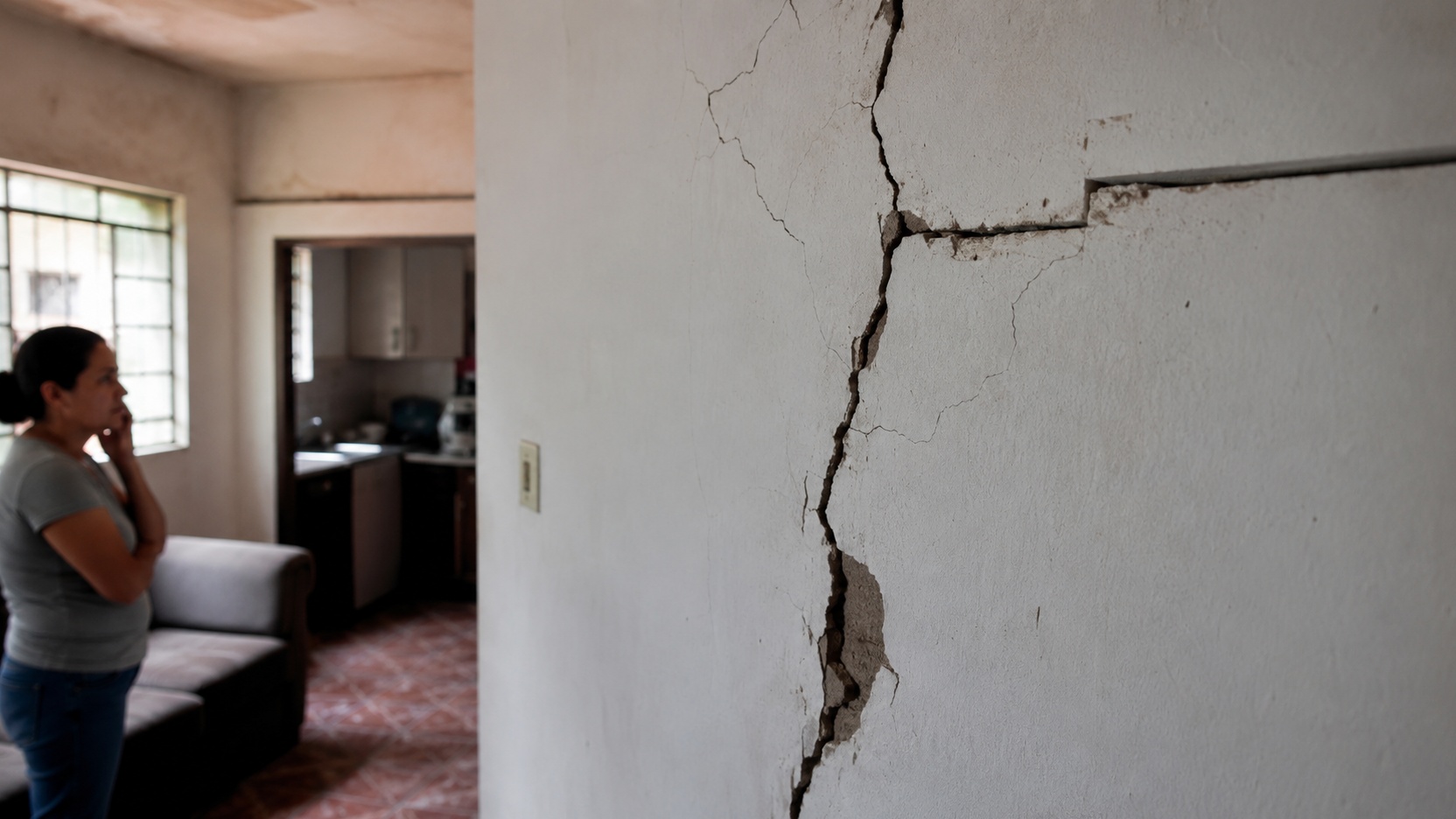
A crack in the wall may just be a coating problem, but it may also appear along with signs of movement, loss of stability or problems with the terrain. The safest point is not to try to find out on your own, from the photo or the width of the opening, whether the structure is compromised. The first decision is different: are there signs of danger now, is there a recent change or does the situation seem stable?
In guidelines published by the Civil Defense of Aracaju, signs such as increased cracks, sinking floors, cracking in walls, tilting of walls, instability of roofs and earth movement appear among the situations that warrant attention and evaluation. Maceió Civil Defense also reinforces that cracks and cracks can have different causes and that the on-site inspection is what allows the appropriate conduct to be indicated. Therefore, this text functions as a referral screening, not as a structural diagnosis.
When you leave the property and call Civil Defense
If the crack appeared or increased noticeably in a short period of time and was accompanied by pops, deformation, sinking of the floor, leaning of the wall, doors and windows that suddenly started to stick, parts of the roof giving way or movement of the ground, treat the whole as a sign of possible risk. The priority stops being measuring the aperture and becomes reducing people's exposure.
The same caution applies when the property is on a slope or close to an embankment and, during or after heavy rain, new cracks appear, soil is displaced, water appears in unusual places, trees or poles are tilting, or changes in the floor. The Alagoas Fire Department advises evacuation when there is evidence of earth movement or risk of collapse. In Aracaju, Civil Defense also relates rain, cracks, sinking floors and earth movement to situations that require rapid assessment.
Under these conditions, take a safe route, move people away from the area that appears unstable, and avoid returning just to observe, photograph, or remove objects. Call Civil Defense on 199. If there is a victim, a collapse is underway or there is a need for rescue, the Fire Department responds on 193. Anatel standardizes these codes as public emergency services in Brazil.
When to seek technical evaluation without waiting for the problem to worsen
Not every situation calls for immediate evacuation, but some call for a professional assessment even when the property still appears usable. This applies to new cracks without an obvious cause, openings that continue to increase over the days, cracks that reappear after successive repairs, cracks near door and window openings that change pattern, diagonal cracks, deformations in slabs or floors and changes that arise along with persistent infiltration or deterioration of materials.
Diagonal cracks deserve attention, but should not be interpreted in isolation as proof of structural failure. Aracaju Civil Defense's guidance is that risk identification is carried out by a trained professional. Crea-SP also clarifies that the assessment of risks related to fissures, cracks, deformations and other building problems must be carried out by a qualified professional, with inspection and technical responsibility compatible with the service.
The objective of the assessment is not just to give a name to the crack. The professional needs to relate the opening to the construction element, the direction of the crack, the material, the loads, the state of conservation, the terrain, possible infiltrations, recent interventions and the evolution of the situation. It is this reading of the whole that guides whether maintenance is sufficient, whether it is necessary to investigate the structure or whether the area should be isolated.
When observing and recording can be an initial approach
When the opening is very thin, shallow, not widening and there is no other sign of deformation, noise, tilting, sinking, roof problems or ground movement, it may be reasonable to record the condition and monitor. This does not make the fissure something demonstrably harmless; it just means that, in the absence of associated signs, the urgency tends to be less than in a condition that is changing.
The most useful record is simple: write down the date you noticed the problem, take photos of the same point without approaching an unsafe area and observe if the line or opening changes. It is also worth recording whether there was heavy rain, work on the property or neighboring land, excavation, intense vibration, leaks, infiltration, changes to doors and windows or changes in the floor level. If there is progress, monitoring is no longer sufficient and technical assessment takes priority.
The width of the crack helps, but does not decide alone
Some Civil Defenses use opening strips to explain, in a didactic way, the difference between fissure, crack and split. In 2026, the Civil Defense of Maceió published a classification in millimeters and associated larger openings with more severe movements. This reference can help the resident describe what they are seeing, but it should not become a safety rule such as “below so many millimeters I can stay” or “above so many millimeters the house will fall”.
The reason is simple: two openings of similar size can have very different causes and consequences. A coating crack is not equivalent to an opening that passes through masonry, appears in several elements at the same time or grows together with deformation. Furthermore, a photograph does not show what happens inside the wall, in the connections between the elements, in the foundation or in the ground.
Therefore, measuring can be used to monitor progress, but it does not replace inspection. What increases urgency is the combination of changes over time, crack pattern, location and other symptoms of the property.
Clacking, tilting and sinking deserve special attention
New and repeated cracking sounds, especially when they coincide with the appearance or growth of cracks, are a sign that should be taken seriously. The same goes for sinking floors, tilting walls, warping roofs and doors or windows that no longer function as they used to. The Aracaju Civil Defense includes these signs in its structural safety and response guidelines during periods of rain.
A single symptom does not allow us to determine the cause. A door can get stuck due to humidity, for example. The problem is when different signs appear together or evolve quickly. It is in this combination that screening should become more conservative: do not attempt to test the structure, remove coatings, knock on the wall or make cosmetic repairs before understanding what is happening.
Rain and terrain movement change priority
Heavy rain can reveal or worsen problems that already existed. Water can increase infiltration, affect coverage, saturate the soil and contribute to movements on slopes. In 2026, Aracaju's Civil Defense reinforced monitoring of risk areas, specifically observing infiltrations, sinking floors, cracks and other signs associated with landslides.
If the house is close to a slope, ravine, retaining wall, embankment or area with poor drainage, a new crack after rain needs to be analyzed in the context of the terrain. Earth movement, water gushing or changing path, leaning trees or posts and steps or floors that change level increase the concern. In this situation, Civil Defense is the first channel when there is doubt about staying safely in the property.
Civil Defense and technical professionals fulfill different roles
Civil Defense is the appropriate channel when there is a suspicion of immediate risk, possibility of collapse, landslide or need to decide whether people can remain in the location. The team can assess the emergency situation and advise protective measures, including closures when necessary.
The qualified professional takes part in the technical investigation of the cause and definition of the repair. Depending on the problem and professional responsibilities, the assessment may involve a civil engineer, a professional specializing in structures, an architect or a technician legally qualified for the corresponding scope. The important thing is that the inspection has compatible technical responsibility and that the service is not reduced to an opinion based solely on photography.
A rule of thumb for deciding your next step
If there is rapid change, clicking, tilting, sinking, deformation, movement of the ground, signs after heavy rain or a concrete sensation that the structure may be giving way, do not try to classify the crack: move away and call Civil Defense. If there is no immediate danger, but the opening is new, recurring, growing or appears together with other changes, seek technical evaluation in the short term. If the fissure appears superficial and stable, without any other symptoms, record and monitor it, keeping the option to evaluate if it persists or changes.
The main message is to avoid two extremes: panicking about any crack or treating every crack as a paint problem. Structural security depends on context and evolution. When there is real doubt about staying in the property, the most prudent decision is to prioritize leaving and request an assessment on site, instead of trying to conclude the risk by photo, ruler or comparison with images on the internet.