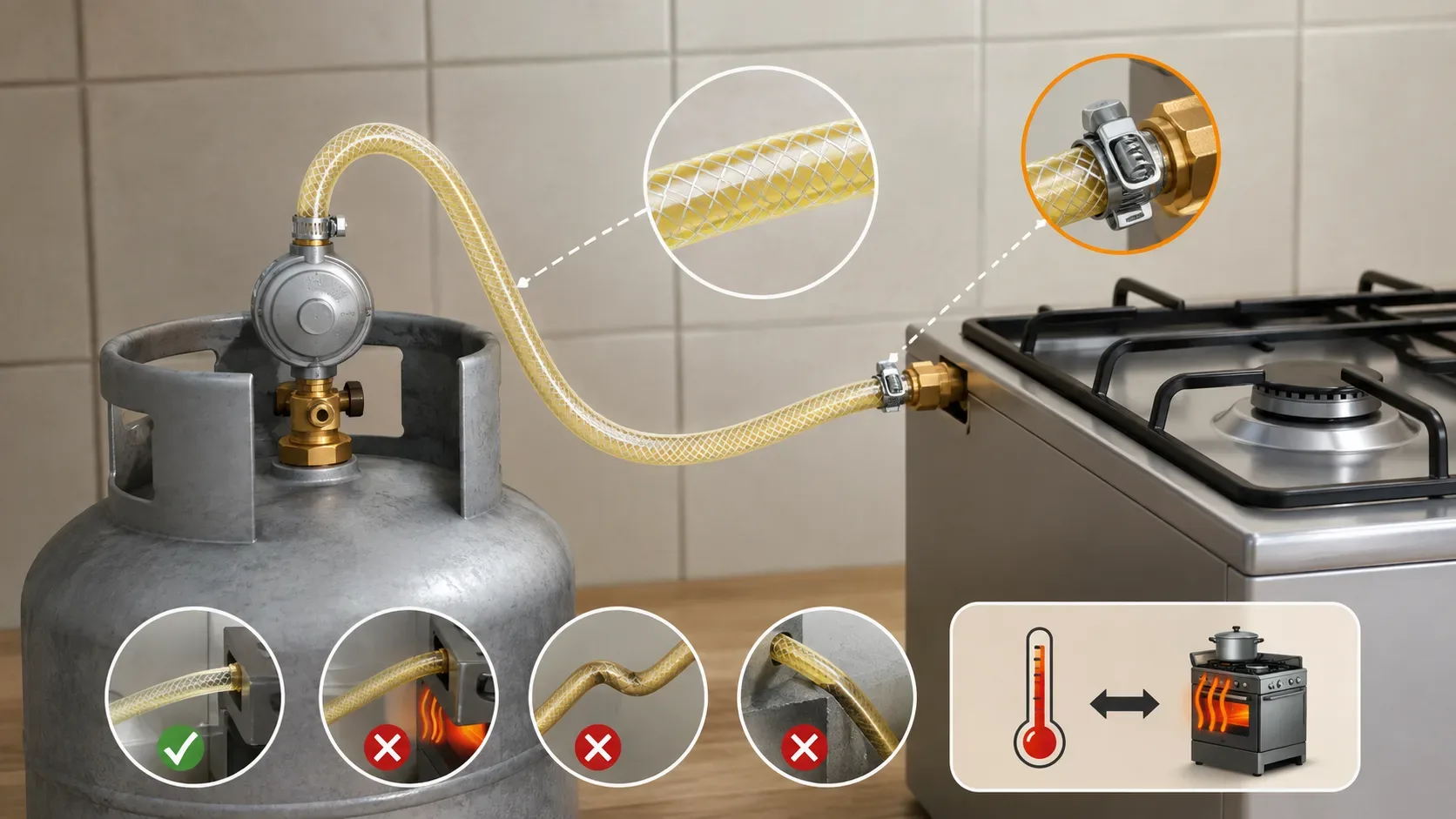
The smell of gas requires immediate action, but it is not the only sign that the installation must remain switched off. Expired deadline, missing marking, hose running behind the oven, splice, improvised clamp or visible damage are reasons not to light the stove until the set is corrected.
For domestic installations with cylinders, the flexible PVC hose with textile reinforcement intended for carrying LPG is subject to compulsory certification and registration with Inmetro. The domestic low pressure regulator, within the scope of up to 4 kg/h, must also bear the Conformity Identification Seal and the registration number.
Quick checklist before turning on the stove
Carry out the inspection with the stove turned off and without disassembling, tightening or moving parts. If an item cannot be safely checked, treat it as pending.
| Inspection point | What should be visible | When to stop using |
|---|---|---|
| Certification | Inmetro seal and registration number legible on hose and regulator | Seal missing, erased, apparently tampered with or number that cannot be checked |
| Validity | Date or indication of end of useful life still in effect | Deadline expired, illegible or unknown |
| Hose | Part suitable for domestic LPG, intact and without deformations | Cracks, cuts, apparent dryness, flattened, softened, burned or melted areas |
| Route | Free hose, visible and away from hot parts | Passage behind the stove or oven, contact with heat, wall through, built-in section or under tension |
| Length | Original piece, pre-cut and seamless | Extension, hose joining, glue, welding, tape or improvised cutting |
| Fixing | Appropriate clamps on both connections, with no apparent play | Wire, tape, inadequate clamp, crooked or loose connection |
| Regulator | Integrated body, legible identification and compatible fit | Crack, deformation, relevant corrosion, expired part, adaptation or need for a tool to force the fit |
| Environment | Cylinder upright, in a ventilated place and away from heat sources | Cylinder confined, lying down, heated or installed in a place without ventilation |
Decision rule: a single item in the “when to stop use” column is enough to not turn on the stove. The purpose of the checklist is not to technically approve the installation, but to identify clear signs that it needs qualified service.
Gas hose: validity begins at manufacturing
The indication printed on the hose is more important than the date it was purchased or installed. Technical guidelines adopt a useful life of five years from manufacture for domestic PVC hose. This means that a piece that has remained in stock for a long time may arrive at home with part of that period already consumed.
When purchasing and during periodic inspections, look for identification information on the strip: manufacturer, reference to NBR 8613, indication of domestic use with regulator, batch, validity and Conformity Identification Seal with the Inmetro registration number. The registration seal should appear at regular intervals along the outer layer of the hose.
If the expiration date has expired, do not use external appearance as a justification for keeping the piece. The aging of the material is not only assessed by color or the presence of visible cracks. Replacement must occur within the indicated period and also before it if there is damage, excessive exposure to heat or physical alteration.
What the position of the hose reveals
The hose should not run behind the stove or oven where it may receive heat during use. It should also not cross walls, be embedded, be pressed by furniture or remain stretched. Official guidelines for domestic PVC hoses still prohibit splicing and indicate pre-cut manufactured pieces, with lengths between 0.80 m and 1.25 m.
The sources consulted do not establish a single distance, in centimeters, that would suit all kitchens. The appropriate position depends on the stove model, gas outlet, ventilation and manufacturer's instructions. When the distance requires stretching, improvised diversion or passing through a hot area, the solution is not to join hoses: it is to request a technical assessment to define the appropriate piping or connector.
Built-in stove requires specific attention
The guidance that accompanies the domestic PVC hose states that it should not be used on built-in stoves. These devices may require another type of connection, depending on the manufacturer's manual, the furniture configuration and applicable standards. Don’t replace the hose just for the appearance of a “tougher” pipe; selection and installation must be carried out by a qualified professional.
How to check the regulator without dismantling
The regulator reduces the LPG pressure in the cylinder to the device's operating level. On the body or lid, look for the Conformity Identification Seal, registration number and product identification. Technical guidelines also indicate validity of five years from manufacture, normally engraved or printed in month and year.
Do not open, adjust or attempt to repair the regulator. The internal assembly works with calibrated components, and dismantling it can alter the output pressure. Also do not use tools to compensate for poor fit or suspected leaks. If the part does not seat normally, is out of date, damaged or requires force, keep the system turned off and seek resale, manufacturer assistance or a qualified installer.
Manometer does not confirm how much gas is left
The pressure inside the cylinder varies depending on factors such as the composition of the LPG and the temperature. Therefore, a pressure gauge attached to the regulator does not work as a reliable indicator of the amount of gas remaining. Additionally, uncertified or incompatible accessories can add connections and potential points of failure. Use only the set intended for installation.
Clamps: small parts, critical function
The hose must be secured to the regulator and the stove inlet with appropriate clamps. Wire, tape, glue or other materials cannot replace this component. An apparently firm hold can change with heat, movement or aging.
During visual inspection, look for play, misalignment, intense oxidation or signs that the clamp is cutting the hose. Don't try to fix it by squeezing it randomly. When there is doubt about the type, position or condition of the fixing, the installation must be checked by a qualified person.
How to check if the product is registered with Inmetro
The number printed on the stamp allows you to search for the product in the Inmetro Object Registration database. For a new purchase, check that the description matches the hose or regulator, the brand and model shown, and that registration is active.
The consultation helps to verify commercial regularity, but does not replace physical inspection. An originally certified product may be expired, damaged or improperly installed. Likewise, an illegible number or a marking that does not correspond to the item sold is a reason not to complete the purchase and ask the supplier for clarification.
Signs to stop and call for assistance
Stop use and do not light the stove when there is:
- gas smell, exhaust noise or suspected leak;
- expired or impossible to read;
- missing seal or registration number;
- cracked, dried out, softened, burned, flattened or cut hose;
- passing behind the stove, contact with a hot part or inadequate exposure to the sun;
- amendment, extension, tape, glue, wire or adaptation;
- cracked, deformed, expired regulator or incompatible fitment;
- cylinder in a closed, lying or heated place;
- any need to disassemble, drill, cut or “find a way” to connect.
If there is a smell of gas or a suspected leak, do not activate switches, sockets, appliances, open flames or electronic devices in the environment. Keep people and animals away, allow natural ventilation only when this can be done without approaching the source of risk and call the Fire Department at number 193 and the responsible distributor or reseller. Do not flame test and do not attempt to locate or repair the leak yourself.
What not to do, even if it seems like a solution
Do not increase the length with splices. Do not use tape to “seal”. Do not tighten the regulator with pliers. Do not exchange cable ties for wire. Do not heat or discard the cylinder to use the remaining gas. Do not install accessories without proven certification and compatibility.
Also, do not accept a visit from someone who presents themselves as an Inmetro inspector to sell or exchange parts. Inmetro and its delegated bodies inspect manufacturers and commerce, do not carry out this type of residential inspection and do not sell hoses or regulators.
Frequently asked questions
Does every gas hose need the Inmetro seal?
The compulsory certification of Inmetro Ordinance No. 247/2021 specifically covers flexible PVC hose with textile fiber reinforcement intended for domestic LPG installation. There are connectors made of other materials and for other configurations, subject to specific standards. Therefore, do not choose just based on color or appearance: follow the device manual and technical installation guidance.
The hose expired, but it looks new. Can I continue using it?
No. Validity takes into account the aging of the material after manufacturing. Preserved appearance does not extend the printed deadline.
No gas smell, is the installation safe?
The absence of odor does not replace inspection. Expired expiration date, lack of certification, heat exposure and improper assembly may exist before any noticeable smell.
Who should make the correction?
Seek technical assistance from the stove manufacturer, the distributor or reseller responsible for the cylinder, or a qualified professional for gas installations. In an emergency or suspected leak, call the Fire Department by calling 193.
Save this checklist
Photograph the expiration and registration markings when the installation is in order and schedule a review before expiration. For a new purchase, check the number in the official Inmetro system. The list helps you recognize stop signs; it does not replace design, installation, testing or technical report.