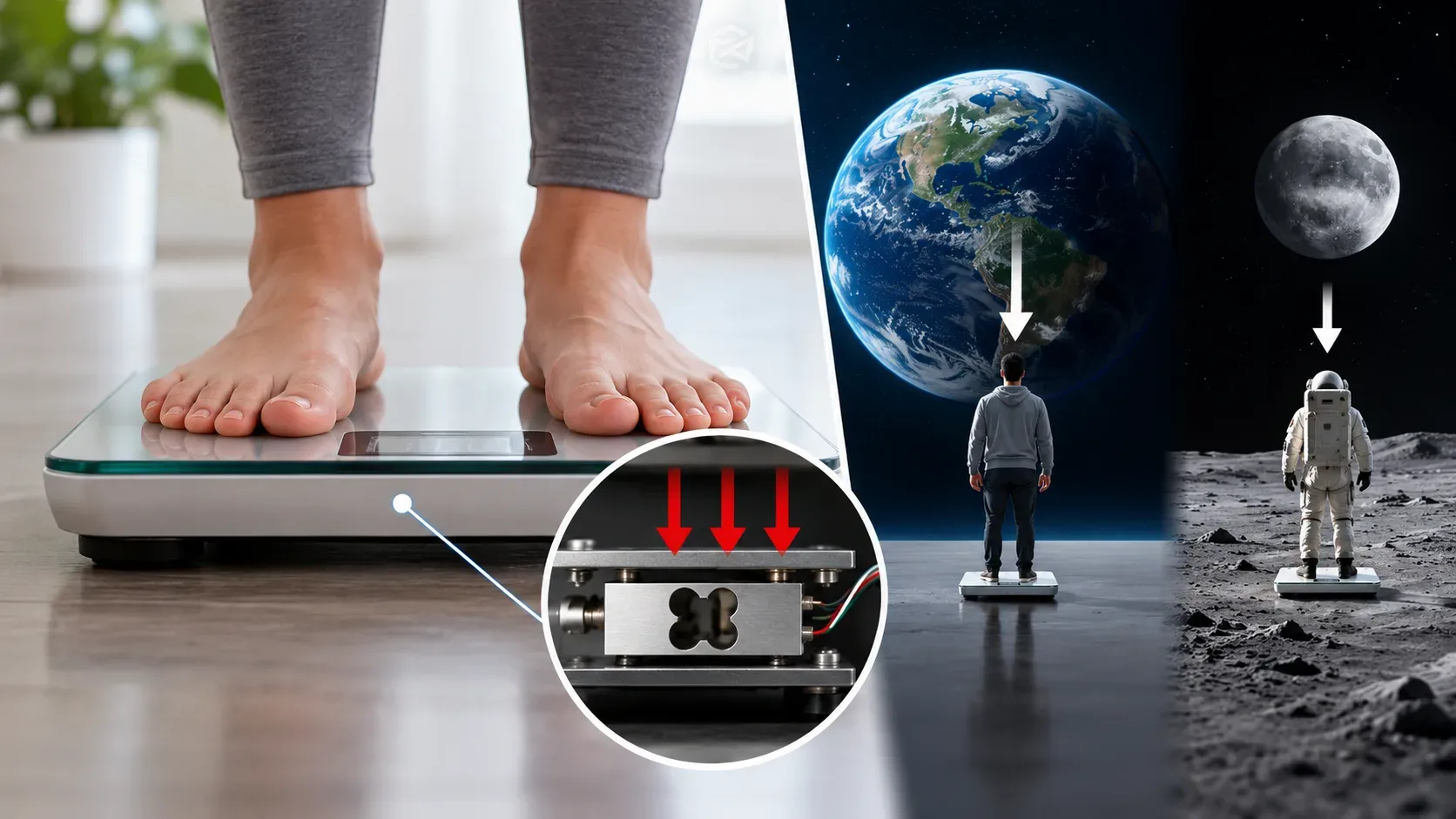
Short answer: in a digital household scale, the sensing element does not “see” kilograms directly. It responds to deformation caused by the force you apply to the platform. When the scale is stationary on a level floor and you are also at rest, this support force — the normal force — has approximately the same magnitude as your gravitational weight. The electronics then use the instrument’s calibration to convert the sensor signal into a value displayed in kilograms.
Mass and weight are not the same quantity
Mass is a property of a body and, in the International System of Units, is expressed in kilograms (kg). The BIPM defines the kilogram as the SI unit of mass. Weight, in physics, is a force associated with gravity and is expressed in newtons (N). The NIST describes weight as a force, so its SI unit is the newton.
In a simple approximation near the surface of a celestial body, we can write:
W = m × g
where W is weight, m is mass and g is the local acceleration due to gravity. For a 70 kg person on Earth, using the standard gravity value of 9.80665 m/s² only as a reference, the weight is about 686 N. The mass remains 70 kg.
What the scale sensor actually detects
Many electronic scales use load cells. These transducers contain elastic elements and often strain gauges whose electrical response changes when the material deforms. The NIST calibrates force transducers by applying known forces and relating the applied force to measured deformation or electrical output.
In practice, when you stand still on the scale, your feet push the platform downward and the platform pushes you upward. This contact force is the normal force. It is what produces the deformation transmitted to the sensor. At rest, with no other important vertical forces, Newton’s second law gives:
N − mg = 0, so N = mg.
That is why, in this common situation, measuring the normal force allows the instrument to infer mass. The sensor measures a response related to force; the complete device turns that response into a mass indication.
Why does the display show kg instead of N?
Because the everyday purpose of a household scale is to report the user’s mass. The instrument is calibrated with known loads and associates a given electrical signal with given mass values. Conceptually, when the person is at rest, the electronics can interpret the measured force through a relation equivalent to m = N/g, with the relevant gravity factor built into the calibration for the intended use.
This does not mean the scale independently measures local gravity every time. It means the device has been adjusted so that the typical force produced by a known mass gives the correct number in kilograms. OpenStax likewise explains that a bathroom scale measures force and is calibrated to provide information about mass.
Thought experiment: the same person on Earth and on the Moon
Suppose a person has a mass of 70 kg, and for simplicity ignore the practical issues of taking a household scale into the lunar environment. That person’s mass would be 70 kg on both Earth and the Moon. What changes is the gravitational force.
| Situation | Mass | Approximate gravity | Approximate weight |
|---|---|---|---|
| Earth | 70 kg | 1 Earth g | 686 N |
| Moon | 70 kg | about 1/6 of Earth’s | about 114 N |
NASA states that surface gravity on the Moon is about one-sixth of Earth’s. Therefore, an Earth-calibrated force scale, if it could operate on the Moon without recalibration, would sense a much smaller force. If it kept applying its Earth calibration factor, it could display roughly 11.7 “kg equivalent” instead of 70 kg. The error would be in the interpretation of the signal, not in a change in the person’s mass.
The scale reading is not always equal to gravitational weight
A scale does not have to be on another world to show that its sensor responds to normal force. The classic example is an elevator. OpenStax uses a bathroom scale to show how the normal force changes under acceleration.
- Elevator at rest or moving at constant velocity: acceleration is zero and, ideally, N = mg.
- Elevator accelerating upward: N is greater than mg, so the scale indicates a larger value.
- Elevator accelerating downward: N is less than mg, so the indication decreases.
- Ideal free fall: N tends to zero; the scale is not being pressed even though gravity is still acting.
The same reasoning explains why supporting part of your body on a sturdy counter can reduce the reading: the counter then supports part of the force that the scale had been supporting.
A simple test to separate “what the sensor feels” from “what the display shows”
- Place the scale on a firm, level floor and wait for the reading to stabilize.
- Stand still and note the value.
- Without stepping off the scale, place your hands on a sturdy surface beside you and press gently downward.
- The reading tends to decrease because the external surface pushes upward on you and the scale supports a smaller fraction of your weight.
The goal is not to obtain a precise measurement in this test, but to notice that the displayed number depends on the contact force reaching the platform. Do not jump on the scale or perform experiments in moving elevators.
“Does a scale measure mass or weight?” depends on which layer of the system you mean
Both answers appear because they refer to different levels:
- physical sensor: responds to force through deformation or another measurable effect;
- static situation on Earth: normal force usually has the same magnitude as gravitational weight;
- electronics and calibration: convert the signal into an estimate of mass;
- display: presents the result in kilograms.
So, for a household platform scale, the most precise wording is: the sensor detects a support force, and the instrument is calibrated to display the corresponding mass in kilograms under its intended conditions of use.
Do all balances and scales work this way?
No. “Scale” or “balance” covers several instrument types. A two-pan balance, for example, compares two masses through gravitational effects on opposite sides; because both are in the same gravitational field, the factor g appears on both sides and cancels in an ideal comparison. A digital bathroom or kitchen scale, by contrast, normally uses a force transducer and electronic calibration.
This distinction resolves the apparent contradiction: the kilogram on the display does not turn weight into a unit of mass. It means the instrument is using a physical force measurement as an indirect route to infer and report mass.