Short answer: the September 2026 equinox occurs at one precise astronomical instant, not over an entire calendar day. NASA places the event at September 23 at 00:05 UTC. In Brasília time (UTC−3), that is September 22 at 9:05 p.m. Even so, the interval from sunrise to sunset observed in Brazil is expected to be a few minutes longer than 12 hours, because sunrise and sunset are defined using the apparent edge of the solar disk and because the atmosphere refracts sunlight.
What exactly happens at the September 2026 equinox
An equinox is the instant when the center of the Sun crosses the plane of Earth's equator. In celestial-coordinate terms, solar declination passes through zero and the subsolar point crosses the equator. That geometry produces, on an idealized Earth, an almost symmetrical division between the illuminated and dark hemispheres.
The 00:05 UTC time on September 23 does not mean every place on Earth is on the same civil date. Brazil uses time zones based on different offsets from UTC, under Brazilian Legal Time and the time-zone organization described by the National Observatory of Brazil. As a result, the instant still falls on the evening of September 22 throughout Brazilian territory:
| Time zone in Brazil | Local time of the equinox |
|---|---|
| UTC−2 | Sep. 22 at 10:05 p.m. |
| UTC−3, including Brasília | Sep. 22 at 9:05 p.m. |
| UTC−4 | Sep. 22 at 8:05 p.m. |
| UTC−5 | Sep. 22 at 7:05 p.m. |
The calendar date therefore depends on the time zone. The physical definition of the equinox, however, is global: there is one single instant for the entire Earth.
Why “equinox” does not guarantee 12 hours from sunrise to sunset
The word equinox is associated with “equal night,” but perfect equality appears only in a geometric simplification. If the Sun were treated as a point, there were no atmosphere and the horizon were ideal, the Sun's center would spend approximately 12 hours above and 12 hours below the horizon at the equinox.
In practice, published sunrise and sunset times use a different reference. The U.S. Naval Observatory defines sunrise or sunset for computational purposes when the center of the Sun is geometrically 50 arcminutes below the horizon. In the standard model, those 50′ come from two effects:
- 16′ for the Sun's apparent semidiameter: sunrise begins when the upper edge of the disk appears; sunset ends when that edge disappears. We do not wait for the center of the disk to cross the horizon.
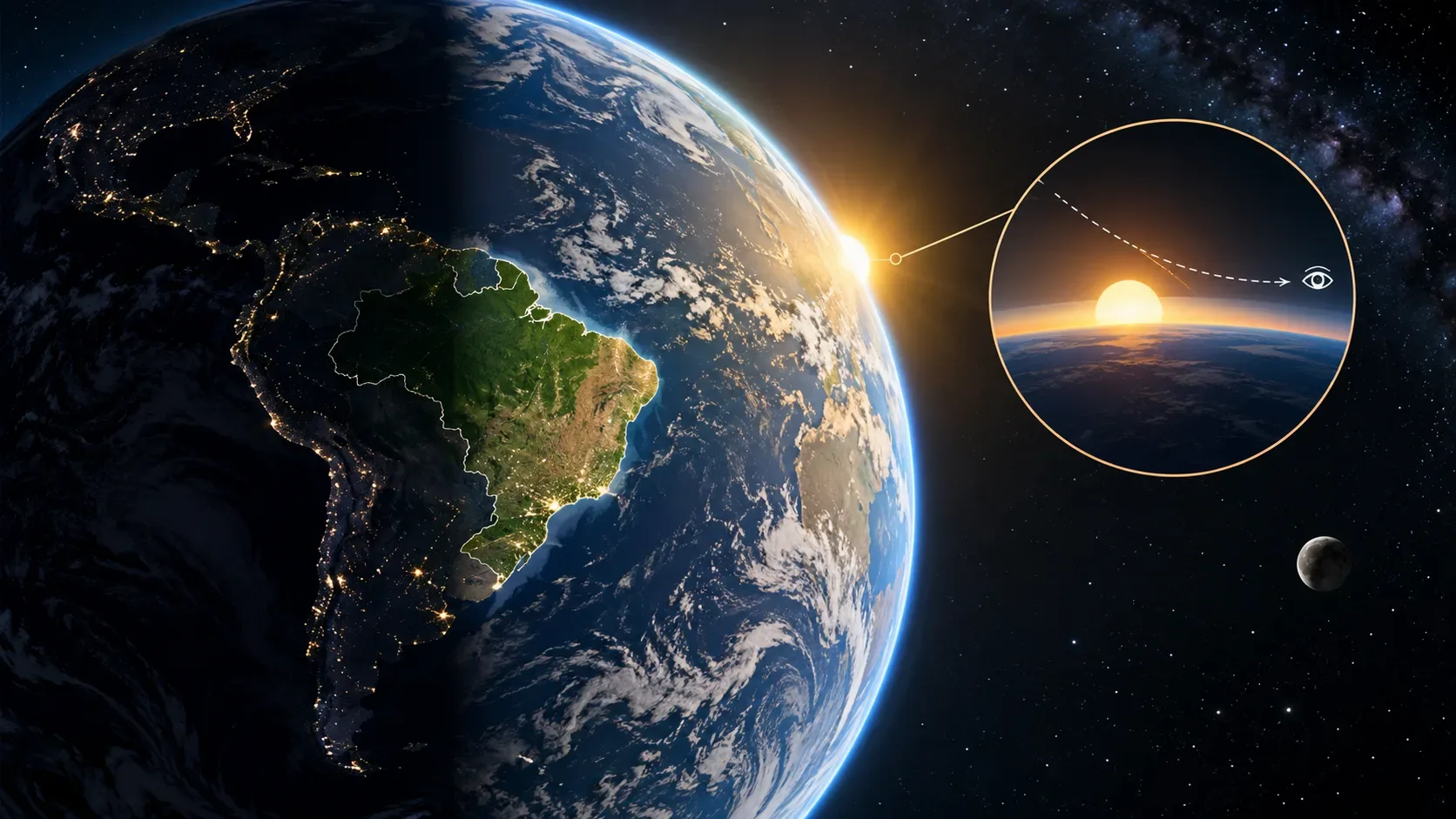
- 34′ for average atmospheric refraction at the horizon: the atmosphere bends sunlight and makes the Sun appear slightly higher than its geometric position.
The sum of 16′ and 34′ is about 0.833°. NOAA uses that same 0.833° correction in sunrise and sunset calculations. The result is straightforward: in the morning we see the Sun's edge before it geometrically reaches the horizon, and in the evening we continue to see it after the center has already moved below the horizon. That adds minutes to the “day” defined from sunrise to sunset.
How much longer than 12 hours is the day near the equinox
There is no single excess that applies to all of Brazil because apparent daylight duration varies with latitude. The U.S. National Weather Service gives a useful order of magnitude for the equinox: about 12 h 06 min 30 s at the equator and roughly 12 h 08 min at 30° latitude. Because Brazilian territory extends from areas north of the equator to latitudes beyond 30° south, it is normal to find values a few minutes above 12 hours in sunrise and sunset tables.
Those figures should not be read as second-by-second forecasts for a city. NOAA itself notes that refraction depends on pressure, humidity and other atmospheric conditions. Observer altitude, terrain, buildings, and a marine or mountainous horizon can also change when the Sun is actually seen. Astronomical calculators normally use an ideal horizon and average refraction so that results remain comparable.
Equinox and equilux are different things
The term for the date when the interval from sunrise to sunset is closest to 12 hours is equilux. It does not have to coincide with the equinox, precisely because observational definitions extend the daylight interval.
According to the National Weather Service explanation, at Southern Hemisphere latitudes the approximately 12-hour equality generally occurs before the September equinox and after the March equinox. The exact date varies with latitude. Very close to the equator, the interval from sunrise to sunset remains several minutes longer than 12 hours throughout the year under the standard convention, so looking for a perfectly exact “12 h 00” day may not produce a useful date.
This avoids a common confusion: the equinox is defined by the Sun's geometric position relative to Earth's equator; the equilux is a daylight-duration condition calculated or observed for a specific location.
The hemisphere changes the season, not the 12-hour rule
At the September equinox, the Sun crosses the celestial equator moving southward. For locations in the Southern Hemisphere, the event astronomically marks the beginning of spring; in the Northern Hemisphere, it marks the beginning of autumn. Because Brazil crosses the equator, the seasonal label is not literally the same for every point in the country.
But that hemispheric difference is not why observed daylight exceeds 12 hours. The main explanation remains the combination of the sunrise/sunset definition based on the solar disk and atmospheric refraction. Latitude changes the size of the effect on daylight duration; the hemisphere mainly determines the direction of seasonal change — whether days are getting longer or shorter after the equinox.
How to read a sunrise and sunset table without getting confused
- Check the location and time zone: the global equinox instant can fall on a different civil date from the UTC date.
- Check the definition used by the source: astronomical calculators normally include the Sun's apparent radius and a standard refraction correction.
- Do not expect 12 h 00 on the equinox itself: 12 h 06, 12 h 07 or 12 h 08 near the date can be fully consistent with the physics and calculation conventions.
- Distinguish calculation from observation: clouds do not change the calculated astronomical instant of sunrise or sunset, but obstacles, terrain and atmospheric conditions can change when the disk is actually perceived.
- If the question is “when are there 12 hours?” look for the local equilux: it depends on latitude and does not define the equinox.
What to remember about 2026
The key fact is that the September 2026 equinox occurs on September 23 at 00:05 UTC, or September 22 at 9:05 p.m. in Brasília. Equinox geometry makes day and night nearly equal, but real or standardized sunrise and sunset times include the solar disk's edge and atmospheric refraction. That is why seeing a little more than 12 hours of daylight in Brazil on that date does not contradict the equinox: it is exactly what those physical and observational definitions lead us to expect.