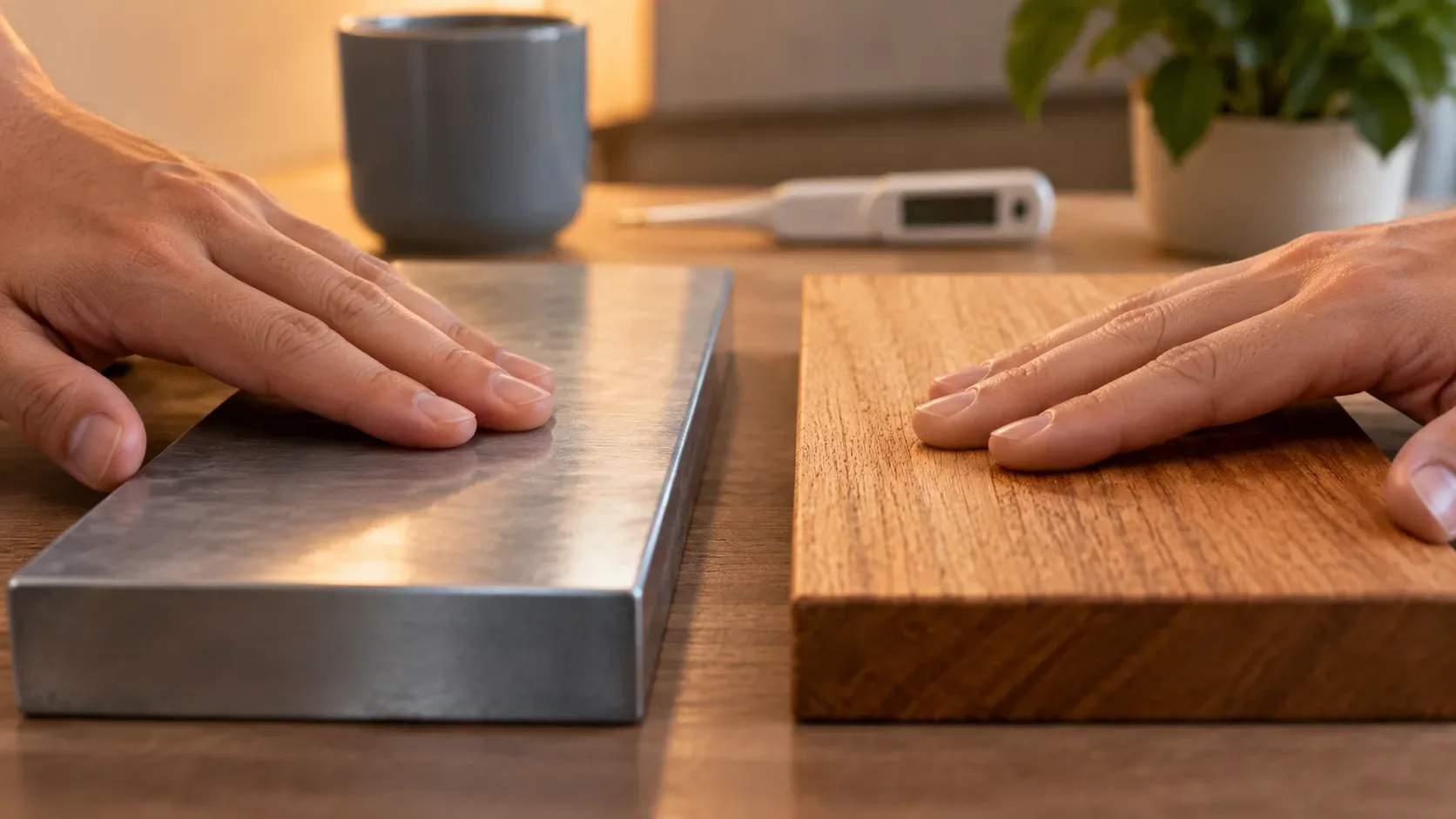
Metal and wood can be at virtually the same temperature and yet metal can feel much colder to the touch. The reason is that skin does not work like a thermometer: it mainly senses how its own temperature changes when it contacts another surface. In an ordinary room, your hand is usually warmer than surrounding objects. When you touch metal, heat leaves the skin faster; when you touch wood, that transfer is slower. The brain interprets the faster cooling of the skin as a sensation of “colder.”
Same temperature does not mean the same thermal sensation
If a metal plate and a wooden block remain in the same environment long enough, away from direct sunlight, heaters, very different air currents, or other energy sources, both tend to approach the ambient temperature. This is thermal equilibrium. The American Physical Society uses the metal-versus-wood comparison to show why touch can suggest different temperatures even when a thermometer gives similar readings.
The key is to separate two ideas: temperature describes the thermal state of a material; heat flow describes how quickly and in which direction thermal energy crosses the interface between your skin and the object. The immediate sensation depends strongly on the second process.
What your hand actually senses when it touches a surface
When two bodies at different temperatures come into contact, heat spontaneously flows from the warmer body to the cooler one. If the surface is below the temperature of your skin, your hand loses heat. Thermoreceptors respond to the change in skin temperature rather than making a “direct reading” of the object’s absolute temperature.
That is why two materials with the same initial temperature can produce different sensory responses. One may draw heat from the contact area quickly, causing the skin to cool more during the first moments. Another may warm its surface layer quickly and then limit the heat flow. To the sense of touch, those two situations feel different even without a meaningful difference in the objects’ initial temperatures.
Thermal conductivity explains part of the story
Thermal conductivity indicates how easily heat is transported through a material. Metals usually have much higher conductivity than wood. When your hand warms the surface region of a metal object, heat spreads quickly into the interior and neighboring regions, keeping the contact surface relatively able to continue accepting energy from your skin.
In wood, heat transport is much slower. The thin region touching the hand warms more locally and begins to reduce the local temperature difference. That lowers the heat flow leaving the skin and makes the wood feel less cold.
This conductivity-based explanation is correct, but it is incomplete for the initial instant of touch. The sensation also depends on how much heat the material can absorb per unit volume while its surface temperature is changing.
Thermal effusivity: the property most directly linked to touch
For transient contact problems, a particularly useful quantity is thermal effusivity. The ISO 7345 standard defines it as the square root of the product of thermal conductivity, density, and specific heat capacity:
b = √(k · ρ · cₚ)
- k: thermal conductivity — how easily heat moves through the material;
- ρ: density — how much mass exists per unit volume;
- cₚ: specific heat capacity — how much energy is needed to change the temperature of a unit mass.
In practical terms, effusivity expresses a surface’s ability to exchange thermal energy with what it touches during a rapid, transient process. Studies of tactile perception relate the drop in fingertip temperature after contact to the material’s thermal effusivity; one example is research published in Measurement on the effective temperature at which fingertips sense this property.
Metal vs. wood: what happens in the first seconds
| Stage | Metal | Wood |
|---|---|---|
| Before touching | May be at the same temperature as the room | May be at the same temperature as the room |
| Contact with a warmer hand | Receives heat quickly | Receives heat more slowly |
| Surface response | Heat is rapidly redistributed into the rest of the object | The contact region warms more locally |
| Effect on skin | Stronger initial cooling | Smaller initial cooling |
| Typical sensation | Colder | Warmer or less cold |
This table describes the common situation in which the objects are below skin temperature. It does not mean that “metal is always cold.” What changes is the rate of heat exchange.
A simple test to separate temperature from sensation
- Choose one metal object and one wooden object that have been in the same room long enough to approach ambient temperature.
- Keep both away from sunlight, operating appliances, warm surfaces, or noticeably different air currents.
- Measure both with the same contact temperature sensor, allowing the reading to stabilize on each surface.
- Then briefly touch both materials with fingers under similar conditions. The metal will tend to feel colder even when the measured temperatures are close.
- Repeat a few times while alternating the order of the materials. The goal is not to assign a “temperature by touch,” but to compare how quickly the cooling sensation develops.
The test highlights the difference between measuring temperature and feeling heat transfer. It also shows why touch is not a reliable instrument for comparing the absolute temperatures of different materials.
Be careful with infrared thermometers on shiny metal
If you use an infrared thermometer, there is an additional trap: polished metal surfaces can have low emissivity and reflect radiation from the surroundings, producing misleading readings. Fluke recommends measuring a shiny surface over a small area covered with non-reflective tape or another suitable preparation after it has reached the same temperature as the surface.
For a simple home experiment, a contact sensor avoids this complication. If an infrared thermometer is the only option, place the same type of matte tape on small areas of both materials, allow the setup to stabilize, and measure the tape rather than bare polished metal.
Why conductivity alone is not enough
Conductivity answers an important question: how easily does heat move inside the material? The initial touch sensation, however, involves a transient process at the skin-surface interface. In that situation, density and volumetric heat capacity matter as well. That is why effusivity is a more complete variable for comparing the initial thermal “impact” of surfaces.
Two materials can have different conductivities and still produce sensations that do not follow a simple rule based only on k. Thickness, porous structure, coatings, roughness, real contact area, and thermal contact resistance can also change the observed result.
What if metal and wood are warmer than the skin?
The logic reverses. If both are above skin temperature, heat flows from the object into the hand. The material that can supply energy faster tends to feel hotter. So the same metal that feels colder than wood in a cool room can feel hotter when both are heated to the same temperature.
This contrast is a strong reminder that the sensation is not a fixed property called “the coldness of metal.” It results from the direction and intensity of heat flow between skin and object.
What can change the result in practice
- Initial temperature: if the objects are not actually under similar conditions, the sensory difference may also reflect a real temperature difference.
- Thickness and mass: very thin objects can warm or cool quickly as a whole.
- Coatings: paint, varnish, plastic, or oxidation alters heat exchange at the surface.
- Roughness and pressure: they change the effective contact area and thermal resistance between skin and object.
- Moisture: water on the skin or material can substantially alter heat transfer.
- Contact time: the difference in sensation is usually most evident during the first moments, before the contact region approaches equilibrium.
The distinction that resolves the question
Metal does not need to be at a lower temperature than wood to feel colder. If both are at the same temperature and below skin temperature, metal will usually draw heat from the hand faster. Conductivity helps explain that behavior; thermal effusivity describes the transient surface exchange more completely because it combines conductivity, density, and specific heat capacity.
In short: temperature tells you how hot or cold the object is; touch sensation depends on how quickly your skin gains or loses heat. That difference between thermal state and energy-transfer rate is what makes metal and wood feel so different even when a thermometer says nearly the same thing.